Adoption and Adult Outcomes in the Early Chiaki Moriguchi John - - PowerPoint PPT Presentation

adoption and adult outcomes in the early
SMART_READER_LITE
LIVE PREVIEW

Adoption and Adult Outcomes in the Early Chiaki Moriguchi John - - PowerPoint PPT Presentation

Adoption and Adult Outcomes in the Early 20th Century Adoption and Adult Outcomes in the Early Chiaki Moriguchi John Parman 20th Century Introduction Chiaki Moriguchi Historical Adoption John Parman Institute for Economic Constructing


slide-1
SLIDE 1

Adoption and Adult Outcomes in the Early 20th Century Chiaki Moriguchi John Parman Introduction Historical Adoption Constructing the Dataset Cross-Sectional Analysis Longitudinal Analysis Pragmatic vs. Sentimental Adoption Next Steps

Adoption and Adult Outcomes in the Early 20th Century

Chiaki Moriguchi Institute for Economic Research, Hitotsubashi University John Parman College of William & Mary and NBER

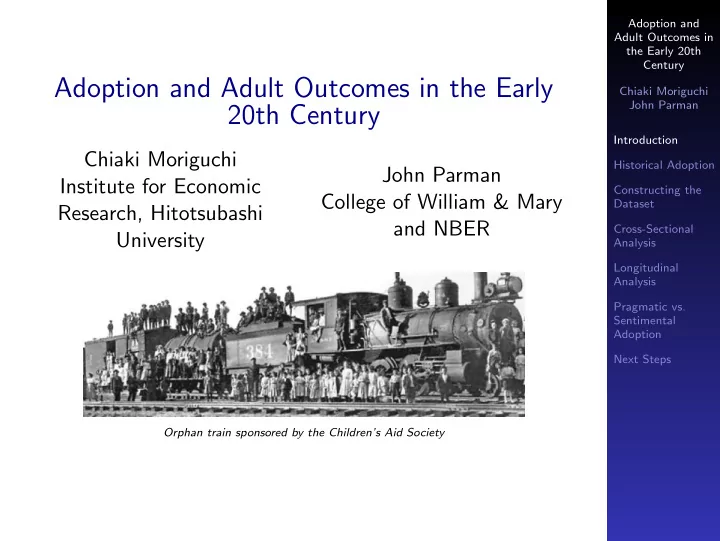
Orphan train sponsored by the Children’s Aid Society

slide-2
SLIDE 2

Adoption and Adult Outcomes in the Early 20th Century Chiaki Moriguchi John Parman Introduction Historical Adoption Constructing the Dataset Cross-Sectional Analysis Longitudinal Analysis Pragmatic vs. Sentimental Adoption Next Steps

Introduction

How does being raised in a non-traditional family influence adult outcomes? The answer helps us better understand child development, nature versus nurture, and the economics

  • f the family

We take a historical perspective on this question with a focus on adopted children in the early 20th century when the nature of adoption was changing We build a longitudinal dataset of adoptees and their siblings by linking across censuses This allows us to assess how adopted children fare relative to the general population and relative to non-adopted siblings

slide-3
SLIDE 3

Adoption and Adult Outcomes in the Early 20th Century Chiaki Moriguchi John Parman Introduction Historical Adoption Constructing the Dataset Cross-Sectional Analysis Longitudinal Analysis Pragmatic vs. Sentimental Adoption Next Steps

Introduction

Our new longitudinal dataset of adopted children and their siblings helps us investigate several questions about early-20th century adoption: Which types of families adopted children? How were those children treated by their adoptive households? How did those childhood experiences translate into long run outcomes? Answers to these questions help us get at bigger issues of the economics of the family and the consequences of the shift from pragmatic to sentimental adoption in the US.

slide-4
SLIDE 4

Adoption and Adult Outcomes in the Early 20th Century Chiaki Moriguchi John Parman Introduction Historical Adoption Constructing the Dataset Cross-Sectional Analysis Longitudinal Analysis Pragmatic vs. Sentimental Adoption Next Steps

Preview of Results

As children, adopted individuals were less likely to attend school, less likely to be literate, and more likely to be idle These differences persisted into adulthood with adopted individuals having lower overall educational attainments and lower incomes Family formation patterns of adopted individuals also differed: they tended to have higher rates of marriage and larger household sizes These effects were somewhat larger in situations where adoption was more likely to be pragmatic rather than sentimental

slide-5
SLIDE 5

Adoption and Adult Outcomes in the Early 20th Century Chiaki Moriguchi John Parman Introduction Historical Adoption Constructing the Dataset Cross-Sectional Analysis Longitudinal Analysis Pragmatic vs. Sentimental Adoption Next Steps

Modern Adoption

Modern studies tell us that there are negative consequences associated with being raised by non-biological parents Clinical studies suggest higher rates of behavioral, schooling, and drug problems among adopted and stepchildren Survey data reveals lower food expenditures and health investments in non-biological children Longitudinal studies show lower educational attainments for these children Some evidence that these worse outcomes are due to selection rather than differential treatment We want to extend these studies to the early twentieth century

slide-6
SLIDE 6

Adoption and Adult Outcomes in the Early 20th Century Chiaki Moriguchi John Parman Introduction Historical Adoption Constructing the Dataset Cross-Sectional Analysis Longitudinal Analysis Pragmatic vs. Sentimental Adoption Next Steps

Changing Institutions, Attitudes and Economies

The early 20th century saw a variety of changes that fundamentally affected adoption and the economics of the family Families and jobs were moving from farms to cities changing the costs and benefits of children Attitudes to and laws governing child labor and compulsory schooling were changing Rates of infant and child mortality were declining dramatically The legal institutions related to adoption changed dramatically from the mid-1800s to the early 1900s Overall, it is a chance to witness the shift from pragmatic to sentimental adoption

slide-7
SLIDE 7

Adoption and Adult Outcomes in the Early 20th Century Chiaki Moriguchi John Parman Introduction Historical Adoption Constructing the Dataset Cross-Sectional Analysis Longitudinal Analysis Pragmatic vs. Sentimental Adoption Next Steps

Changing Institutions, Attitudes and Economies

50 100 150 200 250 Infant mortality (per 1,000) 20 40 60 80 High school graduation rate 1850 1900 1950 2000 Year High school graduation rate Infant mortality (per 1,000)

slide-8
SLIDE 8

Adoption and Adult Outcomes in the Early 20th Century Chiaki Moriguchi John Parman Introduction Historical Adoption Constructing the Dataset Cross-Sectional Analysis Longitudinal Analysis Pragmatic vs. Sentimental Adoption Next Steps

Changing Institutions, Attitudes and Economies

US - 1870 US - 1880 US - 1890 US - 1900 US - 1910 US - 1920 US - 1930 US - 1940 US - 1950 US - 1990

20 40 60 80 100 Enrollment rate 50 100 150 200 250 Infant mortality rate

slide-9
SLIDE 9

Adoption and Adult Outcomes in the Early 20th Century Chiaki Moriguchi John Parman Introduction Historical Adoption Constructing the Dataset Cross-Sectional Analysis Longitudinal Analysis Pragmatic vs. Sentimental Adoption Next Steps

Adoption in Mid 19th Century

slide-10
SLIDE 10

Adoption and Adult Outcomes in the Early 20th Century Chiaki Moriguchi John Parman Introduction Historical Adoption Constructing the Dataset Cross-Sectional Analysis Longitudinal Analysis Pragmatic vs. Sentimental Adoption Next Steps

Changing Institutions, Attitudes and Institutions

From ”The Best Method of Disposing of Our Pauper and Vagrant Children” (C.L. Brace, 1859): “The Emigration-plan of the Children’s Aid Society, is simply to connect the supply of juvenile labor of the city with the demand from the country, and to place unfortunate, destitute, vagrant, and abandoned children at once in good families in the country.”

slide-11
SLIDE 11

Adoption and Adult Outcomes in the Early 20th Century Chiaki Moriguchi John Parman Introduction Historical Adoption Constructing the Dataset Cross-Sectional Analysis Longitudinal Analysis Pragmatic vs. Sentimental Adoption Next Steps

Adoption in the Late 19th Century

slide-12
SLIDE 12

Adoption and Adult Outcomes in the Early 20th Century Chiaki Moriguchi John Parman Introduction Historical Adoption Constructing the Dataset Cross-Sectional Analysis Longitudinal Analysis Pragmatic vs. Sentimental Adoption Next Steps

Adoption in the Early 20th Century

slide-13
SLIDE 13

Adoption and Adult Outcomes in the Early 20th Century Chiaki Moriguchi John Parman Introduction Historical Adoption Constructing the Dataset Cross-Sectional Analysis Longitudinal Analysis Pragmatic vs. Sentimental Adoption Next Steps

Adoption in the Early 20th Century

New York Times, 1927

slide-14
SLIDE 14

Adoption and Adult Outcomes in the Early 20th Century Chiaki Moriguchi John Parman Introduction Historical Adoption Constructing the Dataset Cross-Sectional Analysis Longitudinal Analysis Pragmatic vs. Sentimental Adoption Next Steps

Adoption in the Early 20th Century

slide-15
SLIDE 15

Adoption and Adult Outcomes in the Early 20th Century Chiaki Moriguchi John Parman Introduction Historical Adoption Constructing the Dataset Cross-Sectional Analysis Longitudinal Analysis Pragmatic vs. Sentimental Adoption Next Steps

The Changing Nature of Adoption

All of these changes impact the relative likelihood of pragmatic versus sentimental adoption This presents a really fascinating opportunity to study how families respond to these changes On the extensive margin, we can examine changes in who adopts and what consequences this has for children On the intensive margin, we can look at how adopted children are treated relative to biological children Adoption during this period offers a unique view into the economics of the family

slide-16
SLIDE 16

Adoption and Adult Outcomes in the Early 20th Century Chiaki Moriguchi John Parman Introduction Historical Adoption Constructing the Dataset Cross-Sectional Analysis Longitudinal Analysis Pragmatic vs. Sentimental Adoption Next Steps

Historical Versus Modern Data

The early 20th century is a fascinating period of study for adoption and adult outcomes However, a historical study is also appealing from a data availability standpoint Privacy concerns severely restrict the availability of modern adoption data Cross-sectional data on adults rarely identify adoptees Longitudinal data have some serious sample size (and potentially selection) issues With complete historical censuses and lots of RA time, a historical longitudinal dataset can track thousands of adopted children and their siblings

slide-17
SLIDE 17

Adoption and Adult Outcomes in the Early 20th Century Chiaki Moriguchi John Parman Introduction Historical Adoption Constructing the Dataset Cross-Sectional Analysis Longitudinal Analysis Pragmatic vs. Sentimental Adoption Next Steps

Modern Sample Sizes

Some representative sample sizes for modern studies: PSID data in Case et al. (2001): 93 individuals with adoptive mothers, 130 with adoptive fathers National Health Survey in Warren (1992): 45 adoptees Hospital data in Dickson et al. (1990): 44 adoptees National Childhood Development Survey: 128 adoptees NLSY: 198 adoptees Colorado Adoption Project: 183 adoptees

slide-18
SLIDE 18

Adoption and Adult Outcomes in the Early 20th Century Chiaki Moriguchi John Parman Introduction Historical Adoption Constructing the Dataset Cross-Sectional Analysis Longitudinal Analysis Pragmatic vs. Sentimental Adoption Next Steps

Historical Adoption Data Sources

There are a few possible places to look for data on historical adoption Records of children’s aid societies, orphanages and

  • ther institutions can help us look at the pool of

potential adopted children and rates of placement These are a bit fragmentary, limited in scope, unrepresentative of adoption experiences, and don’t give us outcomes Instead, we’ll focus on federal census records IPUMS samples offer an easy way to look at adopted children in their adoptive households Complete census returns available through ancestry.com

  • ffer a way to track children over time
slide-19
SLIDE 19

Adoption and Adult Outcomes in the Early 20th Century Chiaki Moriguchi John Parman Introduction Historical Adoption Constructing the Dataset Cross-Sectional Analysis Longitudinal Analysis Pragmatic vs. Sentimental Adoption Next Steps

IPUMS Federal Census Samples

IPUMS provides fully cleaned and coded samples of all

  • f the federal censuses

From 1880 on, relation to head of household is provided in the census offering a way to identify adopted children One big caveat: adoption is self-reported and gets no mention in enumerator instructions Nonetheless, we see adopted children in each census Even better, we see adopted children with non-adopted siblings letting us potentially control for household characteristics

slide-20
SLIDE 20

Adoption and Adult Outcomes in the Early 20th Century Chiaki Moriguchi John Parman Introduction Historical Adoption Constructing the Dataset Cross-Sectional Analysis Longitudinal Analysis Pragmatic vs. Sentimental Adoption Next Steps

IPUMS Federal Census Samples

Column 4. Relationship to head of family.-Designate the head of the family, whether husband or father, widow, or unmarried person of either sex, by the word ”Head;” for other members

  • f a family write wife, father, mother, son,

daughter, grandson, daughter-in-law, uncle, aunt, nephew, niece, boarder, lodger, servant, etc., according to the particular relationship which the person bears to the head of the family.

slide-21
SLIDE 21

Adoption and Adult Outcomes in the Early 20th Century Chiaki Moriguchi John Parman Introduction Historical Adoption Constructing the Dataset Cross-Sectional Analysis Longitudinal Analysis Pragmatic vs. Sentimental Adoption Next Steps

IPUMS Federal Census Samples

Year Sample Number of biological children Number of adopted children 1880 10% 2,762,316 7,384 1890

  • 1900

1% 349,204 954 1910 1% 403,692 1,330 1920 1% 457,338 782 1930 5% 2,512,650 7,232 2000 5% 3,873,515 103,051 Number of adopted children in IPUMS census samples

slide-22
SLIDE 22

Adoption and Adult Outcomes in the Early 20th Century Chiaki Moriguchi John Parman Introduction Historical Adoption Constructing the Dataset Cross-Sectional Analysis Longitudinal Analysis Pragmatic vs. Sentimental Adoption Next Steps

IPUMS Federal Census Samples

Year Biological only Adopted only Biological and adopted 1880 97.15% 0.51% 0.34% 1890

  • 1900

97.40% 0.46% 0.19% 1910 97.18% 0.50% 0.15% 1920 97.95% 0.20% 0.10% 1930 97.03% 0.40% 0.14% 2000 88.21% 2.01% 1.82% White HHs Distribution of married two-parent households by type of children, 1880-1930 and 2000

slide-23
SLIDE 23

Adoption and Adult Outcomes in the Early 20th Century Chiaki Moriguchi John Parman Introduction Historical Adoption Constructing the Dataset Cross-Sectional Analysis Longitudinal Analysis Pragmatic vs. Sentimental Adoption Next Steps

IPUMS Federal Census Samples

Year Biological only Adopted only Biological and adopted 1880 92.98% 0.72% 0.37% 1890

  • 1900

92.86% 1.00% 0.43% 1910 91.84% 1.34% 0.51% 1920 93.91% 0.88% 0.36% 1930 91.74% 1.64% 0.57% 2000 84.16% 2.27% 1.97% Black HHs Distribution of married two-parent households by type of children, 1880-1930 and 2000

slide-24
SLIDE 24

Adoption and Adult Outcomes in the Early 20th Century Chiaki Moriguchi John Parman Introduction Historical Adoption Constructing the Dataset Cross-Sectional Analysis Longitudinal Analysis Pragmatic vs. Sentimental Adoption Next Steps

Adoptee Age Distribution

500 1000 Number of adoptees 8500 9000 9500 10000 10500 11000 Number of males 2 4 6 8 10 12 14 16 18 Age All males, 1910 IPUMS 1% Adopted males

slide-25
SLIDE 25

Adoption and Adult Outcomes in the Early 20th Century Chiaki Moriguchi John Parman Introduction Historical Adoption Constructing the Dataset Cross-Sectional Analysis Longitudinal Analysis Pragmatic vs. Sentimental Adoption Next Steps

Adoptee Age Distribution

.02 .04 .06 .08 .1 Adopted males as a percentage of all males 2 4 6 8 10 12 14 16 18 Age

slide-26
SLIDE 26

Adoption and Adult Outcomes in the Early 20th Century Chiaki Moriguchi John Parman Introduction Historical Adoption Constructing the Dataset Cross-Sectional Analysis Longitudinal Analysis Pragmatic vs. Sentimental Adoption Next Steps

Constructing a Longitudinal Dataset

We’d like to see whether any childhood differences in the IPUMS data translate into differences in adult

  • utcomes

With the 72-year-rule, all censuses are public up to 1940 This means we can track the same individual across multiple census, observing him as a child and as an adult We start by finding all adopted children in the 1910 federal census by searching a digital index of the census These children are then found in the 1940 federal census by searching on the basis of name, birth year and birth state We can also find their siblings (both biological and non-biological) in the 1940 federal census

slide-27
SLIDE 27

Adoption and Adult Outcomes in the Early 20th Century Chiaki Moriguchi John Parman Introduction Historical Adoption Constructing the Dataset Cross-Sectional Analysis Longitudinal Analysis Pragmatic vs. Sentimental Adoption Next Steps

Complete Federal Census Counts of Adoptees

Census year Number of adopted individuals Number of stepchildren Number of boarders under the age of 18 1900 101,764 488,991 356,723 1910 128,755 666,119 324,484 1920 88,416 638,098 253,143 1930 173,485 978,652 260,087 1940 55,220 807,170 40,381 Number of children in nontraditional households in the federal census by census year

slide-28
SLIDE 28

Adoption and Adult Outcomes in the Early 20th Century Chiaki Moriguchi John Parman Introduction Historical Adoption Constructing the Dataset Cross-Sectional Analysis Longitudinal Analysis Pragmatic vs. Sentimental Adoption Next Steps

Adoptive Family in the 1910 Census

slide-29
SLIDE 29

Adoption and Adult Outcomes in the Early 20th Century Chiaki Moriguchi John Parman Introduction Historical Adoption Constructing the Dataset Cross-Sectional Analysis Longitudinal Analysis Pragmatic vs. Sentimental Adoption Next Steps

Adoptive Family in the 1910 Census

slide-30
SLIDE 30

Adoption and Adult Outcomes in the Early 20th Century Chiaki Moriguchi John Parman Introduction Historical Adoption Constructing the Dataset Cross-Sectional Analysis Longitudinal Analysis Pragmatic vs. Sentimental Adoption Next Steps

Adopted Siblings as Adults in the 1940 Census

slide-31
SLIDE 31

Adoption and Adult Outcomes in the Early 20th Century Chiaki Moriguchi John Parman Introduction Historical Adoption Constructing the Dataset Cross-Sectional Analysis Longitudinal Analysis Pragmatic vs. Sentimental Adoption Next Steps

Adopted Siblings as Adults in the 1940 Census

slide-32
SLIDE 32

Adoption and Adult Outcomes in the Early 20th Century Chiaki Moriguchi John Parman Introduction Historical Adoption Constructing the Dataset Cross-Sectional Analysis Longitudinal Analysis Pragmatic vs. Sentimental Adoption Next Steps

Adopted Siblings as Adults in the 1940 Census

slide-33
SLIDE 33

Adoption and Adult Outcomes in the Early 20th Century Chiaki Moriguchi John Parman Introduction Historical Adoption Constructing the Dataset Cross-Sectional Analysis Longitudinal Analysis Pragmatic vs. Sentimental Adoption Next Steps

The Linked Dataset

Once this linking process is complete, we have longitudinal data on both adoptees and their siblings Childhood household characteristics: location, parents’

  • ccupations, parents’ literacy, family structure, farm

status Childhood individual characteristics: birth order, school attendance, literacy, occupation Adult characteristics: occupation, income, years of schooling, family structure, children ever born, children surviving

slide-34
SLIDE 34

Adoption and Adult Outcomes in the Early 20th Century Chiaki Moriguchi John Parman Introduction Historical Adoption Constructing the Dataset Cross-Sectional Analysis Longitudinal Analysis Pragmatic vs. Sentimental Adoption Next Steps

The Linked Dataset

Variable Adopted children successfully linked to 1940 census Adopted children who could not be linked IPUMS 1% sample of the 1910 census 12.38 12.08 9.14 (6.23) (6.43) (5.81) 0.71 0.59 0.87 (0.46) (0.49) (0.33) 7.00 7.22 6.97 (2.80) (2.94) (19.09) 0.33 0.30 0.41 (0.32) (0.32) (0.36) 0.19 0.18 0.11 (0.39) (0.39) (0.31) 0.23 0.21 0.28 (0.42) (0.41) (0.45) 0.24 0.22 0.31 (0.43) (0.42) (0.46) Number of observations 2,511 12,518 194,987 Notes: Standard deviations given in parentheses. Urban percentage is defined as the percentage of individuals in a county designated as living in an urban area in the IPUMS 1% sample. All samples are restricted to males. The IPUMS 1% sample is restricted to children under the age of 20. Individuals are defined as moving across states if the state of residence in 1910 is different than the birth state given in the census. Characteristics of children in 1910 by adoption status and linking outcome Age White (1=yes) Number of household members Percentage of county that is urban Child has moved across states (1=yes) Mother has moved across states (1=yes) Father has moved across states (1=yes)

slide-35
SLIDE 35

Adoption and Adult Outcomes in the Early 20th Century Chiaki Moriguchi John Parman Introduction Historical Adoption Constructing the Dataset Cross-Sectional Analysis Longitudinal Analysis Pragmatic vs. Sentimental Adoption Next Steps

The Linked Dataset

Variable Adopted children successfully linked to 1940 census Adopted children who could not be linked IPUMS 1% sample of the 1910 census Percentage living in: New England 6.22 4.77 6.08 Middle Atlantic 11.79 11.13 19.00 East North Central 15.83 12.18 18.35 West North Central 15.27 11.81 12.78 South Atlantic 21.08 25.62 15.10 East South Central 10.26 13.13 10.56 West South Central 11.59 15.01 11.42 Mountain 4.08 3.26 2.73 Pacific 3.88 3.08 3.93 Number of observations 2,511 12,518 194,987 Characteristics of children in 1910 by adoption status and linking outcome Notes: Standard deviations given in parentheses. Urban percentage is defined as the percentage of individuals in a county designated as living in an urban area in the IPUMS 1% sample. All samples are restricted to males. The IPUMS 1% sample is restricted to children under the age of 20. Individuals are defined as moving across states if the state of residence in 1910 is different than the birth state given in the census.

slide-36
SLIDE 36

Adoption and Adult Outcomes in the Early 20th Century Chiaki Moriguchi John Parman Introduction Historical Adoption Constructing the Dataset Cross-Sectional Analysis Longitudinal Analysis Pragmatic vs. Sentimental Adoption Next Steps

The Linked Dataset

slide-37
SLIDE 37

Adoption and Adult Outcomes in the Early 20th Century Chiaki Moriguchi John Parman Introduction Historical Adoption Constructing the Dataset Cross-Sectional Analysis Longitudinal Analysis Pragmatic vs. Sentimental Adoption Next Steps

The Linked Dataset

slide-38
SLIDE 38

Adoption and Adult Outcomes in the Early 20th Century Chiaki Moriguchi John Parman Introduction Historical Adoption Constructing the Dataset Cross-Sectional Analysis Longitudinal Analysis Pragmatic vs. Sentimental Adoption Next Steps

The Linked Dataset

Variable Adoptees Siblings of adoptees IPUMS 1% sample of the 1940 census White (1=yes) 0.71 0.76 0.90 (0.46) (0.43) (0.29) Number of household members 4.85 4.84 4.27 (3.00) (2.95) (2.34) Percentage of county that is urban 0.52 0.51 0.56 (0.33) (0.33) (0.33) Moved across states (1=yes) 0.39 0.42 0.29 (0.49) (0.49) (0.46) Years of schooling 7.97 8.71 8.77 (3.35) (3.23) (3.65) Annual income (1940 dollars) 842.58 838.54 830.88 (949.17) (1003.76) (928.29) Hours worked in past week 44.97 45.10 36.01 (16.42) (15.69) (22.47) Weeks worked in past year 41.66 39.77 39.70 (16.40) (18.07) (17.71) Married (1=yes) 0.85 0.72 0.66 (0.36) (0.45) (0.47) Number of observations 2,511 818 367,425 Notes: Standard deviations given in parentheses. Urban percentage is defined as the percentage

  • f individuals in the county desidgnated as living in an urban area in the IPUMS 1% sample.

All samples are restricted to males. The IPUMS 1% sample is restricted to men between the ages of 20 and 59. Individuals are defined as moving across states if the state of residence in 1910 is different than the birth state given in the census. Characteristics of adult adoptees and adoptee siblings in 1940

slide-39
SLIDE 39

Adoption and Adult Outcomes in the Early 20th Century Chiaki Moriguchi John Parman Introduction Historical Adoption Constructing the Dataset Cross-Sectional Analysis Longitudinal Analysis Pragmatic vs. Sentimental Adoption Next Steps

Empirical Approach with Cross-Sectional Data

The IPUMS data provide an opportunity to compare adopted children to the general population of children Since IPUMS samples households rather than individuals we can also compare adopted children to non-adopted children in the same household Potential dependent variables: literacy, school attendance, labor force participation Controls: age and race of individual; age, race, nativity, literacy, and occupation of parents; sibling composition; home ownership, urban and farm indicators; state-year fixed effects Also use HH fixed effects to look at within-HH variation in blended HHs

slide-40
SLIDE 40

Adoption and Adult Outcomes in the Early 20th Century Chiaki Moriguchi John Parman Introduction Historical Adoption Constructing the Dataset Cross-Sectional Analysis Longitudinal Analysis Pragmatic vs. Sentimental Adoption Next Steps

Cross-Sectional Results

Dependent variable: HH fixed effects: no yes no yes Adopted (1=yes)

  • 0.015***
  • 0.010
  • 0.056***
  • 0.092*

(0.006) (0.020) (0.012) (0.053) Age 0.028*** 0.025*** 0.334*** 0.358*** (0.002) (0.002) (0.004) (0.005) Age squared

  • 0.001***
  • 0.001***
  • 0.015***
  • 0.015***

(0.0001) (0.0001) (0.0001) (0.0002) Birth order

  • 0.0001
  • 0.0039***

0.015*** 0.034*** (0.0005) (0.001) (0.0009) (0.0026) Mean probability 0.9256 0.926 0.834 0.834

  • No. of observations

286,511 286,848 286,511 286,848 Adjusted R-squared 0.153 0.008 0.215 0.271 Literate (1=yes) Attending School (1=yes) Literacy and school attendance: white males age 10-17, 1900-1930 OLS results controlling for age, race, nativity, literacy and occupation of parents; sibling composition; house ownership; urban and farm indicators; state-year fixed

  • effects. Standard errors given in parentheses.
slide-41
SLIDE 41

Adoption and Adult Outcomes in the Early 20th Century Chiaki Moriguchi John Parman Introduction Historical Adoption Constructing the Dataset Cross-Sectional Analysis Longitudinal Analysis Pragmatic vs. Sentimental Adoption Next Steps

Cross-Sectional Results

Dependent variable: In school and not in LF In school and in LF Not in school and in LF Not in school and not in LF HH fixed effects: no no no no Adopted (1=yes)

  • 0.055***
  • 0.002

0.013** 0.043*** (0.012) (0.004) (0.006) (0.011) Age 0.331*** 0.003*

  • 0.169***
  • 0.164***

(0.004) (0.002) (0.002) (0.003) Birth order 0.017***

  • 0.002***
  • 0.005***
  • 0.010***

(0.001) (0.001) (0.001) (0.001) Mean probability 0.808 0.026 0.058 0.108

  • No. of observations

286,511 286,511 286,511 286,511 Adjusted R-squared 0.227 0.075 0.157 0.096 School attendance and labor force participation: white males age 10-17, 1900-1930 OLS results controlling for age, race, nativity, literacy and occupation of parents; sibling composition; house ownership; urban and farm indicators; state-year fixed

  • effects. Standard errors given in parentheses.
slide-42
SLIDE 42

Adoption and Adult Outcomes in the Early 20th Century Chiaki Moriguchi John Parman Introduction Historical Adoption Constructing the Dataset Cross-Sectional Analysis Longitudinal Analysis Pragmatic vs. Sentimental Adoption Next Steps

Cross-Sectional Results

Dependent variable: In school and not in LF In school and in LF Not in school and in LF Not in school and not in LF HH fixed effects: yes yes yes yes Adopted (1=yes)

  • 0108**

0.016

  • 0.048

0.140*** (0.055) (0.023) (0.040) (0.046) Age 0.356*** 0.002

  • 0.193***
  • 0.166***

(0.006) (0.002) (0.004) (0.005) Birth order 0.036***

  • 0.002
  • 0.018***
  • 0.016***

(0.003) (0.001) (0.002) (0.002) Mean probability 0.808 0.0261 0.058 0.108

  • No. of observations

286,848 286,848 286,848 286,848 Adjusted R-squared 0.286 0.011 0.147 0.106 School attendance and labor force participation: white males age 10-17, 1900-1930 OLS results controlling for age, race, nativity, literacy and occupation of parents; sibling composition; house ownership; urban and farm indicators; state-year fixed

  • effects. Standard errors given in parentheses.
slide-43
SLIDE 43

Adoption and Adult Outcomes in the Early 20th Century Chiaki Moriguchi John Parman Introduction Historical Adoption Constructing the Dataset Cross-Sectional Analysis Longitudinal Analysis Pragmatic vs. Sentimental Adoption Next Steps

Empirical Approach with Longitudinal Data

The linked sample includes only adoptees and their siblings This is sufficient to do household fixed effects regressions comparable to the cross-sectional data To compare both adoptees and siblings to the general population, we merge the linked data with the IPUMS 1% 1940 sample (restricted to males 20-59) Regressions will be similar to the cross-sectional data, but with different outcomes and no childhood household controls Dependent variables: years of education, annual income, marital status, household size

slide-44
SLIDE 44

Adoption and Adult Outcomes in the Early 20th Century Chiaki Moriguchi John Parman Introduction Historical Adoption Constructing the Dataset Cross-Sectional Analysis Longitudinal Analysis Pragmatic vs. Sentimental Adoption Next Steps

Adoption and Adult Outcomes

Dependent variable: HH fixed effects: no yes no yes Adopted (1=yes)

  • 0.48***
  • 0.56
  • 0.14***

0.01 (0.09) (0.35) (0.02) (0.13) Adoptee sibling (1=yes) 0.08

  • 0.08

(0.14) (0.05) Urban county in 1940 (1=yes) 0.94*** 0.91** 0.48*** 0.48 (0.07) (0.40) (0.03) (0.29) Age in 1940

  • 0.07***
  • 0.18

0.15*** 0.14 (0.01) (0.23) (0.003) (0.11) Age in 1940 squared 0.0001 0.001

  • 0.002***
  • 0.002

(0.0001) (0.003) (0.0000) (0.001) Moved across states (1=yes) 0.62*** 0.35 0.15*** 0.05 (0.10) (0.38) (0.02) (0.23) Number of observations 289,769 2,150 207,888 1,479 Adjusted R-squared 0.11 0.35 0.18 0.25

Schooling and income for adult white males, 1940

Years of schooling Log of annual income OLS results with standard errors clustered by residence state given in parentheses. All regressions include residence state fixed effects. Samples for the weeks worked and hours worked regressions are restricted to individuals reporting positive values. * significant at 10%, ** significant at 5%, *** significant at 1%

slide-45
SLIDE 45

Adoption and Adult Outcomes in the Early 20th Century Chiaki Moriguchi John Parman Introduction Historical Adoption Constructing the Dataset Cross-Sectional Analysis Longitudinal Analysis Pragmatic vs. Sentimental Adoption Next Steps

Adoption and Adult Outcomes

Dependent variable: HH fixed effects: no yes no yes no yes Adopted (1=yes) 0.76*** 0.11 0.05*** 0.10*** 0.05***

  • 0.03

(0.08) (0.36) (0.01) (0.04) (0.02) (0.03) Adoptee sibling (1=yes) 0.63***

  • 0.06***

0.09*** (0.12) (0.02) (0.02) Urban county in 1940 (1=yes)

  • 0.38***

0.71

  • 0.01*

0.001 0.09*** 0.24*** (0.03) (0.57) (0.005) (0.09) (0.01) (0.08) Age in 1940

  • 0.05***

0.26 0.10*** 0.07 0.01***

  • 0.03

(0.01) (0.23) (0.002) (0.05) (0.002) (0.04) Age in 1940 squared 0.0005***

  • 0.003
  • 0.001***
  • 0.001
  • 0.0001***

0.0004 (0.0001) (0.002) (0.00002) (0.001) (0.00002) (0.0004) Moved across states (1=yes)

  • 0.36***

0.09 0.01***

  • 0.02

(0.04) (0.47) (0.004) (0.06) Number of observations 289,821 2,202 289,821 2,202 289,821 2,202 Adjusted R-squared 0.04

  • 0.01

0.19

  • 0.14

0.16 0.40 Number of household members Married (1=yes) Moved across states (1=yes) OLS results with standard errors clustered by residence state given in parentheses. All regressions include residence state fixed effects. * significant at 10%, ** significant at 5%, *** significant at 1% Family formation of adult white males, 1940
slide-46
SLIDE 46

Adoption and Adult Outcomes in the Early 20th Century Chiaki Moriguchi John Parman Introduction Historical Adoption Constructing the Dataset Cross-Sectional Analysis Longitudinal Analysis Pragmatic vs. Sentimental Adoption Next Steps

Pragmatic vs. Sentimental Adoption

Adoptees look different than the general population and, along certain dimensions, their non-adopted siblings These differences can be driven by four very different mechanisms:

Selection in terms of who gets adopted Selection in terms of who adopts The effects of being adopted Differential treatment after adoption

Ideally, we would like to assess which of these mechanisms are driving our results

slide-47
SLIDE 47

Adoption and Adult Outcomes in the Early 20th Century Chiaki Moriguchi John Parman Introduction Historical Adoption Constructing the Dataset Cross-Sectional Analysis Longitudinal Analysis Pragmatic vs. Sentimental Adoption Next Steps

Pragmatic vs. Sentimental Adoption

Controlling for observable characteristics helps address some of the selection into adoption issues Household characteristics and household fixed effects help control for who adopts We’re particularly interested in getting at the differential treatment component One approach: identify situations where adoption is more likely to be sentimental and see if within-family effects decrease

slide-48
SLIDE 48

Adoption and Adult Outcomes in the Early 20th Century Chiaki Moriguchi John Parman Introduction Historical Adoption Constructing the Dataset Cross-Sectional Analysis Longitudinal Analysis Pragmatic vs. Sentimental Adoption Next Steps

Pragmatic vs. Sentimental Adoption

There are a few observable characteristics of households that may be correlated with the likelihood of sentimental adoption

Rural or farm status Presence of biological children Whether the mother has lost children Gender mix of children Shared last name

Including an interaction term between a measure of adoption motivations and the adopted dummy gives us a way to directly test whether pragmatic motivations translate into differential treatment of children

slide-49
SLIDE 49

Adoption and Adult Outcomes in the Early 20th Century Chiaki Moriguchi John Parman Introduction Historical Adoption Constructing the Dataset Cross-Sectional Analysis Longitudinal Analysis Pragmatic vs. Sentimental Adoption Next Steps

Pragmatic vs. Sentimental Adoption in the Cross-Sectional Data

Dependent variable: Literate In school In labor force Not in school and in labor force In school and in labor force HH fixed effects: yes yes yes yes yes Adopted (1=yes)

  • 0.0018
  • 0.0591
  • 0.1536**
  • 0.1341**
  • 0.0194

(0.0294) (0.0782) (0.0637) (0.0590) (0.0335) Adopted x same surname 0.0806* 0.0484 0.1597* 0.0366 0.1231** (0.0443) (0.1178) (0.0960) (0.0889) (0.0505) Adopted x farm

  • 0.0968**
  • 0.1411

0.2156** 0.2227**

  • 0.0071

(0.0431) (0.1146) (0.0934) (0.0865) (0.0491) Birth Order

  • 0.0039***

0.0341***

  • 0.0194***
  • 0.0176***
  • 0.0018

(0.0010) (0.0026) (0.0022) (0.0020) (0.0011) Age 0.0251*** 0.3584***

  • 0.1907***
  • 0.1927***

0.0020 (0.0020) (0.0054) (0.0044) (0.0041) (0.0023) Age Squared

  • 0.0009***
  • 0.0152***

0.0082*** 0.0081*** 0.0001 (0.0001) (0.0002) (0.0002) (0.0001) (0.0001)

  • No. of Observations

286,848 286,848 286,848 286,848 286,848 R-squared 0.0078 0.2713 0.0587 0.0746 0.0107 Schooling and labor force participation for white males age 10-17, 1900-1930 OLS results with standard errors clustered by residence state given in parentheses. * significant at 10%, ** significant at 5%, *** significant at 1%

slide-50
SLIDE 50

Adoption and Adult Outcomes in the Early 20th Century Chiaki Moriguchi John Parman Introduction Historical Adoption Constructing the Dataset Cross-Sectional Analysis Longitudinal Analysis Pragmatic vs. Sentimental Adoption Next Steps

Pragmatic vs. Sentimental Adoption in the Longitudinal Data

Household type Lived on farm in 1910 Lived in a rural area in 1910 Adoptee had older brothers Adoptee had older siblings Mother had lost a child Same surname as adoptive parents Mean value for household type 0.379 0.428 0.273 0.559 0.491 0.121 Standard deviation for household type (0.485) (0.495) (0.446) (0.497) (0.500) (0.326) Adopted (1=yes)

  • 0.227
  • 0.142

0.112

  • 0.061
  • 0.446
  • 0.632

(0.413) (0.418) (0.471) (0.628) (0.526) (0.518) Adopted x household type

  • 0.487
  • 0.336
  • 1.264
  • 0.517

0.198 0.659 (0.757) (0.623) (0.852) (0.731) (0.762) (0.655) Number of

  • bservations

1361 2222 1361 1361 1273 2233 Effects of adoption status on schooling, dependent variable is years of educational attainment, white males only OLS results with standard errors clustered by residence state given in parentheses. Regressions include family fixed effects and control for living in an urban area in 1940, moving across states by 1940, and a quadratic in age. * significant at 10%, ** significant at 5%, *** significant at 1%

slide-51
SLIDE 51

Adoption and Adult Outcomes in the Early 20th Century Chiaki Moriguchi John Parman Introduction Historical Adoption Constructing the Dataset Cross-Sectional Analysis Longitudinal Analysis Pragmatic vs. Sentimental Adoption Next Steps

Pragmatic vs. Sentimental Adoption in the Longitudinal Data

Household type Lived on farm in 1910 Lived in a rural area in 1910 Adoptee had older brothers Adoptee had older siblings Mother had lost a child Same surname as adoptive parents Mean value for household type 0.379 0.428 0.273 0.559 0.491 0.121 Standard deviation for household type (0.485) (0.495) (0.446) (0.497) (0.500) (0.326) Adopted (1=yes) 0.083

  • 0.014

0.089 0.025

  • 0.009

0.066 (0.194) (0.178) (0.189) (0.263) (0.220) (0.257) Adopted x household type

  • 0.355
  • 0.002
  • 0.233
  • 0.045
  • 0.077
  • 0.135

(0.482) (0.332) (0.290) (0.308) (0.297) (0.299) Number of

  • bservations

998 1583 998 998 932 1589 Effects of adoption status on adult earnings, dependent variable is log income, white males only OLS results with standard errors clustered by residence state given in parentheses. Regressions include family fixed effects and control for living in an urban area in 1940, moving across states by 1940, and a quadratic in age. * significant at 10%, ** significant at 5%, *** significant at 1%

slide-52
SLIDE 52

Adoption and Adult Outcomes in the Early 20th Century Chiaki Moriguchi John Parman Introduction Historical Adoption Constructing the Dataset Cross-Sectional Analysis Longitudinal Analysis Pragmatic vs. Sentimental Adoption Next Steps

Pragmatic vs. Sentimental Adoption in the Longitudinal Data

Household type Lived on farm in 1910 Lived in a rural area in 1910 Adoptee had older brothers Adoptee had older siblings Mother had lost a child Same surname as adoptive parents Mean value for household type 0.379 0.428 0.273 0.559 0.491 0.121 Standard deviation for household type (0.485) (0.495) (0.446) (0.497) (0.500) (0.326) Adopted (1=yes) 0.023 0.008 0.013 0.058 0.030 0.012 (0.052) (0.051) (0.073) (0.091) (0.074) (0.069) Adopted x household type

  • 0.074
  • 0.048
  • 0.030
  • 0.095
  • 0.068
  • 0.023

(0.118) (0.096) (0.109) (0.120) (0.092) (0.096) Number of

  • bservations

1388 2274 1388 1388 1300 3184 Effects of adoption on marital status in 1940, dependent variable is married (1=yes), white only OLS results with standard errors clustered by residence state given in parentheses. Regressions include family fixed effects and control for living in an urban area in 1940, moving across states by 1940, and a quadratic in age. * significant at 10%, ** significant at 5%, *** significant at 1%

slide-53
SLIDE 53

Adoption and Adult Outcomes in the Early 20th Century Chiaki Moriguchi John Parman Introduction Historical Adoption Constructing the Dataset Cross-Sectional Analysis Longitudinal Analysis Pragmatic vs. Sentimental Adoption Next Steps

Pragmatic vs. Sentimental Adoption in the Longitudinal Data

Household type Lived on farm in 1910 Lived in a rural area in 1910 Adoptee had older brothers Adoptee had older siblings Mother had lost a child Same surname as adoptive parents Mean value for household type 0.379 0.428 0.273 0.559 0.491 0.121 Standard deviation for household type (0.485) (0.495) (0.446) (0.497) (0.500) (0.326) Adopted (1=yes)

  • 0.067

0.149

  • 0.034

0.166

  • 0.041

0.286 (0.640) (0.442) (0.630) (0.813) (0.571) (0.837) Adopted x household type 0.669

  • 0.144

0.429

  • 0.061

0.567

  • 0.353

(1.063) (0.798) (0.995) (1.096) (0.938) (0.964) Number of

  • bservations

1388 2274 1388 1388 1300 2286 Effects of adoption status on adult household size, dependent variable is number of household members in 1940, white only OLS results with standard errors clustered by residence state given in parentheses. Regressions include family fixed effects and control for living in an urban area in 1940, moving across states by 1940, and a quadratic in age. * significant at 10%, ** significant at 5%, *** significant at 1%

slide-54
SLIDE 54

Adoption and Adult Outcomes in the Early 20th Century Chiaki Moriguchi John Parman Introduction Historical Adoption Constructing the Dataset Cross-Sectional Analysis Longitudinal Analysis Pragmatic vs. Sentimental Adoption Next Steps

Moving Forward

These preliminary results suggest that outcomes for adopted children did differ from those of children raised by biological parents Some of these differences persist even within families The within-family differences are sensitive to the type of family that raised the adopted child The task now is to put together additional data to refine and expand on these results:

Better utilize occupation info (occupational mobility, alternative measures of SES) Exploit migration information Refine measures of household type Utilize 1920 and 1930 census records with automated linking