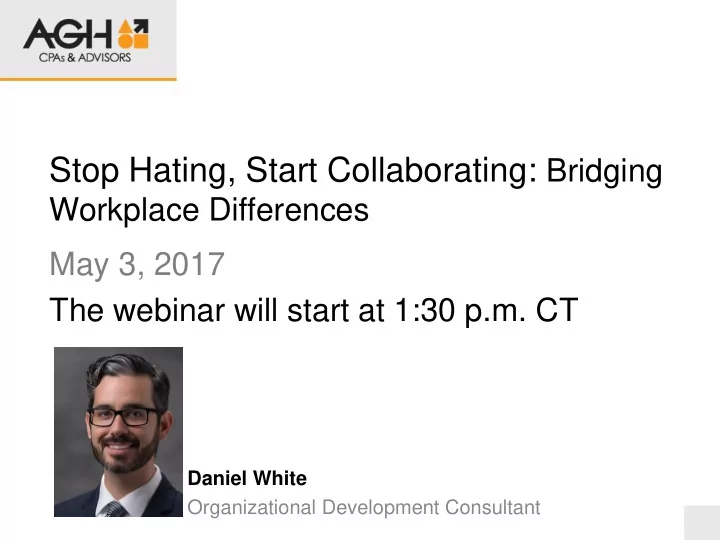
SLIDE 1 Stop Hating, Start Collaborating: Bridging
Workplace Differences May 3, 2017 The webinar will start at 1:30 p.m. CT
Daniel White Organizational Development Consultant
SLIDE 2 Administration
If you need HR or CPE credit, please participate in all polls throughout the presentation.
SLIDE 3 Administration
A recording of today’s webinar will be emailed for your reference or to share with others.
SLIDE 4 Administration
For best quality, call in by phone instead of using your computer speakers.
SLIDE 5 Administration
To ask questions during the presentation, use the questions box on the right side of your screen.
SLIDE 6 About the Speaker
Daniel White
Organizational Development Consultant
Expertise in strategic planning, leadership development and employee engagement Experience teaching masters-level courses in organizational development
SLIDE 7 Learning Objectives
Recognize the benefits of working with different view points. Identify potential barriers to collaboration. Learn the steps of a process to bridge differences and build trust. Understand how to translate the process into different situations.
SLIDE 8
Poll #1
SLIDE 9
Ways to Be Different
SLIDE 10
Activity: Identifying Differences
SLIDE 11 Diversity Defined
A visible (gender, ethnicity, etc.) dimension that differentiates one group of people from another.
SLIDE 12 Diversity Defined
A visible (gender, ethnicity, etc.) or invisible (religion, thinking style, disability, etc.) dimension that differentiates one group of people from another. A visible (gender, ethnicity, etc.) or invisible (religion, thinking style, disability, etc.) dimension that differentiates one group of people from another.
SLIDE 13 Iceberg
http://www.brookgraham.com/WhatWeDo/Iceberg.aspx
SLIDE 14
Poll #2
SLIDE 15
Why Embrace Our Differences?
SLIDE 16
THE WORLD IS CHANGING
SLIDE 17
Trends
SLIDE 18
Politics
Pew:
86%
believe we are more politically divided than the past. Gallup:
77%
believe the US is split over the most important values.
SLIDE 19 Employment Trends
Younger
SLIDE 20
Generations
Gen Y is the
largest
generation in the workforce.
SLIDE 21
Generations
By 2025:
75% of
workers will be Gen Y.
SLIDE 22 Employment Trends
Younger Multicultural
SLIDE 23
Multicultural
2016:
1 in 4
were minorities.
SLIDE 24
Multicultural
2016:
1 in 4
were minorities. 2050:
1 in 2
will be minorities.
SLIDE 25
Multicultural
2050:
No ethnic majority
SLIDE 26 Employment Trends
Younger Multicultural Women
SLIDE 27
Women
SLIDE 28
Benefits of Diversity & Collaboration
Increased creativity Better end result More representative of population Connect with changing population
SLIDE 29
Cognitive Diversity
SLIDE 30
Potential Barriers to Collaboration
SLIDE 32 Mindsets
- “Better than others”
- Don’t like change
SLIDE 33 Mindsets
- “Better than others”
- Don’t like change
- Don’t see the need for diversity
SLIDE 34 Mindsets
- “Better than others”
- Don’t like change
- Don’t see the need for diversity
- Don’t like those different (the enemy)
SLIDE 35 Mindsets
- “Better than others”
- Don’t like change
- Don’t see the need for diversity
- Don’t like those different (the enemy)
- Don’t have time
SLIDE 36
How to Bridge the Gap
SLIDE 37
Stages of Diversity Competence
SLIDE 38 Stages of Diversity Competence
Denial
SLIDE 39 Stages of Diversity Competence
Denial Polarization
SLIDE 40 Stages of Diversity Competence
Denial Polarization Minimization
SLIDE 41 Stages of Diversity Competence
Denial Polarization Minimization Acceptance
SLIDE 42 Stages of Diversity Competence
Denial Polarization Minimization Acceptance Adaptation
SLIDE 43
Poll #3
SLIDE 44
How do we move toward adaptation?
SLIDE 45
The Process
Understand the other person.
SLIDE 46
The Process
Understand the other person. Discover common ground.
SLIDE 47
The Process
Understand the other person. Discover common ground. Make a connection.
SLIDE 48
The Process
Understand the other person. Discover common ground. Make a connection. Adapt your style.
SLIDE 49
The Process In Detail
SLIDE 50 Understand the Other Person
- Get to know them.
- Research his or her background & history.
- Understand his or her intent.
- What are some possible reasons the
person might believe that?
SLIDE 51 Discover Common Ground
- What common background do you have?
- What common interests or hobbies do
you share?
- What common desires do you have?
SLIDE 52 Make a Connection
- Ask the person questions.
- Show interest in things the person cares
about.
- Small talk
- Go to lunch and don’t talk work.
- Work on a work project together.
- Go to an event outside work together.
SLIDE 53 Adapt Your Style
- Know what the person would prefer to do.
- Express your desire to adapt.
- Meet the person halfway (or more).
SLIDE 54
Applying the Process
SLIDE 55
IDEOLOGIES
SLIDE 56
Sports
SLIDE 57
Politics
SLIDE 58
Health
SLIDE 59
Religion/Ethics
SLIDE 60
Ideologies
Understand the person’s intent.
SLIDE 61
GENERATIONS
SLIDE 62 Multiple Generations
https://usflearn.instructure.com/courses/1177483/pages/generations-2-multiple-generations-in-the-workplace
SLIDE 63
Poll #4
SLIDE 64
Example – Dress Code
SLIDE 65 Is it a business necessity?
(Could it cost us a customer, money, or a foot?)
SLIDE 66
Example – Work Ethic
SLIDE 67
Helping Others to Collaborate
SLIDE 68 Reasons Not A Team Player
- Selfish/Don’t care about others
SLIDE 69 Reasons Not A Team Player
- Selfish/Don’t care about others
- Doesn’t feel valued/appreciated
SLIDE 70 Reasons Not A Team Player
- Selfish/Don’t care about others
- Doesn’t feel valued/appreciated
- Frustrated by others’:
- Work style
- Quality standards
- Personality
SLIDE 72 Helping Others
- Identify the real issue.
- Don’t let it fester.
SLIDE 73 Helping Others
- Identify the real issue.
- Don’t let it fester.
- Help them understand others’ intentions.
SLIDE 74
THE BIG IDEA
SLIDE 75
The Big Idea
The issue isn’t about working with different (generations / ethnicities / ideologies) –
it’s about understanding and valuing people.
SLIDE 76
REVIEW
SLIDE 77
Review – The Need
Society is rapidly becoming more diverse and divided.
SLIDE 78
Review – The Process
Understand the other person. Discover common ground. Make a connection. Adapt your style.
SLIDE 79
Poll #5
SLIDE 80
Questions?
SLIDE 81 Thank you!
Daniel White
Organizational Development Consultant
daniel.white@aghlc.com www.linkedin.com/in/danielwilliamwhite @dw_white 316.291.4017