ADMIN Reading Chapter 8 Including RAID (8.2) but dont stress - - PowerPoint PPT Presentation

admin
SMART_READER_LITE
LIVE PREVIEW

ADMIN Reading Chapter 8 Including RAID (8.2) but dont stress - - PowerPoint PPT Presentation

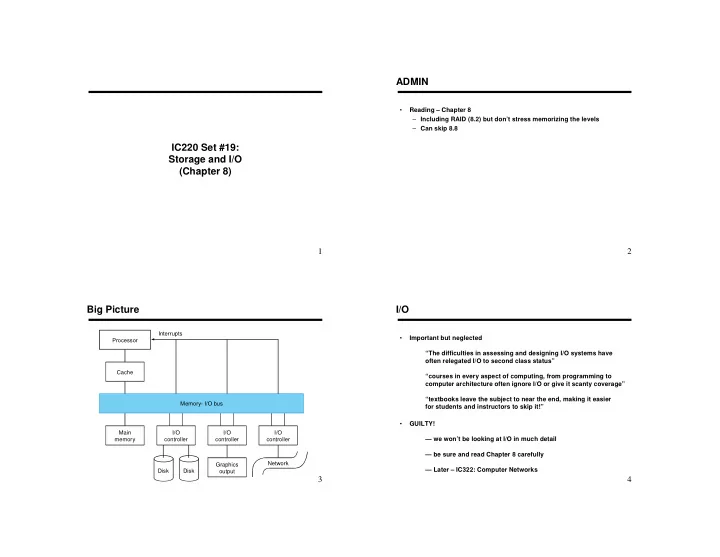
ADMIN Reading Chapter 8 Including RAID (8.2) but dont stress memorizing the levels Can skip 8.8 IC220 Set #19: Storage and I/O (Chapter 8) 1 2 Big Picture I/O Interrupts Important but neglected Processor The


slide-1
SLIDE 1

1

IC220 Set #19: Storage and I/O (Chapter 8)

2

ADMIN

  • Reading – Chapter 8

– Including RAID (8.2) but don’t stress memorizing the levels – Can skip 8.8

3

Big Picture

Disk Disk Processor Cache Memory- I/O bus Main memory I/O controller I/O controller I/O controller Graphics

  • utput

Network Interrupts

4

I/O

  • Important but neglected

“The difficulties in assessing and designing I/O systems have

  • ften relegated I/O to second class status”

“courses in every aspect of computing, from programming to computer architecture often ignore I/O or give it scanty coverage” “textbooks leave the subject to near the end, making it easier for students and instructors to skip it!”

  • GUILTY!

— we won’t be looking at I/O in much detail — be sure and read Chapter 8 carefully — Later – IC322: Computer Networks

slide-2
SLIDE 2

5

Outline

  • A. Overview
  • B. Physically connecting I/O devices to Processors and Memory (8.4)
  • C. Interfacing I/O devices to Processors and Memory (8.5)
  • D. Performance Measures (8.6)
  • E. Disk details/RAID (8.2)

6

(A) I/O Overview

  • Can characterize devices based on:
  • 1. behavior
  • 2. partner (who is at the other end?)
  • 3. data rate
  • Performance factors:

— access latency — throughput — connection between devices and the system — the memory hierarchy — the operating system

  • Other issues:

– Expandability, dependability

7 (B) Connecting the Processor, Memory, and other Devices

Two general strategies:

  • 1. Bus: ____________ communication link

Advantages: Disadvantages:

  • 2. Point to Point Network: ____________ links

Use switches to enable multiple connections Advantages: Disadvantages:

8

(B) Bus Basics – Part 1

  • Types of buses:

– Process-memory

  • Short, high speed, fixed device types
  • custom design

– I/O

  • lengthy, different devices
  • Standards-based e.g., USB, Firewire
  • Connect to proc-memory bus rather than directly to process
  • Only one pair of devices (sender & receiver) may use bus at a time

– Bus _______________ decides who gets the bus next based on some ______________ strategy – May incorporate priority, round-robin aspects

  • Have two types of signals:

– “Data” – data or address – Control

slide-3
SLIDE 3

9

I/O Bus Standards

  • Today we have two dominant I/O bus standards:

10

(B) Bus Basics – Part 2

  • Clocking scheme:
  • 1. ____________________

Use a clock, signals change only on clock edge + Fast and small

  • All devices must operate at same rate
  • Requires bus to be short (due to clock skew)
  • 2. ____________________

No clock, instead use “handshaking” + Longer buses possible + Accommodate wide range of device

  • more complex control

11 Handshaking example – CPU read from memory

DataRdy Ack Data ReadReq 1 3 4 5 7 6 4 2 2

  • 1. CPU requests read
  • 2. Memory acknowledges, CPU deasserts request
  • 3. Memory sees change, deasserts Ack
  • 4. Memory provides data, asserts DataRdy
  • 5. CPU grabs data, asserts Ack
  • 6. Memory sees Ack, deasserts DataRdy
  • 7. CPU sees change, deasserts Ack

12

(C) Processor-to-device Communication

How does CPU send information to a device?

  • 1. Special I/O instructions

x86: inb / outb How to control access to I/O device?

  • 2. Use normal load/instructions to special addresses

Called ______________________ Load/store put onto bus Memory ignores them (outside its range) Address may encode both device ID and a command How to control access to I/O device?

slide-4
SLIDE 4

13

(C) Device-to-processor communication

How does device get data to the processor?

  • 1. CPU periodically checks to see if device is ready: _________________
  • CPU sends request, keep checking if done
  • Or just checks for new info (mouse, network)
  • 2. Device forces action by the processor when needed: _________________
  • Like an unscheduled procedure call
  • Same as “exception” mechanism that handles

TLB misses, divide by zero, etc.

  • 3. DMA:
  • Device sends data directly to memory w/o CPU’s involvement
  • Interrupts CPU when transfer is complete

14

DMA and Cache Coherency

Disk Disk Processor Cache Memory- I/O bus Main memory I/O controller I/O controller I/O controller Graphics

  • utput

Network Interrupts

What could go wrong?

15

(D) I/O’s impact on performance

  • Total time = CPU time + I/O time
  • Suppose our program is 90% CPU time, 10% I/O. If we improve CPU

performance by 10x, but leave I/O unchanged, what will the new performance be?

  • Old time = 100 seconds
  • New time =

16

(D) Measuring I/O Performance

  • Latency?
  • Throughput?
  • Throughput with maximum latency?
  • Transaction processing benchmarks

– TPC-C – TPC-H – TPC-W

  • File system / Web benchmarks

– “Make” benchmark – SPECSFS – SPECWeb

slide-5
SLIDE 5

17

(E) Disk Drives

  • To access data:

— seek: position head over the proper track (3 to 14 ms. avg.) — rotational latency: wait for desired sector (.5 / RPM) — transfer: grab the data (one or more sectors) 30 to 80 MB/sec

Platter Track Platters Sectors Tracks

18

(E) RAID

  • _______________ ________________ _______________ ___________
  • Idea: lots of cheap, smaller disks
  • Small size and cost makes easier to add redundancy
  • Multiple disks increases read/write bandwidth

19

RAID

RAID 0 – “striping”, no redundancy RAID 1 – mirrored

20

RAID

RAID 4 – Block-interleaved parity RAID 5 – Distributed Block-interleaved Parity

slide-6
SLIDE 6

21

RAID

RAID 10 – Striped mirrors

  • Key point – still need to do other backups (e.g. to tape)

– Provides protection from limited number of disk failures – No protection from human failures!

22

Pentium 4

  • I/O Options

Parallel ATA (100 MB/sec) Parallel ATA (100 MB/sec) (20 MB/sec) PCI bus (132 MB/sec) CSA (0.266 GB/sec) AGP 8X (2.1 GB/sec) Serial ATA (150 MB/sec) Disk Pentium 4 processor 1 Gbit Ethernet Memory controller hub (north bridge) 82875P Main memory DIMMs DDR 400 (3.2 GB/sec) DDR 400 (3.2 GB/sec) Serial ATA (150 MB/sec) Disk AC/97 (1 MB/sec) Stereo (surround- sound) USB 2.0 (60 MB/sec) . . . I/O controller hub (south bridge) 82801EB Graphics

  • utput

(266 MB/sec) System bus (800 MHz, 604 GB/sec) CD/DVD Tape 10/100 Mbit Ethernet

23

Fallacies and Pitfalls

  • Fallacy: the rated mean time to failure of disks is 1,200,000 hours,

so disks practically never fail.

  • Fallacy: magnetic disk storage is on its last legs, will be replaced.
  • Fallacy: A 100 MB/sec bus can transfer 100 MB/sec.
  • Pitfall: Moving functions from the CPU to the I/O processor,

expecting to improve performance without analysis.