
SLIDE 1
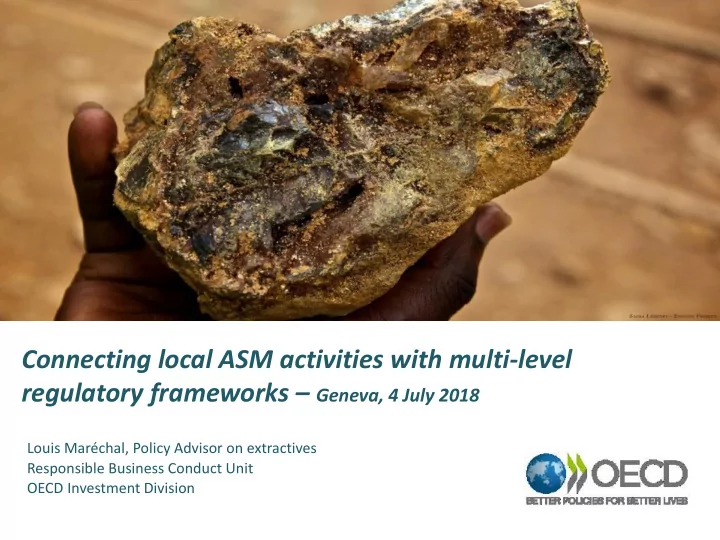
Connecting local ASM activities with multi-level regulatory frameworks – Geneva, 4 July 2018
Louis Maréchal, Policy Advisor on extractives Responsible Business Conduct Unit OECD Investment Division
Addressing conflict and serious human rights abuses in mineral - - PowerPoint PPT Presentation
Connecting local ASM activities with multi-level regulatory frameworks Geneva, 4 July 2018 Louis Marchal, Policy Advisor on extractives Responsible Business Conduct Unit OECD Investment Division Addressing conflict and serious human
Louis Maréchal, Policy Advisor on extractives Responsible Business Conduct Unit OECD Investment Division
resources is a source of growth, but can be associated with significant adverse impacts, including
– Serious human rights impacts (e.g. child labour, forced labour) – Financing conflict – Money-laundering, terrorist financing & sanctions violations – Bribery
America, Europe)
tantalum, tungsten, gold, cobalt, precious stones, coal, oil & gas, etc.)
extent ASM and LSM
Artisanal gold from the Democratic Republic of the Congo
recorded presence of illegal armed groups
Global support for OECD Due Diligence Guidance (2011)
Political Industry & Consumer Legal & regulatory
2013)
Resolutions on DRC (2009, 2010, 2011, 2012, 2013, 2014, 2015, 2016) Ivory Coast (2013, 2014, 2015) and CAR (2016)
Lusaka Decl. (2010)
Recommendation (2011)
+ Commissioners statement
Work
civil society (e.g. Amnesty Int’l, Global Witness, Human Rights Watch, PAC, Enough Project)
AIAG (automotive), AIA (aerospace) LBMA, RJC & WGC (gold & jewellery), CCCMC (China), and DMCC (Dubai)
OECD-benchmarked industry audits cover ~85-90% of total refined gold production OECD-benchmarked industry audits cover ~93% Ta, ~75% Sn, ~60% W production
Frank Act conflict minerals reporting
mineral supply chains
Rwanda, Burundi & Uganda
Canada
modern slavery & child labour (e.g. UK & US)
decrees (forthcoming)
Objective
To provide clear, practical guidance for companies to ensure responsible
money-laundering and fraud in supply chains
suppliers (e.g. supplier upgrading)
Method and scope
5-step risk-based due diligence process, applies to all mineral resources & all companies throughout the entire mineral supply chain that potentially contribute to conflict, serious abuses, bribery, tax evasion and money laundering through mining or mineral sourcing practices
Principles
Progressive improvements over time and good faith and reasonable efforts promoting constructive engagement with suppliers Global scope - intended to enable investment and trade in conflict-affected and high-risk areas, i.e. no blacklists, no embargoes, no protectionism
“Downstream” companies:
Identify gold refiners in supply chain (Collect information on their upstream due diligence (e.g. both through individual efforts and industry auditing) Use collective industry leverage to encourage improvement of upstream due diligence
“Upstream” companies:
Establish traceability or chain of custody to mine of origin For “red flagged” supply chains, undertake on- the-ground assessments of mines, producers & traders for conflict, serious abuses, bribery, tax evasion, fraud, money-laundering Collaborative engagement with local gov’t, CSOs, local business to prevent & mitigate impacts, monitor
ASM has a key role, can drive sector-wide changes in responsible sourcing The Guidance enables market access through collaborative efforts of all actors involved Detailed Appendix on ASGM provides roadmap to create economic and development
All stakeholders (e.g. governments, industry, civil society) encouraged to use the suggested measures in the Appendix
6
OECD Secretariat released in May 2016 an ‘’ASM FAQ’’ to clarify expectations of the Guidance with regard to responsible ASM engagement by int’l private sector
7
Global implementation of OECD Due Diligence Guidance
Law enforment / customs Formalisation of ASM & combating child labour Transparency / government capacity building initiatives
OECD Due Diligence Guidance for Responsible Supply Chains of Minerals from Conflict-Affected and High-Risk Areas FAQ on sourcing gold from artisanal and small scale miners Gold industry and sector initiatives for the responsible sourcing of minerals (2014) Mineral supply chain and conflict links in Eastern Democratic Republic of Congo Report on due diligence in Colombia's gold supply chain OECD Council report on the implementation of the due diligence guidance Contact: louis.marechal@oecd.org For further information on the OECD’s work on Responsible Business Conduct