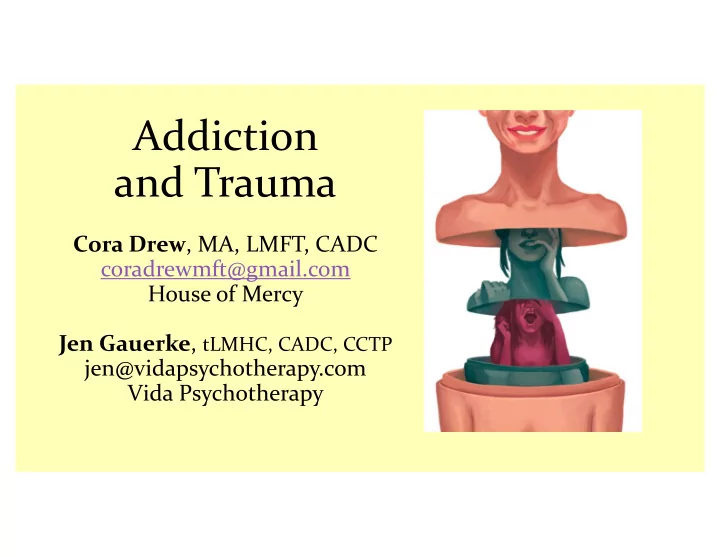
Addiction and Trauma Cora Drew , MA, LMFT, CADC - - PowerPoint PPT Presentation
Addiction and Trauma Cora Drew , MA, LMFT, CADC coradrewmft@gmail.com House of Mercy Jen Gauerke , tLMHC, CADC, CCTP jen@vidapsychotherapy.com Vida Psychotherapy Objectives: Participants will: 1. Define addiction and trauma. 2. Describe the
Objectives:
Participants will:
- 1. Define addiction and trauma.
- 2. Describe the brain’s role in trauma and addiction
- “brain disease”
- 3. Explain the trauma and addiction loop.
- 4. Recognize crisis and need for referral as ethical
best practice: continued use/OD, withdrawals, suicidality.
- 5. Demonstrate treatment recommendations and
interventions, including mindfulness.
What is it?
- Addiction :
Any dysfunctional and habitual form of coping with emotions, such as… This leaves the root problem unaddressed, the emotional need unmet, creating a feedback loop. Organizing their life around the
- addiction. (Abel & O’Brien)
- Trauma:
When an event or situation in the past overwhelmed a person’s ability to cope, creating an emotional wound, leaving enduring physiological and psychological distress and
- adaptation. This also can create
a feedback loop.
Wile E Coyote: Middle aged male coyote, under nourished, no supportive
family, little socialization.
(Van Der Kolk, 2014, 53)
“Being traumatized means continuing to organize your life as if the trauma were still going on– unchanged and immutable– as every new encounter or event is contaminated by the past.”
Disease model of Addiction
Us Use – casual, infrequent Ab Abuse – tolerance De Dependence - physical Ad Addiction- life centered Sub Substanc nce Use Di Disorder r –DSMV
Is it…
Connecting Addiction & Trauma
- Executive Functioning (Decision Making – choice argument)
- Trauma hijacks the usual ‘top down processing’ (Levine, 2010).
- Automatic prioritizing of needs (McCauley, 2010, Pleasure Unwoven)
- Shame and blame
- Clinical issues with stages of change (Abel & O’Brien)
- Trauma
PTSD Use Relief
Un-firing and Un-wiring; escaping the limbic system.
Starting Treatment:
Do not rush into treating trauma! BEGIN: Build relationship Safety (harm reduction/abstinence) Teach coping/resourcing skills Medication management THEN: Utilize Methadologies
Wile is court-ordered to treatment…
Ad Addressing Ad Addiction
- Assessment (ASAM)
- Treatment approach
Ad Addressing Trauma
- Assessment (biopsychosocial)
- Therapeutic approach
Wile is court-ordered to treatment…
Ad Addressing Ad Addiction
- Assessment (ASAM)
- Treatment approach
- Relapse Prevention
Ad Addressing Trauma
- Assessment
- Therapeutic approach
- Processing trauma
- Increased symptoms &
emotional distress
Relapse Prevention Planning
- Triggers (Internal and External)
- Red Flags
- Coping Skills/Resourcing
*Positive Self Talk
- Professional Support System
- Personal Support System
- What do I need? (HALTS)
Relapse Prevention Plan for _____________________________ Date: Triggers (Internal and External) 1. 2. 3. 4. 5. 6. 7. 8. Red Flags 1. 2. 3. 4. 5. 6. 7. 8. Coping Skills/ Resourcing 1. 2. 3. 4. 5. 6. 7. 8. Professional Support System 1. 2. 3. 4. 5. 6. Personal Support System 1. 2. 3. 4. 5. 6. What do I need? (HALTS) 1. 2. 3. 4. 5. 6. Keep a copy of this plan in a place where you can access it easily and use it when you are struggling with difficult emotions, thoughts, and decisions. If you are having thoughts of suicide or self-harm to immediately go to the nearest hospital, call the suicide hotline 1-800-273-8255, or call 911. _______________________________________________ __________________________________________ Client signature Clinician signature
Wile is court-ordered to treatment…
Ad Addressing Ad Addiction
- Assessment (ASAM)
- Treatment approach
- Relapse Prevention &
Triggers*
- Relapse Processing
Addressin ing Trauma
- Assessment
- Therapeutic approach
- Processing trauma
- Increased symptoms &
emotional distress
Relapse
Wile is court-ordered to treatment…
Ad Addressing Ad Addiction
- Assessment (ASAM)
- Treatment approach
- Relapse Prevention &
Triggers*
- Relapse Processing
- Coping skills
- Create Recovery Lifestyle
- Eliminate addictive behavior
Ad Addressing Trauma
- Assessment
- Therapeutic approach
- Processing trauma
- Increased symptoms &
emotional distress
- Coping skills
- Decreasing trauma symptoms
- Increasing daily function
Relapse
Questions to ask for possible referral:
- Does the client report current daily substance use or issues with
basic functioning? Higher level of care may be required to interrupt use – review ASAM dimensions/criteria
- Is the client using opiates, benzos, or alcohol, which could lead to
life-threatening with thdrawals? Medical intervention/inpatient
- Are the client’s PTSD-type symptoms and/or substance use
persisting despite your standard clinical interventions? Scope of practice, review DSMV
- Is the client su
suicidal or at risk for ov
- verdose (during and after
treatment)? Harm reduction, safety planning
ADDICTION RECOVERY GROUP
Jen Gauerke, tLMHC, CADC, is starting a new recovery group at Vida Psychotherapy in West Des Moines. This group will educate about the aspects of recovery, the impact of trauma, and the shame of addiction. It will also provide a setting to explore self and relationships with a caring group of adults who are striving for a better life and continued recovery. This is not a 12 Step group and is not a replacement for intensive inpatient treatment or individual therapy. Time and dates will be determined as group members meet with Jen for intake interviews and according to the availability of membership. Some insurance providers may cover the cost of services, or the out of pocket fee is $100 for intake and $32 per group.
STARTING SOON!
GROUP WILL BE LIMITED TO 8 PARTICIPANTS
Contact Jen Gauerke (515)528-7892 To schedule an intake session
jen@vidapsychotherapy.com
For adults seeking support in ongoing recovery from chemical addiction.
Flyers available for groups!
Objectives:
Participants will: 1.
- 1. Define addiction and trauma.
2.
- 2. Describe th
the brain’s role le in tr trauma and d addi ddicti tion
- “b
“brain in dise isease se” 3.
- 3. Expla
lain th the tr trauma and d addi ddicti tion
- n loop
loop. 4.
- 4. Recognize crisis and
d need d for referral l as eth thical l be best prac actice: continued use/OD, OD, withdrawal als, suic suicid idalit ity.
- 5. Demonstrate treatment recommendations and
interventions, including mindfulness.
Addiction Treatment Approaches
- Motivational Interviewing (MI)
- CBT
- Acceptance and Commitment Therapy (ACT)
- EMDR
- Mindfulness-Based Relapse Prevention
- Mindfulness-based Stress Reduction (MBSR)
- Groups, including community based.
(AA, NA, SMART, Celebrate, Refuge Recovery)
- Psychiatry – medication management
Including MAT (as needed for opiate and alcohol-related disorders)
- Psychoeducation and early intervention
- Case management
- Trauma Informed Care in Substance Abuse Counseling
Trauma Processing Approaches
- Narrative (Trauma Focused CBT)
- Eye Movement Desensitization Reprocessing (EMDR)
- Somatic Experiencing
- Creative Stress Reduction (Yoga, art,etc.)
- Dialectical Behavioral Therapy
- Attachment/EFT for Individuals
- Emotionally Focused Therapy (for couples triggering each other)
- Prolonged Exposure, Rewind Technique, Brainspotting (suggested by
attendees)
ACT – Acceptance & Commitment Therapy (by Russ Harris)
Meet client where they are with the Hexaflex (addiction may start with acceptance)
- Be here now
- Know what matters
- Do what it takes
- Pure awareness
- Watch your thinking
- Open Up
EMDR & Window of Tolerance
Polyvagal Theory Chart
Mindfulness and Meditation
“Mindfulness is the process of ‘paying attention in a particular way:
- n purpose, in the present moment, and non-jugmentally.’”
Benefits:
Stuctural Brain Changes Reduced Autonomic Arousal Perceptual Shift Increase in Spirituality Greater Situational awareness Values Clarification Increase in Self Awareness Addiction Substitution Urge Surfing Letting Go
Shonin, E. & Van Gordon, W. Int J Ment Health Addiction(2016). 14.844. https://doi.org/10.1007/s11469-016-9653-7 “Beauty of Silence” by Gloria Rothrock
What are we bringing to the relationship? Remember self care! Personal trauma of therapist Negative core beliefs about addiction and trauma Countertransference
References
- Understanding Addiction as a disease video. https://youtu.be/-
6GMwAsdCOI
- The Body Keeps the Score: Brain, Mind, and Body in the Healing of
Trauma (van der Kolk, 2015: Penguin Group) In An
- Unspoken Voice: How the Body Releases Trauma and Restores
Goodness (Levine, 2010)
- The Mechanisms of Mindfulness in the Treatment of Mental Illness
and Addiction (Shonin, E. & Van Gordon, W.) Int J Ment Health Addiction(2016). 14.844. https://doi.org/10.1007/s11469-016- 9653-7
- Treating Addictions with EMDR Therapy and the Stages of Change
(Abel & O’Brien, 2015)
Suggested Readings
- Co-occurring Disorders: Integrated Assessment and Treatment of Substance
Use and Mental disorders (Atkins, 2014)
- Integrated Dual Disorders Treatment Revised: Best Practices, Skills, and
Resources for Successful Client Care (Dartmouth, 2015)
- Seeking Safety: A Treatment Manual for PTSD and Substance Abuse (Najavits,
2002) - IPV/DV specific
- The Body Keeps the Score: Brain, Mind, and Body in the Healing of Trauma
(van der Kolk, 2015)
- In An Unspoken Voice: How the Body Releases Trauma and Restores Goodness
(Levine, 2010)
- In the Realm of Hungry Ghosts: Close Encounters with Addiction (Mate, 2010)
- Trauma Stewardship: an everyday guide to caring for self while caring for
- thers (van Dernoot, 2007)
Suggested Readings, continued…
- Treating Addictions with EMDR Therapy and the Stages of Change
(Abel & O’Brien, 2015)
- Rewiring the Addicted Brain; an EMDR-based treatment model for
- vercoming addictive disorders (Parnell, 2018)
- ACT made simple (Harris, 2009) at:
https://www.actmindfully.com.au/upimages/ACT_Made_Simple_In troduction_and_first_two_chapters.pdf
- EMDRandbeyond.com & EMDRIA
- Disordered Eating- Women, Food, and God (Roth, 2010)
- Sex addiction - Naked in Public (Sprout, 2015)