SLIDE 1 Activity 1
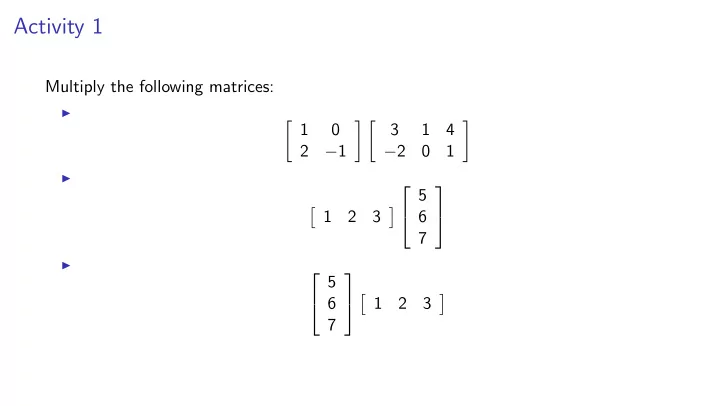
Multiply the following matrices:
◮
1 2 −1 3 1 4 −2 1
2 3
5 6 7
◮
5 6 7 1 2 3
SLIDE 2 Activity 2
Define the function f : R3 − → R3 by f (x) = 1 2 1 3 1 x
◮ Write a rule for f in the form f (
x1 x2 x3 ) = ? ? ? .
◮ Let g be the inverse of f . Write a rule for g. ◮ What is the domain of g? ◮ What is the matrix B such that g(y) = By?
SLIDE 3 Quiz
Let f : U − → V be a linear transformation. Recall that the kernel of f is {u ∈ U : f (u) = 0}. This is a subspace of U. We say a vector space is trivial if it has
- nly one element, which is necessarily a zero vector since every vector space contains a
zero vector.
◮ Prove that if the kernel of f is not trivial then f is not one-to-one:
Proof: Suppose the kernel of f is not trivial. We show that f is not
◮ Prove that if the kernel of f is trivial then f is one-to-one.
Proof: Suppose the kernel of f is trivial. We show that f is
SLIDE 4
The Basis
[5] The Basis
SLIDE 5
Ren´ e Descartes
Born 1596. After studying law in college,....
I entirely abandoned the study of letters. Resolving to seek no knowledge other than that of which could be found in myself or else in the great book of the world, I spent the rest of my youth traveling, visiting courts and armies, mixing with people of diverse temperaments and ranks, gathering various experiences, testing myself in the situations which fortune offered me, and at all times reflecting upon whatever came my way so as to derive some profit from it.
He had a practice of lying in bed in the morning, thinking about mathematics....
SLIDE 6 Coordinate systems
In 1618, he had an idea... while lying in bed and watching a fly on the ceiling. He could describe the location of the fly in terms of two numbers: its distance from the two walls. He realized that this works even if the two walls were not perpendicular. He realized that you could express geometry in algebra.
◮ The walls play role of what we now call axes. ◮ The two numbers are what we now call coordinates
SLIDE 7 Coordinate systems
In terms of vectors (and generalized beyond two dimensions),
◮ coordinate system for a vector space V is specified by generators a1, . . . , an of V ◮ Every vector v in V can be written as a linear combination
v = α1 a1 + · · · + αn an
◮ We represent vector v by the vector [α1, . . . , αn] of coefficients.
called the coordinate representation of v in terms of a1, . . . , an. But assigning coordinates to points is not enough. In order to avoid confusion, we must ensure that each point is assigned coordinates in exactly one way. How? We will discuss unique representation later.
SLIDE 8
Coordinate representation
Definition: The coordinate representation of v in terms of a1, . . . , an is the vector [α1, . . . , αn] such that
v = α1 a1 + · · · + αn an
In this context, the coefficients are called the coordinates. Example: The vector v = [1, 3, 5, 3] is equal to 1 [1, 1, 0, 0] + 2 [0, 1, 1, 0] + 3 [0, 0, 1, 1] so the coordinate representation of v in terms of the vectors [1, 1, 0, 0], [0, 1, 1, 0], [0, 0, 1, 1] is [1, 2, 3]. Example: What is the coordinate representation of the vector [6, 3, 2, 5] in terms of the vectors [2, 2, 2, 3], [1, 0, −1, 0], [0, 1, 0, 1]? Since [6, 3, 2, 5] = 2 [2, 2, 2, 3] + 2 [1, 0, −1, 0] − 1 [0, 1, 0, 1], the coordinate representation is [2, 2, −1].
SLIDE 9
Coordinate representation
Definition: The coordinate representation of v in terms of a1, . . . , an is the vector [α1, . . . , αn] such that
v = α1 a1 + · · · + αn an
In this context, the coefficients are called the coordinates. Now we do an example with vectors over GF(2). Example: What is the coordinate representation of the vector [0,0,0,1] in terms of the vectors [1,1,0,1], [0,1,0,1], and [1,1,0,0]? Since [0, 0, 0, 1] = 1 [1, 1, 0, 1] + 0 [0, 1, 0, 1] + 1 [1, 1, 0, 0] the coordinate representation of [0, 0, 0, 1] is [1, 0, 1].
SLIDE 10 Coordinate representation
Definition: The coordinate representation of v in terms of a1, . . . , an is the vector [α1, . . . , αn] such that
v = α1 a1 + · · · + αn an
In this context, the coefficients are called the coordinates. Why put the coordinates in a vector? Makes sense in view of linear-combinations definitions of matrix-vector multiplication. Let A = a1 · · ·
an
.
◮ “u is the coordinate representation of v in terms of a1, . . . , an” can be written as
matrix-vector equation Au = v
◮ To go from a coordinate representation u to the vector being represented, we
multiply A times u.
◮ To go from a vector v to its coordinate representation, we can solve the
matrix-vector equation Ax = v.
v
SLIDE 11 Linear Combinations: Lossy compression
Say you need to store or transmit many 2-megapixel images: How do we represent the image compactly?
◮ Obvious method: 2 million pixels =
⇒ 2 million numbers
◮ Strategy 1: Use sparsity! Find the
“nearest” k-sparse vector. Later we’ll see this consists of suppressing all but the largest k entries.
◮ More sophisticated strategy?
SLIDE 12 Linear Combinations: Lossy compression
Strategy 2: Represent image vector by its coordinate representation:
◮ Before compressing any images, select vectors v1, . . . , vn. ◮ Replace each image vector with its coordinate representation in terms of
v1, . . . , vn.
For this strategy to work, we need to ensure that every image vector can be represented as a linear combination of v1, . . . , vn. Given some D-vectors v1, . . . , vn over F, how can we tell whether every vector in FD can be written as a linear combination of v1, . . . , vn? We also need the number of vectors v1, . . . , vn to be much smaller than the number of pixels. Given D, what is minimum number of vectors v1, . . . , vn such that every vector in FD can be written as a linear combination?
SLIDE 13
Linear Combinations: Lossy compression
Strategy 3: A hybrid approach Step 1: Select vectors v1, . . . , vn. Step 2: For each image to compress, find its coordinate representation u in terms of
v1, . . . , vn
Step 3: Replace u with the closest k-sparse vector ˜
u, and store ˜ u.
Step 4: To recover an image from ˜
u, calculate the corresponding linear combination of v1, . . . vn.
SLIDE 14
Greedy algorithms for finding a set of generators
Question: For a given vector space V, what is the minimum number of vectors whose span equals V? How can we obtain a minimum number of vectors? Two natural approaches come to mind, the Grow algorithm and the Shrink algorithm.
SLIDE 15
Grow algorithm
def Grow(V) S = ∅ repeat while possible: find a vector v in V that is not in Span S, and put it in S. The algorithm stops when there is no vector to add, at which time S spans all of V. Thus, if the algorithm stops, it will have found a generating set. But is it bigger than necessary?
SLIDE 16
Shrink Algorithm
def Shrink(V) S = some finite set of vectors that spans V repeat while possible: find a vector v in S such that Span (S − {v}) = V, and remove v from S. The algorithm stops when there is no vector whose removal would leave a spanning set. At every point during the algorithm, S spans V, so it spans V at the end. Thus, if the algorithm stops, the algorithm will have found a generating set. The question is, again: is it bigger than necessary?
SLIDE 17
When greed fails
Is it obvious that Grow algorithm and Shrink algorithm find smallest sets of generators? Look at example for a problem in graphs... Points are called nodes, links are called edges. Each edge has two endpoints, the nodes it connects. The endpoints of an edge are neighbors. Definition: A dominating set in a graph is a set S of nodes such that every node is in S or a neighbor of a node in S.
SLIDE 18
When greed fails: dominating set
Definition: A dominating set in a graph is a set S of nodes such that every node is in S or a neighbor of a node in S. Grow Algorithm: initialize S = ∅ while S is not a dominating set, add a node to S that is not currently adjacent to S Shrink Algorithm: initialize S = all nodes while there is a node x such that S −{x} is a dominating set, remove x from S Neither algorithm is guaranteed to find the smallest solution.
SLIDE 19 Minimum spanning forest
Athletic Complex Main Quad Pembroke Campus Keeney Quad Wriston Quad Bio-Med Gregorian Quad
Definition: A sequence of edges [{x1, x2}, {x2, x3}, {x3, x4}, . . . , {xk−1, xk}] with no repeats is called an x1-to-xk path. Example “Main Quad”-to-”Gregorian Quad” paths in above graph:
◮ one goes through “Wriston Quad” , ◮ one goes through “Keeney Quad”
Definition: A x-to-x path is called a cycle.
SLIDE 20 Minimum spanning forest
Athletic Complex Main Quad Pembroke Campus Keeney Quad Wriston Quad Bio-Med Gregorian Quad
Definition: A sequence of edges [{x1, x2}, {x2, x3}, {x3, x4}, . . . , {xk−1, xk}] with no repeats is called an x1-to-xk path. Example “Main Quad”-to-”Gregorian Quad” paths in above graph:
◮ one goes through “Wriston Quad” , ◮ one goes through “Keeney Quad”
Definition: A x-to-x path is called a cycle.
SLIDE 21 Minimum spanning forest: spanning
Athletic Complex Main Quad Pembroke Campus Keeney Quad Wriston Quad Bio-Med Gregorian Quad Athletic Complex Main Quad Pembroke Campus Keeney Quad Wriston Quad Bio-Med Gregorian Quad
Definition: A set S of edges is spanning for a graph G if, for every edge {x, y} of G, there is an x-to-y path consisting of edges of S. Soon we see connection between this use of “spanning” and its use with vectors.
SLIDE 22 Minimum spanning forest: forest
Athletic Complex Main Quad Pembroke Campus Keeney Quad Wriston Quad Bio-Med Gregorian Quad
Definition: A set of edges of G is a forest if the set includes no cycles.
SLIDE 23 Minimum spanning forest: forest
Athletic Complex Main Quad Pembroke Campus Keeney Quad Wriston Quad Bio-Med Gregorian Quad
Definition: A set of edges of G is a forest if the set includes no cycles.
SLIDE 24 Minimum spanning forest: forest
Athletic Complex Main Quad Pembroke Campus Keeney Quad Wriston Quad Bio-Med Gregorian Quad
Definition: A set of edges of G is a forest if the set includes no cycles.
SLIDE 25 Minimum spanning forest
Athletic Complex Main Quad Pembroke Campus Keeney Quad Wriston Quad Bio-Med Gregorian Quad
2 7 9 5 3 6 8 4
Minimum spanning forest problem:
◮ input: a graph G, and an assignment of real-number weights to the edges of G. ◮ output: a minimum-weight set S of edges that is spanning and a forest.
Application: Design hot-water delivery network for the university campus:
◮ Network must achieve same connectivity as input graph. ◮ An edge represents a possible pipe. ◮ Weight of edge is cost of installing the pipe. ◮ Goal: minimize total cost.
SLIDE 26 Minimum spanning forest: Grow algorithm
Athletic Complex Main Quad Pembroke Campus Keeney Quad Wriston Quad Bio-Med Gregorian Quad
2 7 9 5 3 6 8 4
def Grow(G) S := ∅ consider the edges in increasing order for each edge e: if e’s endpoints are not yet connected add e to S. Increasing order: 2, 3, 4, 5, 6, 7, 8, 9.
SLIDE 27 Minimum spanning forest: Shrink algorithm
Athletic Complex Main Quad Pembroke Campus Keeney Quad Wriston Quad Bio-Med Gregorian Quad
2 7 9 5 3 6 8 4
def Shrink(G) S = {all edges} consider the edges in order, from highest-weight to lowest-weight for each edge e: if every pair of nodes are connected via S − {e}: remove e from S. Decreasing order: 9, 8, 7, 6, 5, 4, 3, 2.
SLIDE 28 Formulating Minimum Spanning Forest in linear algebra
Athletic Complex Main Quad Pembroke Campus Keeney Quad Wriston Quad Bio-Med Gregorian Quad
Let D = set of nodes {Pembroke, Athletic, Bio-Med, Gregorian, Main, Keeney, Wriston} Represent a subset of D by a GF(2) vector: subset {Pembroke, Main, Gregorian} is represented by Pembroke Athletic Bio-Med Main Keeney Wriston Gregorian 1 1 1
SLIDE 29 Formulating Minimum Spanning Forest in linear algebra
Athletic Complex Main Quad Pembroke Campus Keeney Quad Wriston Quad Bio-Med Gregorian Quad
edge vector
Pembroke Athletic Bio-Med Main Keeney Wriston Gregorian {Pembroke, Athletic}
1 1
{Pembroke, Bio-Med}
1 1
{Athletic, Bio-Med}
1 1
{Main, Keeney}
1 1
{Main, Wriston}
1 1
{Keeney, Wriston}
1 1
{Keeney, Gregorian}
1 1
{Wriston, Gregorian}
1 1
SLIDE 30 Formulating Minimum Spanning Forest in linear algebra
Athletic Complex Main Quad Pembroke Campus Keeney Quad Wriston Quad Bio-Med Gregorian Quad
The vector representing {Keeney, Gregorian}, Pembroke Athletic Bio-Med Main Keeney Wriston Gregorian 1 1 is the sum, for example, of the vectors representing {Keeney, Main }, {Main, Wriston}, and {Wriston, Gregorian} : Pembroke Athletic Bio-Med Main Keeney Wriston Gregorian 1 1 1 1 1 1 A vector with 1’s in entries x and y is the sum of vectors corresponding to edges that form an x-to-y path in the graph.