
Artificial Intelligence
Chapter 1
Chapter 1 1Outline
♦ What is AI? ♦ A brief history ♦ The state of the art
Chapter 1 2What is AI?
Systems that think like humans Systems that think rationally Systems that act like humans Systems that act rationally
Chapter 1 3Acting humanly: The Turing test
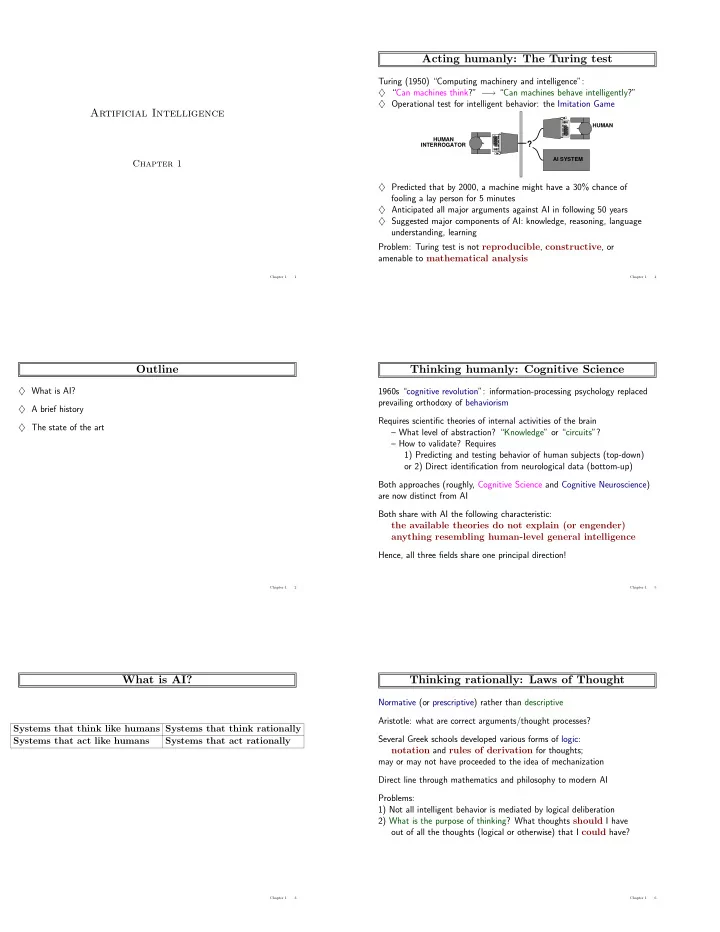
Turing (1950) “Computing machinery and intelligence”: ♦ “Can machines think?” − → “Can machines behave intelligently?” ♦ Operational test for intelligent behavior: the Imitation Game
AI SYSTEM HUMAN
?
HUMAN INTERROGATOR
♦ Predicted that by 2000, a machine might have a 30% chance of fooling a lay person for 5 minutes ♦ Anticipated all major arguments against AI in following 50 years ♦ Suggested major components of AI: knowledge, reasoning, language understanding, learning Problem: Turing test is not reproducible, constructive, or amenable to mathematical analysis
Chapter 1 4Thinking humanly: Cognitive Science
1960s “cognitive revolution”: information-processing psychology replaced prevailing orthodoxy of behaviorism Requires scientific theories of internal activities of the brain – What level of abstraction? “Knowledge” or “circuits”? – How to validate? Requires 1) Predicting and testing behavior of human subjects (top-down)
- r 2) Direct identification from neurological data (bottom-up)
Both approaches (roughly, Cognitive Science and Cognitive Neuroscience) are now distinct from AI Both share with AI the following characteristic: the available theories do not explain (or engender) anything resembling human-level general intelligence Hence, all three fields share one principal direction!
Chapter 1 5Thinking rationally: Laws of Thought
Normative (or prescriptive) rather than descriptive Aristotle: what are correct arguments/thought processes? Several Greek schools developed various forms of logic: notation and rules of derivation for thoughts; may or may not have proceeded to the idea of mechanization Direct line through mathematics and philosophy to modern AI Problems: 1) Not all intelligent behavior is mediated by logical deliberation 2) What is the purpose of thinking? What thoughts should I have
- ut of all the thoughts (logical or otherwise) that I could have?