John Hampton Manager, Ejection Seat Engineering Goodrich, Specialty Seating Systems
This presentation does not contain any ITAR-controlled technical data/defense services and does not contain EAR-controlled licensable technology/technical data
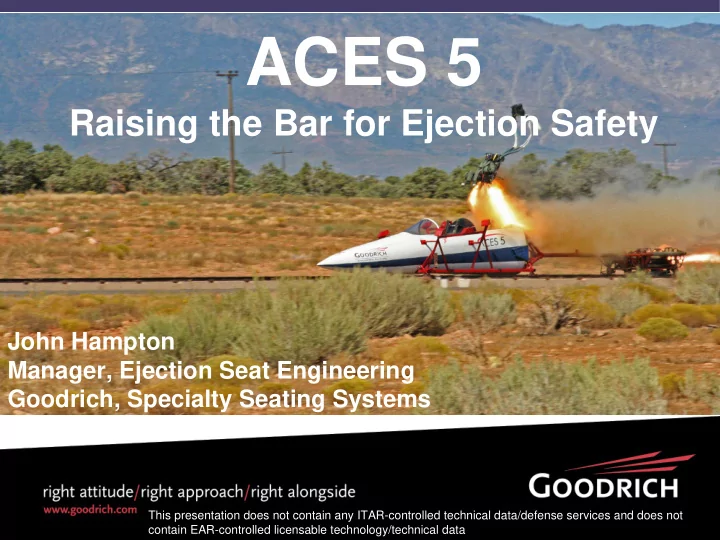
ACES 5 Raising the Bar for Ejection Safety John Hampton Manager, - - PowerPoint PPT Presentation
ACES 5 Raising the Bar for Ejection Safety John Hampton Manager, Ejection Seat Engineering Goodrich, Specialty Seating Systems This presentation does not contain any ITAR-controlled technical data/defense services and does not contain
John Hampton Manager, Ejection Seat Engineering Goodrich, Specialty Seating Systems
This presentation does not contain any ITAR-controlled technical data/defense services and does not contain EAR-controlled licensable technology/technical data
2
EJECTION SAFETY
Improved Neck Load Limits Next Gen Seat Requirements
2010
ACES 5 – Raising the Bar for Ejection Safety Head / Neck Loading
EJECTION SAFETY 103 to 245 lbs 0 to 600 KEAS Percentage of Aircrew Population at Risk of Major Neck Injury 2003 Neck Load Limits / Legacy Seat Requirements
1999 / 2003
Legacy Seats / Gen I HMDs
1990s
Timeline
3
2003 Neck Load Requirements
needed?
– Increased mass (approx 5 lbs of head supported mass) – Forward centre of gravity (CG) position (approx 2 lbs added to the front of the helmet) – Increased moment of inertia (MOI) – Degraded aerodynamic profile (longer helmet)
103 lbs 245 lbs 170 lbs 103 lbs 245 lbs 170 lbs
4
2003 Neck Load Requirements
injury, Abbreviated Injury Scale (AIS) 3 injury
& MIz moments
“Overview of Ejection Injury Criteria”, summarized in next slide
5
2003 Neck Load Requirements
Ref: Nichols JP. Overview of ejection neck injury
Association Symposium; 2006 October; Reno, NV. Creswell, OR: SAFE; 2006
Notes:
Above 450 KEAS case 6 limits apply to all aircrew sizes.
as the denominator for MIx & MIz moment indices where there is no automotive basis
6
2003 Neck Load Requirements
Requirements could be improved?
aircrew?
450 KEAS
with axial loads is not adequately covered
under predict injury in some areas
7
2003 Neck Load Requirements
Issue 1- NIC Limits above 450 KEAS
could be exposed to 761 lbs of neck tension when the short duration tension limit for the mid male is 618 lbs
lbs) could be exposed to 761 lbs of neck tension when the short duration tension limit for the small female is 414 lbs
above 450 KEAS
than 245 lbs 2003 Neck Tension Duration Limits
8
2003 Neck Load Requirements
Issue 1- NIC Limits above 450 KEAS
increases significantly after 500 lbs of tension, and at the case 6 short duration tension limit of 761 lbs the probability of a major neck injury (AIS 3+) is 86%
The latest National Highway Traffic Safety Administration (NHTSA) major neck injury probability chart for upper neck tension for the small female is shown opposite with the 2003 short duration neck tension limits for case 1 and case 6 included (Ref 1)
Ref 1: Laituri TR, Henry S, Kachnowski B, Sullivan K. A Initial Assessment of Next-Generation USA Frontal NCAP:Fidelity of Various Risk Curves for Estimating Field Injury Rates of Belted
9
2003 Neck Load Requirements
Issue 1- NIC Limits above 450 KEAS
10
2003 Neck Load Requirements
Issue 1- NIC Limits above 450 KEAS
limits between case 6 and smaller aircrew is more pronounced when axial loads are combined with the flexion / extension moments as part of the Nij injury criteria
limit difference between case 1 and case 6 is double, the moments limits are almost triple Case 6 limits present a high risk of major neck injury to smaller aircrew
11
2003 Neck Load Requirements
Issue 1- NIC Limits above 450 KEAS
Issue 1 Summary
neck loading limits should extend to 600 KEAS for all aircrew and not degrade to case 6 limits above 450 KEAS
12
2003 Neck Load Requirements
Issue 2- Out of Position
the 2003 requirements
misaligned relative to the spine with Mx or Mz moments, e.g. head displaced to the side and interacting with a head restraint system
OOP condition has the potential for much higher off axis Mx & Mz moments than with legacy seats
reduced with increasing flexion and extension (My) moments
tension and off-axis moments, Mx & Mz, but the same principal does apply, i.e. if the neck is not aligned with the spine then its ability to withstand tensile and compression loads is reduced
13
2003 Neck Load Requirements
Issue 2- Out of Position
roll moments (UN Mx) are plotted against axial loads (UN Fz), the measured loads do not exceed the current 2003 neck injury criteria, i.e. it is below the short duration tension limit and the UN MIx limit
criteria were to be used with the UN My moments replaced with the UN Mx roll moments, then the load in this example would clearly exceed an Nij (Mx) of 0.5
* Note: Data scaled from a real test to illustrate issue
14
2003 Neck Load Requirements
Issue 2- Out of Position
from side impact air bags, it was proposed to use a modified Nij criteria which combines the Mx & My moments (Ref 1) as both together reduce the ability of the neck to withstand tensile loads
the risk of neck injury it is proposed to combine all the moments in a modified Nij criteria, while maintaining the current limit of 0.5 for the upper neck
current lower neck MIz limit is 1.0
Ref 1: SM Duma, JR Crandall, WD Pilkey, K Seki and T Akoi. Dynamic Response of the Hybrid III three year old dummy head and neck during side air bag loading. Proceedings of the Institution of Mechanical Engineers, Journal of Automobile Engineering, Volume 213, part D, 1999.
15
2003 Neck Load Requirements
Issue 2- Out of Position
Issue 2 Summary
be applied that includes the off axis moments that
2003 requirements associated with the combination of axial loads and off axis moments
would be the modified Nij criteria with a limit of 0.5 for the upper neck and 1.0 for the lower neck
16
2003 Neck Load Requirements
New Research
research and testing going on looking at injuries and new injury limits in the automotive world as well as in the military world
definition of neck load limits in some of the areas where there was no automotive background and no injury basis in the 2003 requirements
that would highlight areas where the current 2003 requirements are in question
17
2003 Neck Load Requirements
New Research
Federal Aviation Administration (FAA) is looking at developing a side impact neck injury criteria
loads when there is an applied lateral bending moment, Ref 1
associated with off axis moments and the need for a new criteria to adequately cover an acceptable risk of neck injury
Ref 1: Joseph Pellettiere, Richard DeWeeese and Allan Abramowitz. Side Facing Aircraft Seat Research Summary. Federal Aviation Administration.
18
Improved Neck Load Requirements
Safe Escape for all Aircrew out to 600 KEAS
Improved Neck Load Requirements
aircrew sizes and weights
0.5 for the upper neck and 1.0 for the lower neck to replace the current Nij, MIx & MIz injury criteria
Significantly reduced risk of neck injury for all aircrew at all ejection speeds
19
ACES 5 – Raising the Bar for Ejection Safety Head / Neck Loading Performance
20
ACES 5 – Raising the Bar for Ejection Safety
21
ACES 5 – Raising the Bar for Ejection Safety Head / Neck Loading
EJECTION SAFETY
Improved Neck Load Limits Next Gen Seat Requirements
2010
EJECTION SAFETY 103 to 245 lbs 0 to 600 KEAS Percentage of Aircrew Population at Risk of Major Neck Injury 2003 Neck Load Limits / Legacy Seat Requirements
1999 / 2003
Legacy Seats / Gen I HMDs
1990s
Timeline