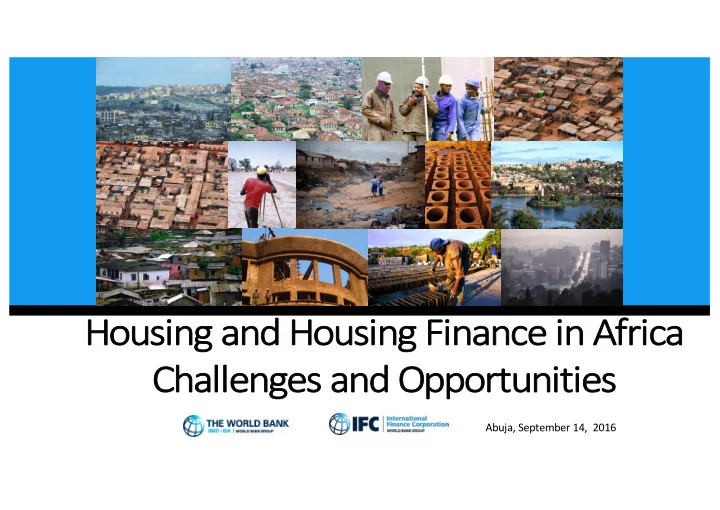
Abuja, September 14, 2016
Abuja, September 14, 2016 Africas chronic housing crisis: - - PowerPoint PPT Presentation
Abuja, September 14, 2016 Africas chronic housing crisis: challenges and opportunities Growing demand from countries and commitments for reform Large impact on Growing slum employment and growth Low & informal incomes population 5
Africa’s chronic housing crisis: challenges and opportunities
2
Low & informal incomes
live on less than $2 per day
70%
Ample room to improve access to finance
with no access to formal housing finance products
94%
Rapid urbanization
countries in SSA will double their urban populations in less than 20 years
25
Growing middle class
number of people consuming $4 to $20 per day, from 1980 to 2010
2x
128 million households by 2020
Tenure Insecurity
- f urban land in
Cameroon is held without title
70%
Large impact on employment and growth
jobs created per housing unit built
5
Growing slum population
- f SSA urban
residents live in slums, and growing
62%
High construction costs
per m2 of affordable housing in SSA, vs. $350/m2 in India, $250/m2 in China
$700
Housing contributes to wealth
- f all tangible
assets in housing
50%
Growing demand from countries and commitments for reform
Dynamics in housing sector create opportunities but also face challenges
3
Growing demand from countries and commitments for reform
Growth of Cities
cities of 500k+ population in 2030 564 cities in 1990
1,393
Ample room to improve access to finance
- f adults have no access
to formal housing finance
93%
Large impact on growth and employment
jobs created per housing unit built
5
Contribution to wealth
- f tangible
assets in housing
50%
Growing middle class
consumers expected to join global middle class by 2030 bringing it to 5 billion
3
billion High GHG impact
- f the world’s greenhouse
gas emissions from buildings.
19 %
Housing represents 3/4 of all new buildings
Low & informal incomes
in low-income countries live
- n less than $2 per day
74%
Tenure Insecurity
- f land in emerging
economies unregistered
70%
Growing slum population
urban residents live in slums, and growing
863
million
Housing Needs
housing units per day required through 2030
96,150
4 Source: McKinsey Analysis Value of affordable housing shortage, 2012, $ Billions
High Shortage and market attractiveness Developed market, redevelopment
- pportunity
Other emerging market opportunity
Affordable Housing is a Global Economic Opportunity
Mexico
$122b
South Africa
$69b
India
$67b
Brazil
$57b
Iran
$55b China $55b Turkey
$43b
Saudi Arabia
$36b
Nigeria
$28b
Egypt
$27b
Argentina
$25b
Russia
$23b
Vietnam
$19b
Iraq
$12b
Philippines
$12b Pakistan
$7b 5
Value of accumulated affordable housing shortage (2012)
Source: McKinsey Global Institute Analysis
Top 16 markets account for ~35 million units, representing an effective and realizable formal market
- f $600-700 billion
Affordable housing: challenges and opportunities
Background – estimated growth of middle class, in mio. people (from 2009 to 2030)
664 322 181 313 680 338 32 525 3,228 105 107 234 North America Central and South America Sub-Saharan Africa North Africa and Middle East Europe Asia-Pacific 2009 2030
Source: UN, World Bank, Brookings Institutions, FT
6
The opportunity – current trends in housing finance
Rising housing consumption Increasing urbanization Growing middle-class Growing populations
- More pollution and congestion in cities
- More green house gas emissions
- More disasters
- Rise in informal settlements
7
upper incom e lower income middl e incom e
8
The overall approach: reform and invest across housing value chain
Menu of WBG interventions Vital to reform structures and catalyze markets to achieve goals
Improve city planning, building regulations, and access to land Expand access to housing finance Invest in basic pro-poor infrastructure and slum upgrading Strengthen residential rental markets
1 2 3
Promote affordable housing Enhance access to microfinance Enhance access to mortgages, construction finance
Boost housing demand through access to finance Reduce formal housing costs
Sector interventions in regulations, planning, construction and land Strengthen local construction & building materials sectors; support private housing development
5 4
9
City Planning & Building Regulations Access to Land Infrastructure & Services End-user Finance Construction & Building Materials Sectors Subsidies Developer Finance Urban Finance & Markets IFC
A comprehensive value-chain approach
The WBG is uniquely positioned to reach across the value chain
Housing Finance Programmatic Strategy Approach
Building Viable Housing Finance Markets in African Economies
- 2. Investment
- 1. Technical
Assistance and Information Building
Builders, constr. materials
The Housing Value Chain
Supply Side Demand Side Building Affordable and Decent Quality Housing Units Increasing Access to Affordable Housing Finance
Land and Infrastructure Construction Primary financing markets Secondary financing markets
GOVERNMENT
- DEV. PARTNERS
BUILDERS BANKS BANKS MFiS CAPITAL MARKETS CONSTRUCTION MATERIALS
Materials
COUNTRY HOUSING MARKET ASSESSMENT FRAMEWORK
Suppl Supply and nd Demand nd an anal alysi sis
Housing Supply analysis
- Current housing production modes
- Current Housing volumes
- Cost Structure
- Construction material partners – Which countries is
Lafarge working in?
- Market situation
- Near to medium term opportunities
Suppl Supply and nd Demand nd an anal alysi sis
Housing Demand analysis
- Affordability - Household income data
- How many households can make payment on a $25k or
$35k unit
- How many households can make payment on a micro
loan for $500 to $3,500
- Rental market data analysis
- Informal Construction market – Evaluate incremental
construction market
- Production modes & volumes
- Cost Structure
- Market Situation
- Near to medium term opportunities
Leg egal en environmen ent a t and Fi Financing
- Housing legal environment
- Analysis of title & mortgage registration: existence and adequacy
- Doing business tables/updates
- Local analyst reports
- Assessment of Contract enforcement practices: courts
- Financing Capabilities and options
- Map lenders: Active/Pipeline/Interested
- Potential employers/development sponsors
- Map MFIs with capital, larger client base, already doing Housing
Microfinance
- Assess potential pipeline investments (Equity, Debt)
REMOVE HOUSING MARKET CONSTRAINTS
Legal and Regulatory reforms Market Structure Support Financial Market Assistance
REMOVE HOUSING MARKET CONSTRAINTS
Legal and Regulatory reforms
- Rationalizing the formalization process of customary rights to facilitate access to
land
- Enhancing the capacity of the land administration, starting with the support of its
- computerization. In exchange for this assistance, registration charges could be
lowered
- Enhancing title & mortgage registration processes: tenure, property and pledge
registries automation and transparency
- Training the judiciary, and particularly the new commercial courts, to create
awareness of the importance of a well-functioning mortgage enforcement mechanism.
- Enacting a Condominium and sectional title law to encourage multi-family homes
- Strengthen debt recovery and enforcement laws (foreclosure and eviction
regulations on loans secured by real estate)
REMOVE HOUSING MARKET CONSTRAINTS
Market Structure Support
- Strengthen the developers’ industry, including land developers
- Support the construction materials industry
- Organize Real Estate Agents around a federation
- Reinforce Appraisers valuation capabilities and standards
- Provide and publish databases of house sales prices, and valuations
REMOVE HOUSING MARKET CONSTRAINTS
Financial Market Assistance
- Structure guarantee schemes for the informal sector households
- Strengthen and encourage MFIs to enter the housing finance space
- Leverage regional bond issuance to build a yield curve to price against
- Work with the Central Bank to monitor the effective implementation
- f Basel1, and progress towards Basel2
- Support the reduction of capital requirements for mortgages
- Reinforce Banks’ asset/liability management (ALM)
- Create enabling regulations for secondary markets
20
§ Lower the cost and price of affordable housing § Scale up local industries, improve techniques
- Builders in Nigeria and Kenya construct up to 350 units at time, compared to 2,000
to 5,000 in China, India, Mexico
- Industrial production methods are faster, cheaper, higher quality
- Invest in local builders, projects, team them with efficient international firms
- Climate change: invest in low energy building materials & methods
§ Support private developers and large scale housing projects
- As scale increases, builders better able to move down market
§ Reduce the cost of materials
- Material costs are very high in Africa compared to China, India, Turkey or CIS: 35%
premium on structural steel, up to 400% on cement
- Invest in local producers to reduce supply & demand gaps, improve efficiency of local
production
- Huge impact for low income incremental self-builders
Invest in construction, building materials & private housing development
Current IFC Partners
§ Make mortgage markets affordable
- WB improves the legal & regulatory framework
- IFC provides refinancing to banks (Kenya, Rwanda, Uganda)
- IFC invests equity in new lenders
- Advisory services (ex: IFC mortgage toolkit)
- Climate change: financing for energy efficiency housing (EDGE)
§ Expand Housing Microfinance
- Small loans for home improvement and self-construction: potential scaling up
through MFIs, savings cooperatives
- IFC investments, Advisory Services (e.g., MoU with Lafarge)
- WB support to HMF Funds, regulatory reforms
§ Expand capital markets
- WB supports liquidity facilities which issue bonds (Nigeria, Tanz.)
- IFC Treasury supports bond markets with local currency issues
- Future: risk-sharing guarantees, enhancement to private bonds
§ Other solutions for informal/lower income HH
- Rental finance, credit risk sharing, contractual savings, rent-to-buy
§ Refocus government interventions
- Restructure failing housing banks / funds / agencies
- Consolidate a few successes (BHS Senegal, NHC Tanzania)
- Support appropriate and targeted subsidy policies
21
Expand Access to Housing Finance
Current WBG Partners
Examples of how IFC helped lenders to grow in sustainable and profitable manner
- Afghanistan
- Morocco
- India
- Albania
22
- Loan Amount: $200 - $4000
- Loan Duration: 6 to 24
Months
- Interest Rate: 2.08% per
month, declining
- Product Eligibility:
- Businessman/women –
employees
- Collateral:
- Personal guarantor
Fi First Microf
- finan
ance Ban ank of
- f Afghan
anistan an – fe features of housing lo loan pr produc duct
23
Morocco: another example of successful WBG interventions
üReleased public land üUnified building code, relaxed planning regulations üModernized rental law (to reduce vacancies) üIncentivized private developers into affordable housing üBoosted retail mortgage markets: competitive, affordable üPublic guarantee fund: >100,000 informal income households have accessed residential mortgage finance üMicro-finance institutions authorized to lend for housing üSlum upgrading program (VSB), financed with a tax on cement, including cost sharing and city contracts
24
Aadhar Housing Finance Company, India. A leader in advancing access
- f affordable segment to housing
- Aadhar Housing Finance Ltd. is specialized housing finance lender
- Focus on customers with low salaries or self-employed with informal
incomes
- Focus on business operations in poorer states of India
Source: Aadhar
25
Aadhar has outperformed market since start of its business operations in 2010 due to specialization on affordable segment and rigorous underwriting and servicing process
Aadhar Market CAGR 184% 120% ROE 15% 21% Gross NPA 0.50% 0.73%
Performance comparison FY 2016
- Aadhar operates in 13 states and serves about 29,000 customers
- Loan portfolio outstanding (03/2016): $273.5m
- Average loan size is $13,380
- Customers earn between $900 - $3,600 annually.
26
IFC initiated market for energy efficiency (EE) loans in Albania
- 2 Microfinance Institutions and 2 banks
joined the program
- Continuous adherence to loan standards
has contributed to low non-performing loan ratios (NPL): 1.6% for EE loans versus 8% for consumer loans
- Surge in demand for EE loans: 4,900 loans
worth $20m (June 2015)
27
Annex – Tools IFC Advisory Services
28
IFC’s Global Mortgage Toolkit: focus on all areas of the value lending chain in housing finance
29
IFC’s Housing Microfinance (HMF) Toolkit – guide for product development and operations Structure of HMF Toolkit:
- Market assessment plan
- Strategy formulation and business plan
preparation
- Product (including shariah-compliant HMF
products)
- Sales and outreach
- Processing and servicing of HMF loans
- Construction technical assistance program
- Risk management and funding
- Training programs for staff and managers
30
Co Conclusion: Ho Housing and Ho Housing Finance in Africa offers num numerous us
- p
- ppor
- rtunities for
- r investment
31
Source: Charlottine’s Pics
- Current conditions in many
emerging markets create unrivalled opportunities
- This is good for households,
construction industry, financial sector and economy
- Housing finance is long-term
commitment & enabling environment is key
- Critical is mix of investment
and advisory services to achieve sustainable
- perations and increase
affordability
32
IFC Housing Finance Investing For Impact! www.ifc.org/housing
Thierno-Habib HANN
Senior Housing Finance Regional Lead Sub-Saharan Africa Financial Institutions Group International Finance Corporation www.ifc.org
- Tel. +1 202 725 9805
+254 712 803 459 E-mail: thann@ifc.org
32