Abstracts - Final Project Presentations School of Communication - - PDF document

abstracts final project presentations school of
SMART_READER_LITE
LIVE PREVIEW

Abstracts - Final Project Presentations School of Communication - - PDF document

Abstracts - Final Project Presentations School of Communication Sciences and Disorders Wednesday, December 5, 2018 Collaborative Health Education Building, 5793 University Avenue Oral Presentations: CHEB 140/150 9:30am 12:00pm The Use of


slide-1
SLIDE 1

Abstracts - Final Project Presentations School of Communication Sciences and Disorders

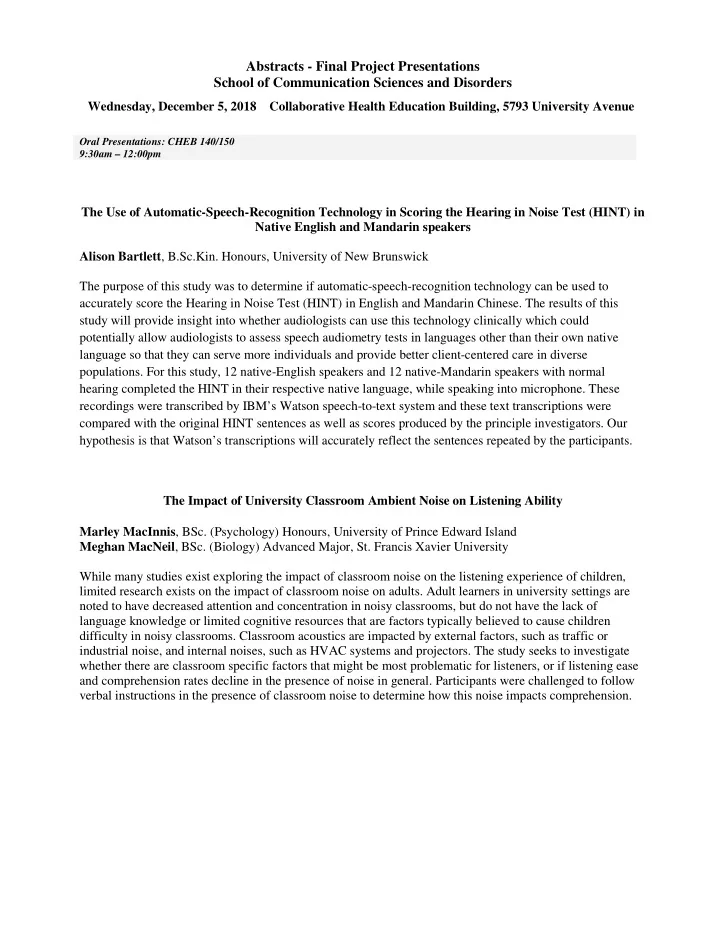
Wednesday, December 5, 2018 Collaborative Health Education Building, 5793 University Avenue The Use of Automatic-Speech-Recognition Technology in Scoring the Hearing in Noise Test (HINT) in Native English and Mandarin speakers Alison Bartlett, B.Sc.Kin. Honours, University of New Brunswick The purpose of this study was to determine if automatic-speech-recognition technology can be used to accurately score the Hearing in Noise Test (HINT) in English and Mandarin Chinese. The results of this study will provide insight into whether audiologists can use this technology clinically which could potentially allow audiologists to assess speech audiometry tests in languages other than their own native language so that they can serve more individuals and provide better client-centered care in diverse

  • populations. For this study, 12 native-English speakers and 12 native-Mandarin speakers with normal

hearing completed the HINT in their respective native language, while speaking into microphone. These recordings were transcribed by IBM’s Watson speech-to-text system and these text transcriptions were compared with the original HINT sentences as well as scores produced by the principle investigators. Our hypothesis is that Watson’s transcriptions will accurately reflect the sentences repeated by the participants. The Impact of University Classroom Ambient Noise on Listening Ability Marley MacInnis, BSc. (Psychology) Honours, University of Prince Edward Island Meghan MacNeil, BSc. (Biology) Advanced Major, St. Francis Xavier University While many studies exist exploring the impact of classroom noise on the listening experience of children, limited research exists on the impact of classroom noise on adults. Adult learners in university settings are noted to have decreased attention and concentration in noisy classrooms, but do not have the lack of language knowledge or limited cognitive resources that are factors typically believed to cause children difficulty in noisy classrooms. Classroom acoustics are impacted by external factors, such as traffic or industrial noise, and internal noises, such as HVAC systems and projectors. The study seeks to investigate whether there are classroom specific factors that might be most problematic for listeners, or if listening ease and comprehension rates decline in the presence of noise in general. Participants were challenged to follow verbal instructions in the presence of classroom noise to determine how this noise impacts comprehension.

Oral Presentations: CHEB 140/150 9:30am – 12:00pm

slide-2
SLIDE 2

Investigating the Missing Letter Effect in Individuals with Aphasia Katie Hill, BA (Psychology), St. Thomas University Katie Lund, BSc (Biology), Mount Allison University Chelsea Dahlgren, BSc (Psychology) Honours, Queen’s University Jasmin Heim, BA (Psychology) Honours, St. Thomas University Kayla Gauley, BA (Linguistics) Honours, Queen’s University Purpose: When asked to read a text for comprehension while marking all instances of a specific letter, typical readers will miss some letters in a systematic way known as the Missing Letter Effect (MLE). For example, the target letter “t” is more likely to be missed in a function word (e.g., “the”) than in a content word (e.g., “toe”). This effect has been studied extensively in normal readers and MLE magnitude is positively related to reading skill. We examined the MLE in people with aphasia in whom reading difficulties are common.Method: The MLE was evaluated in 5 individuals with aphasia and 5 matched

  • controls. Aphasia type, severity and reading level were assessed using a battery of standardized tests.

Results & Discussion: The MLE results and relationship to aphasia characteristics will be presented. Our findings may help us to better understand reading in aphasia as well as have clinical implications. Examining diversity and Inclusion in the Curriculum and Climate at the School of Communication Sciences and Disorders Dashiel Brockman, BA (English Literature) Honours, Concordia University (Montréal) Robin Kroeker, BA (English Literature), University of Victoria Clinicians and students in Speech-Language Pathology and Audiology need to develop, advocate for, and foster knowledge and competency of cultural and linguistic diversity to meet the evolving demographics in Canada. The current study examines the curriculum and climate regarding cultural competence and safety at the Dalhousie School of Communication Sciences and Disorders (SCSD). Current students, staff, sessional lecturers, and faculty at the SCSD comprise the participant groups of the

  • study. Data will be collected via qualitative online questionnaires. The intention is that results will provide

baseline evidence to support action plans at the school designed to improve curriculum and climate. These plans will ultimately help to cultivate more culturally competent future clinicians for the professions of Speech-Language Pathology and Audiology.

slide-3
SLIDE 3

Investigating Release From Familiar Maskers Mitchel Frith, BA (French), Dalhousie University Remington Shandro, BSc (Psychology), University of Alberta In this study, we investigated the impact of familiar noise on speech understanding in competing

  • noise. For example, it is known that it is easier to understand speech when the competing noise is familiar.

This effect has been observed when the competing noise is a random multi-talker babble, such as the sound generated by a crowd of people talking all at once (Felty et. al, 2009). The effect has also been observed when the competing noise is a repeated white noise (Langhans & Kohlrausch, 1992) as well as a familiar speaker (Johnsrude et al., 2013). The phenomenon works both ways to the effect that familiarity with the voice of the target speaker can also facilitate speech understanding when there is competing sound (Johnsrude, 2016). Therefore, since it is known that listeners show evidence of learning even randomly generated noises when there is a degree of familiarity, speech tests in audiometry typically use different competing noises for each item on a test when testing a listener's speech reception in noise. In this study we investigated the impact of repeated noise in speech-in-noise testing. Participants completed the Hearing In Noise Test (HINT) in the control condition with a different noise track played for each trial as well as the HINT in a test condition with the same noise track played for each trial. Early results indicate that participants perform better in the test condition, suggesting that the brain is capable of learning short noise samples rapidly and effectively, reducing the effect of masking from such noise. Exploring Caregivers’ Communication with People with Dementia in Long-term Care: An Appreciative Inquiry Montgomery Kathryn Boone, BA (English & Psychology Honours), University of New Brunswick Saint John Erika Marguerite Sanderson, BA (Psychology) Honours, Mount Allison University Kristen Diane Smith, BSc (Biology) Honours, Dalhousie University Paige Hannah Zwicker, BSc (Psychology with Neuroscience), Acadia University This qualitative study used Appreciative Inquiry to begin to explore the awareness and perceptions of caregivers of residents with dementia in long-term care regarding use of external memory and communication aids, and to explore ideas around the implementation of memory and communication aids. Appreciative Inquiry is an approach used to look at what is working and to build on strengths within an

  • rganization (Hammond, 2013). This study is the first phase in investigating the communication strategies

that are being used to support communication and functioning in persons with dementia living in two private long-term care facilities in Halifax. Participants included administrators/managers, and family and staff caregivers of persons with dementia. Appreciative Inquiry procedures were used to collect focus group data about perceptions and experiences of participants regarding communicating with people with dementia. Qualitative analyses were used to explore emergent themes, including: positive body language, visual supports, familiarity and relationships, beliefs, education and training, music, and humor. These themes provide insight into strategies that are currently being used to communicate with people with dementia, as well as other issues that impact their experiences. These results can be used in the next phase of the study to develop training and supports for caregivers so that they can use more effective communication strategies with persons with dementia.

slide-4
SLIDE 4

A Seven Year Case Report of Wernicke's Aphasia Post-Encephalitis Jaclyn Kirstiuk, BA (Psychology), McGill University Andrea Power, BSc Honours (Behavioural Neuroscience), Memorial University of Newfoundland This unique longitudinal case report follows the communication abilities of a woman with Wernicke’s aphasia post herpes simplex viral encephalitis (HSVE). She was followed for seven years, beginning at 13 months post-onset, in conjunction with six periods of intensive communication therapy. Consistent and marked gains in impairment-based and functionally-based measures were observed, as well as in day-to-day

  • functioning. We contribute to the limited research on aphasia post-HSVE, showing the capacity for dramatic

improvements up to eight years post-onset. Findings suggest that intensive therapy can improve both linguistic ability and functional communication in Wernicke’s aphasia. Longitudinal Overview of Treatment Outcomes for Clients who Attended Multiple InteRACT Programs Danielle Scholten, BSc (Medicinal Chemistry) Honours, University of New Brunswick Daniel Hammill, BMus Honours, Western University Adina Jones, BA (Psychology) High Honours, University of Regina This study explored longitudinal outcomes for 29 participants who attended two or more terms of InteRACT (intensive rehabilitation for aphasia). We analyzed scores on impairment-based and functional communication measures with the following objectives: (1) examine patterns of longitudinal outcomes within and across individuals, and (2) explore whether any associations could be observed between specific participant variables at the outset of treatment (participant age, aphasia chronicity, severity and/or type) and clinically significant and/or marked gains/losses across terms. We found that 13/23 participants made clinically significant impairment-based gains over 2 or more terms, and 10/29 participants made marked functional communication gains over 2 or more terms. Further, participant age, chronicity, and type or severity of aphasia appeared not to be associated with greater gains on either outcome measure. These results suggest that some clients, regardless of their age or aphasia profile, can continue to make functional, as well as impairment-based gains during the chronic period of aphasia recovery by attending multiple terms of intensive therapy. An Intervention for Speech Intelligibility in Adults with Down Syndrome Sarah Anthony, B.A. (Linguistics), University of Victoria Madeleine Léger, B.A. (Psychology) Honours, Université de Moncton Melissa Spence, B.A. (Psychology) Honours, Laurentian University Poor intelligibility can adversely affect adults with Down syndrome and speech therapy programs are often

  • unavailable. Thus, there is a need to study intelligibility interventions for this population. This study

investigated a six-week, twice weekly intelligibility intervention for three adults with DS. Intervention focused on the implementation of a compensatory strategy (“slow and clear”) to increase intelligibility.

Buffet Lunch & Clinician Appreciation – CHEB 170 12:00pm – 2:00pm Poster Presentations – CHEB 170 2:00pm – 3:30pm

slide-5
SLIDE 5

Progress was monitored using pre-, post- and follow-up testing and weekly probes. Results demonstrate that six weeks of intervention can lead to improvements in articulation accuracy, overall intelligibility, and use of a targeted strategy in adults with DS. Interventions consisting of awareness training combined with focused articulation therapy can be effective in raising overall metalinguistic awareness and the ability to identify and repair communication breakdowns. The results underline the practical importance of providing therapy to this underserved population. From Hearing Screenings to Hearing Tests: Do Patient Education Materials (PEMs) that Meet Readability Guidelines Make a Difference? Saidah Adisa, BSc (Psychology, Honours), Concordia University Heather Collins, BA (Psychology), Memorial University of Newfoundland Mehak Sidhu, BSc (Biology and Psychology), University of Western Ontario Previous research has found most written health materials for patients do not follow appropriate reading guidelines and are related to reduced compliance to clinicians' recommendations. Objective: To determine if pamphlets that follow readability guidelines will impact older adults’ compliance to audiological

  • recommendations. Methods: Phase 1: A focus group will be conducted with professionals dispensing hearing

aids, experienced hearing aid users, and a graphic designer to gather opinions on the design of a new pamphlet to be given following hearing screenings. Phase 2: Conduct hearing screenings at senior living

  • centers. Participants who need a referral to audiology will be randomly assigned to one of 3 groups: newly

designed pamphlet, currently available pamphlet that does not meet readability guidelines, or no pamphlet. Hypothesis: Recipients of the new pamphlet will be more likely to visit an audiologist than participants who receive pamphlets that do not meet readability guidelines or who receive no pamphlet. Auditory Nerve Model Verification in Adults with Normal Hearing Sylvia Ciechanowski, B.Sc. (Biological Science) Honours, University of Guelph Chantal Belanger, B.Sc. (Psychology, Neuroscience and Behaviour, with Music Cognition Specialization) Honours, McMaster University Laura Richardson, B.Sc. (Honours Specialization in Biology), University of Western Ontario Karen Lenehan, M.Sc. Exercise & Sport Science (Sport Psychology), B.Sc. (Kinesiology) Honours, Univeristy of New Brunswick Models of the auditory system can be used to predict how different types of auditory damage affects hearing. We hypothesized that ear-canal assessment provides a better estimate of auditory nerve function than standard scalp electrodes, which was then verified by comparing responses to model-predicted auditory nerve responses. We also hypothesized that subject-normalized responses will be less variable than non- normalized responses, allowing for a better prediction of underlying nerve function. Responses were averaged and spectrally analyzed using MATLAB (The Mathworks) and response amplitudes were extracted at each modulation frequency (following a Fast Fourier Transform) as a function of stimulus carrier frequency, level and modulation depth. Each response was tested for significance using an F-test for hidden periodicity (in MATLAB). The results of this study will help us understand the value of this model for developing stimuli for auditory assessment, and to inform possible model improvements to improve predictive accuracy.

slide-6
SLIDE 6

Cochlear Synaptopathy Induced by Low-Level Noise Exposure in an Animal Model, and Corresponding Noise-Induced Hidden Hearing Loss in Humans Alex MacAulay, BSc (Psychology) Honours, Acadia University James (Jake) MacPherson, BSc, St. Francis Xavier University Scott McGinley, BSc Honours, University of Waterloo Vincent Chow, BSc (Kinesiology) Honours, McMaster University Animal studies have demonstrated that a single brief noise exposure at the highest possible sound level that does not cause a permanent threshold shift can produce massive synapse loss. Researchers have speculated that such synaptic loss may result in coding-in-noise deficits (CIND), but this theory has not been verified with robust evidence. The proposed study will examine whether a similar loss can be induced with repeated lower level (85 dB SPL) noise exposures, where the summed energy is equivalent to the single noise dose used in prior studies. Potential CIND will be evaluated by measuring cochlear and scalp recorded responses to amplitude modulation signals in combination with masking. Coding-in-noise ability will also be compared behaviorally and electrophysiologically across human subjects with and without extensive histories of noise exposure (e.g., in noisy bars). Results are expected to show less synaptic loss, which may not be accompanied with significant CIND. Mutual Learning about Speech and Language Development: Conversations between L'nu Speaking Senior University Students and Non-L'nu Speech Language Pathology Students Libbie Alex (Cape Breton University) Susy Denny (Cape Breton University) Stacey Ernst (Dalhousie University) Astrid Johnston (Dalhousie University) Samantha Lenahan (Dalhousie University) Using an Indigenous methodology, three Dalhousie University students and two-to-three L’nu speaking Cape Breton University students had three conversations to describe the similarities and differences in speech and language development between L’nu and Non-L’nu communities. Little research has compared Indigenous and non-Indigenous perspectives on language development (Jonk & Enns, 2009; Ball & Lewis, 2014; Crago & Pesco, 2008). Current research highlights a disconnect between professionals’ and Indigenous communities’ expectations of children’s language and ideas about what constitutes a language-learning problem (Ball & Bernhardt, 2008; Findlay, Kohen & Miller, 2014). Differences in language development between Indigenous and non-Indigenous communities render current speech-language pathology assessments inappropriate for use in the diverse Indigenous populations across Canada, including the Mi’kmaw (L’nu)

  • population. To provide appropriate assessment and treatment services, speech-language pathologists must

understand how L’nu children develop language, and how L’nu families use language to interact with young children and support language learning.