Abstraction: The Hardcore of Software Engineering Dewayne E Perry - - PDF document

abstraction the hardcore of software engineering
SMART_READER_LITE
LIVE PREVIEW

Abstraction: The Hardcore of Software Engineering Dewayne E Perry - - PDF document

Abstraction: The Hardcore of Software Engineering Dewayne E Perry Motorola Regents Chair in Software Engineering Electrical and Computer Engineering The University of Texas at Austin 1 What is Software Engineering (SE)? SE is concerned


slide-1
SLIDE 1

1

1

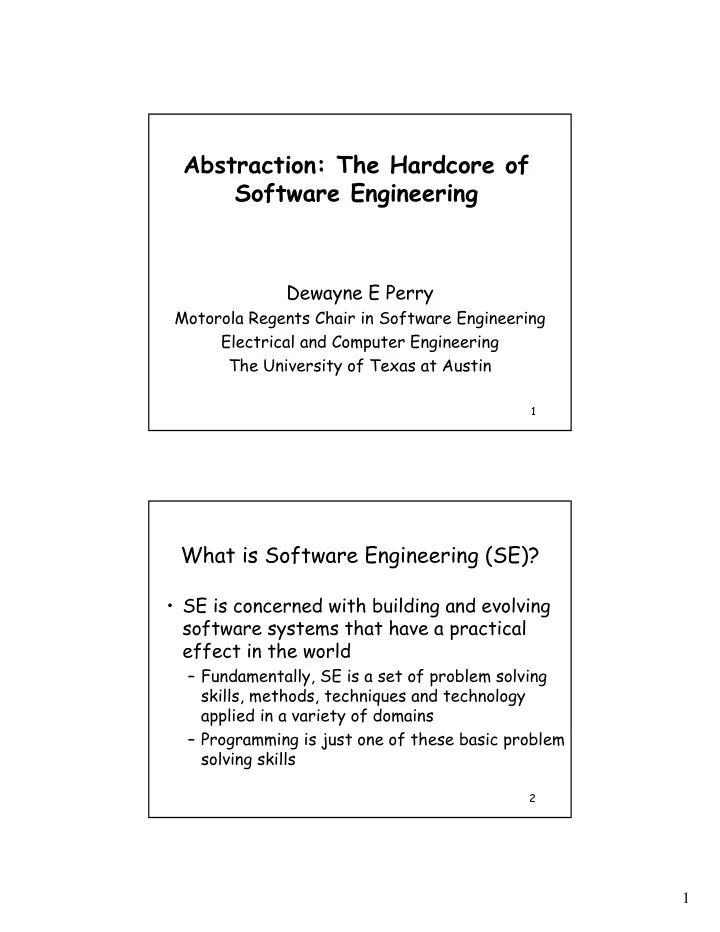
Abstraction: The Hardcore of Software Engineering

Dewayne E Perry

Motorola Regents Chair in Software Engineering Electrical and Computer Engineering The University of Texas at Austin

2

What is Software Engineering (SE)?

  • SE is concerned with building and evolving

software systems that have a practical effect in the world

– Fundamentally, SE is a set of problem solving skills, methods, techniques and technology applied in a variety of domains – Programming is just one of these basic problem solving skills

slide-2
SLIDE 2

2

3

Basic job of a Software Engineer

  • Discover, create and build/evolve

abstractions and behaviors

  • Effectively evaluate and decide among

alternative abstractions/solutions To do this we use

– Theories or models that we use or create

  • From standard well understood domains
  • For new domains we do not understand well

4

Basic job of a Software Engineer

– Experience

  • Feedback, either directly or from users
  • Experimentation, engineering or scientific

– Process

  • Problems solving methods and techniques
  • Technologies appropriate to the product and to

the methods and techniques

  • Organizational and cultural structures -
slide-3
SLIDE 3

3

5

Software Engineering Research

  • Discover, create and build new

abstractions to help software engineers

  • Evaluate the effectiveness and utility of

these abstractions for engineering software systems

  • Discover, create and evaluate effective

measures for comparing and evaluating abstractions, behaviors and solutions

6

Abstractions

  • SE, as any engineering discipline, is a

discipline of design

– Brooks’ goal: conceptual integrity of design – Abstractions are our fundamental intellectual tool for design

  • Simplification
  • Generalization
  • Codification
  • Satisficing
slide-4
SLIDE 4

4

7

Abstractions

  • For the SEs, abstractions

– Are the primary means of managing complexity – Provide basic domain specific concepts

  • For SE Researcher, abstractions

– Provide the primary means to help SEs to think about how to architect, design, build and evolve software systems – Remove accidental underbrush and simplify SW development

8

Whither Structured Programming?

  • Basic set of abstractions for programming

– Basic set of programming actions

  • Complete
  • Orthogonal

– Well defined semantics, composition and proof rules – Disciplined control flow – Static structure reflects dynamic structure – Basis for additional needed abstractions

  • Eg, separation of normal and abnormal (exceptions)
slide-5
SLIDE 5

5

9

Some Useful Abstractions

  • Problem versus solution space
  • Virtual machines
  • Product families
  • Essential versus accidental characteristics
  • Components and connectors
  • Computations versus behaviors

10

Problem vs Solution Space

  • SE’s often too focused on solutions
  • Emphasis on problem domain

– What rather than how – Problem discourse – Domain abstractions

  • In the world rather than in the machine
  • Jackson: shape of the solution should

reflect the shape of the problem

slide-6
SLIDE 6

6

11

Virtual Machines

  • Interfaces as little languages
  • Coherent and related set of abstractions
  • Layering

– with increasingly rich concepts – with increasingly higher level languages

  • Domain specific machine and language
  • Encapsulated implementations - changeable

12

Product Families

  • Parnas: Planning for change
  • Commonality vs variability
  • System as a sequence of family members

– Some parts are invariant – Some change

  • Exploit commonality to reduce maintenance
  • Basis for things to come

– Product line architecture

slide-7
SLIDE 7

7

13

Essential versus Accidental

  • Brooks: Critical distinction
  • Essential - need to be managed

– Basic facts of life

  • Accidental - need to be remedied – Eg,

– Inadequate abstractions, expressions – Inadequate modes of expression – Inadequate support and resources – Inadequate knowledge

14

Components and Connectors

  • Perry/Wolf: Logical rather physical distinction
  • Connectors represent interactions

– Communication – Coordination – Mediation

  • Components represent computations and

behaviors to be composed

  • Connectors relate and regulate the behavior of

the composed components

  • Possible: composable non-functional properties
slide-8
SLIDE 8

8

15

Computations vs Behaviors

  • Turski: critical distinction
  • Computations

– Bounded, neat problems – Underlying theory available – Admit of clean, theoretically nice solutions

  • Eg, Misra’s composition of concurrent programs
  • Behaviors

– Unbounded, messy problems – Little theory available – often make it up as we go – Harder to formally describe and reason about

16

Evaluation

  • Few agreed on measures

– Still at level of naïve art critic

  • I know what I like
  • I’ll know it when I see it

– Tend to rely on experience (anecdotal) – Poor construct validity

  • Eg, cohesion

– Little agreement on effectiveness and reliability of metrics

slide-9
SLIDE 9

9

17

Creating Effective Evaluations

  • Tends to be I have a dream paradigm
  • Too little theory to go on
  • Experimental side of SE (and CS) very immature

– Lack of understanding of basic experimental issues: design, validity, analysis – Lack of standard designs and measures

  • Virtually no replicated experiments
  • A long way to go yet

18

Conclusions

  • Abstractions and evaluations fundamental

to software engineering

  • Abstractions, evaluations and the creation
  • f effective measures fundamental to

software engineering research.

  • Doing well in the abstractions department
  • Doing poorly in the evaluations department
  • Much worse in creating effective measures