Absence of a Patients Right to Die: Physician-Assisted Suicide in - - PowerPoint PPT Presentation

absence of a patient s right to die
SMART_READER_LITE
LIVE PREVIEW

Absence of a Patients Right to Die: Physician-Assisted Suicide in - - PowerPoint PPT Presentation

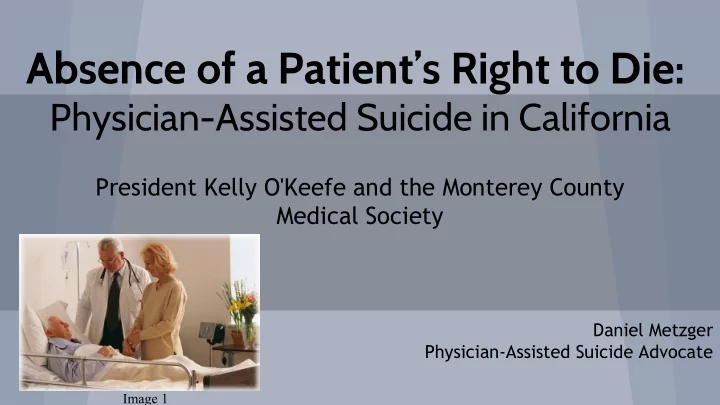
Absence of a Patients Right to Die: Physician-Assisted Suicide in California President Kelly O'Keefe and the Monterey County Medical Society Daniel Metzger Physician-Assisted Suicide Advocate Image 1 The Issue for Discussion

slide-1
SLIDE 1

Absence of a Patient’s Right to Die:

Physician-Assisted Suicide in California

President Kelly O'Keefe and the Monterey County Medical Society

Daniel Metzger Physician-Assisted Suicide Advocate

Image 1

slide-2
SLIDE 2

The Issue for Discussion

  • California is denying terminally ill patient’s

right to die

  • Patients being forced to live in pain

○ Artificially kept alive

  • Morals and personal beliefs shape opposing

arguments

Image 2

slide-3
SLIDE 3

Urgency to Consider Legalization

  • Four states have legalized PAS

○ Countries across the globe as well ○ Remaining states in US have laws prohibiting this act

  • 56% of Americans believe that a doctor should

be allowed to assist a terminally ill patient in committing suicide (Gallup Organization, 2013)

  • New freedoms being passed across US
slide-4
SLIDE 4

Why legalize?

  • Inconsistency across country
  • Patients taking matters into own hands

○ Inhumane and gruesome

  • Death is imminent
  • End of life care costs

○ Patients with terminal illnesses can spend $53,432-$105,000 in 2 years (Neuberg, 2008) ○ Family left with debt

Image 3

slide-5
SLIDE 5

Why the AMA?

  • Leading association of US doctors
  • Doctors open to idea

○ Do not want to actually perform the act themselves

(Cohen, Fihn, Boyko, Jonsen, Wood, 1994)

  • Physicians are being convicted

○ ie. Jack Kevorkian

  • Ability to make change

Image 4 Image 5

slide-6
SLIDE 6

No Reason to Worry

  • Arguments are being created out of fear

and inability to see possible change

○ Slippery slope ○ Abuse of power ○ Not a treatment option ■ Simply murder

  • Doctors can opt out

Image 6

slide-7
SLIDE 7

Difference from Current Systems

  • Laws similar to
  • nes present in

states where PAS is legal

○ More formal guidelines ○ Stricter overlook ○ Longer time frame

  • Formation of a PAS

Review Board/Council

○ Assigned to cases ○ Complete understanding of laws ○ Make decisions/approvals ○ Possible criminalization

slide-8
SLIDE 8

What you can do…

  • Be open to possible change

○ Hear both sides of issue

  • Understand logic of legal PAS

○ Step away from personal morals

  • Shift opinion on matter

○ Public announcement ■ General public’s opinion will shift

  • Slowly stop group’s anti-PAS efforts

Image 7

slide-9
SLIDE 9

Conclusions/Takeaways

  • Physician-assisted suicide must be seen as a

type of treatment

  • PAS can be easy, peaceful, and conducted by a

licensed professional who knows exactly what to do

  • Improved systems can be put in place in

California

  • Mistakes will happen, but will lead to beneficial

change

  • Logic should shape laws, not personal morals
slide-10
SLIDE 10

Images Page

Image 1: http://www.123rf.com/photo_18095126_female-and-male-doctors-standing-next-to-a-patient- in-a-hospital-bed.html Image 2: http://www.charlottenow.com/charlotte_doctors-g-12/ Image 3: http://laurenjepson111.edublogs.org/ Image 4: https://plus.google.com/+ama Image 5: http://www.cmanet.org/societies/detail/?society=monterey-county-medical-society Image 6: http://blog.megankeane.com/2013/05/29/life-lessons-in-hair-pulling-day-2/ Image 7: http://shotofprevention.com/2012/02/24/how-the-doctorparent-relationship-can-impact- immunization-decisions/

slide-11
SLIDE 11

Reference

Benatar, D. (2011). A legal right to die: responding to slippery slope and abuse arguments. US national library of medicine. 18(5) 206-207. Retrieved from http://www.ncbi.nlm.nih.gov/pmc/articles/PMC3185895/. Cohen, J., Fihn, S., Boyko, E., Jonsen, A., Wood, R. (1994). Attitudes toward assisted suicide and euthanasia among physicians in washington state. The New England journal of medicine. 89-94. Retrieved from http://www. nejm.org/doi/full/10.1056/NEJM199407143310206. Gallup Organization. (2007). Opinion polls/surveys. Retrieved from http://euthanasia.procon.org/view.resource.php?resourceID=000134. Lesser, H. (2010). Should it be legal to assist suicide? Journal of evaluation in clinical practice. 330-334. Retrieved from http://content.ebscohost.com.library2.csumb.edu: 2048/pdf23_24/pdf/2010/EV1/01Apr10/48858628.pdf? T=P&P=AN&K=48858628&S=R&D=aph&EbscoContent=dGJyMNHX8kSeqK840dvuOLCmr0ueqK5SsKu4Sq% 2BWxWXS&ContentCustomer=dGJyMOvl7Izj6OORuePfgeyx44Dt6fIA. Neuberg, G. W. (2008). The cost of end-of-life-care. American heart association. Retrieved from http://circoutcomes.ahajournals.org/content/2/2/127.full. State-by-state guide to physician-assisted suicide. ProCon.org. (2013). Retrieved from http://euthanasia.procon.org/view.resource.php?resourceID=000132.