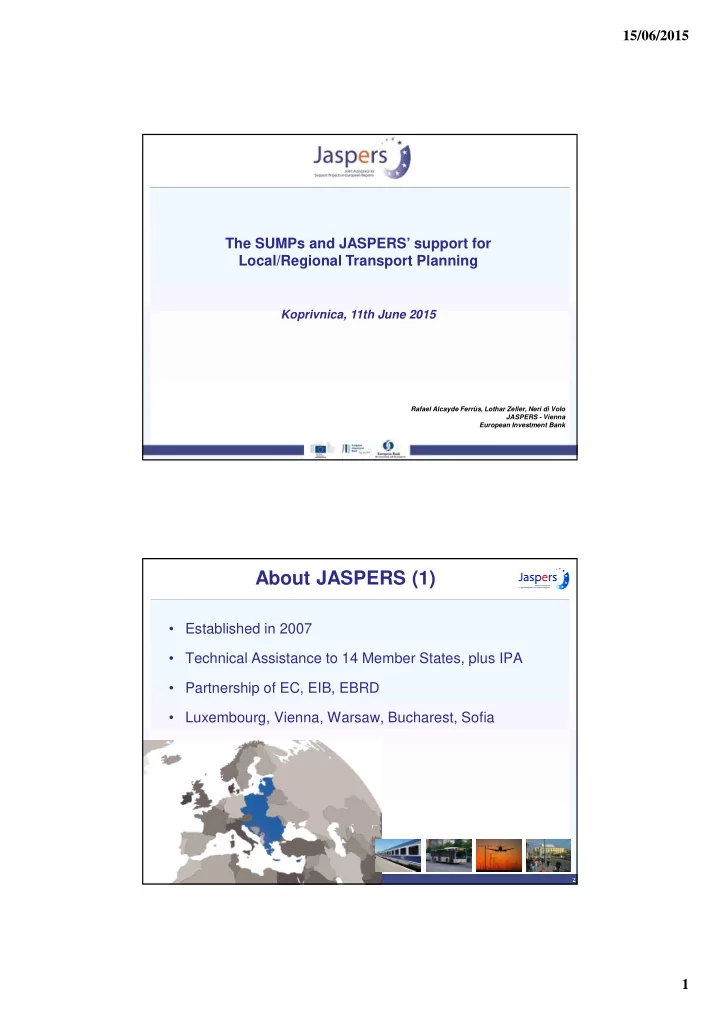
About JASPERS (1) Established in 2007 Technical Assistance to 14 - - PDF document

about jaspers 1
SMART_READER_LITE
LIVE PREVIEW

About JASPERS (1) Established in 2007 Technical Assistance to 14 - - PDF document

15/06/2015 The SUMPs and JASPERS support for Local/Regional Transport Planning Koprivnica, 11th June 2015 Rafael Alcayde Ferrs, Lothar Zeller, Neri di Volo JASPERS - Vienna European Investment Bank About JASPERS (1) Established in


slide-1
SLIDE 1

15/06/2015 1 The SUMPs and JASPERS’ support for Local/Regional Transport Planning

Koprivnica, 11th June 2015

Rafael Alcayde Ferrùs, Lothar Zeller, Neri di Volo JASPERS - Vienna European Investment Bank

About JASPERS (1)

  • Established in 2007
  • Technical Assistance to 14 Member States, plus IPA
  • Partnership of EC, EIB, EBRD
  • Luxembourg, Vienna, Warsaw, Bucharest, Sofia

2

slide-2
SLIDE 2

15/06/2015 2

About JASPERS (2)

  • Independent Technical Advice – through MAs
  • Focus on Upstream Activities
  • Centered on Cohesion Funds (ERDF, CF)
  • Future Support on Connecting Europe Facility Projects

Strategy Development Project Preparation Compliance Issues Horizontal Support

About JASPERS (3)

JASPERS ADVISORY

  • Staff of approximately 100 technical experts covering all sectors
  • Located (mainly) in Regional Offices

+

  • JASPERS now also provides Independent Quality Review Facility for

Major Projects – Located in Brussels

Roads Air, Maritime, Public Transport Energy and Solid Waste Water and Waste Water Smart Development Networking Platform & Comp. Centre Independent Quality Review

slide-3
SLIDE 3

15/06/2015 3

EU’s “SUMP” Methodology

  • High level strategic guidance
  • Accent on social dimension of mobility and planning process

Source: DG MOVE, 2014

Content

  • General planning approach and sustainability
  • Transport Plans
  • The Functional Region concept
  • How to take into account sustainability of O&M in the Plan
  • JASPERS’ possible support
slide-4
SLIDE 4

15/06/2015 4

Planning & Sustainability (1)

INCOME Revenues Subsidies OPEX Operations Maintenance CAPEX EU support National support …

How can we efficiently use EU funds to improve effectiveness and financial sustainability of our transport system ?

Planning & Sustainability (2)

Current practice: Available CAPEX -> N projects

…most of FS / Plans have a great focus on needed CAPEX -> robust analysis of investment costs etc. – not the same for OPEX

Can we afford a proper O&M of our system after the Plan / the Project ? “Someone will take care of it when the new system/project is actually put into operation…”

slide-5
SLIDE 5

15/06/2015 5

Planning & Sustainability (3)

Sustainability:

Current situation Future situation:

  • Plan level
  • Project level

Get to know your system

It all starts with an appropriate planning of our transport system and goes into the PSC PSC update of PSC

Planning & Sustainability (4)

Therefore a Transport Plan should:

  • start from the knowledge of the current situation

be based on a robust data collection and analysis

  • analyze and define measures not only in terms of infrastructure but also
  • peration and organization / institutional setup

target an effective, efficient system – provide the basis for future projects (long term commitment) …and should not simply be a (prioritized) a list of projects to meet the budget (wish-list)…

slide-6
SLIDE 6

15/06/2015 6

Transport Plans

Policies (White Book, etc.)

International/National strategies (TEN-T, NTS, National Transport Master Plan, etc.) Local/Regional Strategies (Node study, SUMP, Functional regional concept, etc.) Programming (availability of funds, preparation/implementation capacity, sustainability of O&M, etc.) Project development (Corridor assessments, general design, Territorial decisions, detailed design, EIA, Building permits, Tender dossier, procurement, implementation, etc.)

Transport Plans – Some main principles

  • Medium-long term process
  • Independent from funding
  • Covering the whole sector (inter-modality)
  • Cover organization/institutional setup and operation – not
  • nly infrastructure
  • Increase financial sustainability
  • Basis for further sector development
  • Consequence of economic and social developments
  • A continuous process
slide-7
SLIDE 7

15/06/2015 7

Transport Plans – Simple philosophy

  • Data
  • Analysis
  • Objectives
  • Measures
  • Projects

In three layers: Organization – Operation and Infrastructure Structure of a TMP - From Problems/Potentials to Strategy to Measures/Projects

Framework/set-up Specific needs, requirements, constraints, capacities, … Mapping of current situation/starting points/assumptions and Analysis Information, data, trends, opinions, … Other relevant plans and programs… Strategic/Specific analysis, problems, challenges, possibilities, developments, … Vision, Objectives, Targets From policy + Analysis Measures Measures, grouping/synergies, alternatives, comparison, integration, selection Implementation plan Implementation, funding, measure priorities/order of development, actions, evaluation

S E A

slide-8
SLIDE 8

15/06/2015 8

The Functional Region concept (1)

Road Rail Air Maritime IWW

Functional Regional Approach Sector Approach

FR1 FR2 FR3

TRANSPORT STRATEGY NATIONAL TRANSPORT STRATEGY

Incorporates the needs identified in Regional and Local planning

  • National Transport Strategy does not define the Regional and Local needs
  • Transport network cannot be planned without understanding regional and local needs

The Functional Region concept (2)

  • Homogeneous area / independent from administrative borders - border

defined by mobility relationships (e.g. within which the majority X% of commuting trips or O/Ds take place)

  • Focused on gravitational centroids
  • Defined in the National Transport Plan and based on traffic model -> can

be overlapping

  • Main reference for a transport plan -> avoid smaller towns alone
  • Outcomes of local/regional plans with national relevance -> one of the

inputs for the preparation of the National Transport Plan, complementing the national sectorial plans/analyses

  • Transport as a result of economic and social activities
  • FRC does not plan these activities
  • Adjusting the transport system to them
  • Supporting sustainable social and economic development
slide-9
SLIDE 9

15/06/2015 9

Key aspects…

  • Participation of all Stakeholders is key to coordinate planning
  • Many concepts and measures already known to the stakeholders, however

the FRC by linking the measures will improve the interfaces between them and in some cases lead to new additional measures, which will help reaching the objectives

  • The FRC will provide answers to many questions (traffic, infrastructure,
  • perations, potentials, et. ) so the following FSs will be harmonised and

more focused on technical details

  • Save time and money, as we do not need to cover everything in the FSs
  • On the basis of the justified measures, projects can be extracted for

financing and implementation

  • Reiterations – will be done again and refined (discontinuities)
  • Nothing is fixed

The Functional Region concept (3)

Public Transport O&M analysis and the Transport Plan

This analysis is not an addendum/a follow up but a fundamental part of the Plan

How to take into account sustainability of O&M in the Plan (1)

slide-10
SLIDE 10

15/06/2015 10

  • Avoid mistakes from the past (lack of funding and organisation to

properly maintain the network)

  • Provide technical and financial constraints for the development of

measures within the Transport Plan

  • Identify the actual O&M cost of proposed measures/projects
  • Identify the needed reorganisation of the transport system following the

introduction of certain measures/projects in order to guarantee an optimal use of the network and financial sustainability

  • Identify measures to make PT more effective and efficient
  • Provide data to define/update the PSC (e.g. production, etc.)

How to take into account sustainability of O&M in the Plan (2)

PSC:

  • Not a mere administrative document
  • Technical tool to guarantee sustainability of the transport

system -> transparency for Public Administration and operator

  • Needs transport data for its performance parameters:

– Production, service modulation – Service availability, reliability – Quality parameters – Compensation, penalties, fares – …

  • Need to update the PSC after the implementation of a Plan / a

Project

How to take into account sustainability of O&M in the Plan (3)

slide-11
SLIDE 11

15/06/2015 11

JASPERS’ possible contribution (1)

  • Support and advice for:

– Strategic analysis of situation, specific needs, etc. – Set-up of methodological framework – Definition/design of planning process – Initial steering of the planning process – Advice during preparation and implementation

Inception Strategic Set-up 3rd Phase Implementation

  • f plan

1st Phase Design of planning process 2nd Phase Preparation

  • f

plan

JASPERS’ possible contribution (2)

  • Specific methodological support and advice for

– Analysis of current situation and definitions of scenarios – Development of intervention strategies and potential measures – Specific Guidelines prepared by JASPERS on these topics available

  • Specific operative support and advice for

– Assessment of required capacities – Capacity building (workshops, etc.) – Outsourcing of activities to external consultants – Issues related to Public Transport (PSC, O&M, etc.) – ...

slide-12
SLIDE 12

15/06/2015 12

Thank you for your attention…… JASPERS Transport Team Vienna

„Strategy is nothing else then applying common sense… … done by qualified experts with significant experience”