Aboriginal Children's Health and Wellbeing February 27, 2018 - - PDF document

aboriginal children s health and well being february 27
SMART_READER_LITE
LIVE PREVIEW

Aboriginal Children's Health and Wellbeing February 27, 2018 - - PDF document

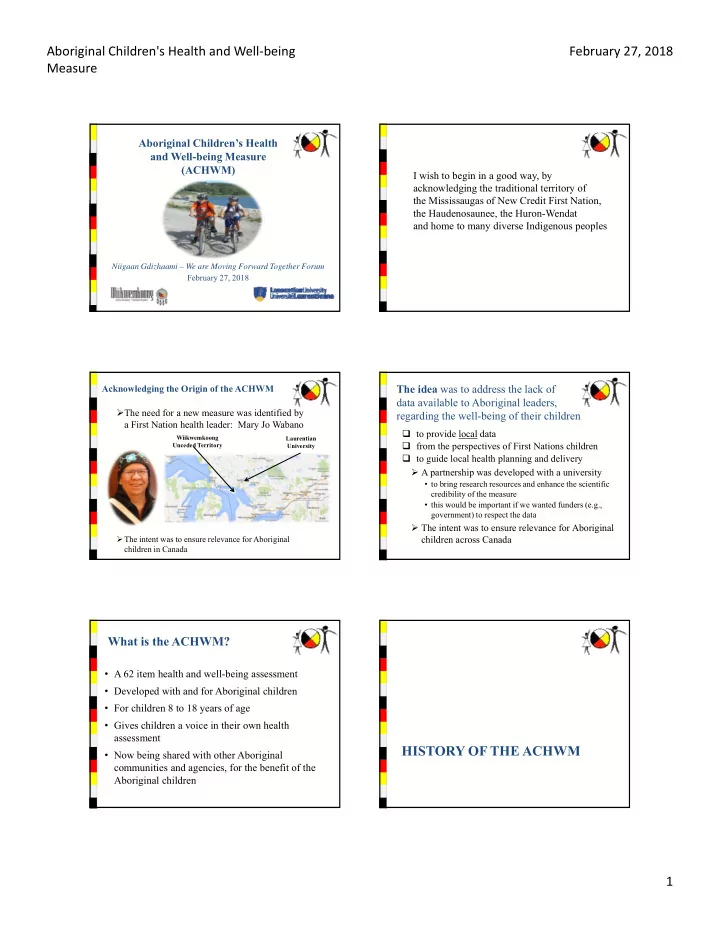
Aboriginal Children's Health and Wellbeing February 27, 2018 Measure Aboriginal Childrens Health and Well-being Measure (ACHWM) I wish to begin in a good way, by acknowledging the traditional territory of the Mississaugas of New Credit


slide-1
SLIDE 1

Aboriginal Children's Health and Well‐being Measure February 27, 2018 1

Aboriginal Children’s Health and Well-being Measure (ACHWM)

Niigaan Gdizhaami – We are Moving Forward Together Forum February 27, 2018

I wish to begin in a good way, by acknowledging the traditional territory of the Mississaugas of New Credit First Nation, the Haudenosaunee, the Huron-Wendat and home to many diverse Indigenous peoples

Acknowledging the Origin of the ACHWM

  • The need for a new measure was identified by

a First Nation health leader: Mary Jo Wabano

  • The intent was to ensure relevance for Aboriginal

children in Canada

Wiikwemkoong Unceded Territory Laurentian University

The idea was to address the lack of data available to Aboriginal leaders, regarding the well-being of their children

 to provide local data  from the perspectives of First Nations children  to guide local health planning and delivery

  • A partnership was developed with a university
  • to bring research resources and enhance the scientific

credibility of the measure

  • this would be important if we wanted funders (e.g.,

government) to respect the data

  • The intent was to ensure relevance for Aboriginal

children across Canada

What is the ACHWM?

  • A 62 item health and well-being assessment
  • Developed with and for Aboriginal children
  • For children 8 to 18 years of age
  • Gives children a voice in their own health

assessment

  • Now being shared with other Aboriginal

communities and agencies, for the benefit of the Aboriginal children

HISTORY OF THE ACHWM

slide-2
SLIDE 2

Aboriginal Children's Health and Well‐being Measure February 27, 2018 2

Developed in 2011

  • Goal: to provide local data

from the perspectives of Aboriginal children, in a feasible and sustainable way

  • Grounded in the Medicine Wheel

framework, includes: spiritual, emotional, physical, and mental health.

  • Created in partnership

with Aboriginal children in Wiikwemkoong

2012: Refined by Children

  • Detailed interviews were conducted with 9 children &

9 parents / caregivers

  • Ensured questions were consistently understood by children

2014-2015: Assessed fit in other communities

 Weechi-it-te-win Family Services June 2014  Métis community in Sudbury July 2014  M’Chigeeng First Nation August 2014  Whitefish First Nation October 2014  Ottawa Intuit Children’s Centre January 2015

Achieved a stable and consistently understood version

Named by the children …

Each community has selected a name for the ACHWM in their language meaning How are You?

Anishnaabemowin Aaniish Naa Gegii

(NE ON)

Aaniin Ezhi-Ayaayan (NW ON) Aniish Na (SW ON) Michif Komon Ca Vo Inuktitut Qanuippit Cree Wacheya Kaniehkeha:ka Ohniió ton hatie Addresses Sustainability

  • No need for data entry
  • Saves data locally or uploads data

to a secure REDCap server

2014: Developed an Android App

Addresses Feasibility

  • Makes doing the survey appealing

to children and efficient

  • Text-to-speech option enables

children with low literacy levels to participate independently

Validity

(r=0.52 vs PedsQL)

Reliability (ICC=0.94) Sensitivity (0.75) Specificity (0.97)

ACHWM meets psychometric criteria

slide-3
SLIDE 3

Aboriginal Children's Health and Well‐being Measure February 27, 2018 3

Shared locally, reviewed by Chief and Council, then published

ACHWM Components

  • 62 Questions
  • 3 open ended questions

– e.g., What activities would you like to do if you had the chance?

  • English and French
  • First Nation, Inuit and

Métis versions

  • Summary Score
  • 4 Quadrant Scores
  • Screening Component

Emotiona l 24 Physical 13 Mental 9 Spiritual 16

Implementation Experience

  • Wiikwemkoong first implemented the ACHWM as a

community survey in 2013, within schools and in the community – With the support of:

The Health Centre The Mental Health Team The Board of Education Chief and Council

  • Has been repeated each year since
  • Every child who completes the ACHWM in

Wiikwemkoong sees a mental health worker for a brief assessment

Chiefs of Ontario Resolution #13/15

HOW THE ACHWM WORKS

COMMUNITY LEVEL INDIVIDUAL LEVEL

Child Completes ACHWM

View Individual Report

Passcode

Population Health Assessment: Description of child health in the community – support advocacy Local Data

Save the Data

Catalyst for honest dialogue that leads to immediate support Program Evaluation: Compare before and after to assess a program’s impact on child health Mental Health Screening/Clinical Practice: Report summarizing the health needs of children at intake

ACHWM at the Individual and Community Level

slide-4
SLIDE 4

Aboriginal Children's Health and Well‐being Measure February 27, 2018 4

Screening & Triage Process

  • Created by the Nadmadwin Mental Health Clinic staff,

in Wiikwemkoong

  • They asked that we flag questions which may suggest

that the participant may be at-risk

  • Programmed into the tablet application
  • Children are referred to a qualified staff member if:
  • 1 or more red flags
  • 2 or more yellow flags
  • Triage component:
  • Lets children know we respect their perspectives
  • Ensures children’s safety, by connecting them to

appropriate local services

Note: not all participants see a mental health worker

Referral Form

It’s about Balance an adjunct app

  • Children were curious about their

results, but we didn’t want to focus

  • n scores (numbers)
  • A way to explore a child’s results

in a way that resonates with them

  • We created a visual component to

show the children their results

  • Encourages a holistic

conversation, focusing on strengths

BENEFITS

Key benefits of the measure:

 gives children a voice in their own health assessment  developed with Aboriginal children 8 to 18 years of age  culturally relevant and grounded in the Medicine Wheel:

  • overall score; physical, emotional, mental and spiritual health scores

 scientifically sound: valid, reliable and sensitive  tablets engage children in a non-judgemental way  automated process enhances feasibility and supports the generation of local report

  • tablets are able to quickly identify urgent health needs and facilitate

new connections to local supports

 generates quantifiable data useful at the local level to support program planning/evaluation and funding requests

Example Community Report

Summary mailed to all households in Wiikwemkoong July 7th 2014

slide-5
SLIDE 5

Aboriginal Children's Health and Well‐being Measure February 27, 2018 5

Outreach Sharing:

 We are sharing with other First Nations and Aboriginal agencies, who want to implement this measure either: a) Research b) Collaborative Practice c) Independent Use  Each community should identify their purpose for implementation: i. mental health screening ii. program evaluation

  • iii. population health assessment

 The ACHWM has no license fee

ACHWM & KEB – Pilot

  • ACHWM may be useful to inform schools about the

health of their students

– Aid in connecting children to relevant supports

  • ACHWM can assist in encouraging students to tell

their story and create honest dialogue

– Tablet does not “judge”

  • Aggregate results may inform school programming

– Evaluate change over time

www.ACHWM.ca Chi Miigwetch

To the many children and community members who have contributed to the ACHWM. Financial Support for this Program has been provided by:

Canadian Institutes of Health Research (CIHR) Ontario Ministry of Health and Long-Term Care: 2 HSRF Grants; 1 SPOR IMPACT Grant Ontario Ministry of Children and Youth Services – Outreach support funding

For More Information Contact:

Nancy L. Young

Professor & Research Chair Rural and Northern Health Laurentian University, Sudbury Phone: 705-675-1151 ext: 4014 nyoung@laurentian.ca

Mary Jo Wabano

Health Services Director Naandwechige Gamig Wikwemikong Health Centre Phone: 705-859-3164 mjwabano@wikyhealth.ca

Marnie Anderson, Research Coordinator Carli McDonald, Research Assistant

ECHO Research Centre Laurentian University Sudbury Phone: 705-675-1151 ext: 4015 mmanderson@laurentian.ca cmcdonald1@laurentian.ca

Trisha Trudeau & Katarina Djeletovic

ACHWM Research Assistants Naandwechige Gamig Wikwemikong Health Centre Phone: 705-859-3164 trishat@wikyhealth.ca katarinad@wikyhealth.ca