SLIDE 1 ¡
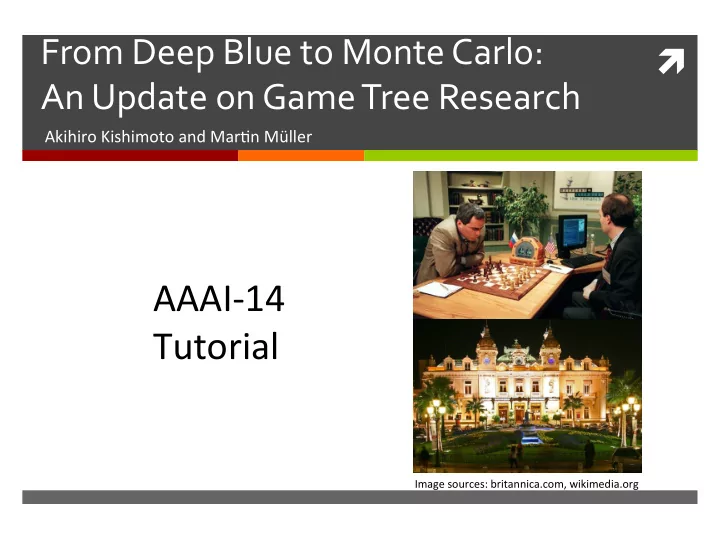
From ¡Deep ¡Blue ¡to ¡Monte ¡Carlo: ¡ ¡ An ¡Update ¡on ¡Game ¡Tree ¡Research ¡
Akihiro ¡Kishimoto ¡and ¡Mar0n ¡Müller ¡
AAAI-‑14 ¡ Tutorial ¡
Image ¡sources: ¡britannica.com, ¡wikimedia.org ¡
SLIDE 2
1997: ¡Deep ¡Blue ¡vs ¡Kasparov ¡
hAps://www.youtube.com/watch?v=NJarxpYyoFI ¡
SLIDE 3 Speakers ¡and ¡their ¡Backgrounds ¡
Akihiro ¡Kishimoto ¡(aka ¡Kishi), ¡IBM ¡Research ¡Ireland ¡
ar0ficial ¡intelligence, ¡parallel ¡compu0ng, ¡high-‑
performance ¡game-‑playing, ¡planning, ¡risk ¡management ¡ systems, ¡computer ¡shogi ¡(Japanese ¡chess) ¡ Mar0n ¡Müller, ¡University ¡of ¡Alberta ¡
computer ¡games, ¡domain-‑independent ¡planning, ¡
combinatorial ¡game ¡theory ¡and ¡algorithms, ¡computer ¡Go, ¡ Monte ¡Carlo ¡Tree ¡Search, ¡Random ¡Walk ¡planning, ¡Fuego ¡
SLIDE 4
Computer ¡Games ¡Tutorial ¡in ¡One ¡Slide ¡
We ¡focus ¡on ¡“classical” ¡two ¡player ¡games ¡such ¡as ¡
chess, ¡checkers, ¡Othello, ¡5-‑in-‑a-‑row, ¡Go,… ¡
Can ¡solve ¡games, ¡or ¡just ¡try ¡to ¡play ¡well ¡ Huge ¡successes ¡with ¡classical ¡minimax ¡methods ¡
such ¡as ¡alphabeta ¡(αβ) ¡ ¡
Recently ¡much ¡progress ¡in ¡Monte ¡Carlo ¡Tree ¡Search ¡
(MCTS) ¡methods ¡
How ¡does ¡it ¡work? ¡
SLIDE 5 Goals ¡of ¡Tutorial ¡
Up ¡to ¡date ¡overview ¡of ¡research ¡techniques ¡ ¡
for ¡classical ¡two ¡player ¡games ¡
Main ¡Algorithms ¡
- Minimax ¡and ¡Alphabeta ¡search ¡
- Proof ¡number ¡search ¡
- Monte ¡Carlo ¡Tree ¡Search ¡
Techniques ¡we ¡touch ¡upon ¡
- Representa0on ¡and ¡implementa0on ¡issues, ¡
Parallel ¡search, ¡machine ¡learning, ¡ ¡ program ¡tuning ¡and ¡op0miza0on, ¡Tes0ng ¡
SLIDE 6
Organization ¡of ¡the ¡Day: ¡Morning ¡
9 ¡-‑ ¡10 ¡
¡Tutorial ¡1: ¡Overview, ¡introduc0on, ¡ ¡ ¡general ¡concepts ¡(Mar0n) ¡
10 ¡-‑ ¡10:30 ¡ ¡Tutorial ¡2: ¡Solving ¡and ¡playing ¡games ¡
¡ ¡(Kishi) ¡ ¡
10:30 ¡-‑ ¡11 ¡ ¡Coffee ¡break ¡ 11 ¡– ¡12:30 ¡
¡Tutorial ¡3: ¡Alphabeta ¡and ¡enhancements ¡ ¡ ¡(Kishi) ¡
12:30 ¡-‑ ¡1 ¡ ¡Tutorial ¡4: ¡Proof ¡Number ¡Search ¡(Kishi) ¡
SLIDE 7
Organization ¡of ¡the ¡Day: ¡Afternoon ¡
2 ¡-‑ ¡3
¡Con0nue ¡Proof ¡Number ¡Search ¡(Kishi) ¡
3 ¡-‑ ¡3:30 ¡
¡Tutorial ¡5: ¡Monte ¡Carlo ¡Tree ¡Search ¡ ¡ ¡ ¡(Mar0n) ¡
3:30 ¡– ¡4 ¡
¡Coffee ¡break ¡
4 ¡-‑ ¡5:30 ¡
¡Con0nue ¡Monte ¡Carlo ¡Tree ¡Search ¡ ¡
5:30 ¡-‑ ¡6 ¡
¡Tutorial ¡6: ¡State ¡of ¡the ¡art ¡in ¡specific ¡ ¡ ¡ ¡games. ¡Wrap-‑up ¡(Mar0n) ¡
SLIDE 8
Some ¡Questions ¡We ¡Address ¡
How ¡did ¡game ¡tree ¡search ¡develop ¡ ¡
since ¡Deep ¡Blue? ¡
What ¡are ¡the ¡ideas ¡behind ¡current ¡methods? ¡ Which ¡successes ¡have ¡they ¡achieved ¡in ¡games ¡and ¡
elsewhere? ¡
What ¡are ¡the ¡biggest ¡open ¡problems ¡in ¡games ¡
research? ¡
SLIDE 9
What ¡we ¡Won’t ¡Talk ¡About ¡
Single-‑agent ¡games, ¡puzzles ¡ Mul0-‑player ¡games ¡ Games ¡of ¡chance ¡(Poker, ¡dice, ¡backgammon,…) ¡ Classical ¡game ¡theory, ¡Nash ¡equilibria,… ¡ Combinatorial ¡game ¡theory, ¡sums ¡of ¡games ¡ General ¡Game ¡Playing ¡(GGP) ¡
SLIDE 10 ¡
From ¡Deep ¡Blue ¡to ¡Monte ¡Carlo: ¡ ¡ An ¡Update ¡on ¡Game ¡Tree ¡Research ¡
Akihiro ¡Kishimoto ¡and ¡Mar0n ¡Müller ¡ ¡
AAAI-‑14 ¡Tutorial ¡1: ¡ ¡ Overview, ¡ ¡ Introduc0on, ¡ ¡ General ¡Concepts ¡ ¡ ¡ Presenter: ¡ ¡ Mar0n ¡Müller, ¡University ¡of ¡Alberta ¡
Image ¡source: ¡ebay.com ¡
SLIDE 11 Prehistory ¡– ¡Game ¡Theory ¡
Zermelo ¡(1913) ¡-‑ ¡existence ¡of ¡a ¡winning ¡strategy ¡ ¡ von ¡Neumann ¡(1928) ¡-‑ ¡first ¡proof ¡of ¡ ¡
general ¡minimax ¡theorem ¡with ¡mixed ¡strategies ¡ ¡
von ¡Neumann ¡and ¡Morgenstern ¡(1944) ¡– ¡ ¡
Theory ¡of ¡Games ¡and ¡Economic ¡Behavior ¡ ¡
Nash ¡(1950) ¡-‑ ¡concept, ¡existence ¡proof ¡of ¡Nash ¡equilibria ¡ ¡ Many ¡applica0ons ¡to ¡decision-‑making, ¡economics, ¡
biology ¡ ¡
At ¡least ¡twelve ¡Nobel ¡prizes ¡for ¡game ¡theorists! ¡
SLIDE 12 Short ¡History ¡of ¡Chess ¡Programming ¡ ¡
- 1950 ¡Shannon ¡“Programming ¡a ¡Computer ¡for ¡Playing ¡Chess” ¡-‑ ¡
evalua6on ¡func6on, ¡selec6ve ¡and ¡brute ¡force ¡search ¡strategies ¡
- 1951 ¡Turing ¡-‑ ¡algorithm ¡for ¡playing ¡chess, ¡simulates ¡it ¡by ¡hand ¡ ¡
- 1956 ¡McCarthy ¡alphabeta ¡pruning ¡
- 1967 ¡GreenblaA ¡chess ¡program, ¡transposi6on ¡tables ¡ ¡
- 1968 ¡First ¡Levy ¡bet, ¡human ¡vs ¡computer ¡
- 1981 ¡Cray ¡Blitz ¡achieves ¡Master ¡ra0ng ¡
- 1982 ¡Ken ¡Thompson’s ¡Belle, ¡hardware ¡accelerated ¡chess ¡program, ¡
earns ¡US ¡Master ¡0tle ¡
- 1988 ¡Deep ¡Thought ¡becomes ¡Grandmaster ¡strength ¡ ¡
- 1996 ¡Kasparov ¡beats ¡Deep ¡Blue ¡
- 1997 ¡Deep ¡Blue ¡beats ¡Kasparov ¡
- today: ¡Mobile ¡phones ¡at ¡strong ¡grandmaster ¡level. ¡ ¡
¡ ¡ ¡ ¡ ¡ ¡ ¡ ¡ ¡ ¡ ¡ ¡ ¡Programs ¡such ¡as ¡Stockfish, ¡Komodo ¡far ¡surpass ¡all ¡humans ¡ ¡ ¡ ¡ ¡ ¡on ¡ordinary ¡PCs ¡
SLIDE 13
State ¡of ¡the ¡Art ¡in ¡Computer ¡Game-‑Playing ¡ ¡
Games ¡solved ¡ Super-‑human ¡strength ¡ ¡ Human ¡world ¡champion ¡level ¡ ¡ Strong ¡play ¡ Weak ¡or ¡intermediate-‑level ¡play ¡ ¡
SLIDE 14 Solved ¡by ¡Search ¡and/or ¡Knowledge ¡ ¡
Four-‑in-‑a-‑row, ¡Connect-‑four ¡(Allis; ¡Allen ¡1988) ¡ Qubic ¡(Patashnik ¡1980) ¡ ¡ Gomoku ¡-‑ ¡5 ¡in ¡a ¡row ¡(Allis ¡1995, ¡Wagner ¡and ¡Virag ¡2000) ¡ ¡ Nine ¡Men’s ¡Morris ¡(Gasser ¡1994) ¡ Awari ¡(Romein ¡2002) ¡ Checkers ¡(Schaeffer ¡et ¡al ¡2007) ¡ Fanorona ¡(Schadd ¡2007) ¡ ¡
SLIDE 15
Solved ¡by ¡Mathematical ¡Techniques ¡ ¡
Using ¡Combinatorial ¡game ¡theory: ¡
Nim ¡(Bouton ¡1908) ¡ Hackenbush, ¡Domineering, ¡… ¡(Winning ¡Ways) ¡ Go ¡endgame ¡puzzles ¡(Berlekamp ¡and ¡Wolfe ¡1994) ¡ ¡
SLIDE 16 Games ¡Solved ¡only ¡on ¡Small ¡Boards ¡ ¡
¡ ¡6x6 ¡(Enderton ¡1994), ¡ ¡ ¡ ¡7x7, ¡8x8, ¡9x9 ¡(Yang; ¡Hayward ¡et ¡al) ¡ ¡
¡5x5 ¡(van ¡der ¡Werf ¡2003), ¡ ¡ ¡ ¡7x4, ¡…(v.d. ¡Werf ¡& ¡Winands, ¡2009) ¡ ¡
¡6x6 ¡(Feinstein ¡1993) ¡ ¡
- Domineering ¡10x10 ¡(Bullock ¡2002) ¡ ¡
- Amazons ¡
¡5x5 ¡(Müller ¡2001), ¡ ¡ ¡ ¡5x6 ¡(Song ¡& ¡Müller ¡2014) ¡
- Dots ¡and ¡Boxes ¡up ¡to ¡4x6 ¡(Wilson) ¡
¡ ¡several ¡varia0ons ¡on ¡rules ¡
SLIDE 17
Not ¡Solved, ¡Super-‑human ¡Strength ¡ ¡
Backgammon ¡(Tesauro ¡-‑ ¡TD-‑Gammon, ¡1995) ¡ ¡ Chess ¡(Deep ¡Blue ¡1997) ¡ Othello ¡(Buro ¡-‑ ¡Logistello, ¡1997) ¡ Scrabble ¡(Sheppard ¡-‑ ¡Maven, ¡2002) ¡ ¡
SLIDE 18
World ¡Champion ¡Level ¡
9x9 ¡Go ¡(Fuego ¡2009, ¡MoGo ¡2009, ¡Zen) ¡ ¡ Shogi ¡-‑ ¡Japanese ¡chess ¡ Xiangqi ¡-‑ ¡Chinese ¡chess ¡(?) ¡ 10x10 ¡draughts? ¡(?) ¡ Heads-‑up ¡(2 ¡person) ¡Poker ¡(Alberta ¡team ¡2008) ¡ Amazons? ¡(Invader ¡-‑ ¡Lorentz) ¡
SLIDE 19
Master ¡Level ¡ ¡
19x19 ¡Go ¡(Zen, ¡Crazy ¡Stone, ¡6 ¡Dan ¡amateur) ¡ 14x14, ¡19x19 ¡Hex? ¡ Bridge? ¡ Poker ¡with ¡3 ¡or ¡more ¡players? ¡ Arimaa? ¡ Havannah? ¡
SLIDE 20
Weak ¡to ¡Intermediate ¡Level ¡
General ¡Game ¡Playing ¡(GGP) ¡-‑ ¡rela0ve ¡strength ¡
varies ¡by ¡game ¡ ¡
SLIDE 21 So, ¡are ¡we ¡Almost ¡Done? ¡
Huge ¡successes ¡ If ¡we ¡“solve ¡Go”, ¡are ¡we ¡done? ¡ Of ¡course ¡not! ¡
Playing ¡beAer ¡than ¡humans ¡is ¡not ¡solving ¡a ¡game ¡
Go ¡will ¡not ¡be ¡“solved” ¡
Games ¡are ¡great ¡test ¡beds ¡to ¡study ¡algorithms ¡ The ¡games ¡people ¡play ¡evolve ¡over ¡0me ¡
SLIDE 22
Why ¡“Classical” ¡Games? ¡
Simple, ¡controlled ¡environment ¡ S0ll ¡hard ¡to ¡solve ¡or ¡play ¡well ¡ Interes0ng ¡for ¡many ¡people ¡ Domains ¡easy ¡to ¡understand ¡ For ¡humans, ¡playing ¡games ¡well ¡ ¡
requires ¡intelligence ¡ ¡
SLIDE 23 Two ¡Player ¡Games ¡– ¡Basic ¡Concepts ¡
Two ¡players, ¡oxen ¡called ¡Black ¡and ¡White ¡ ¡ Move ¡alternately: ¡I ¡play, ¡you ¡play, ¡I ¡play,… ¡ Zero-‑sum: ¡my ¡win ¡is ¡opponent’s ¡loss ¡ Perfect ¡Informa0on: ¡ ¡
Both ¡players ¡know ¡state ¡of ¡the ¡game ¡ No ¡hidden ¡informa0on ¡
No ¡chance: ¡ ¡
no ¡dice ¡rolls, ¡card ¡draws, ¡other ¡random ¡events ¡ ¡ Games ¡of ¡pure ¡skill ¡
SLIDE 24 Sample ¡Game: ¡NoGo ¡
NoGo, ¡short ¡for ¡No ¡Capture ¡Go. ¡ ¡
Also ¡called ¡An0 ¡Atari ¡Go ¡ ¡
Rules ¡similar ¡to ¡Go ¡
Gameplay ¡is ¡completely ¡different ¡
Played ¡on ¡a ¡grid, ¡ini0ally ¡empty ¡ Two ¡players ¡Black ¡and ¡White ¡ One ¡move ¡= ¡put ¡one ¡stone ¡of ¡your ¡ ¡
Last ¡player ¡who ¡can ¡move ¡wins ¡
Brief ¡ ¡ Demo ¡
SLIDE 25 ¡ ¡NoGo ¡Concepts ¡and ¡Rules ¡
Block ¡– ¡connected ¡set ¡of ¡stones ¡of ¡
same ¡color ¡
Example: ¡two ¡black ¡blocks: ¡ ¡
three ¡Black ¡stones ¡{A1, ¡B1, ¡B2}, ¡ ¡ single ¡stone ¡{C3} ¡ Liberty ¡– ¡empty ¡intersec0on ¡adjacent ¡
to ¡a ¡block ¡
Each ¡block ¡needs ¡at ¡least ¡one ¡liberty ¡ Illegal ¡moves: ¡capture ¡and ¡suicide ¡
Example: ¡only ¡A, ¡B ¡legal ¡for ¡White ¡
SLIDE 26 Basic ¡Concepts, ¡Terminology ¡
- 1. Game ¡posi0on, ¡board ¡state ¡
- 2. Game ¡state, ¡state ¡
- 3. Move, ¡ac0on ¡
- 4. Move ¡sequence, ¡history, ¡game ¡record ¡
- 5. State ¡space, ¡game ¡graph, ¡game ¡tree ¡
- 6. Score, ¡value, ¡evalua0on, ¡result ¡ ¡
SLIDE 27
- 1. ¡Game ¡Position, ¡Board ¡State
¡
“Snapshot” ¡of ¡game ¡in ¡progress ¡ Examples: ¡ ¡
- board ¡state, ¡board ¡posi0on: ¡
which ¡pieces ¡on ¡which ¡loca0ons? ¡
- cards ¡held, ¡cards ¡open, ¡on ¡stacks, ¡
discarded,… ¡
- money, ¡etc ¡held ¡by ¡each ¡player ¡or ¡
public ¡
Image ¡sources: ¡texasnoregrets.com, ¡ ¡ everythingbrisa.blogspot.ca ¡ ¡
SLIDE 28
¡
Complete ¡descrip0on ¡of ¡ ¡
current ¡game ¡situa0on ¡ ¡
Includes: ¡ ¡
Game ¡posi0on ¡ ToPlay ¡-‑ ¡whose ¡turn ¡it ¡is ¡ Oxen ¡includes ¡(parts ¡of) ¡history: ¡ ¡
sequence ¡of ¡moves ¡from ¡start ¡of ¡game ¡ ¡
When ¡is ¡history ¡needed? ¡ ¡
Depends ¡on ¡rules, ¡structure ¡of ¡search ¡space ¡ ¡ Example: ¡detect ¡posi0on ¡repe00on ¡
Image ¡source: ¡www.theguardian.com ¡
SLIDE 29 What’s ¡in ¡a ¡Game ¡State ¡? ¡
All ¡informa0on ¡needed ¡to ¡ ¡
Determine ¡set ¡of ¡legal ¡moves ¡ Determine ¡if ¡game ¡is ¡finished ¡or ¡not ¡
A ¡player ¡might ¡also ¡resign ¡to ¡end ¡the ¡game ¡
Determine ¡the ¡result ¡when ¡finished ¡
Who ¡wins, ¡and ¡by ¡how ¡much? ¡
SLIDE 30 Game ¡State ¡Examples ¡
NoGo: ¡state ¡= ¡(posi0on, ¡toPlay) ¡
Does ¡not ¡need ¡history ¡(why?) ¡
Go: ¡Ko ¡rules ¡prevent ¡repe00ons ¡
Need ¡history ¡in ¡state ¡to ¡determine ¡legal ¡moves ¡
Go: ¡legal ¡capture ¡ Go: ¡illegal ¡ko ¡re-‑capture ¡
SLIDE 31
¡
Move: ¡from ¡one ¡state ¡to ¡the ¡next ¡
Usually: ¡small, ¡simple ¡descrip0on ¡
Example: ¡White ¡E2 ¡
Change ¡of ¡full ¡state ¡is ¡oxen ¡implicit ¡
and ¡has ¡to ¡be ¡computed ¡ Par0al ¡move: ¡if ¡move ¡is ¡complicated ¡ ¡
it ¡may ¡make ¡sense ¡to ¡split ¡it ¡up ¡
Examples: ¡ ¡
chess: ¡from-‑to ¡squares ¡ Arimaa: ¡each ¡move ¡moves ¡four ¡pieces ¡
SLIDE 32
- 4. ¡Move ¡Sequence, ¡History, ¡Game ¡Record
¡
Move ¡sequence: ¡ ¡
zero ¡or ¡more ¡consecu0ve ¡moves ¡ Leads ¡from ¡one ¡state ¡to ¡another ¡through ¡a ¡
sequence ¡of ¡intermediate ¡states ¡
Abstract ¡example: ¡ ¡
Move ¡sequence ¡<m1, ¡m2, ¡m3> ¡ Start ¡state ¡s0 ¡ Playing ¡m1 ¡in ¡s0 ¡leads ¡to ¡s1 ¡ ¡ Playing ¡m2 ¡in ¡s1 ¡leads ¡to ¡s2, ¡etc. ¡
Concrete ¡example: ¡see ¡figure ¡
<B ¡B4, ¡W ¡C3, ¡B ¡D1> ¡ A ¡move ¡sequence ¡is ¡legal ¡if ¡each ¡move ¡ ¡
is ¡legal ¡in ¡the ¡corresponding ¡state ¡
SLIDE 33 History, ¡Game ¡Record ¡
History ¡– ¡move ¡sequence ¡from ¡start ¡of ¡game ¡to ¡
current ¡state ¡
Game ¡record ¡– ¡history ¡of ¡a ¡complete ¡game ¡
Popular ¡file ¡formats: ¡pgn, ¡sgf,… ¡ Support ¡varia0ons, ¡annota0ons, ¡comments,… ¡
SLIDE 34
- 5. ¡State ¡Space, ¡Game ¡Graph, ¡Game ¡Tree
¡
State ¡space: ¡
Which ¡states ¡exist? ¡ How ¡are ¡they ¡connected ¡by ¡moves? ¡
Game ¡graph, ¡game ¡tree: ¡
Each ¡state ¡is ¡a ¡node ¡in ¡a ¡graph ¡ Connect ¡states ¡s1, ¡s2 ¡by ¡a ¡directed ¡edge ¡iff ¡
there ¡is ¡a ¡legal ¡move ¡from ¡s1 ¡to ¡s2 ¡
Can ¡different ¡move ¡sequences ¡lead ¡to ¡the ¡
same ¡state? ¡If ¡no, ¡the ¡game ¡graph ¡is ¡a ¡tree ¡
Image ¡source: ¡sciencefair.math.iit.edu ¡
SLIDE 35 Game ¡Tree, ¡DAG, ¡DCG ¡
Tree: ¡
Root ¡= ¡star0ng ¡posi0on ¡ Using ¡full ¡history ¡will ¡always ¡result ¡in ¡a ¡tree ¡ Following ¡edges ¡on ¡path ¡from ¡root ¡gives ¡the ¡
move ¡sequence ¡ DAG ¡– ¡directed ¡acyclic ¡graph ¡
Different ¡sequences ¡may ¡lead ¡to ¡same ¡state ¡ Acyclic: ¡non-‑empty ¡move ¡sequence ¡cannot ¡
lead ¡back ¡to ¡the ¡same ¡node ¡
Example: ¡NoGo ¡game ¡graph ¡is ¡a ¡DAG ¡
DCG ¡– ¡directed ¡cyclic ¡graph, ¡may ¡have ¡loops ¡
SLIDE 36 DAG ¡Examples ¡
Sequence ¡<B ¡B4, ¡W ¡C3, ¡B ¡D1> ¡ Sequence ¡<B ¡D1, ¡W ¡C3, ¡B ¡B4> ¡ Both ¡lead ¡to ¡same ¡game ¡state ¡
¡ (Tricky) ¡quiz ¡for ¡chess ¡players: ¡do ¡
a) 1. ¡e4 ¡e5 ¡
¡
b) 1. ¡Nf3 ¡d5 ¡
Lead ¡to ¡the ¡same ¡game ¡state? ¡
Image ¡source: ¡www.mark-‑weeks.com ¡
SLIDE 37 DCG ¡-‑ ¡Directed ¡Cyclic ¡Graph ¡
In ¡NoGo, ¡we ¡cannot ¡have ¡loops ¡
Each ¡move ¡adds ¡exactly ¡one ¡stone ¡to ¡the ¡board ¡
In ¡many ¡games ¡we ¡can ¡repeat ¡the ¡board ¡posi0on ¡
But: ¡is ¡it ¡really ¡the ¡same ¡game ¡state??? ¡ Usually ¡not, ¡but ¡depends ¡on ¡game ¡rules ¡ We ¡will ¡come ¡back ¡to ¡this ¡ques0on ¡
Example ¡in ¡chess, ¡checkers: ¡ ¡
move ¡pieces ¡back ¡and ¡forth ¡
Example ¡in ¡Go: ¡ko ¡rule ¡(forbids ¡repe00on) ¡
Image ¡source: ¡ ¡ commons.wikipedia.org ¡
SLIDE 38
- 6. ¡Game ¡Score, ¡Value, ¡Evaluation, ¡Result
¡ ¡
Result: ¡at ¡end ¡of ¡game ¡
Simplest: ¡win ¡/ ¡loss ¡(1/0) ¡ Oxen: ¡win ¡/ ¡loss ¡/ ¡draw ¡(1/0.5/0) ¡ Point-‑scoring ¡games: ¡ ¡
¡score ¡= ¡size ¡of ¡win ¡/ ¡loss ¡
Example: ¡Black ¡wins ¡by ¡3.5 ¡points ¡
Value ¡of ¡a ¡posi0on: ¡
Game-‑theore0c ¡value: ¡ ¡
result ¡assuming ¡best ¡play ¡by ¡both ¡ Evalua6on: ¡what ¡a ¡player ¡(program) ¡ ¡
es6mates ¡the ¡value ¡to ¡be ¡
Examples: ¡winning ¡probability, ¡expected ¡score ¡
Image ¡source: ¡ beautyandthefeastblog.com ¡
SLIDE 39 Summary ¡of ¡Tutorial ¡1 ¡
Brief ¡history ¡of ¡computer ¡players, ¡state ¡of ¡the ¡art ¡in ¡
playing ¡and ¡solving ¡games ¡
Sample ¡game: ¡NoGo ¡ Basic ¡concepts: ¡ ¡
game ¡posi0on, ¡game ¡state ¡ move, ¡move ¡sequence ¡ state ¡space, ¡game ¡graph ¡ result ¡ ¡-‑ ¡value ¡– ¡evalua0on ¡
Image ¡source: ¡www.ps4site.com ¡