A world post Roe v. Wade Daniel Grossman, MD October 2019 UCSF - - PowerPoint PPT Presentation

a world post roe v wade
SMART_READER_LITE
LIVE PREVIEW

A world post Roe v. Wade Daniel Grossman, MD October 2019 UCSF - - PowerPoint PPT Presentation

Disclosures I have nothing to disclose A world post Roe v. Wade Daniel Grossman, MD October 2019 UCSF Obstetrics and Gynecology Update University of California, San Francisco | Bixby Center for Global Reproductive Health 1 2 Objectives


slide-1
SLIDE 1

University of California, San Francisco | Bixby Center for Global Reproductive Health

A world post Roe v. Wade

Daniel Grossman, MD

October 2019 UCSF Obstetrics and Gynecology Update

Disclosures

⇾ I have nothing to disclose

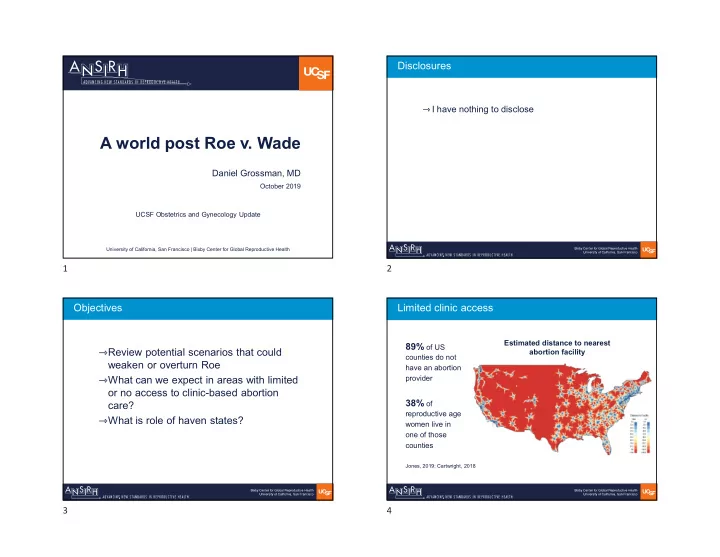
Objectives ⇾Review potential scenarios that could weaken or overturn Roe ⇾What can we expect in areas with limited

  • r no access to clinic-based abortion

care? ⇾What is role of haven states? Limited clinic access

89% of US

counties do not have an abortion provider

38% of

reproductive age women live in

  • ne of those

counties Estimated distance to nearest abortion facility

Jones, 2019; Cartwright, 2018

1 2 3 4

slide-2
SLIDE 2

State restrictions enacted per year

Guttmacher Institute

Risk to abortion rights if Roe fell

Center for Reproductive Rights

What can we expect in low- access states?

Low-access areas ⇾Increased need for logistic support to help patients travel to where they need to go

⇾Travel costs, support ⇾Role of abortion funds

⇾Role of local clinicians to provide direct referral

⇾Need to know where patients can travel to access

services and what logistic support exists

⇾May be opportunity to facilitate care by starting work-up

locally

⇾Increased self-managed abortion

5 6 7 8

slide-3
SLIDE 3

Medication abortion ⇾Mifepristone

⇾Progesterone receptor

blocker

⇾Causes lining of uterus

to thin, helping to separate pregnancy from uterus

⇾Misoprostol

⇾Prostaglandin ⇾Causes softening of

cervix, uterine contractions

Spitz, Contraception 2010

Medication abortion regimens

96% 85% 0% 10% 20% 30% 40% 50% 60% 70% 80% 90% 100% Mifepristone-misoprostol Misoprostol alone Efficacy

Self-managed abortion ⇾How common is it? ⇾What methods do women use? ⇾Why do women do this? ⇾Is it safe and effective? ⇾Is there a role for healthcare providers as access to clinic-based care becomes more constrained? Self-induction among abortion clients in the US 2.2%

Ever used something to self-induce

0.9%

Used something else (Vitamin C, herbs)

1.3%

Used misoprostol

~2%

took something in current pregnancy in 2008 Foreign-born women more likely to have ever used misoprostol or other substance

Jerman, 2016

9 10 11 12

slide-4
SLIDE 4

Self-induction among abortion clients in Texas

Among abortion clients:

⇾6.9% reported attempting

to end current pregnancy prior to seeking abortion care

⇾2.8% used herbs ⇾1% used misoprostol

⇾12% in cities near the

Mexican border

Grossman, et al., 2014

Self-induction among Texas women age 18-49

Among a sample of the general population of Texas women age 18-49:

⇾ 1.7% reported ever

attempting self-induction

⇾Approximately

100,000 women

Texas Policy Evaluation Project, 2015

Methods women in national sample reported using for SIA (n=7,022)

N

10 20 30 40 50 60

Herbs Other drug Misoprostol Physical (hit in abdomen) EC after Other

Self-Induction Methods reported by Texas women, 2015 2 4 6 8 10 12 Misoprostol Other medication Herb, tea or vitamin

Texas Policy Evaluation Project, 2015

N

13 14 15 16

slide-5
SLIDE 5

Reasons for attempting self-abortion

⇾ Lack of knowledge about services ⇾ Young age ⇾ Financial barriers ⇾ Desire to avoid clinic ⇾ More like menstrual regulation ⇾ “Less of an abortion” ⇾ Interest in alternative medicine ⇾ Safer, quicker, more natural

Barriers to clinic- based care Preference for self-abortion

Grossman, et al., 2010

Is self-induced abortion safe? Medications obtained online in the US

⇾ Ordered 20 mifepristone-misoprostol combination products and 2 misoprostol-only products ⇾ Obtained 18 mife-miso and 2 miso-only products ⇾ No site required Rx or medical information ⇾ Took 9.5 days to receive (range 3-21 business days) ⇾ Price of combination products: $110-$360

Tablet Assay results Mifepristone 200 mg 184 – 204 mg Misoprostol 200 mcg 34 – 201 mcg

Murtagh, et al., 2018

Safety of self-use in other countries ⇾Limited data on self-use of medication abortion shows promise

⇾OTC use in Bangladesh (mife/miso) ⇾71% reported correct use and 96% pregnancies terminated ⇾Harm-reduction model in Peru (miso only) ⇾Of those who took miso, 89% reported complete abortion and

  • nly 8% had self-reported adverse event

⇾Women on Web in Ireland (mife/miso)

⇾ 95% reported successfully ending pregnancy without surgical intervention ⇾ 0.7% reported receiving blood transfusion ⇾ 2.6% reported receiving antibiotics

Kapp, 2017; Footman, 2018; Grossman, et al., 2018; Aiken, 2017

17 18 19 20

slide-6
SLIDE 6

Post-abortion care in post-Roe, low-access states

⇾ Be prepared for life-threatening complications (uterine perforation, hemorrhage, infection)…but hopefully these will be few ⇾ Be aware of medication abortion and normal course

⇾Don’t intervene when unnecessary (treat signs and

symptoms, not ultrasound findings)

⇾Most cases of incomplete abortion can be treated

with any of the following:

⇾Expectant management ⇾Medication (usually misoprostol 800 mcg buccal or 600 mcg SL) ⇾Vacuum aspiration

Legal risks >> medical risks

⇾ At least 20 people have been prosecuted for allegedly attempting or helping someone attempt to self-manage an abortion ⇾ Women of color and those with low incomes at highest risk ⇾ No jurisdiction currently mandates physician reporting of self- managed abortion

ACOG Position Statement on Decriminalization of SIA

⇾ Opposes the prosecution of a pregnant woman for conduct alleged to have harmed her fetus, including the criminalization of self-induced abortion. The threat of prosecution may result in negative health outcomes by deterring women from seeking needed care, including care related to complications after abortion. ⇾ ACOG also opposes administrative policies that interfere with the legal and ethical requirement to protect private medical information by mandating obstetrician– gynecologists and other clinicians to report to law enforcement women they suspect have attempted self- induced abortion. Such actions compromise the integrity of the patient–physician relationship.

December 2017

Learn to live with diagnostic uncertainty

⇾ Clinically may be difficult to distinguish spontaneous early pregnancy loss from self-managed/induced abortion ⇾ Management largely the same ⇾ How should we balance what we gain by trying to determine cause of pregnancy loss versus the risk of criminalizing the patient if they disclose an attempt to self-manage their abortion?

21 22 23 24

slide-7
SLIDE 7

Harm Reduction Model

ABORTION ILLEGAL DENIED

BEFORE

  • 1. Counseling regarding

alternatives to abortion

  • 2. Information about

abortion methods and their risks (including misoprostol)

AFTER

  • 1. Post-abortion care
  • 2. Prevention of

complications

  • 3. Referrals for other

services

  • 4. Contraception

counseling Briozzo et al., 2006; Briozzo et al, 2016

What is the role of clinicians in haven states?

Meeting the needs of patients traveling for services ⇾Expand capacity of services providing care, including for abortion after the first trimester

⇾Consider expansion to provide care closer to borders using

telemedicine or mobile clinics

⇾Expand training opportunities both to meet demand for care and to allow for learners from low-access states ⇾Increased need for logistic and financial support

⇾Examples of Austin and New York City funding

Expanding access in haven states ⇾Expansion of telemedicine services, as well as coverage for telemedicine ⇾Policies such as provision of medication abortion on college campuses ⇾Expansion of provision by advanced practice clinicians

25 26 27 28

slide-8
SLIDE 8

University of California, San Francisco | Bixby Center for Global Reproductive Health

Thank you!

Daniel Grossman, MD

Daniel.Grossman@ucsf.edu

29