A Vertically Integrated Module Design for Track Triggers at - - PowerPoint PPT Presentation

a vertically integrated module design for track triggers
SMART_READER_LITE
LIVE PREVIEW

A Vertically Integrated Module Design for Track Triggers at - - PowerPoint PPT Presentation

A Vertically Integrated Module Design for Track Triggers at Super-LHC The environment expected at future LHC upgrades pose unprecedented challenges for particle detector systems. Although the details of the future path of the experiments is


slide-1
SLIDE 1

A Vertically Integrated Module Design for Track Triggers at Super-LHC

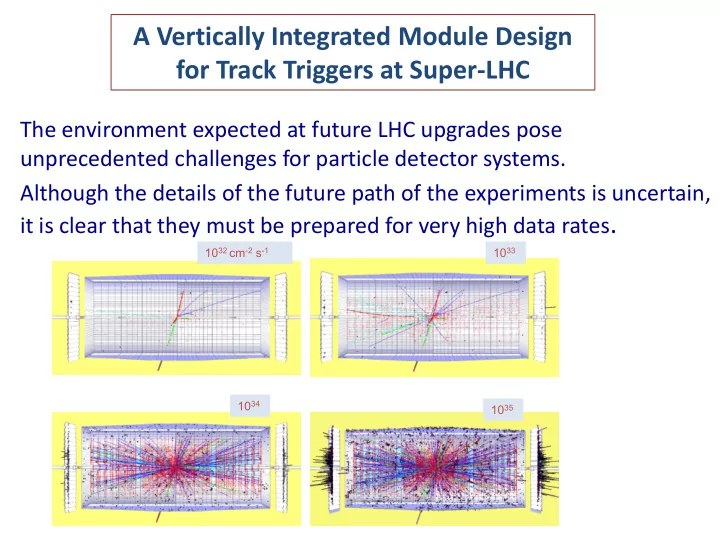
The environment expected at future LHC upgrades pose unprecedented challenges for particle detector systems. Although the details of the future path of the experiments is uncertain, it is clear that they must be prepared for very high data rates.

1033 1033 1035 1035 1032 cm-2 s-1 1032 cm-2 s-1 1034 1034

slide-2
SLIDE 2

Proposal Information

  • Proposals are for “generic” R&D, essentially defined as post-phase 1 for LHC
  • Funding for all proposals is $3M for FY11
  • $625k each taken from CMS, ATLAS this year -> $1.25M next year
  • Letters of intent (not mandatory) due mid-Feb, full proposals due March 19
  • Both CMS and ATLAS have decided to submit a single proposal each – with

details in the appendices – track trigger will be a high priority piece of the CMS proposal

  • Funding will be supplemented by FNAL generic R&D funds as well as

international collaborators

  • We have now heard that some CMS/ATLAS bridge funding should be

available for phase 2 projects.

slide-3
SLIDE 3

Physics Reach

  • Much of the discussion has been aimed at retaining trigger

capabilities at sLHC, but we need more than that. This work is intended for an era when the LHC has presumably discovered new physics and the experiments will need to make precise measurements

  • f supersymmetric states, Higgs, KK modes, black holes …
  • Much of the new physics is expect to couple to heavy states, b, t –

tracking is crucial.

  • The new physics could be very complex – supersymmetric states with

cascade decays, missing energy … we will need more powerful tools at the trigger level We need to think about qualitatively new capabilities, exemplified by a L1 tracking trigger This is not an immodest proposal – we are trying to transform the way trackers and triggering systems are integrated

slide-4
SLIDE 4

Tracking Triggers

  • Current tools are limited

– calorimeter triggers cannot select individual primary vertices, have poor hadronic energy resolution, depend on isolation – Muon triggers limit the physics reach, especially for complex, multi-object topologies.

  • A track-based trigger can provide transformational capabilities

– Selection of a parent primary vertex (z resolution) – Excellent momentum resolution – providing an initial particle flow basis for triggering – Ability to provide isolation cuts – Excellent matching to calorimeter and muon objects – Access to detailed event topology information.

  • It has been done in drift chambers (CDF) and fibers (D0) – can it be done in

silicon with much higher granuarity (10x) and event rates (12x)

slide-5
SLIDE 5

The Trigger Problem

CMS upgrade “strawman” design: >150 m2 of silicon, >50 M pixel channels, 86 M “strip” channels. Raw hit data (20bits/hit) rate at 40 Mhz crossings, 200 interactions/crossing, 14 TeV

  • 2.75x1013 bits/second of hits in the tracker – we want to use this

information to make a decision on whether an event is “interesting”

  • Equivalent to 2x the 2009 US internet bandwidth
  • Can only record ~1x10⁵/40x106 events/sec ~1/400 crossings
  • 3.2 ms

decision time

34 50 104

1.7 2.5

slide-6
SLIDE 6

Track Triggering

We are interested in triggering on high transverse momentum (stiff) tracks

  • These have least curvature in the 4T

CMS magnetic field. Filter out and cluster data from low Pt tracks-reduce data by >20

  • Curvature information can be analyzed locally – minimal data

transfer and associated power

– Stacked layers ~ 1mm apart – Local processing and local hit correlation

slide-7
SLIDE 7

The 3D Solution

The vertical interconnection ability available in 3D seems to be an optimal solution to this problem

  • A single chip on the bottom tier can

connect to both top and bottom sensors – locally correlate information

  • Analog information from the top

sensor is passed to ROIC through the interposer

  • One layer of chips
  • No “horizontal” data transfer necessary – lower noise and power
  • Fine Z information is not necessary on the top sensor – long (~1

cm vs ~1-2 mm) strips can be used to minimize via density in the interposer

slide-8
SLIDE 8

Double Stack Concept

8 Ronald Lipton, SLAC Inst. Seminar 1/13/2010

8 Spreadsheet estimate Data flow:

  • Hit information flows from top to

bottom tier

  • Bottom (master) tier looks for

local correlations, filters clusters, and sends data off-module

  • Stubs are sent off the rod to a

processor which forms local tracks (tracklets) and tracks.

?

slide-9
SLIDE 9

Thrusts

  • 1. The development and demonstration of techniques to

fabricate robust vertically integrated assemblies of sensors and readout chips.

  • 2. The development very high speed, fault tolerant, designs

and associated ICs for transmitting sparse data on a readout module.

  • 3. Mechanical design of a module and it’s associated support.
  • 4. Development of a low mass bump bonded interposer which

must carry all of the module electrical signals, space the sensors by ~1mm, and carry the analog signals

  • 5. Development of processes and techniques to produce large

area, fully sensitive, sensor/ROIC arrays with minimal dead area, high yield and low cost.

slide-10
SLIDE 10

Ingredients

  • Vertical interconnection of top and bottom sensors through ROIC

– Provided by TSVs and thinning (also possible with SOI, MAPS) – Tezzaron/Chartered run

  • Low mass interposer

– Silicon or PCB based technology, etched voids, sensors need to be separated by ~1-2 mm

  • Robust, fine pitch sensor-detector interconnection which can

expose the topside TSVs – Direct Oxide Bonding (DBI) by Ziptronix

  • Cu-Cu bonding by Tezzaron
  • SOI-based sensors
  • High speed, low power data communication using micropipelines
  • Low cost, industrial scale fabrication (150 m2)
slide-11
SLIDE 11

1 1

11 Readout IC wafer with TSV from foundry Sensor DBI bond Oxide bond diced ROIC to sensor Wafer. Flip, thin to expose TSV Sensor Contact lithography provides Access to topside pads for vertical data path Sensor Thin to expose TSV

Interposer

Test, assemble module with interposer Sensor

Bump Bond module

Sensor

3D Doublet Layer Construction

slide-12
SLIDE 12

Oxide Bonding

  • Ziptronix Direct Bonded Interconnect (DBI)

based on formation of oxide bonds between activated SiO2 surfaces with integrated metal – Silicon oxide/oxide inital bond at room

  • temp. (strengthens with 350 deg cure)

– Replaces bump bonding – Chip to wafer or wafer to wafer process – Creates a solid piece of material that allows bonded wafers to be aggressively thinned – ROICs can be placed onto sensor wafers with 10 µm gaps - full coverage detector planes – ROICs can be placed with automated pick and place machines before thermal processing - much simpler than the thermal cycle needed by solder bumps

  • Initial studies at Fermilab using BTeV ROICS
slide-13
SLIDE 13

Wafer Bonding/Tiling

Will be used for bonding Tezzaron 3D ICs to sensors

  • Discussed in detail with Ziptronix
slide-14
SLIDE 14

VICTR Chip

  • Intended to demonstrate

the ingredients of of a 3D- based track trigger

– 3D chip with TSVs – Silicon and kapton-based interposers – DBI oxide bonding and thinning – Bump bonded assembly – Simple top-bottom tier direct coincidence

Short Strip Tier Long Strip Tier

Front end from ATLAS 3D FEI4

slide-15
SLIDE 15

Demonstration Module

Long strip (5mm) sensor Short strip (1mm) sensor Interposer Short strip DBI bonds Bond pad redistribution ROIC .5 mm 8 mm

slide-16
SLIDE 16

Current Status

  • 2D wafers completed – being bonded together to 3D wafers
  • 2D test wafer (short strip tier) being tested now
  • First set of sensors complete

– Planarity tested at Ziptronix – Sensors available for bond and quality tests

  • Second set complete to last metal

– Last metal changes to reflect Ziptronix requests for bond topology layout changes being completed

  • Silicon interposers produced – some problems with continuity
  • Full sized PCB interposer produced – initial lot had poor yield. Second

lot underway. – Use to develop full module design and fabrication

  • Readout electronics concept defined

– Plan to validate design concepts through 1) simulation and 2) test chips

slide-17
SLIDE 17

Phase II In-chip Logic

  • 3D design allows for local logic
  • Each strip looks at ~ 4 neighbors

– Kill all hits if cluster is too large – Central strip outputs hit information to internal logic – Interpolation to ½ strip

  • External settings for dead or

noisy strips, shift of information in phi, pt threshold

  • Neighbor chip sends cluster

information for last short strips

  • Pipelined design:

1. Signal amplification/discrimination 2. Local cluster finding 3. Global cluster finding 4. Pt and charge outputs 5. Z clustering?

slide-18
SLIDE 18

Full 10 x 10 cm Module design

CF skin for module protection and mounting points Sensor Sensor with integrated ROIC Rigid/flex PC board Twisted wire interconnect Low mass spacer Bump bonds Passive components

slide-19
SLIDE 19

PCB- based Interposer

Data bus (2 layers) Data bus (2 layers) Analog via array 600 micron pitch

slide-20
SLIDE 20

Additional R&D

  • Interposer

– Kapton/Kevlar-based with material removed – Group through vias to allow for voids – Etching, mechanical drilling to remove material – Planarity, bump bonding of large areas (600-800 micron pitch)

  • ROIC

– Add functionality – trigger and readout – Understand yield issues with larger area chips – VHDL/Verilog simulation of readout/logic with GEANT input

  • Sensor integration/DBI

– DBI has tight planarity requirements – special sensor processing with thin oxide, metal – Can we post process standard sensors to add tungsten plugs and CMP – DBI yield, real costs – see later

slide-21
SLIDE 21

Sensor post Processing

  • DBI requires flat initial topography

for good yield

  • BNL sensors specially fabricated
  • Examine using post processing with
  • xide deposition, tungsten

sputtering, and CMP to provide wafers with acceptable topography

slide-22
SLIDE 22

Yields and Large Area Arrays

  • We are trying to build large area arrays of

chips (10x10 cm) with low cost, good yield. This is the hardest part of the problem. IC Die are limited to ~2x2 cm reticules – Use known good die – implies die-to- wafer bonding. – But die-to-wafer is more costly and suffers from it’s own yield issues – Wafer-to-wafer is cheaper and should have better overall yield – but there are too many edges (lose 3x thickness for guard ring)

  • Is there a way to combine both?
slide-23
SLIDE 23

Die-based Assemblies

  • Technology has been demonstrated

(VTT, MIT-LL (FNAL), … to build edgeless sensors with DRIE (3D sensor) technology

  • The VTT process, which involves first

bonding the sensor to a handle wafer is well adapted to wafer-to-wafer oxide bonding

slide-24
SLIDE 24

Edgeless chip- sensor assemblies

slide-25
SLIDE 25

5-Year Plan

VICTR Chip Sensor design and fab IC/Sensor bonding Interposer Bump bond and test Mechanical Studies VICTR 2 Multi chip modules Architecture and simulation Chip prototypes for high speed transmission FY2011