A (Unified) Syntax for A (Unified) Syntax for Structural Equation - - PowerPoint PPT Presentation

a unified syntax for a unified syntax for structural
SMART_READER_LITE
LIVE PREVIEW

A (Unified) Syntax for A (Unified) Syntax for Structural Equation - - PowerPoint PPT Presentation

A (Unified) Syntax for A (Unified) Syntax for Structural Equation Modeling Structural Equation Modeling Manuel J. A. Eugster and Armin Monecke Manuel J. A. Eugster and Armin Monecke Work In Progress! Institut f ur Statistik Institut f


slide-1
SLIDE 1

A (Unified) Syntax for Structural Equation Modeling

Manuel J. A. Eugster and Armin Monecke

Institut f¨ ur Statistik Ludwig-Maximiliams-Universit¨ at M¨ unchen

Psychoco 2012, Universit¨ at Innsbruck, 2012

1 / 28

A (Unified) Syntax for Structural Equation Modeling

Manuel J. A. Eugster and Armin Monecke

Institut f¨ ur Statistik Ludwig-Maximiliams-Universit¨ at M¨ unchen

Psychoco 2012, Universit¨ at Innsbruck, 2012

Work In Progress!

1 / 28

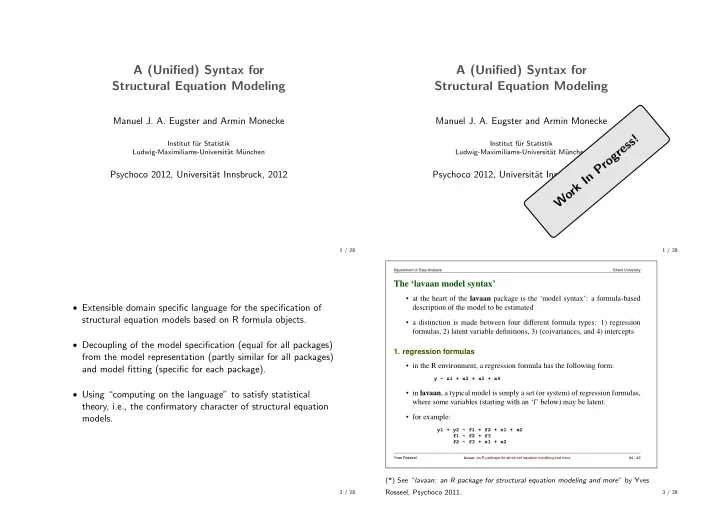
  • Extensible domain specific language for the specification of

structural equation models based on R formula objects.

  • Decoupling of the model specification (equal for all packages)

from the model representation (partly similar for all packages) and model fitting (specific for each package).

  • Using “computing on the language” to satisfy statistical

theory, i.e., the confirmatory character of structural equation models.

2 / 28

Department of Data Analysis Ghent University

The ‘lavaan model syntax’

  • at the heart of the lavaan package is the ‘model syntax’: a formula-based

description of the model to be estimated

  • a distinction is made between four different formula types: 1) regression

formulas, 2) latent variable definitions, 3) (co)variances, and 4) intercepts

  • 1. regression formulas
  • in the R environment, a regression formula has the following form:

y ~ x1 + x2 + x3 + x4

  • in lavaan, a typical model is simply a set (or system) of regression formulas,

where some variables (starting with an ‘f’ below) may be latent.

  • for example:

y1 + y2 ~ f1 + f2 + x1 + x2 f1 ~ f2 + f3 f2 ~ f3 + x1 + x2

Yves Rosseel lavaan: an R package for structural equation modeling and more 24 / 42

(*) See “lavaan: an R package for structural equation modeling and more” by Yves Rosseel, Psychoco 2011.

3 / 28

slide-2
SLIDE 2

Department of Data Analysis Ghent University

The ‘lavaan model syntax’

  • at the heart of the lavaan package is the ‘model syntax’: a formula-based

description of the model to be estimated

  • a distinction is made between four different formula types: 1) regression

formulas, 2) latent variable definitions, 3) (co)variances, and 4) intercepts

  • 1. regression formulas
  • in the R environment, a regression formula has the following form:

y ~ x1 + x2 + x3 + x4

  • in lavaan, a typical model is simply a set (or system) of regression formulas,

where some variables (starting with an ‘f’ below) may be latent.

  • for example:

y1 + y2 ~ f1 + f2 + x1 + x2 f1 ~ f2 + f3 f2 ~ f3 + x1 + x2

Yves Rosseel lavaan: an R package for structural equation modeling and more 24 / 42

(*) See “lavaan: an R package for structural equation modeling and more” by Yves Rosseel, Psychoco 2011.

5) Constraints 6) Groups 7) Dataset

3 / 28

## Model formulas: y ~ f1 + x1 + x2

4 / 28

## Structural models: regression(y ~ f1 + x1 + x2)

5 / 28

## Structural models: regression(y ~ f1 + x1 + x2) Structural equation model specification type lhs rhs lhsparam rhsparam group 1 regression y f1 y f1 <NA> 2 regression y x1 y x1 <NA> 3 regression y x2 y x2 <NA> No dataset and 0 constraint(s) specified

5 / 28

slide-3
SLIDE 3

## Structural models: regression(y ~ f1 + x1 + x2) + ## Measurement models: latent(f1 ~ y1 + y2 + y3)

6 / 28

## Structural models: regression(y ~ f1 + x1 + x2) + ## Measurement models: latent(f1 ~ y1 + y2 + y3) Structural equation model specification type lhs rhs lhsparam rhsparam group 1 regression y f1 y f1 <NA> 2 regression y x1 y x1 <NA> 3 regression y x2 y x2 <NA> 4 latent f1 y1 f1 y1 <NA> 5 latent f1 y2 f1 y2 <NA> 6 latent f1 y3 f1 y3 <NA> No dataset and 0 constraint(s) specified

6 / 28

## Structural models: regression(y ~ f1 + x1 + x2) + ## Measurement models: latent(f1 ~ y1 + y2 + y3) + ## Covariances and intercepts: covariance(y1 ~ y2) + intercept(y1 ~ 1)

7 / 28

## Structural models: regression(y ~ f1 + x1 + x2) + ## Measurement models: latent(f1 ~ y1 + y2 + y3) + ## Covariances and intercepts: covariance(y1 ~ y2) + intercept(y1 ~ 1) Structural equation model specification type lhs rhs lhsparam rhsparam group 1 regression y f1 y f1 <NA> 2 regression y x1 y x1 <NA> 3 regression y x2 y x2 <NA> 4 latent f1 y1 f1 y1 <NA> 5 latent f1 y2 f1 y2 <NA> 6 latent f1 y3 f1 y3 <NA> 7 covariance y1 y2 y1 y2 <NA> 8 intercept y1 1 y1 1 <NA> No dataset and 0 constraint(s) specified

7 / 28

slide-4
SLIDE 4

The power of R model formulas!

8 / 28

## Interactions: regression(y ~ f1 + x1*x2) Structural equation model specification type lhs rhs lhsparam rhsparam group 1 regression y f1 y f1 <NA> 2 regression y x1 y x1 <NA> 3 regression y x2 y x2 <NA> 4 regression y x1:x2 y x1:x2 <NA> No dataset and 0 constraint(s) specified

9 / 28

## Arithmetic expressions: regression(y ~ f1 + x1 + I(3.1415 * x2)) Structural equation model specification type lhs rhs lhsparam rhsparam group 1 regression y f1 y f1 <NA> 2 regression y x1 y x1 <NA> 3 regression y I(3.1415 * x2) y I(3.1415 * x2) <NA> No dataset and 0 constraint(s) specified

10 / 28

## Arithmetic expressions: regression(y ~ f1 + x1 + I(3.1415 * x2)) Structural equation model specification type lhs rhs lhsparam rhsparam group 1 regression y f1 y f1 <NA> 2 regression y x1 y x1 <NA> 3 regression y I(3.1415 * x2) y I(3.1415 * x2) <NA> No dataset and 0 constraint(s) specified ## Parameter labels: regression(y ~ f1 + x1 + I(3.1415 * x2), param = c("I(3.1415 * x2)" = "pix2")) Structural equation model specification type lhs rhs lhsparam rhsparam group 1 regression y f1 y f1 <NA> 2 regression y x1 y x1 <NA> 3 regression y I(3.1415 * x2) y pix2 <NA> No dataset and 0 constraint(s) specified

10 / 28

slide-5
SLIDE 5

## Groups: regression(y ~ f1 + x1) + latent(f1 ~ y1 + y2 | g1) Structural equation model specification type lhs rhs lhsparam rhsparam group 1 regression y f1 y f1 <NA> 2 regression y x1 y x1 <NA> 3 latent f1 y1 f1 y1 g1 4 latent f1 y2 f1 y2 g1 No dataset and 0 constraint(s) specified

11 / 28

## Groups: regression(y ~ f1 + x1) + latent(f1 ~ y1 + y2 | g1) Structural equation model specification type lhs rhs lhsparam rhsparam group 1 regression y f1 y f1 <NA> 2 regression y x1 y x1 <NA> 3 latent f1 y1 f1 y1 g1 4 latent f1 y2 f1 y2 g1 No dataset and 0 constraint(s) specified ## Global group: regression(y ~ f1 + x1) + latent(f1 ~ y1 + y2 | g1) + group(g2) Structural equation model specification type lhs rhs lhsparam rhsparam group 1 regression y f1 y f1 g2 2 regression y x1 y x1 g2 3 latent f1 y1 f1 y1 g1 4 latent f1 y2 f1 y2 g1 No dataset and 0 constraint(s) specified

11 / 28

Data for models.

12 / 28

## Model specification: regression(y ~ f1 + x1) + latent(f1 ~ y1 + y2) Structural equation model specification type lhs rhs lhsparam rhsparam group 1 regression y f1 y f1 <NA> 2 regression y x1 y x1 <NA> 3 latent f1 y1 f1 y1 <NA> 4 latent f1 y2 f1 y2 <NA> No dataset and 0 constraint(s) specified

13 / 28

slide-6
SLIDE 6

## Model specification: regression(y ~ f1 + x1) + latent(f1 ~ y1 + y2) + ## Dataset: dataset(dat) Structural equation model specification type lhs rhs lhsparam rhsparam group level param free 1 regression y f1 y f1 <NA> <NA> y_f1 TRUE 2 regression y x1 y x1 <NA> <NA> y_x1 TRUE 3 latent f1 y1 f1 y1 <NA> <NA> f1_y1 TRUE 4 latent f1 y2 f1 y2 <NA> <NA> f1_y2 TRUE A dataset and 0 constraint(s) specified

14 / 28

## Model specification: regression(y ~ f1 + x1 | g1) + latent(f1 ~ y1 + y2) + ## Dataset: dataset(dat) Structural equation model specification type lhs rhs lhsparam rhsparam group level param free 1 regression y f1 y f1 g1 1 y_f1:1 TRUE 2 regression y f1 y f1 g1 2 y_f1:2 TRUE 3 regression y x1 y x1 g1 1 y_x1:1 TRUE 4 regression y x1 y x1 g1 2 y_x1:2 TRUE 5 latent f1 y1 f1 y1 <NA> <NA> f1_y1 TRUE 6 latent f1 y2 f1 y2 <NA> <NA> f1_y2 TRUE A dataset and 0 constraint(s) specified

15 / 28

## Model specification: regression(y ~ f1 + x1 | g1) + latent(f1 ~ y1 + y2) + ## Dataset: dataset(dat) + ## Constraints: constraint(f1_y1 == 10) Structural equation model specification type lhs rhs lhsparam rhsparam group level param free 1 regression y f1 y f1 g1 1 y_f1:1 TRUE 2 regression y f1 y f1 g1 2 y_f1:2 TRUE 3 regression y x1 y x1 g1 1 y_x1:1 TRUE 4 regression y x1 y x1 g1 2 y_x1:2 TRUE 5 latent f1 y1 f1 y1 <NA> <NA> f1_y1 FALSE 6 latent f1 y2 f1 y2 <NA> <NA> f1_y2 TRUE A dataset and 1 constraint(s) specified

16 / 28

## Model specification: regression(y ~ f1 + x1 | g1) + latent(f1 ~ y1 + y2) + ## Dataset: dataset(dat) + ## Constraints: constraint(f1_y1 == 10) + constraint(y_f1:2 == y_f1:1) Structural equation model specification type lhs rhs lhsparam rhsparam group level param free 1 regression y f1 y f1 g1 1 y_f1:1 TRUE 2 regression y f1 y f1 g1 2 y_f1:2 FALSE 3 regression y x1 y x1 g1 1 y_x1:1 TRUE 4 regression y x1 y x1 g1 2 y_x1:2 TRUE 5 latent f1 y1 f1 y1 <NA> <NA> f1_y1 FALSE 6 latent f1 y2 f1 y2 <NA> <NA> f1_y2 TRUE A dataset and 2 constraint(s) specified

17 / 28

slide-7
SLIDE 7

Model checking.

18 / 28

## Measurement model m <- latent(visual ~ x1 + x2 + x3) + latent(textual ~ x4 + x5 + x6) + latent(speed ~ x7 + x8 + x9) m <- m + dataset(HolzingerSwineford1939) ## MV variances: m <- m + covariance(x1 ~ x1) + covariance(x2 ~ x2) + covariance(x3 ~ x3) + covariance(x4 ~ x4) + covariance(x5 ~ x5) + covariance(x6 ~ x6) + covariance(x7 ~ x7) + covariance(x8 ~ x8) + covariance(x9 ~ x9) ## LV variances: m <- m + covariance(visual ~ visual) + covariance(textual ~ textual) + covariance(speed ~ speed) ## LV covariance: m <- m + covariance(visual ~ textual) + covariance(visual ~ speed) + covariance(textual ~ speed) ## Constraints: m <- m + constraint(visual_x1 == 1) + constraint(textual_x4 == 1) + constraint(speed_x7 == 1)

19 / 28

## Model specification summary: summary(m) Structural equation model specification latent(formula = visual ~ x1 + x2 + x3) latent(formula = textual ~ x4 + x5 + x6) latent(formula = speed ~ x7 + x8 + x9) ... Variables: Latent Manifest 12 3 9 Latent: visual, textual, speed Manifest: x1, x2, x3, x4, x5, x6, x7, x8, x9 Parameters: Free Fixed Restricted 24 21 3 Free: visual_x2, visual_x3, textual_x5, textual_x6, speed_x8, speed_x9, x1_x1, x2_x2, x3_x3, x4_x4, x5_x5, x6_x6, x7_x7, x8_x8, x9_x9, visual_visual, textual_textual, speed_speed, visual_textual, visual_speed, textual_speed

20 / 28

... Fixed: visual_x1, textual_x4, speed_x7 Restricted: Constraints: Active Inactive 3 3 Active: visual_x1 == 1 textual_x4 == 1 speed_x7 == 1 Inactive: Data: 301 obs. of 9 variables, 0 grouping variables Variable Level Group Mean Median SD Kurtosis Skewness N NAs x1 NA NA 4.9 5.0 1.2 0.31

  • 0.25 301

x2 NA NA 6.1 6.0 1.2 0.33 0.47 301 ... Degrees of freedom: 24

21 / 28

slide-8
SLIDE 8

## Model specification plot (via qgraph): plot(m)

visual_x2 visual_x3 textual_x5 textual_x6 speed_x8 speed_x9 x1_x1 x2_x2 x3_x3 x4_x4 x5_x5 x6_x6 x7_x7 x8_x8 x9_x9 visual_visual textual_textual speed_speed visual_textual visual_speed textual_speed

  • visual

x2 x3

textual

x5 x6

speed

x8 x9 x7 x4 x1

Specified model 22 / 28

Model fitting: our initial design idea ...

23 / 28

semspec semrepr model.matrix fit semspec semPLS, lavaan, sem, ... semspec semrepr model.matrix fit semspec semPLS, lavaan, sem, ...

Formula representation

regression(y ~ f1 + x1 + x2) + latent(f1 ~ y1 + y2 + y3) + constraint(y1_y2 == 10) + dataset(dat)

slide-9
SLIDE 9

semspec semrepr model.matrix fit semspec semPLS, lavaan, sem, ...

Formula representation

regression(y ~ f1 + x1 + x2) + latent(f1 ~ y1 + y2 + y3) + constraint(y1_y2 == 10) + dataset(dat)

List representation

Structural equation model specification type lhs rhs lhsparam rhsparam group 1 regression y f1 y f1 <NA> 2 regression y x1 y x1 <NA> ...

semspec semrepr model.matrix fit semspec semPLS, lavaan, sem, ...

Formula representation

regression(y ~ f1 + x1 + x2) + latent(f1 ~ y1 + y2 + y3) + constraint(y1_y2 == 10) + dataset(dat)

List representation

Structural equation model specification type lhs rhs lhsparam rhsparam group 1 regression y f1 y f1 <NA> 2 regression y x1 y x1 <NA> ...

Matrix representation

semspec semrepr model.matrix fit semspec semPLS, lavaan, sem, ...

Formula representation

regression(y ~ f1 + x1 + x2) + latent(f1 ~ y1 + y2 + y3) + constraint(y1_y2 == 10) + dataset(dat)

List representation

Structural equation model specification type lhs rhs lhsparam rhsparam group 1 regression y f1 y f1 <NA> 2 regression y x1 y x1 <NA> ...

Matrix representation Fitting methods

Model translator: proof of concept ...

25 / 28

slide-10
SLIDE 10

## Translation for the sem package: as_sem_syntax(m) x2 = visual_x2 * visual x3 = visual_x3 * visual x5 = textual_x5 * textual x6 = textual_x6 * textual x8 = speed_x8 * speed x9 = speed_x9 * speed x7 = 1 * speed x4 = 1 * textual x1 = 1 * visual C(x1, x1) = x1_x1 C(x2, x2) = x2_x2 C(x3, x3) = x3_x3 ... ## Model fit with the sem package: semfit_sem(m)

26 / 28

## Translation for the sem package: as_sem_syntax(m) x2 = visual_x2 * visual x3 = visual_x3 * visual x5 = textual_x5 * textual x6 = textual_x6 * textual x8 = speed_x8 * speed x9 = speed_x9 * speed x7 = 1 * speed x4 = 1 * textual x1 = 1 * visual C(x1, x1) = x1_x1 C(x2, x2) = x2_x2 C(x3, x3) = x3_x3 ... ## Model fit with the sem package: semfit_sem(m) ## ... semPLS and lavaan packages: as_semPLS_syntax(m); semfit_semPLS(m) as_lavaan_syntax(m); semfit_lavaan(m)

26 / 28

A Unified Syntax for SEM?

27 / 28

A Unified Syntax for SEM?

27 / 28

slide-11
SLIDE 11

Adding semantics to the formulas using descriptive functions and seeing model specifications as programs allows

  • to create easy and easily extensible model specification

“user-interfaces” with on-the-fly error checking;

  • to maintain a clean separation of model specification, model

representation and model fitting;

  • and to satisfy statistical theory.

Prototype implementation available as package semspec from https://r-forge.r-project.org/projects/sempls/.

28 / 28