SLIDE 1
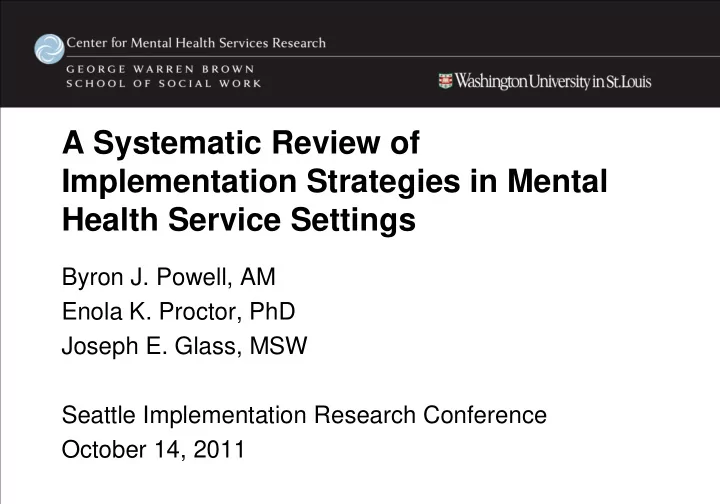
A Systematic Review of Implementation Strategies in Mental Health Service Settings
Byron J. Powell, AM Enola K. Proctor, PhD Joseph E. Glass, MSW Seattle Implementation Research Conference October 14, 2011
SLIDE 2
Implementation Strategies
“Systematic intervention processes to adopt and integrate evidence-based health innovations into routine care”
Powell et al., 2011
SLIDE 3 What is Known About the Effectiveness
- f Implementation Strategies?
- Several Systematic Reviews in Health
– Several strategies have been found to be effective under some, but not all circumstances
(Bero et al., 1998; Gilbody et al., 2003; Grimshaw et al., 2004, 2006)
– Most strategies result in modest improvements in performance (i.e., no “magic bullet”) – Passive approaches (e.g.,“train and pray”) are generally ineffective – Mixed-evidence regarding the effectiveness of multi-faceted interventions (Grimshaw et al., 2006;
Wensing et al., 2009)
SLIDE 4
Purpose
Few reviews focusing on implementation strategies in mental health. Our purpose is: 1.To characterize rigorous studies of implementation strategies in mental health 2.To demonstrate what we have learned about the effectiveness of implementation strategies in mental health service settings
SLIDE 5 Guiding Conceptual Model #1: Proctor et al.’s Conceptual Model of IR
Outcomes Feasibility Fidelity Penetration Acceptability Sustainability Adoption Costs
What?
QIs ESTs Implementation Strategies
Implementation Research Methods
Service Outcomes* Efficiency Safety Effectiveness Equity Patient- centeredness Timeliness Patient Outcomes Satisfaction Function Health status/ symptoms
Proctor et al., 2009
Implementation Strategies Systems Environment Organizational Group/Learning Supervision Individual Providers/Consumer s Intervention Strategies Evidence- Based Treatments
SLIDE 6 Guiding Conceptual Model #2: Consolidated Framework for IR (CFIR)
Intervention Characteristics
Evidentiary support, relative advantage, adaptability, trialability, and complexity
Characteristics of Individuals
Knowledge, self-efficacy, stage of change, identification with
Inner Setting
Structural characteristics, networks and communications, culture, climate, readiness for implementation
Outer Setting
Patient needs and resources, organizational connectedness, peer pressure, external policy and incentives
Process of Implementation
Planning, engaging, executing, reflecting, evaluating
Damschroder et al., 2009
SLIDE 7 Descriptive Research Questions
- What types of strategies have been
rigorously evaluated?
- What conceptual domains (of the CFIR) do
the strategies address?
- What types of outcomes are assessed?
- What can we learn from the methodological
strengths and weaknesses of implementation studies?
SLIDE 8 Effectiveness Research Questions
- What types of strategies are most effective
in improving clinical and implementation
- utcomes?
- Are multifaceted strategies more effective
than discrete strategies?
- Are multifaceted implementation strategies
that address multiple theoretical domains more effective than those that address fewer domains?
SLIDE 9 Methods
Databases:
CINAHL Plus, Medline, PubMed, PsycINFO, SocINDEX, and hand search of Implementation Science and selected articles
Search Term Concepts:
Implementation (McKibbon et al., 2010); Evidence-based practice; Mental health; Study Designs
Inclusion Criteria:
- 1. Empirical research on the implementation of an evidence-based
psychosocial treatment or guideline
- 2. Must involve both implementation strategy and clinical
intervention
- 3. Comparison design meeting Cochrane EPOC’s standards of rigor
(RCT, CCT, ITS, CBA)
SLIDE 10
Study Identification Flowchart (n = 12)
SLIDE 11 Data Extraction
- Cochrane EPOC Abstraction Form
– Clinical intervention – Strategies – Quality criteria – Outcomes – Results
– What theoretical domains did the strategies target?
- Two reviewers independently extracted data
SLIDE 12 Examples of Strategies Evaluated
- Mailing targeted practice guidelines
- Educational materials
- Training workshops
- Opinion leaders
- Audit and feedback
- Supervision and consultation
- Networking with other organizations
- Organizational capacity building
- Stakeholder engagement
SLIDE 13 Characteristics of Strategies Evaluated
- Only one study (8%) evaluated a discrete strategy
- 92% were multifaceted
- Average number of strategies evaluated = 5.17
(SD = 2.95, Range 1-12)
SLIDE 14 Lessons from Methodological Strengths and Weaknesses
- Limited theoretical justification for the
selection of strategies
– Only 42% cited a specific theory – Most cited Rogers’ Diffusion Theory – Few used theory to explicitly guide the selection
- f strategies or to test specific propositions
- Description of strategies was sometimes
very poor (note: Michie et al., 2009)
- We need more valid and reliable
implementation outcome measures
SLIDE 15
Characteristics of Strategies (Cont.)
CFIR Domain: Percent of Studies That Addressed it: Characteristics of Intervention: 25% Characteristics of Individuals: 75% Inner Setting: 58% Outer Setting: 33% Process of Implementation: 75%
SLIDE 16 What Outcomes Were Assessed?
- 92% of studies evaluated at least one
implementation outcome
- 33% evaluated both implementation and
clinical outcomes
- The average number of implementation
- utcomes per study was 1.67 (range = 1-4)
SLIDE 17
What Implementation Outcomes Were Assessed?
SLIDE 18 Outcomes Attained
- 66% attained a statistically-significant
positive result on at least one primary implementation or clinical outcome
- We did not examine effect size due to
heterogeneity of outcomes assessed
SLIDE 19
Results According to # of Strategies and Conceptual Domains Addressed
Non-Significant (n = 4) Significant (n = 8) Mean # of Strategies Employed 4 (SD = 2) 5.75 (SD = 3.28) Mean # of CFIR Domains Addressed 2 (SD = .82) 3 (1.20)
SLIDE 20 Implications for Future Research
- IR should be theory driven
- IR should integrate cost data whenever
possible
- An expanded range of implementation
- utcomes should be evaluated
- We need objective indicators of behavior
change (i.e., not solely self-report)
SLIDE 21 Implications for Future Research (Cont.)
- We need to develop/test strategies that move
beyond targeting individual professionals
- More attention should be given to the
acceptability and feasibility of strategies
- We need a suite of reporting guidelines for
different types of implementation research (Eccles et al., 2009; It would be great to see a SIRC group take on this task)
SLIDE 22 Limitations
- Heterogeneity in implementation strategies, clinical
interventions, outcomes, and measures makes comparing strategies difficult
- Methodological weaknesses may be attributed to poor
reporting (or page limitations)
- Lack of established reporting guidelines for IR studies
make quality assessment difficult
- Many limits inherent to RCTs and other “rigorous”
designs
- Haven’t “vetted” our list of studies and asked for
additional ones
SLIDE 23
References
*Atkins, M. S., Frazier, S. L., Leathers, S. J., Graczyk, P. A., Talbott, E., Jakobsons, L., et al. (2008). Teacher key opinion leaders and mental health consultation in low-income urban schools. Journal of Consulting and Clinical Psychology, 76(5), 905-908. *Azocar, F., Cuffel, B., Goldman, W., & McCarter, L. (2003). The impact of evidence- based guideline dissemination for the assessment and treatment of major depression in a managed behavioral health care organization. Journal of Behavioral Health Services & Research, 30(1), 109-118. Bero, L. A., Grilli, R., Grimshaw, J. M., Harvey, E., Oxman, A. D., & Thomson, M. A. (1998). Getting research findings into practice: Closing the gap between research and practice: An overview of systematic reviews of interventions to promote the implementation of research findings. British Medical Journal, 317(7156), 465-468. *Bert, S. C., Farris, J. R., & Borkowski, J. G. (2008). Parent training: Implementation strategies for Adventures in Parenting. J Primary Prevent, 29, 243-261. *Chamberlain, P., Price, J., Reid, J., & Landsverk, J. (2008). Cascading implementation of a foster and kinship parent intervention. Child Welfare, 87(5), 27-48.
SLIDE 24 References (Continued)
Damschroder, L. J., Aron, D. C., Keith, R. E., Kirsh, S. R., Alexander, J. A., & Lowery, J. C. (2009). Fostering implementation of health services research findings into practice: A consolidated framework for advancing implementation
- science. Implementation Science, 4(50).
Davies, P., Walker, A. E., & Grimshaw, J. M. (2010). A systematic review of the use
- f theory in the design of guideline dissemination and implementation strategies
and interpretation of the results of rigorous evaluations. Implementation Science, 5(14)Eccles, M. P., Armstrong, D., Baker, R., Cleary, K., Davies, H., Davies, S., et al. (2009). An implementation research agenda. Implementation Science, 4(18). *Forsner, T., Wistedt, A. A., Brommels, M., Janszky, I., Leon, A. P. d., & Forsell, Y. (2010). Supported local implementation of clinical guidelines in psychiatry: A two-year follow-up. Implementation Science, 5(4). Gilbody, S., Whitty, P., Grimshaw, J., & Thomas, R. (2003). Educational and
- rganizational interventions to improve the management of depression in
primary care: A systematic review. JAMA, 289(23), 3145-3151.
SLIDE 25 References (Continued)
*Glisson, C., Schoenwald, S. K., Hemmelgarn, A., Green, P., Dukes, D., Armstrong,
- K. S., et al. (2010). Randomized trial of MST and ARC in a two-level evidence-
based treatment implementation strategy. Journal of Consulting and Clinical Psychology, 78(4), 537-550. Grimshaw, J., Eccles, M., Thomas, R., MacLennan, G., Ramsay, C., Fraser, C., et
- al. (2006). Toward evidence-based quality improvement. Evidence (and its
limitations) of the effectiveness of guideline dissemination and implementation strategies 1966-1998. Journal of General Internal Medicine, 21 (Suppl 2), S14- 20. Grimshaw, J. M., Thomas, R. E., MacLennan, G., Fraser, C., Ramsay, C. R., Vale, L., et al. (2004). Effectiveness and efficiency of guideline dissemination and implementation strategies. Health Technology Assessment, 8(6). *Herschell, A. D., McNeil, C. B., Urquiza, A. J., McGrath, J. M., Zebell, N. M., Timmer, S. G., et al. (2009). Evaluation of a treatment manual and workshops for disseminating, Parent-Child Interaction Therapy. Adm Policy Ment Health, 36, 63-81.
SLIDE 26 References (Continued)
*Kauth, M. R., Sullivan, G., Blevins, D., Cully, J. A., Landes, R. D., Said, Q., et al. (2010). Employing external facilitation to implement cognitive behavioral therapy in VA clinics: A pilot study. Implementation Science, 5(75). *Kramer, T. L., & Burns, B. J. (2008). Implementing cognitive behavioral therapy in the real world: A case study of two mental health centers. Implementation Science, 3(14). *Lochman, J. E., Boxmeyer, C., Powell, N., Qu, L., Wells, K., & Windle, M. (2009). Dissemination of the coping power program: Importance of intensity of counselor
- training. Journal of Consulting and Clinical Psychology, 77(3), 397-409.
Powell, B. J., McMillen, J. C., Carpenter, C. R., Griffey, R. T., Bunger, A. C., Glass,
- J. E., et al. (Revise and Resubmit). A compilation of strategies for implementing
clinical innovations in health and mental health. *McDonel, E. C., Bond, G. R., Salyers, M., Fekete, D., Chen, A., McGrew, J. H., et
- al. (1997). Implementing Assertive Community Treatment programs in rural
- settings. Administration and Policy in Mental Health, 25(2), 153-173.
SLIDE 27 References (Continued)
Michie, S., Fixsen, D., Grimshaw, J. M., & Eccles, M. P. (2009). Specifying and reporting complex behaviour change interventions: the need for a scientific
- method. Implementation Science, 4(40).
*Palinkas, L. A., Schoenwald, S. K., Hoagwood, K., Landsverk, J., Chorpita, B. F., & Weisz, J. R. (2008). An ethnographic study of implementation of evidence-based treatments in child mental health: first steps. Psychiatric Services, 59(7), 738- 746. *Salyers, M. P., McGuire, A. B., Rollins, A. L., Bond, G. R., Mueser, K. T., & Macy,
- V. R. (2010). Integrating assertive community treatment and illness management
and recovery for consumers with severe mental illness. Community Mental Health Journal, 46, 319-329.
SLIDE 28 Acknowledgements & Contact Info
This work was supported in part by the following grants from the National Institutes of Health: GWB Mental Health Services Research Training (T32 MH019960) Dissemination and Implementation Research Core (UL1 RR024992) Center for Mental Health Services Research (P30 MH068579) Social Work Training in Addictions Research (T32 DA015035) Ruth L. Kirschstein National Research Service Award (F31AA021034) Byron J. Powell Brown School of Social Work Washington University Campus Box 1196
- St. Louis, Missouri 63130
bjpowell@wustl.edu