
SLIDE 1
A systematic approach to studying the physics of cool clouds in the hot winds of galaxy halos
Ian Remming & Cameron Liang University of Chicago
1
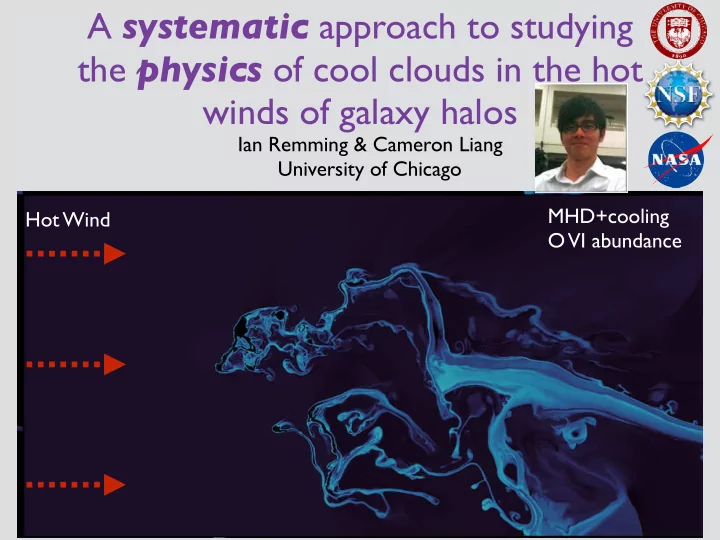
MHD+cooling O VI abundance Hot Wind
A systematic approach to studying the physics of cool clouds in the - - PowerPoint PPT Presentation
A systematic approach to studying the physics of cool clouds in the hot winds of galaxy halos Ian Remming & Cameron Liang University of Chicago MHD+cooling Hot Wind O VI abundance 1 Why is the CGM multiphase? Image credit: HST
Ian Remming & Cameron Liang University of Chicago
1
MHD+cooling O VI abundance Hot Wind
2 Image credit: HST
~~ moving through ~~
3
Image credit: HST
4
Gnedin & Hollon 2012, Haardt & Madau 2012, McCourt+ 2017,
Schneider & Robertson 2017 , Scannapieco & Brüggen 2015
5
Spitzer 1962, Cowie & McKee 1977, Armillotta+ 2016, Armillotta+ 2017
6
(Gnedin & Hollon 2012, Haardt & Madau 2012)
(Meyer, Balsara & Aslam 2012, 2014)
7
Meyer, Balsara & Aslam 2012, 2014, Orlando+ 2008, McCourt+ 2015
8
The B-field moves with the gas, tangles, and wraps around cold filaments. Protects cold gas from the wind. The stronger B-field contains the cooling gas in one long feature. The B-field insulates the cold gas from the hot environment. Cloud core cools and shatters. Wind compresses and breaks apart fragments.
β-1 = 0, cooling only β-1 =0.1, Weak Field and cooling β-1 =1.0, strong field and cooling β-1 =1.0, cooling, anisotropic conduction
9
The B-field moves with the gas, tangles, and wraps around cold filaments. Protects cold gas from the wind. The stronger B-field contains the cooling gas in one long feature. The B-field insulates the cold gas from the hot environment. Cloud core cools and shatters. Wind compresses and breaks apart fragments.
β-1 = 0, cooling only β-1 =0.1, Weak Field and cooling β-1 =1.0, strong field and cooling β-1 =1.0, cooling, anisotropic conduction
10
β-1 = 0.1 β-1 = 1.0 β-1 = 1.0 + conduction Around cold, dense features, the magnetic field lines are compressed. The B-field protects the gas from shear instabilities and conduction.
−4 −3 −2 −1 log nH [cm−3] 4 5 6 7 log T [K] 1.0 2.0 2.8 log β−1
51 pc 51 pc
Weak initial field Strong initial field
11
◼ Protecting from shear instabilities
−4 −3 −2 −1 log nH [cm−3] 4 5 6 7 log T [K] 1.0 2.0 2.8 log β−1
◼ Field lines drape around pc-scale
◼ The warm cloud shatters.
(see McCourt’s talk later today)
◼ The cloud fully evaporates on a short timescale < 7 Myr. ◼ Enhancing the local field strength,