SLIDE 1
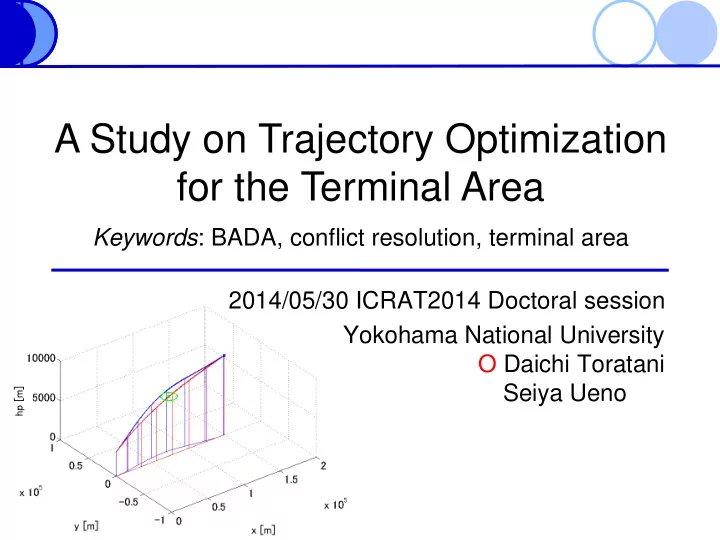
A Study on Trajectory Optimization for the Terminal Area
Keywords: BADA, conflict resolution, terminal area 2014/05/30 ICRAT2014 Doctoral session Yokohama National University O Daichi Toratani Seiya Ueno
SLIDE 2 1, Introduction
- Background and target of this study
2, Problem formulation (without conflict)
3, Simulation results (without conflict) 4, Problem formulation (Conflict resolution)
- Introducing conflict resolution
5, Simulation results (Conflict resolution) 6, Conclusion and future plan
Table of contents
1/25
SLIDE 3 Continuous descent operation (CDO)
1, Introduction 1/6
CDO Conventional descent operation CDO is able to improve;
- Fuel consumption
- Noise pollution
etc.
- Descending constant rate
- Constant thrust
Step-by-step Climb Descent
Tokyo international airport (Haneda airport), HND
Proposed for the CDO 2/25 Crossing
SLIDE 4 the optimal conflict-free trajectory for the CCO.
Air traffic management in the terminal area
1, Introduction 2/6
Air port Air port Conflict Fixed!
- Conventional descent operation
(Step-by-step)
- Continuous descent operation
Climb Descent Continuous climb operation (CCO)
Stepped climb CCO
3/25 The purpose of this study is …
SLIDE 5 Optimal trajectory → Arc
4/13
𝑌0 = 90 [deg] 𝑌𝑔 = 0 [deg] 1 1 where 𝑌𝑈 = 𝜄 𝑦 𝑧 0: Initial f : Terminal
Optimal control theory and trajectory optimization
cos 𝜄 sin 𝜄
- State equation (Dubins car)
𝑒 𝑒𝑢 𝜄 𝑦 𝑧 = 𝑣 cos 𝜄 sin 𝜄 Input: 𝑣
- Criterion (Minimum input)
Minimizing 𝐾 =
𝑢0 𝑢𝑔 1
2 𝑣2 𝑒𝑢 𝑊 = 1 (const.) 𝑦 𝑧 𝜄 𝑦 𝑧
𝑌0 = 90 [deg] 𝑌𝑔 = 0 [deg] 1 1
1, Introduction 3/6
e.g.) Cruising aircraft
SLIDE 6 5/13
Related previous studies (Optimal control approach)
- A. Andreeva-Mori et al., “Scheduling of Arrival Aircraft Based on
Minimum Fuel Burn Descents”
- Fuel burn model
- Optimal trajectory
→ CDO
- J. Hu et al., “Optimal Coordinated Maneuvers for Three-Dimensional
Aircraft Conflict Resolution”
conflict resolution
conflict resolution
1, Introduction 4/6
SLIDE 7
6/16
Problem of the trajectory optimization
1, Introduction 5/6
! It is difficult to treat spatial and temporal conflict resolutions simultaneously.
Vectoring (Spatial control) Changing velocity (Temporal control) In the practice of the air traffic control, … Spatial conflict resolution Temporal conflict resolution Slowdown Spatial and Temporal conflict resolution
?
SLIDE 8 Space-time coordinate system (STCS)
1, Introduction 6/6
t x y t = t1 t = t2 t = t3 x y
t
To develop the optimization method in the STCS.
- Conflict resolution, minimum fuel, minimum time, etc.
In the STCS,;
- The vertical axis means time.
- It is able to treat the time
along with the position.
- It is also able to calculate
the altitude. 4D trajectory Which conflict resolutions (spatial or temporal) are optimal to resolve conflict?
The target of this study is ... 7/25
SLIDE 9
𝑈ℎ𝑠 − 𝐸 𝑊𝑈𝐵𝑇 = 𝑛0 𝑒ℎ 𝑒𝑢 + 𝑛𝑊𝑈𝐵𝑇 𝑒𝑊𝑈𝐵𝑇 𝑒𝑢 ↔ 𝑒𝑊𝑈𝐵𝑇 𝑒𝑢 = 1 𝑛 𝑈ℎ𝑠 − 𝐸 − 𝑛 sin 𝛿
𝑒𝜔 𝑒𝑢 = 0 𝑊𝑈𝐵𝑇 tan 𝜚
𝐺𝐺 = 𝐷
𝑔1 1 + 𝑊𝑈𝐵𝑇
𝐷
𝑔2
𝑈ℎ𝑠
𝑈ℎ𝑠 = 𝐷𝑈𝑑,1 1 − ℎ𝑞 𝐷𝑈𝑑,2 + 𝐷𝑈𝑑,3ℎ𝑞
2
Base of aircraft data (BADA)
γ 𝑛 𝐸 𝑀 𝑈ℎ𝑠 𝑦 ℎ𝑞
2, Problem formulation (w/o conflict) 1/5
𝜔 𝛿 𝑦 𝑧 𝐼𝑞 𝑊𝑈𝐵𝑇 8/25
SLIDE 10
𝑒 𝑒𝑢 𝛿 𝑦 𝑧 ℎ𝑞 = 𝑊𝑈𝐵𝑇 tan 𝜚 1 𝑛 𝑈ℎ𝑠 − 𝐸 − 𝑛 sin 𝛿 𝑞 𝑊𝑈𝐵𝑇 cos 𝛿 cos 𝜔 𝑊𝑈𝐵𝑇 cos 𝛿 sin 𝜔 𝑊𝑈𝐵𝑇 sin 𝛿
𝐺𝐺 = 𝐷
𝑔1 1 + 𝑊𝑈𝐵𝑇
𝐷
𝑔2
𝑈ℎ𝑠 𝑞: Rate of flight path angle
Base of aircraft data (BADA)
𝑊𝑈𝐵𝑇 𝜔
γ 𝑛 𝐸 𝑀 𝑈ℎ𝑠 𝑦 ℎ𝑞 𝜔 𝛿 𝑦 𝑧 𝐼𝑞 𝑊𝑈𝐵𝑇
2, Problem formulation (w/o conflict) 2/5
9/25
SLIDE 11
𝑒 𝑒𝑡 𝜔𝑡 𝜔𝑢 𝑦 𝑧 𝑢 = 𝜆𝑡 𝜆𝑢 cos 𝜔𝑡 cos 𝜔𝑢 sin 𝜔𝑡 cos 𝜔𝑢 sin 𝜔𝑢 𝜆: Curvature Subscript 𝑡: Spatial 𝑢: Temporal Independent variable Length of the trajectory 𝑡 x y
t
𝜔𝑡 ds 𝜔𝑢 dy dx dl 𝑊 = 𝑒𝑚 𝑒𝑢 = tan 90° − 𝜔𝑤 = 1 tan 𝜔𝑢 𝑏 = − 𝜆𝑢 sin3𝜔𝑢 ↔ 𝜆𝑢 = −𝑏sin3𝜔𝑢 dl dt ds 𝜔𝑢
- Velocity and acceleration
2, Problem formulation (w/o conflict) 3/5
Space-time coordinate system (STCS)
10/25
SLIDE 12
- BADA (Independent variable: time)
𝑒 𝑒𝑢 𝜔𝑡 𝑊𝑈𝐵𝑇 𝛿 𝑦 𝑧 ℎ𝑞 = 𝑊𝑈𝐵𝑇 tan 𝜚 1 𝑛 𝑈ℎ𝑠 − 𝐸 − 𝑛 sin 𝛿 𝑞 𝑊𝑈𝐵𝑇 cos 𝛿 cos 𝜔𝑡 𝑊𝑈𝐵𝑇 cos 𝛿 sin 𝜔𝑡 𝑊𝑈𝐵𝑇 sin 𝛿
𝑒𝜔𝑢 𝑒𝑡 = −𝑏sin3𝜔𝑢 𝑒𝑢 𝑒𝑡 = sin 𝜔𝑢 𝑊𝑈𝐵𝑇 = 1 tan 𝜔𝑢
+
2, Problem formulation (w/o conflict) 4/5
𝑒 𝑒𝑡 𝜔𝑡 𝜔𝑢 𝛿 𝑦 𝑧 ℎ𝑞 𝑢 = sin 𝜔𝑢 tan 𝜔𝑢 tan 𝜚 −sin3𝜔𝑢 1 𝑛 𝑈ℎ𝑠 − 𝐸 − 𝑛 sin 𝛿 sin 𝜔𝑢 𝑞 cos 𝜔𝑡 cos 𝜔𝑢 cos 𝛿 sin 𝜔𝑡 cos 𝜔𝑢 cos 𝛿 cos 𝜔𝑢 sin 𝛿 sin 𝜔𝑢 11/25
SLIDE 13 Optimal control problem and calculation method
Constraint equation Criterion Boundary conditions
𝑒𝒀 𝑒𝑡 = 𝑮 𝐾 =
𝑡𝐺
𝑀 𝑒𝑡 𝒀 𝑡0 = 𝒀𝟏 𝒀 𝑡𝑔 = 𝒀𝒈
- Two-point boundary value problem (TPBVP)
Simultaneous non-linear differential equations
- Simultaneous non-linear equations
Simultaneous non-linear equations solver
2, Problem formulation (w/o conflict) 5/5
Optimal control theory Linear approximation State equation Fuel flow Initial and terminal state
Minimizing
12/25
SLIDE 14 Optimal climbing trajectory in the 3D space
Simulation conditions
Units: 𝜔𝑡 𝑊𝑈𝐵𝑇 𝛿 𝑦 𝑧 ℎ𝑞 𝑢 = deg m/s deg m m m s 𝐺 : Terminal free Initial condition 𝜔𝑡0 𝑊𝑈𝐵𝑇0 𝛿0 𝑦0 𝑧0 ℎ𝑞0 𝑢0 = 0 150.0 5 3000
291.6 [kt] 9843 [ft]
Terminal condition 𝜔𝑡𝑔 𝑊𝑈𝐵𝑇𝑔 𝛿𝑔 𝑦𝑔 𝑧𝑔 ℎ𝑞𝑔 𝑢𝑔 = 0 250.0 𝐺 𝐺 10000 𝐺
485.0 [kt] 32808 [ft]
32808 [ft]
Data of aircraft Boeing 777-200
3, Simulation results (w/o conflict) 1/3
107.99 [nm] 54.00 [nm]
13/25
SLIDE 15 Trajectories in the 3D space and the STCS
3D space Space-time coordinate system
3, Simulation results (w/o conflict) 2/3
32808 [ft]
14/25
SLIDE 16 TAS, altitude, fuel flow, and fuel consumption
- The optimal trajectory in the STCS is derived.
39370 [ft] 583.2 [kt]
3, Simulation results (w/o conflict) 3/3
11.02 [lb/s] 6614 [lb]
700.3 [s] 2509 [kg]
15/25
SLIDE 17
Spatial conflict resolution
x y time 5 [nm] Spatial interval Vectoring (Spatial control)
Temporal conflict resolution
x y time 250 [m/s] 37.0 [s] 5 [nm] = 9260 [m] Temporal interval in the STCS Changing velocity (Temporal control)
4, Problem formulation (Conflict resolution) 1/2
16/25
SLIDE 18
If you wont to add a new constraint, … Waypoint
Interior-point constraint
4, Problem formulation (Conflict resolution) 2/2
17/25
SLIDE 19
Trajectory1 Trajectory2 Split! Initial1 Initial2 Terminal1 Terminal2 Position1 = Position2 (Specified) Angle1 = Angle2 (Free) ⋮
Interior-point constraint
4, Problem formulation (Conflict resolution) 2/2
17/25
SLIDE 20 If you wont to add a new constraint, … Waypoint Trajectory1 Trajectory2 Split! Initial1 Initial2 Terminal1 Terminal2 Position1 = Position2 (Specified) Angle1 = Angle2 (Free) ⋮ Trajectory with constraint
- The original trajectory optimization is transformed to the trajectory
- ptimization problem with a new constraint.
- To see clearly which conflict resolutions are optimal, conflict
resolution with specified point is shown.
Interior-point constraint
4, Problem formulation (Conflict resolution) 2/2
17/25
SLIDE 21 Conflict point 𝜔𝑡 𝑊𝑈𝐵𝑇 𝛿 𝑦 𝑧 ℎ𝑞 𝑢 = 0 225.9 2.410 73842 7553 384.4
439.0 [kt] 39.87 [nm] 24781 [ft]
Simulation conditions (Interior point constraint)
32808 [ft]
5, Simulation results (Conflict resolution) 1/6
54.00 [nm]
107.99 [nm]
Descending aircraft Fixed
18/25
SLIDE 22 32808 [ft]
Spatial w/o conflict
Simulation conditions (Spatial conflict resolution)
5, Simulation results (Conflict resolution) 2/6
107.99 [nm] 54.00 [nm]
Interior point conditions 𝜔𝑡𝑗𝑜𝑢 𝑊𝑈𝐵𝑇𝑗𝑜𝑢 𝛿𝑗𝑜𝑢 𝑦𝑗𝑜𝑢 𝑧𝑗𝑜𝑢 ℎ𝑞𝑗𝑜𝑢 𝑢𝑗𝑜𝑢 = 0 𝐺 𝐺 73842 9260 𝐺 𝐺
39.87 [nm] 5 [nm]
19/25
SLIDE 23 Spatial conflict resolution
3D space x-y plane
5, Simulation results (Conflict resolution) 3/6
Spatial w/o conflict
32808 [ft]
20/25
- It is confirmed that the spatial conflict resolution is
able to resolve the conflict with the spatial control.
SLIDE 24 Temporal w/o conflict
Simulation conditions (Temporal conflict resolution)
5, Simulation results (Conflict resolution) 4/6
54.00 [nm]
107.99 [nm]
Interior point conditions 𝜔𝑡𝑗𝑜𝑢 𝑊𝑈𝐵𝑇𝑗𝑜𝑢 𝛿𝑗𝑜𝑢 𝑦𝑗𝑜𝑢 𝑧𝑗𝑜𝑢 ℎ𝑞𝑗𝑜𝑢 𝑢𝑗𝑜𝑢 = 0 𝐺 𝐺 73842 𝐺 421.4 5 [nm] / 225.9 [m/s] = 41.0 [s] 384.4 + 41.0 = 421.4 [s] Conflict point 𝑢𝑗𝑜𝑢=384.4 [s] 𝑊𝑈𝐵𝑇𝑗𝑜𝑢=225.9 [m/s] 21/25
SLIDE 25 Temporal conflict resolution
Space-time coordinate system x-y plane
5, Simulation results (Conflict resolution) 5/6
Spatial w/o conflict
22/25
- It is confirmed that the temporal conflict resolution is
able to resolve the conflict decreasing its velocity.
SLIDE 26 5, Simulation results (Conflict resolution) 6/6
Fuel flow and fuel consumption
w/o conflict Spatial Temporal Terminal time [s] 700.3 705.7 769.6 Fuel consumption [kg] [lb] 2509 2520 2581 5531 5556 5690
- The fuel consumption with the spatial conflict resolution
is lower than the fuel consumption with the temporal conflict resolution.
Cuise 𝑦𝑔 = 150000 [m] = 80.99 [nm]
11.02 [lb/s] 6614 [lb]
23/25
SLIDE 27 The trajectory optimization method in the space-time coordinate system is developed, and the optimal trajectory is derived. By introducing the interior-point constraint, the
conflict-free trajectories with spatial and temporal conflict resolutions are obtained. The fuel consumption with the spatial conflict resolution is lower than the fuel consumption with the temporal conflict resolution.
Conclusion
6, Conclusion and future plan
24/25
SLIDE 28 The optimal trajectories will be obtained in various boundary conditions.
- e.g.) Conflict resolution with accelerating velocity.
The model of the trajectory will be improved.
- Introducing mass change, 𝑊
𝐷𝐵𝑇, clime rate, etc.
Multiple aircraft will be introduced to the trajectory
25/25
Future plan
6, Conclusion and future plan