
SLIDE 1
HEALTH SYSTEMS ASSESSMENT
Mhondoro Ngezi District 2019
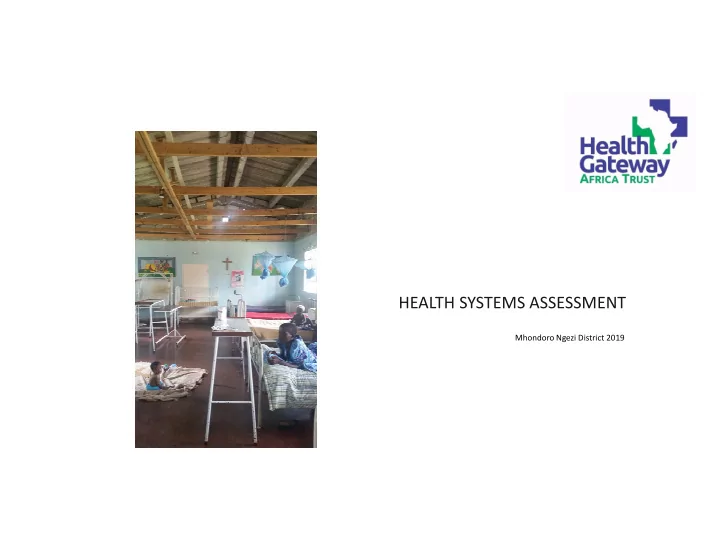
HEALTH SYSTEMS ASSESSMENT Mhondoro Ngezi District 2019 Purpose, - - PowerPoint PPT Presentation
HEALTH SYSTEMS ASSESSMENT Mhondoro Ngezi District 2019 Purpose, Objectives and Program Trajectory Purpose, Objectives and Program Trajectory Disadvantaged communities Women and children HealthGateway Africa Trust Access to Health Care
HEALTH SYSTEMS ASSESSMENT
Mhondoro Ngezi District 2019
‘HealthGateway Africa Trust’
Increase universal access to care Need‐based coverage Health equity Increase community participation
Phase 1
Increasing service delivery capacity
Increasing facility range of services
instituting phased service payment scheme for gradual self sustainability
Phase 2
Increasing community uptake health care services
awareness campaigns
Preventing disease occurrence by boosting resilience
to nutritional supplements
livelihood & quality of life
In line with phase 1 objectives
Disease prevalence, severity, health seeking behavior Institutional capacity expertise medication equipment Services affordability accessibility Review of external support programmin g
Hypertension (BP) 45 years of age and above There is no medicine
Causes stroke Organ failure Blindness Sudden death
Life‐style condition
Unhealthy diet Excessive alcohol intake
Diabetes Mental Illness Asthma
500 1000 1500 2000 2500 3000 3500 4000 DIABETES ASTHMA LEPROSY EPILEPSY MENTAL ILLNESS HYPERTENSION
CA BREAST CA CERVIX CA PROSTATE ALL OTHER CANCERS
352 302 2 124 342 2593 26 33 9 4 2 190 391 381 3 136 347 3640 87 65 5 1 2 202
Mhondoro Ngezi District 2018 Disease Prevanence By Gender
Female Prevalence Male Prevalence
100 200 300 400 500 600 700 DIABETES ASTHMA LEPROSY EPILEPSY MENTAL ILLNESS HYPERTENSION
CA BREAST CA CERVIX CA PROSTATE ALL OTHER CANCERS
41 50 37 86 197 26 1 30 140 25 61 45 647 4 50 4 2 28
St Michaels Ward 2018 Disease Prevalence by Gender
Female Prevalence Male Prevalence
TABLE 2: In St Michaels ward 1, women are 3 times more susceptible than men to developing Hypertension and Diabetes.
Tuberculosis (TB) Men = low health seeking behavior Cancers = ignorance Teenagers with HIV HIV
Cross cutting among ‐ wide variety
Non‐ disclosure causes wrong diagnosis STIGMA fuels Non‐ disclosure Traditional myths & misconcepti
High illiteracy rate
Early child marriages Hospital staff not trained or experienced Let alone the community
Theatre professionals Mental health nurses Professional counsellors A single ambulance driver No dedicated trained security
Doctor Eye surgeon Dentist
Results Based Financing (RBF) resources inadequate.
Drugs for Hypertension Mental illness Epilepsy Antibiotics in Analgesics Wound dressing towels
Includes Hypertension 2nd line medication Oxygen tanks Resuscitation medication Facilities, and equipment
ii.No ambulance iii.Need for WIFI to improve communication
St Michaels and Ngezi hospitals under capacitated General infrastructure not conducive for hospital operations
Technical Equipment
Increasing Capacity via Equipment Reducing Workload via Prevention activities: To reduce and eventually eliminate targeted ailments (group‐ counselling sessions)
Non‐technical Equipment
Clients: To improve client’s quality
improved well‐being. Providers: To improve provider working conditions, effectiveness and staff retention.
St Michaels Hospital
Gadgets a.BP/ Hypertension assessment machines b.Diabetes machines (re‐usable) Equipment a.No IT equipment and staff also not trained for ICT (at least 10 computers required) b.Physiotherapy training machines c.Medicine trolleys (at least 6 needed) d.Surgical trolleys (at least 10 needed) e.Kitchen ware needed f.Chairs for staff and clients g.Sundries – of the 60 hospital beds, most of them are obsolete; 104 lockers old and rusty – used since 1984 Facilities and Infrastructure a.Water supply pipe system needs to be changed from galvanized to PVC to stop water calcifying. b.Back‐up borehole urgently required c.Sluice room needs refabricating
Ngezi Hospital
Gadgets a.BP machines Equipment a.Scales to weigh children & adults b.Photocopier not working c.Beds old and malformed – blankets and mattresses tattered and torn d.Cleaning equipment (mop with bucket and rollers) e.Curtains f.Washing machine not working g.Generator not working h.Fridges not working i.Hospital has no ambulance j.Sluicing Expecting mothers have no stove Facilities and Infrastructure
Resource allocation Performance management Performance‐ based reward
Deliveries Consultations Immunization
75% of RBF = hospital demands 25% = staff incentives Allocation differ with institution
Consultation fees Admission fees
Cost RTGS$ 5 per day 50% cannot afford to pay Cost RTGS$ 5 25% cannot afford to pay
Consultation = RTGS$ 2. 50% cannot afford. Service free for under 5s and over 65s. Maternity patients pay a fee & bring material needed.
No stake‐holder
Incompatibility Low ingenuity programming models. Poor or no transitional
Programmer conflict of
demand to donors Incentivizing health facility staff for specific
Abuse of Donated
monitoring critical. Hospitals not distribution centres. Sponsors should have
Commodity allocation should be based on need & performance. Audit critical. Pilot critical.