A STUDY ON THE BEHAVIOR ANALYSIS OF HUMAN RIGHT A STUDY ON THE BEHAV - - PDF document

a study on the behavior analysis of human right a study
SMART_READER_LITE
LIVE PREVIEW

A STUDY ON THE BEHAVIOR ANALYSIS OF HUMAN RIGHT A STUDY ON THE BEHAV - - PDF document

18 TH INTERNATIONAL CONFERENCE ON COMPOSITE COMPOSITE MATERIALS A STUDY ON THE BEHAVIOR ANALYSIS OF HUMAN RIGHT A STUDY ON THE BEHAV OF HUMAN RIGHT ARM UNDER IMPACT CON ARM UNDER IMPACT CONDITION DITION J. Chae 1 *, E. Choe 1 , J. Lee 1 , H.


slide-1
SLIDE 1

1 General Introduction In this study, the behavior analysis of human right arm under impact condition was performed by creating the human model of Korean both the impact force and the applied load of the specific joint through a simulation of occurred condition with hammering impact was obtained right arm was modeled by muscle-skeleton elements to obtain the behavior of right arm of human under impact condition, where physical and geometrical properties of human body such as Young's modulus, shear modulus, cross sectional area, length, density, moment of inertia and position were defined. Based

  • n the numerical model of the right arm, the impact

response of the right arm was obtained. By the comparison with the experimental results, the model

  • f the right arm was verified.

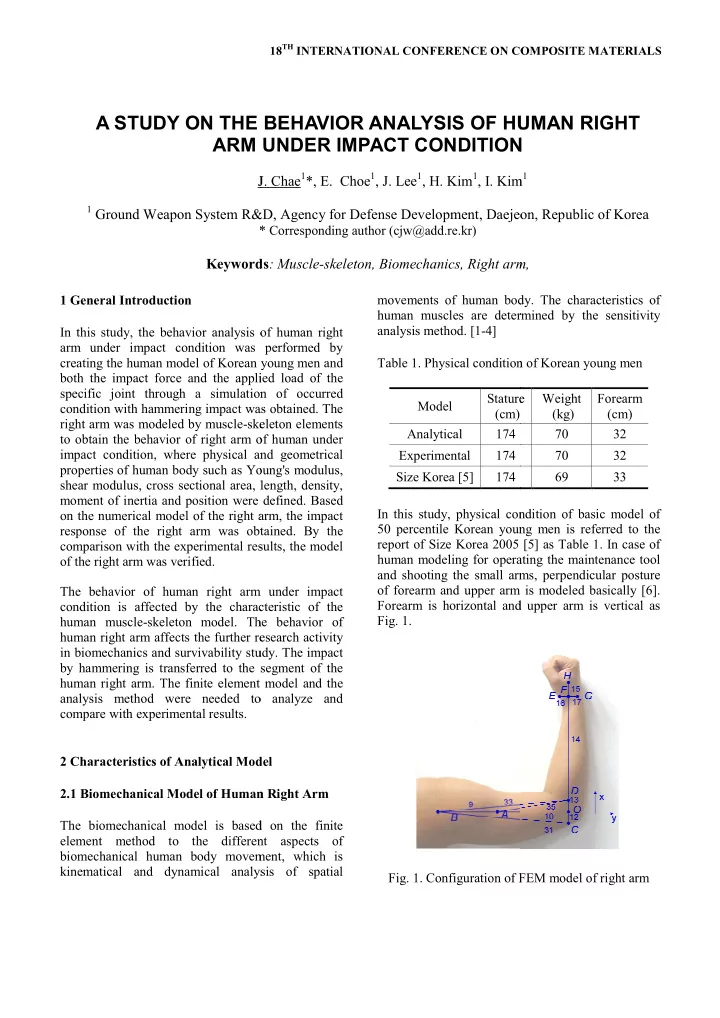
The behavior of human right arm under impact condition is affected by the characteristic of the human muscle-skeleton model. The behavior of human right arm affects the further research activity in biomechanics and survivability study. by hammering is transferred to the segment of the human right arm. The finite element model and the analysis method were needed to analyze and compare with experimental results. 2 Characteristics of Analytical Model 2.1 Biomechanical Model of Human Right Arm The biomechanical model is based on the element method to the different aspects of biomechanical human body movement, which is kinematical and dynamical analysis of spatial

A STUDY ON THE BEHAV ARM UNDER IMPACT CON

J.

1 Ground Weapon System R&D, Agency

*

Keywords

18TH INTERNATIONAL CONFERENCE ON COMPOSITE

behavior analysis of human right was performed by young men and both the impact force and the applied load of the joint through a simulation of occurred was obtained. The skeleton elements avior of right arm of human under physical and geometrical properties of human body such as Young's modulus, shear modulus, cross sectional area, length, density, moment of inertia and position were defined. Based

  • del of the right arm, the impact

response of the right arm was obtained. By the comparison with the experimental results, the model human right arm under impact condition is affected by the characteristic of the he behavior of the further research activity

  • study. The impact

to the segment of the human right arm. The finite element model and the to analyze and Model Biomechanical Model of Human Right Arm is based on the finite to the different aspects of human body movement, which is kinematical and dynamical analysis of spatial movements of human body human muscles are determined analysis method. [1-4] Table 1. Physical condition of Model Stature (cm) Analytical 174 Experimental 174 Size Korea [5] 174 In this study, physical condition of 50 percentile Korean young m report of Size Korea 2005 human modeling for operat and shooting the small arms,

  • f forearm and upper arm is

Forearm is horizontal and upper arm is vertical

  • Fig. 1.
  • Fig. 1. Configuration of FEM model of right arm

A STUDY ON THE BEHAVIOR ANALYSIS OF HUMAN RIGHT ARM UNDER IMPACT CONDITION

  • J. Chae1*, E. Choe1, J. Lee1, H. Kim1, I. Kim

Ground Weapon System R&D, Agency for Defense Development, Daejeon, Republic

* Corresponding author (cjw@add.re.kr)

Keywords: Muscle-skeleton, Biomechanics, Right arm

COMPOSITE MATERIALS

movements of human body. The characteristics of human muscles are determined by the sensitivity Physical condition of Korean young men Stature Weight (kg) Forearm (cm) 70 32 70 32 69 33 condition of basic model of young men is referred to the [5] as Table 1. In case of human modeling for operating the maintenance tool and shooting the small arms, perpendicular posture

  • f forearm and upper arm is modeled basically [6].

Forearm is horizontal and upper arm is vertical as Configuration of FEM model of right arm

OF HUMAN RIGHT DITION

Kim1 Daejeon, Republic of Korea Right arm,

slide-2
SLIDE 2

2.2 Kinematics and Dynamics Kinematics is described as follows. The major equation of generalized displacement { skeleton-muscle system depends

  • n

static application of forces {P}

[] ∙ {∆} = {}

Where, [K] is a global matrix of system stiffness, { is a generalized displacements vector and { generalized exterior forces vector. The the global stiffness matrix [K] are calculated by common rules of the finite element method be represented as;

 =   

   

Where, ke

ij is elements of local stiffness matrix

  • riented in global coordinate system,

numbers of generalized displacements in local system, and n is the number of finite elements.

  • Fig. 2. Rod element and degree of freedom of node
  • f human body

The structural mechanical displacements of bar elements are represented in Fig. 2. Connection between local stiffness matrix of bar element and arbitrary oriented in global Kinematics is described as follows. The major generalized displacement {Δ} of muscle system depends

  • n

static (1) ] is a global matrix of system stiffness, {Δ} generalized displacements vector and {P} is a generalized exterior forces vector. The elements of ] are calculated by common rules of the finite element method and can (2) is elements of local stiffness matrix system, i and j are the numbers of generalized displacements in local is the number of finite elements. Rod element and degree of freedom of node mechanical displacements of bar Connection between local stiffness matrix of bar element and arbitrary oriented in global X Y Z stiffness matrix of the same element in local is carried out by way of guide cosine matrix [ And [l] is matrix of direction cosines.

  = [][

where,

[] =  [] [] [] []  , []

Each element of local stiffness matrix a force or reaction appearing in displacement along j direction. is are represented in Fig. 3

  • Fig. 3. Stiffness matrix

Where, L is length of element,

  • f elasticity and rigidity,

section, J0, is polar moment of inertia, inertia moments of elements on cross about main central axis. Moment of human is described by the following equation.

[]∆̈  + []∆̇  + [

Where, [H] is a dissipation matrix in terms of experimental coefficients α

[] = [] +

3 2 3 2 3 2 3 2 2 2

12 6 6 12 6 6 5 10 5 10 12 6 12 6 6 6 5 10 5 10 6 4 6 2 2 10 15 10 30 6

z z z z y y y y y y y y

EA EA N N L L EJ N EJ N EJ N EJ N L L L L L L EJ EJ EJ EJ N N N N L L L L L L GJ GJ L L EJ EJ EJ EJ N NL N NL L L L L +

  • +

+

  • +

+

  • +

+

  • 2

2 3 2 3 2 3 2 3 2

4 2 6 2 10 15 10 30 12 6 6 12 6 6 5 10 5 10 12 6 12 6 6 6 5 10 5 10 6

z z z z z z z z y y y y

EJ N EJ NL EJ N EJ NL L L L L EA EA N N L L EJ N EJ N EJ N EJ N L L L L L L EJ EJ EJ EJ N N N N L L L L L L GJ GJ L L + +

  • +
  • +
  • +

+ +

  • 2

2 2 2

2 6 4 10 30 10 15 6 2 6 4 2 10 30 10 15

y y y y z z z z

EJ EJ EJ EJ N NL N NL L L L L EJ N EJ NL EJ N EJ NL L L L L

  • +

+ +

  • +

é ù ê ú ê ú ê ú ê ú ê ú ê ú ê ú ê ú ê ú ê ú ê ú ê ú ê ú ê ú ê ú ê ú ê ú ê ú ê ú ê ú ê ú ê ú ê ú ê ú ê ú ê ú ê ú ê ú ê ú ê ú ê ú ë û

stiffness matrix of the same element in local x y z [ke] is carried out by way of guide cosine matrix [L]. direction cosines.

[][]

(3)

 [ ] =           

(4) stiffness matrix ke

ij represents

a force or reaction appearing in i direction for unit

  • direction. Full stiffness matrix

tiffness matrix considering force N length of element, E and G are modulus

  • f elasticity and rigidity, F is an area of cross-

is polar moment of inertia, Jy and Jz are

  • f elements on cross-section area

Moment of human right arm is described by the following equation.

[]{∆} = {}

(5) dissipation matrix in terms of α and β as follows;

] + []

(6)

3 2 3 2 3 2 3 2 2 2

12 6 6 12 6 6 5 10 5 10 12 6 12 6 6 6 5 10 5 10 6 4 6 2 10 15 10 30

z z z z y y y y y y y y

EA EA N N L L EJ N EJ N EJ N EJ N L L L L L L EJ EJ EJ EJ N N N N L L L L L L GJ GJ L L EJ EJ EJ EJ N NL N NL L L L L +

  • +

+

  • +

+

  • +

+

  • 2

2 3 2 3 2 3 2 3 2

4 2 6 2 10 15 10 30 12 6 6 12 6 6 5 10 5 10 12 6 12 6 6 6 5 10 5 10

z z z z z z z z y y y y

EJ N EJ NL EJ N EJ NL L L L L EA EA N N L L EJ N EJ N EJ N EJ N L L L L L L EJ EJ EJ EJ N N N N L L L L L L GJ GJ L L + +

  • +
  • +
  • +

+ +

2 2 2 2

2 6 4 2 10 30 10 15 6 2 6 4 2 10 30 10 15

y y y y z z z z

EJ EJ EJ EJ N NL N NL L L L L EJ N EJ NL EJ N EJ NL L L L L

  • +

+ +

  • +

é ù ê ú ê ú ê ú ê ú ê ú ê ú ê ú ê ú ê ú ê ú ê ú ê ú ê ú ê ú ê ú ê ú ê ú ê ú ê ú ê ú ê ú ê ú ê ú ê ú ê ú ê ú ê ú ê ú ê ú ê ú ê ú ë û

slide-3
SLIDE 3

3 A STUDY ON THE BEHAVIOR ANALYSIS OF HUMAN RIGHT ARM UNDER IMPACT CONDITION

If experimental data is absent, [H] is described by the following equation, approximately according to Arsenev et al. [7],

[] = 0.15 ∙ 4ν[]

(7) where, ν is the lowest natural frequency of the

  • system. {Pt+δt} is a generalized exterior force vector

with arbitrary law of change. To determine natural frequencies and modes of vibration, the human right arm FEM (bar element system) is provided by modified solution of values ([K]-ω2[M])․{U}, where [M] is equal to [M]1+[M]2, [M]1 is the diagonal mass matrix of system taking into account mass and their moment of inertia, [M]2 is the mass matrix of the system taking into account distributed mass of elements; ωi is the spectrum of natural frequencies (i=1…n), and {U}i is the natural vector (normalized form of vibrations of the system

  • n i-th frequency).

∆̈  in Equation (5) can be described as Equation (8) by considering very short time δt and arbitrary time variation τ and applying linear acceleration principle.

∆̈  = ∆̈  + ∆̈  − ∆̈   ∙ 

(8) Where, by applying the boundary conditions  ∥= ∆̇  and ( ∥= {∆}) considering δt=τ in Equation (8), Equation (5) can be formulated as Equation (9).

[ ] [ ] [ ] { } { } [ ] { }

{ } { }

[ ] { }

{ } { }

2 2

6 3 6 6 2 3 2 2

t t t t t t t t t t

M H K t t P M t t t H t

d d

d d d d d d

+ +

é ù æ ö × + × + × D = ç ÷ ê ú è ø ë û ì ü æ ö + × × D + × D + × D ç ÷ ï ï ï è øï í ý æ ö ï ï + × × D + × D + × D ç ÷ ï ï è ø î þ & && & &&

(9)

If initial conditions are given, the dynamic response

  • f human system can be calculated by Equation (9).

3 Behavior Analysis of Human Right Arm 3.1 Biomechanical Model Analysis From a biomechanical point of view, the support locomotors apparatus of human is controlled by a biomechanical system consisting of chains, links and their joints with a group of muscles. A number of movable chains, movement degrees of freedom, nomenclature muscle groups and their interactions vary with the current human body position. The human skeleton represents a complex spatial construction by using different kinds of muscles and

  • skeletons. The complexity of the human body

structure necessitates using the development of mathematical model and finite element approach. The muscle-skeleton analysis is only performed in FEM model of human right arm because it is the major effect among human behavior. It is designed as a rod element for each muscle and skeleton. The primary muscle elements and skeleton elements of FEM model are showed in Fig. 1. Table 2 presents the data of geometric characteristics. Table 3 shows mechanical properties of the elements. When the nodal point F got the shock as shown in Fig.4, the behavior of that point was analyzed. It was used input data of B&K 8201 force sensor. Maximum impact forces are 418N, 424N and 431N and their durations are about 0.01 sec.

  • Fig. 4. Force history of right arm analysis on the

wrist by experiment The upper arm is fastened to stay motionless on the

  • table. The wrist was impacted in y-axis direction

while the forearm was vertical to the upper arm. At

0.000 0.002 0.004 0.006 0.008 0.010 100 200 300 400 500

input Fmax=418N input Fmax=424N input Fmax=431N Force (N) Time (sec)

slide-4
SLIDE 4

that time, the movement of the marker on the wrist is calculated as Fig. 5. Table 2. Geometrical information of FEM model of right arm [8] Node y (cm) x (cm) Node y (cm) x (cm) O E

  • 2

32 A

  • 12

F 32 B

  • 30

G 2 32 C

  • 2

H 38 D 2

  • Table 3. Mechanical property of finite element

model of right arm [8]

  • No. Elasticity

E(kg/cm2) Area A(cm2) Rigidity G(kg/cm2) Density ρ(kg/cm3) 9 200,000 2.3 20,000 0.019 10 200,000 2.3 20,000 0.019 12 200,000 2.0 20,000 0.0079 13 200,000 2.0 20,000 0.0079 14 200,000 3.0 20,000 0.0079 15 200,000 10.0 20,000 0.0067 16 200,000 4.0 20,000 0.0067 17 200,000 4.0 20,000 0.0067 31 64.1 12.6 38.0 0.0005 33 64.1 12.6 38.0 0.0005 35 64.1 10.8 38.0 0.0005

  • No. Weight

W(kg) Inertia Momentum J0 (cm4) Jy (cm4) Jz (cm4) 9 0.799 0.84 0.42 0.42 10 0.542 0.84 0.42 0.42 12 0.032 0.64 0.32 0.32 13 0.032 0.64 0.32 0.32 14 0.719 1.43 0.715 0.715 15 0.403 15.92 7.96 7.96 16 0.054 2.55 1.275 1.275 17 0.054 2.55 1.275 1.275 31 0.172 25.27 12.635 12.635 33 0.170 25.27 12.635 12.635 35 0.059 18.39 9.195 9.195 The maximum displacement in y-axis direction

  • ccurred at 0.109 sec. The values for each are 121.5

mm, 123.2 mm and 125.3 mm. As the impact value is bigger, the displacement increases more and more in value. The quantitative analysis had to be verified through several test and evaluation.

  • Fig. 5. Analytical results of node F (right wrist)

behavior along the y direction 3.2 Experimental Setup Analysis Several tests are conducted to verify the results of behavior of the wrist. While the upper arm is fastened to stay motionless on the table, the forearm is vertical to the upper arm. When the wrist is impacted in y-axis direction with a hammer, the behavior is measured. Fig. 6 shows the experiment setup of this test. Time histories are measured while it is impacted using 0.8 kg rubber hammer. These are used as input data to analyze FEM model in Fig. 4.

0.00 0.02 0.04 0.06 0.08 0.10 0.12 0.14 20 40 60 80 100 120 140

analysis Fmax=418N analysis Fmax=424N analysis Fmax=431N Displacement (mm) Time (sec)

slide-5
SLIDE 5
  • Fig. 6. Schematic diagram of experiment setup for

right arm Marker of motion is attached to the The behavior of the wrist is measured with high speed camera. Some captured images from 1024×1024 pixel SRCMOS image sensor of high speed camera. Test results are arranged with the impact values and y-axis direction displacement of right wrist. Tests are conducted three times. The maximum values of each test are 418 431 N. Time history is equally applied using input data of analysis. Also, the behavior of right wrist is measured as shown in Fig. 7.

  • Fig. 7. Experimental results of right wrist behavior

along the y direction under 418 N, 424 N and 431 N

0.00 0.02 0.04 0.06 0.08 0.10 20 40 60 80 100 120 140

experiment, F experiment, F experiment, F Displacement (mm) Time (sec)

A STUDY ON THE BEHAV OF HUMAN RIGHT ARM UNDER IMPACT CONDITION

Schematic diagram of experiment setup for centre of wrist. measured with high Some captured images are analyzed 1024 pixel SRCMOS image sensor of arranged with the axis direction displacement of conducted three times. The 418 N, 424 N and s equally applied using input behavior of right wrist is Experimental results of right wrist behavior along the y direction under 418 N, 424 N and 431 N 3.3 Comparison of Biomechanical Model Experimental Setup

  • Fig. 8-10 show similar trend of

experimental results of right wrist behavior y direction under 418 N, 424 quantitative displacement but also behavior displacement time

  • tendency. In the case of

displacement 136.6 mm, different is 3.1 mm. The verified the behavior analysis of under impact condition

  • Fig. 8. Comparison of analytical and experimental

results of right wrist behavior along the y direction under 418 N

  • Fig. 9. Comparison of analytical and experimental

results of right wrist behavior along the y direction under 424 N

0.10 0.12 0.14

experiment, Fmax=418N experiment, Fmax=424N experiment, Fmax=431N

0.00 0.02 0.04 0.06 20 40 60 80 100 120 140

Displacement (mm) Time (sec)

0.00 0.02 0.04 0.06 20 40 60 80 100 120 140

Displacement (mm) Time (sec)

5 A STUDY ON THE BEHAVIOR ANALYSIS IMPACT CONDITION

Biomechanical Model and 10 show similar trend of analytical and

  • f right wrist behavior along the

N, 424 N and 431 N. Not only displacement but also maximum time history shows a similar

  • tendency. In the case of maximum behavior

136.6 mm, standard deviation of The results of comparison ehavior analysis of human right arm Comparison of analytical and experimental results of right wrist behavior along the y direction Comparison of analytical and experimental results of right wrist behavior along the y direction

0.06 0.08 0.10 0.12 0.14

analysis experiment Time (sec)

0.08 0.10 0.12 0.14

analysis experiment Time (sec)

slide-6
SLIDE 6
  • Fig. 10. Comparison of analytical and experimental

results of right wrist behavior along the y direction under 431 N 4 Conclusions The right arm was modeled by muscle-skeleton elements to obtain the behavior of right arm of human under impact condition, where physical and geometrical properties of human body such as Young's modulus, shear modulus, cross sectional area, length, density, moment of inertia and position were defined. Based on the FEM model of the right arm, the impact response of the right arm was

  • btained. By the comparison with the experimental

results, the model of the right arm was verified. The result of this study shows accuracy of the real behavior and analytical behavior of human right arm. The standard deviation is only 3.1 mm at 418 N, 3.6 mm at 424 N, 1.8 mm at 431 N. Each error percentage is 6-7% in y direction. It can be validated that human right arm research has high accuracy for real behavior as well as influence of muscle-skeleton and hammering interaction. This study can be applied to virtual human modeling, exoskeleton development, anthropology research, biomechanics research, gait analysis and medical science. References

[1] Choi H.Y., "Numerical Human Head Model for Traumatic Injury Assessment," KSME International Journal, Vol. 15, No. 7, pp. 995-1001, 2001 [2] Yang Bae Jeon, Sang Bong Kim and Soon Sil Park, "Modeling and Motion Control of Mobile Robot for Lattice Type Welding," KSME International Journal,

  • Vol. 16, No. 1, pp. 83-93, 2002

[3] Sung Kyun Kim and Hong Hee Yoo, "Vibration Analysis

  • f

Cantilever Plates Undergoing Translationally Accelerated Motion," KSME International Journal, Vol. 16 No. 4, pp. 448- 453, 2002 [4] Hyeonki Choi, Emily Keshner and Barry W. Peterson, "Musculoskeletal Kinematics During Voluntary Head Tracking Movements in Primate," KSME International Journal, Vol. 17 No. 1, pp. 32-39, 2003 [5] “5th Size Korea,” Korean Agency for Technology and standard, Human Database, 2005 [6] Young Jin Choi, Young Shin Lee, Se Hoon Lee, Je Wook Chae, Eui Jung Choe and Suk Kyun Hong, “Impact Path Analysis of Human Body with Three Typical Shooting Postures,” Key Engineering Materials, Vols 326-328, pp. 899-902, 2006 [7] Arsenev S.I., Mishin A.M., Sizonov A.A. and Titukh I.N., "Numerical Modeling of Vibrational Effect on the Human Body," Journal of Low Frequency Noise & Vibration. Vol. 15, No. 4, pp. 161-163, 1996. [8] Je Wook Chae and Lee Young-Shin, "Modeling and Numerical Investigation of the Biomechanical Interaction for Human-Rifle System,” KSME International Journal, Vol. 17 No. 1, pp. 32-39, 2004

0.00 0.02 0.04 0.06 0.08 0.10 0.12 0.14 20 40 60 80 100 120 140

analysis experiment Displacement (mm) Time (sec)