3.1. Strategic Behavior Matilde Machado 3.1. Strategic Behavior - - PDF document

3 1 strategic behavior
SMART_READER_LITE
LIVE PREVIEW

3.1. Strategic Behavior Matilde Machado 3.1. Strategic Behavior - - PDF document

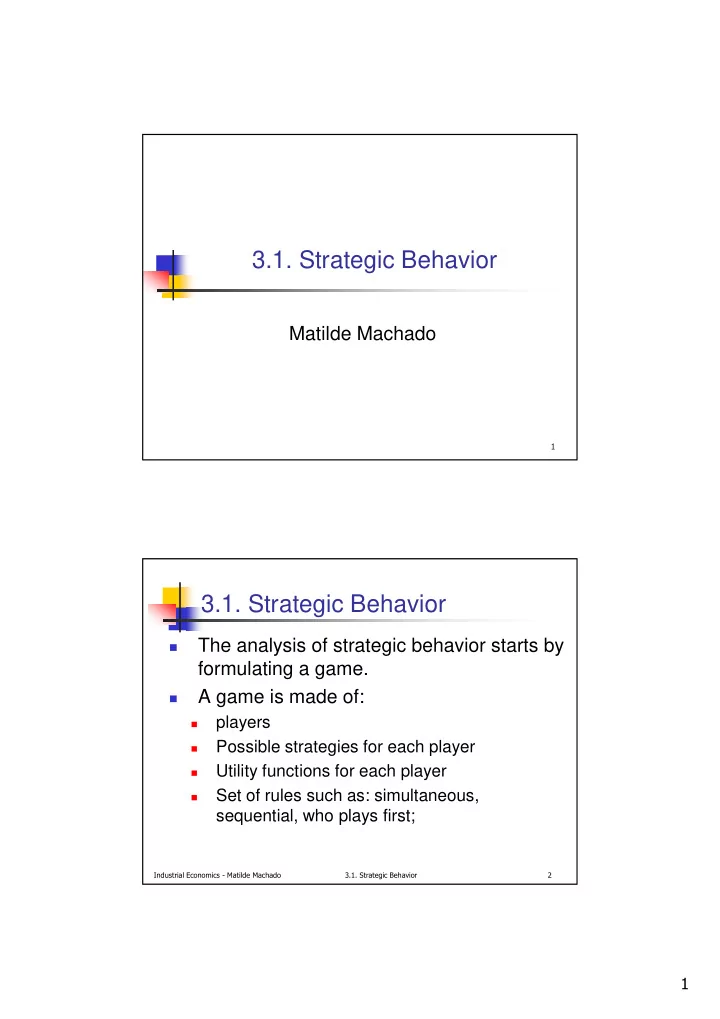
3.1. Strategic Behavior Matilde Machado 3.1. Strategic Behavior The analysis of strategic behavior starts by formulating a game. A game is made of: players Possible strategies for each player Utility functions for


slide-1
SLIDE 1
  • 3.1. Strategic Behavior

Matilde Machado

  • 3.1. Strategic Behavior
  • The analysis of strategic behavior starts by

formulating a game.

  • A game is made of:
  • players
  • Possible strategies for each player
  • Utility functions for each player
  • Set of rules such as: simultaneous,

sequential, who plays first;

slide-2
SLIDE 2
  • 3.1. Strategic Behavior

Example: Strategies: player 1 = {A,B} player 2 = {C,D} Utilities: player 1: if he plays A =3 or 1; if B = 4,-2 player 2: if he plays C =0 or 2; if D =-1, 1

C D A 3,0 1,-1 B 4,2

  • 2,1

Player 2 Player 1

  • 3.1. Strategic Behavior

Example (cont.): Rules of the game: each player chooses his strategy independently of the other. But of course, the outcome is a function of both players’ strategies. Therefore, there is an interdependence between their strategies, which is typical of game theory. Solution: The equilibrium concept that is mostly used is Nash equilibrium.

slide-3
SLIDE 3
  • 3.1. Strategic Behavior

Nash equilibrium– a vector of strategies (one strategy for each player) is a Nash equilibrium if none of the players can increase his utility through a unilateral move (that is given the strategy of the other player). …. Back to the game…

  • 3.1. Strategic Behavior

player 2: If player 1 plays A → best response is C; u=0 If player 1 plays B → best response is C; u=2 ⇒ C is a dominant strategy to player 2 because it is always preferable to D player 1: If player 2 plays C → best response is B; u=4 If player 2 plays D (which he won’t) → best response is A; u=1 {B,C} is the only Nash equilibrium of the game.

C D A 3,0 1,-1 B 4,2

  • 2,1

player 2 player 1

slide-4
SLIDE 4
  • 3.1. Strategic Behavior

Formally, {B,C} is a Nash equilibrium because:

1 1 1 2 2 2

( , ) ( , ) or alternativelly ( , ) ( , ) ( , ) or alternativelly c ( , )

argmax argmax

i j

U b c U a c b U i c U b c U b d U b j ≥ = ≥ =

  • 3.1. Strategic Behavior

In Industrial Organization:

  • Players are firms
  • Strategies are going to be prices, quantities,

advertising, product quality, R&D, capacity, etc.

  • Utilities are going to be profits
slide-5
SLIDE 5
  • !

3.1. Strategic Behavior

An example: Assume firms A and B are deciding whether or not to launch an advertising campaign. The campaign will cost 10 000 Euros. In case both firms launch the campaign, firm A gets all the benefits of the campaign and firm B will not benefit from the campaign although it will incur in costs. In case firm B launches the campaign alone, then its profits will increase. The payoffs

  • f the game are the following:
  • "

3.1. Strategic Behavior

A NA A

190,-10 190,0

NA

100,110 100,100

B A ¿What will firm A do? That depends on what firm B will do and vice- versa (note that both firms know the payoff matrix). Each firm wishes to maximize profit given what the other firm does and for that needs to take into account what the other firm does. In order to solve for the Nash equilibrium we need to construct the best response functions. RA(A)=A; RA(NA)=A (Advertising is dominant for A) and for B: RB(A)=NA; RB(NA)=A

slide-6
SLIDE 6
  • 3.1. Strategic Behavior

Generalizing in IO

  • The profit function is continuous in the strategies
  • f the player and its rival’s.
  • Strategies are going to be actions i.e. 1×1

vectors profit of firm i when it performs action ai and its rival action aj where ai∈Ai and aj∈Aj.

  • The pair

is a Nash equilibrium iff:

( , )

i i j

a a Π ≡

* *

( , )

i j

a a

  • 3.1. Strategic Behavior

The pair is a Nash equilibrium iff: Or written a bit differently:

* * * * * *

arg max ( , ) ( , ) are best responses respectively arg max ( , )

i j

i i i j a i j j j i j a

a a a a a a a a  = Π  =  = Π  

* * * * * * * *

( , ) ( , ) ( , ) ( , )

i i i j i j i i i j j i j i j j j j

a a a a a a A a a a a a a A Π ≥ Π ∀ ≠ ∈  Π ≥ Π ∀ ≠ ∈  

* *

( , )

i j

a a

slide-7
SLIDE 7
  • 3.1. Strategic Behavior

If there are interior solutions, then: Lets assume that Ai=Aj=ℜ and Πi and Πj are concave (i.e. Πi

ii<0 and Πj jj<0) for all values of ai

and aj ⇒ the FOC’s are enough to derive the Nash equilibrium ( a system of 2 equations and 2 unknowns).

* * 2 * * * 2 * * 2 * * * 2

( , ) ( , ) satisfies 0; ( , ) ( , ) satisfies 0;

i i i j i j i i i j j i j i j j j j

a a a a a a a a a a a a a a  ∂Π ∂ Π = ≤  ∂ ∂   ∂Π ∂ Π  = ≤  ∂ ∂ 

  • 3.1. Strategic Behavior

Models of Strategic Behavior :

  • Cournot model – quantity is the strategic

variable

  • Bertrand model – price is the strategic variable
  • Stackelberg model – it is the same as Cournot

but sequential

Note: In the standard Monopoly model we obtain the same result regardless of the choice variable of the Monopolist (price or quantity) this no longer holds for the Oligopoly models. The equilibrium depends crucially on the strategic variable.