A short history of the automobile Why Modern Programming Languages - - PowerPoint PPT Presentation

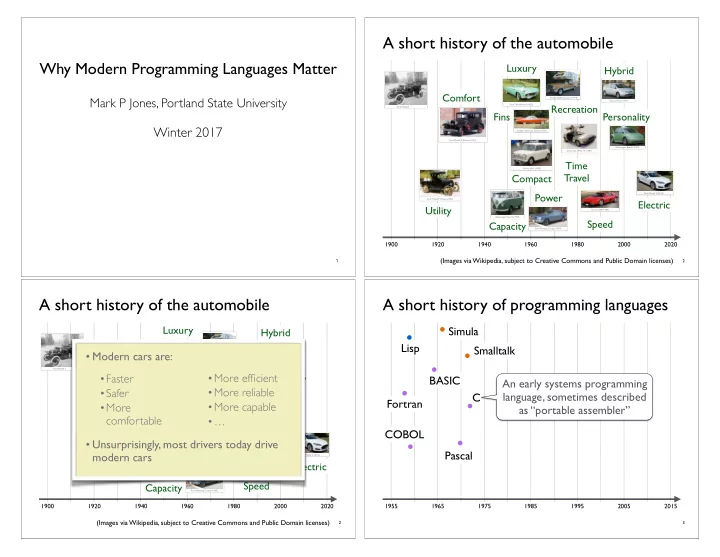
a short history of the automobile
SMART_READER_LITE
LIVE PREVIEW

A short history of the automobile Why Modern Programming Languages - - PowerPoint PPT Presentation

A short history of the automobile Why Modern Programming Languages Matter Luxury Hybrid Comfort Mark P Jones, Portland State University Dodge D200 Camper (1974) Toyota Prius (1997) Ford Thunderbird (1955) Recreation Ford Model T Fins


slide-1
SLIDE 1

Mark P Jones, Portland State University

Winter 2017

Why Modern Programming Languages Matter

1

A short history of the automobile

2

1900 1920 1940 1960 1980 2000 2020

Ford Model T Ford Model T Pickup (1922)

Utility

Ford Model A Deluxe (1931)

Comfort

Volkswagen Type 2 (1949)

Capacity

Ford Thunderbird (1955)

Luxury

Cadillac Eldorado Seville (1959)

Fins

Morris Mini (1959)

Compact

Ford Mustang Coupe (1965)

Power

Dodge D200 Camper (1974)

Recreation

DeLorean DMC-12 (1981)

Time
 Travel

Ferrari 348 (1989)

Speed

Toyota Prius (1997)

Hybrid

Volkswagen Beetle (2002)

Personality

Tesla Model S (2012)

Electric

(Images via Wikipedia, subject to Creative Commons and Public Domain licenses)

A short history of the automobile

2

1900 1920 1940 1960 1980 2000 2020

Ford Model T Ford Model T Pickup (1922)

Utility

Ford Model A Deluxe (1931)

Comfort

Volkswagen Type 2 (1949)

Capacity

Ford Thunderbird (1955)

Luxury

Cadillac Eldorado Seville (1959)

Fins

Morris Mini (1959)

Compact

Ford Mustang Coupe (1965)

Power

Dodge D200 Camper (1974)

Recreation

DeLorean DMC-12 (1981)

Time
 Travel

Ferrari 348 (1989)

Speed

Toyota Prius (1997)

Hybrid

Volkswagen Beetle (2002)

Personality

Tesla Model S (2012)

Electric

  • Faster
  • Safer
  • More

comfortable

  • More efficient
  • More reliable
  • More capable
  • Modern cars are:
  • Unsurprisingly, most drivers today drive

modern cars

(Images via Wikipedia, subject to Creative Commons and Public Domain licenses)

A short history of programming languages

3

1955 1965 1975 1985 1995 2005 2015

Lisp Fortran COBOL BASIC Pascal C Simula Smalltalk An early systems programming language, sometimes described as “portable assembler”

slide-2
SLIDE 2

A short history of programming languages

3

1955 1965 1975 1985 1995 2005 2015

Lisp Clojure F# Haskell Scala Fortran COBOL BASIC Pascal C Ada Simula C++ Java C# Python JavaScript PHP Smalltalk Swift Go Rust Still the most widely used systems programming language, 45 years later! It’s as if everyone is still driving a Ford Model T!

A short history of programming languages

3

1955 1965 1975 1985 1995 2005 2015

Lisp Clojure F# Haskell Scala Fortran COBOL BASIC Pascal C Ada Simula C++ Java C# Python JavaScript PHP Smalltalk Swift Go Rust Still the most widely used systems programming language, 45 years later! It’s as if everyone is still driving a Ford Model T!

  • Higher-level
  • Feature rich
  • Type safe
  • Memory safe
  • Less error prone
  • Well-designed
  • Well-defined
  • Modern programming languages are:
  • Surprisingly, most systems programmers

today are still using C …

C is great … what more could you want?

  • Programming in C gives systems developers:
  • Good (usually predictable) performance characteristics
  • Low-level access to hardware when needed
  • A familiar and well-established notation for writing

imperative programs that will get the job done

  • What can you do in modern languages that you can’t already

do with C?

  • Do you really need the fancy features of newer object-
  • riented or functional languages?
  • Are there any downsides to programming in C?

4 5

Could a different language make it impossible to write programs with errors like these ?

slide-3
SLIDE 3

The Habit programming language

  • “a dialect of Haskell that is designed to meet the needs of

high assurance systems programming” Habit = Haskell + bits

  • Habit, like Haskell, is a functional programming language
  • For people trained in using C, the syntax and features of

Habit may be unfamiliar

  • I won’t assume familiarity with functional programming here
  • We’ll focus on how Habit uses types to detect and

prevent common types of programming errors

6

Division

  • You can divide an integer by an integer to get an integer result
  • In Habit:

div :: Int ⟶ Int ⟶ Int

  • This is a lie!
  • Correction:

You can divide an integer by a non-zero integer to get an integer result

  • In Habit:

div :: Int ⟶ NonZero Int ⟶ Int

  • But where do NonZero Int values come from?

7

1st arg 2nd arg result “has type”

Where do NonZero values come from?

  • Option 1: Integer literals - numbers like 1, 7, 63, and 128

are clearly all NonZero integers

  • Option 2: By checking at runtime

nonzero :: Int ⟶ Maybe (NonZero Int)

  • These are the only two ways to get a NonZero Int!
  • NonZero is an abstract datatype

8

Values of type Maybe t are either:

  • Nothing
  • Just x for some x of type t

Examples using NonZero values

  • Calculating the average of two values:

ave :: Int ⟶ Int ⟶ Int
 ave n m = (n + m) `div` 2

  • Calculating the average of a list of integers:

average :: List Int ⟶ Maybe Int
 average nums
 = case nonzero (length nums) of
 Just d ⟶ Just (sum nums `div` d)
 Nothing ⟶ Nothing

  • Key point: If you forget the check, your code will not compile!

9

a non zero literal checked!

slide-4
SLIDE 4

Null pointer dereferences

  • In C, a value of type T* is a pointer to an object of type T
  • But this may be a lie!
  • A null pointer has type T*, but does NOT point to an
  • bject of type T
  • Attempting to read or write the value pointed to by a null

pointer is called a “null pointer dereference” and often results in system crashes, vulnerabilities, or memory corruption

  • Described by Tony Hoare (who introduced null pointers in

the ALGOL W language in 1965) as his “billion dollar mistake”

10

Pointers and reference types

  • Lesson learned: we should distinguish between
  • References (of type Ref a): guaranteed to point to values
  • f type a
  • Pointers (of type Ptr a): either a reference or a null
  • These types are not the same: Ptr a = Maybe (Ref a)
  • You can only read or write values via a reference
  • Code that tries to read from a pointer will fail to compile!
  • Goodbye null pointer dereferences!

11

  • Arrays are collections of values stored in contiguous locations

in memory

  • Address of a[i] = start address of a + i*(size of element)
  • Simple, fast, … and dangerous!
  • If i is not a valid index (an “out of bounds index”), then an

attempt to access a[i] could lead to a system crash, memory corruption, …

  • A common path to “arbitrary code execution”
  • Arrays are collections of values stored in contiguous locations

in memory

  • Address of a[i] = start address of a + i*(size of element)
  • Simple, fast, … and dangerous!
  • If i is not a valid index (an “out of bounds index”), then an

attempt to access a[i] could lead to a system crash, memory corruption, buffer overflows, …

  • Arrays are collections of values stored in contiguous locations

in memory

  • Address of a[i] = start address of a + i*(size of element)
  • Simple, fast, … and dangerous!
  • Arrays are collections of values stored in contiguous locations

in memory

  • Address of a[i] = start address of a + i*(size of element)
  • Simple, fast, …

Arrays and out of bounds indexes:

12

pointer to start


  • f array a
  • ffset i

Array bounds checking

  • The designers of C knew that this was a potential problem …

but chose not to address it in the language design:

  • We would need to store a length field in every array
  • We would need to check for valid indexes at runtime
  • The designers of Java knew that this was a potential problem

… and chose to address it in the language design:

  • Store a length field in every array
  • Check for valid indexes at runtime
  • Performance OR Safety … pick one!

13

slide-5
SLIDE 5

Arrays in Habit

  • Key idea: make array size part of the array type, do not allow

arbitrary indexes: (@) :: Ref (Array n t) ⟶ Ix n ⟶ Ref t

  • Fast, no need for a runtime check, no need for a stored length
  • Ix n is another abstract type:

maybeIx :: Int ⟶ Maybe (Ix n)
 modIx :: Int ⟶ Ix n
 incIx :: Ix n ⟶ Maybe (Ix n)

14

start address index element address a[i] is written as a@i in Habit guaranteed to be ≥ 0 and < n array length, as part of the type

  • Given two 32 bit input values:
  • base:
  • limit:
  • Calculate a 64 bit descriptor:
  • Needed for the calculation of “Global Descriptor Table

(GDT) entries” on the x86

Bit twiddling

15

low high 5 3 2

Each box is one nibble (4 bits), least significant bits on the right

In assembly

low

16

movl base, %eax movl limit, %ebx mov %eax, %edx shl $16, %eax mov %bx, %ax movl %eax, low shr $16, %edx mov %edx, %ecx andl $0xff, %ecx xorl %ecx, %edx shl $16,%edx

  • rl %ecx, %edx

andl $0xf0000, %ebx

  • rl %ebx, %edx
  • rl $0x503200, %edx

movl %edx, high

%edx mov shl 16 %eax movw %eax and 0xf0000 %ebx shr 16 %edx %ecx mov and 0xff %ecx shl 16 %edx

  • r

%edx %eax mov %ebx mov high base limit xor %edx low high 5 3 2

  • r

%edx 5 3 2

  • r 0x503200

%edx

In C

17

low = (base << 16) // purple | (limit & 0xffff); // blue high = (base & 0xff000000) // pink | (limit & 0xf0000) // green | ((base >> 16) & 0xff) // yellow | 0x503200; // white

limit base low high 5 3 2

  • Examples like this show why we use high-level languages

instead of assembly!

  • But let’s hope we don’t get those offsets and masks wrong …
  • And there is no safety net if we get the types wrong …
slide-6
SLIDE 6

In Habit

18

limit base low high 5 3 2

  • Compiler tracks types and automatically figures out

appropriate offsets and masks:

bitdata GDT
 = GDT [ pink :: Bit 8 | 0x5 :: Bit 4
 | green :: Bit 4 | 0x32 :: Bit 8
 | yellow :: Bit 8 | purple, blue :: Bit 16 ] makeGDT :: Unsigned ⟶ Unsigned ⟶ GDT
 makeGDT (pink # yellow # purple) -- base
 (0 # green # blue) -- limit
 = GDT [pink|green|yellow|purple|blue] silly :: GDT ⟶ Bit 8
 silly gdt = gdt.pink + gdt.yellow

  • Programmer describes layout in a type definition:

Additional examples

  • Layout and initialization of memory-based tables and data

structures

  • Distinguishing physical and virtual addresses
  • Tracking (and limiting) side effects
  • ensuring some sections of code are “read only”
  • identifying/limiting code that uses privileged operations
  • preventing code that sleeps while holding a lock
  • Reusable methods for concise and consistent input

validation…

19

Chipping away ...

20

HaL4: A Capability- Enhanced Microkernel Implemented in Habit

based on seL4

HaL4: A Capability- Enhanced Microkernel Implemented in Habit

Chipping away ...

21

based on Haskell

slide-7
SLIDE 7

HaL4: A Capability- Enhanced Microkernel Implemented in Habit

Using types …

22

based on Haskell

HaL4: A Capability- Enhanced Microkernel Implemented in Habit

Using functional programming ...

23

based on Haskell

The CEMLaBS Project

  • Three technical questions:
  • Feasibility: Is it possible to build an inherently “unsafe”

system like seL4 in a “safe” language like Habit?

  • Benefit: What benefits might this have, for example, in

reducing development or verification costs?

  • Performance: Is it possible to meet reasonable

performance goals for this kind of system?

  • A social question:
  • Can we persuade developers to try new languages?
  • Maybe there is a role for modern programming languages …!?

24