A RF-Gun Cooling System Presented by: Danielle Hannah Supervised - - PowerPoint PPT Presentation

a rf gun cooling system
SMART_READER_LITE
LIVE PREVIEW

A RF-Gun Cooling System Presented by: Danielle Hannah Supervised - - PowerPoint PPT Presentation

A RF-Gun Cooling System Presented by: Danielle Hannah Supervised by: Maurice Ball Jamie Santucci 1 Danielle N. Hannah Born and raised in Marietta, Georgia Spelman College/North Carolina A&T Dual Degree Engineering


slide-1
SLIDE 1

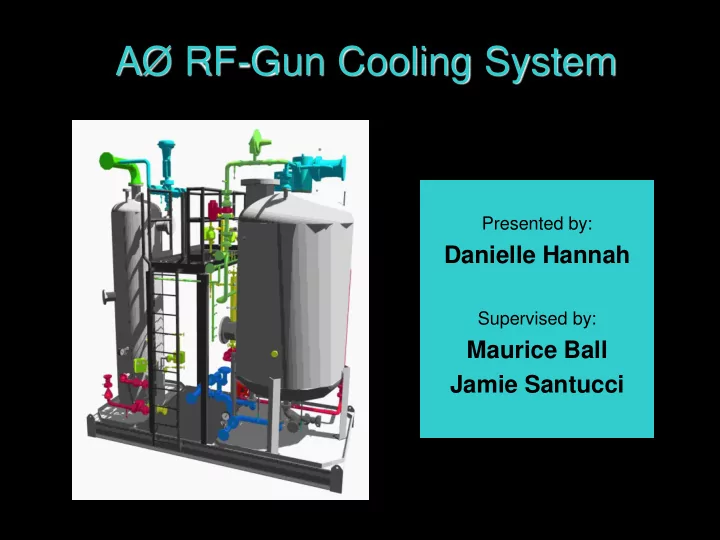
AØ RF-Gun Cooling System

Presented by:

Danielle Hannah

Supervised by:

Maurice Ball Jamie Santucci

1
slide-2
SLIDE 2

Danielle N. Hannah

  • Born and raised in Marietta, Georgia
  • Spelman College/North Carolina A&T

– Dual Degree Engineering Program (DDEP)

  • B.A. Mathematics and B.A. Architectural Engineering

– Rising Junior

  • Summer Internships in Science and Technology (SIST)

2

slide-3
SLIDE 3

AØ Experiment

  • The AØ Photoinjector (AØPI) facility is

a small research and development program section within the Accelerator Division (AD).

  • An essential component of the overall

AØPI is a Radio Frequency Electron Gun (RF-gun).

  • The RF-gun is located in the south cave
  • f the AØ building.
  • This gun consists of cavities that are

used to accelerate a beam of electrons.

3

slide-4
SLIDE 4

Project Background

  • The RF-gun emits heat.
  • This poses a problem to the well-being
  • f the machine and the physicists.

 Engineers of the Mechanical Support Department created a low- conductivity water (LCW) skid cooling system to keep the RF-gun at a consistent temperature.

  • Within the next 5 years, a new RF-gun

will be installed in the AØ north cave.

  • The new RF-gun will use the same

cooling system as the current gun.  But before the installation occurs it must be assured that the current cooling system for the AØ PI RF-gun is up to par.

4

slide-5
SLIDE 5

Project Description

  • This presents how the AØ PI RF-gun skid system was

characterized, improved, and documented over the course of a summer.

  • In order to obtain these goals the following steps had to be

executed:

– Outlined spreadsheet acting as a project timeline, – Development of a detailed system schematic, – Refinement of the system’s appearance, – Completed fluid analysis throughout system.

5

slide-6
SLIDE 6

System Schematic

6

slide-7
SLIDE 7

Draft #1

7

slide-8
SLIDE 8

Final Draft

8

slide-9
SLIDE 9

Draft #1

9

slide-10
SLIDE 10

Final Draft

10

slide-11
SLIDE 11

System Updates

11

slide-12
SLIDE 12

Re-Labeling

12

slide-13
SLIDE 13

Original Labels

13

slide-14
SLIDE 14

Original Labels

14

slide-15
SLIDE 15

New Labels

15

slide-16
SLIDE 16

New Labels

16

slide-17
SLIDE 17

17

slide-18
SLIDE 18

Flow Rate Measurements

18

slide-19
SLIDE 19

Section 3: Section 1: Q = 30.0 gpm Section 2: Q = 5.5 gpm Q = 24.4 gpm Q = 29.9 gpm

19

1 3 2

slide-20
SLIDE 20

Flow Fluid Analysis

20

slide-21
SLIDE 21

Bernoulli’s Principle

  • The most useful single equation in fluid mechanics.
  • States that for an inviscid flow, an increase in the speed
  • f the fluid occurs simultaneously with a decrease in

pressure.

L

h g v p z g v p z 2 144 2 144

2 2 2 2 2 2 1 1 1 1

Equation 1

21

2 2 2 1 1 1

. . . . . . head vel head press head elev head vel head press head elev

slide-22
SLIDE 22

Fluid Flow Analysis

  • Bernoulli’s Equation (Equation 1) can be expressed as:

in order to calculate the change in pressure from P1 to P2.

  • In efforts to minimize errors, the entire system was separated

into 13 sections (A-M).

L

h g v v P P 2 144

2 1 2 2 2 1

d Q Re 6 . 50

e

R f 64

4 2

00259 . d KQ hL

Equation 2

[hL=head loss (ft), Re=Reynold’s number, K=resistance coefficient, Z=elevation (ft), P=pressure (psi), ρ=weight density (lb/ft3), v=velocity (ft/s), μ=absolute viscosity (cP), d=diameter (in), D=diameter (ft), f=friction factor, Q=rate of flow (gpm), L=pipe length (ft), g=acceleration of gravity (ft/s2)]

Equation 5 Equation 4 Equation 3

22

D fL K Equation 6

slide-23
SLIDE 23

Sections A-G, L-M

23

slide-24
SLIDE 24

Sections G-L

24

slide-25
SLIDE 25

Pressure Drop Calculation:

Section A

Given:

  • fT= 0.019
  • μ = 1.7 cP
  • ρ = 62.42 lb/ft3
  • v = 2.87 ft/s

Measured:

  • d = 0.17225 ft
  • Z2 = 9.833 ft
  • Z1 = 0 ft
  • L = 69.5 ft
  • Q = 30 gpm

Assumptions:

  • All fittings are standard 45 or 90 elbows.

Calculations:

  • Re =
  • f = 0.026
  • K =
  • 45 = 16fT
  • 90 = 30fT
  • KTOTAL= 0.608 + 6.84 + 10.49
  • hL =
  • ΔP =

5139 . 3 6 . 94753 7 . 1 1 42 . 62 min 30 067 . 2 6 . 50

3

cP ft lb gal in

= 2.7 x 10⁴

067 . 2 684 . 21 067 . 2 12 5 . 69 026 . ft in in ft

= 10.490

= 17.95

019 . 16 2 019 . 30 12

= 0.608 = 6.84

= 2.292 ft

ft ft ft ft in ft lb 292 . 2 833 . 9 144 42 . 62

3 2 2

= 5.256 psi

25

254 . 18 84 . 41 min 067 . 2 30 95 . 17 00259 .

4 2

in gal

slide-26
SLIDE 26

Total System Pressure Drop

  • Section A = 5.256 psi
  • Section B = 1.664 psi
  • Section C = 0.893 psi
  • Section D = 2.484 psi
  • Section E = 1.398 psi
  • Section F = 1.061 psi
  • Section G = 5.174 psi
  • Section H = 1.423 psi
  • Section I = 1.134 psi
  • Section J = 4.213 psi
  • Section K = 4.444 psi
  • Section L = 5.561 psi
  • Section M = 3.909 psi

Section A + B + C +…K + L + M =

38.614 psi or 89.198 ft

26

AØ RF-Gun Skid System gauge readings

Pressure Gauge psi Temperature Gauge F P-01 33 T-01 53 P-02 13 T-02 36 P-03 7.5 T-03 51 P-04 62.5 T-04 50.5 P-05 9 T-05 65 P-06 7 T-06 45 P-07 140 T-07 60 P-08 137 T-08 58 P-09 19 T-09 44 P-10 9.5 T-10 82 P-11 5 P-12 141 P-13 135 P-14 10 P-15 54 P-16 10 P-17 22 P-18 25 P-19 22

Entire Gauge Pressure Drop =

134 psi or 309.54 ft

slide-27
SLIDE 27

Project Timeline

27

slide-28
SLIDE 28

Project Manager

28

slide-29
SLIDE 29

Summary

A system schematic was perfected The entire system’s temperature and pressure gauges were re-labeled The drop in pressure (calculated) throughout the system was compared with the drop in pressure (readings) to conclude that the gauge readings were inaccurate.

  • Thus, the current cooling system is not up to par.

29

slide-30
SLIDE 30

Future Goals

Develop a procedure to switch RF-gun cooling back and forth from North Cave to South Cave Develop instrumentation for the system to data log

  • n ACNET, a control system that accelerators use.

30

slide-31
SLIDE 31

Acknowledgments

  • Maurice Ball, AD, Engineering, Mechanical Support Dept.
  • Jamie Santucci, AD, Photoinjector
  • Elmie Peoples-Evans, APC High Intensity Neutrino Source Dept.
  • David Peterson, AD, Antiproton Source Dept.
  • Dr. James Davenport, SIST founder
  • Dianne Engram, Workforce Development & Resources, Equal

Opportunity & Counseling, SIST director

  • 2009 SIST interns, staff, and committee
  • Fermi National Accelerator Laboratory

31