SLIDE 1
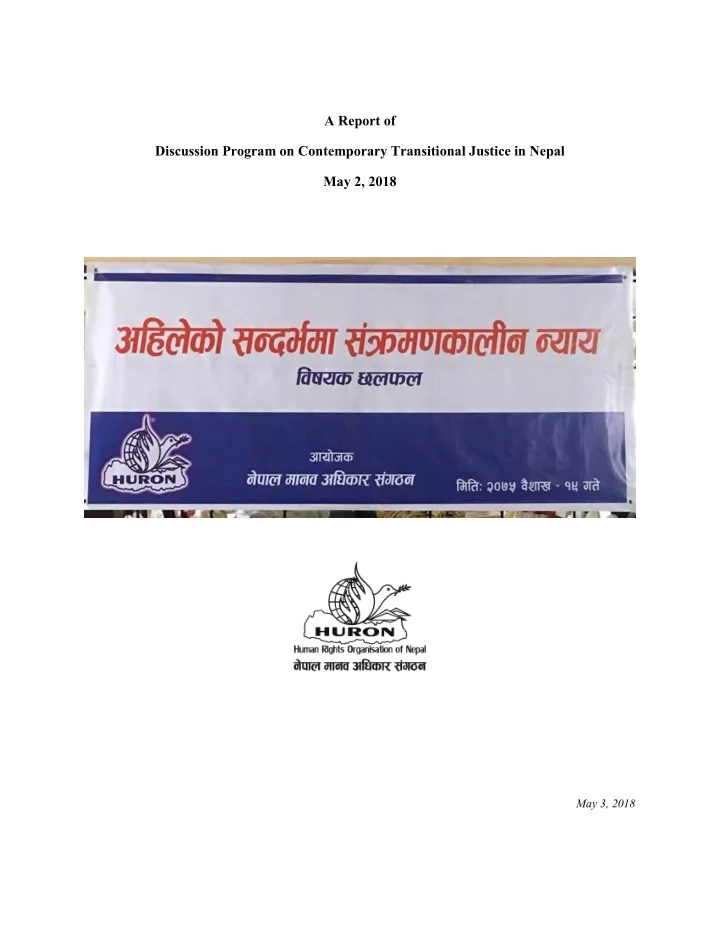
A Report of Discussion Program on Contemporary Transitional Justice in Nepal May 2, 2018
May 3, 2018
SLIDE 2 2
Table of Contents
- 1. Background…………………………………………………………………………………………...3
- 2. Objectives……………………………………………………………………………………………..4
General Objectives…………………………………………………………………………………...4 Specific Objectives……………………………………………………………………………………4
- 3. Summary of Paper……………………………………………………………………………………4
- 4. Comments…………………………………………………………………………………………….5
- 5. Open Discussion Session…………………………………………………………………………….6
- 6. Concluding Remarks………………………………………………………………………………....6
- 7. List of Guests…………………………………………………………………………………….….10
- 8. Photographs……………………………………………………………………………………….…11
Annex 1 – Full Script of Paper Presented by Mr. Indra Prasad Aryal…………………………….15
SLIDE 3 3
Background On 25 April 2014, the Parliament of Nepal passed the Act on Commission on Investigation of Disappeared Persons and Truth and Reconciliation, creating the Commission on Investigation of Disappeared Persons (CIEDP) and the Truth and Reconciliation Commission (TRC). The Act was published on 21 May 2014. On 10 February 2015, the Government of Nepal established these two Commissions. In June 2014, the Office of United Nations High Commissioner for Human Rights (OHCHR) issued a Technical Note providing an analysis of the Act and offered recommendations to the Government to ensure compliance with international laws and standards. The Note concluded that the provisions in the Act that give the Commission powers to recommend amnesties for gross violations of international human rights law and serious violations of international humanitarian law fail to comply with Nepal‟s international legal obligations, and are also inconsistent with the United Nations policy on amnesties. The note recommended the following summaries which the act falls short on and hasn‟t heeded the call of OHCHR till date:
- 1. The Act does not contain provisions to ensure the independence and impartiality of the Commissioners or the
- peration of the two Commissions.
- 2. Provisions concerning reparations should specify that victims have the right to reparation, and that full and
effective reparations include not only restitution, compensation, rehabilitation, but also measures of “satisfaction” and guarantees of non-recurrence.
- 3. The broad authority to facilitate reconciliation, including without the consent of the victim, is problematic as the
nature of reconciliation means it cannot be forced upon people.
- 4. Terms such as “serious violation of human rights”, “act of disappearing a person” and “reparations” used in the
Act are not clearly defined and are used inconsistently. These terms should be defined in full conformity with international law Either there is a minimal understanding of human rights or there is an acute level of indifference for human rights among political leaders in Nepal. Since the signing of Comprehensive Peace Agreement (CPA) in November, 2006, the major political parties have time and again succeeded to influence the legislation with vague and ambiguous interpretations of law and misuse of power as in the case of Truth and Reconciliation Commission. The agony and trauma of tens of thousands who lost family members during the conflict era will be never be addressed in Nepal if Comprehensive Peace Agreement is cited loosely for escaping justice. The CPA mentions of establishing a National Peace and Rehabilitation Commission which may set up necessary mechanisms for the success of peace campaign. However, with tacit support from both sides, the commission has been used to deny justice rather than provide it. There are 60,000 petitions registered in Truth and Reconciliation Commission from the conflict victims. Further, 3,000 are complaints are received in Commission of Investigation on Enforced Disappeared Persons (CIEDP). The mandates of both these commission should be to ensure that justice, accountability and reparations are achieved by the victims of Maoist era conflict but these commissions look to serve political interests to escape justice rather than achieve it. In addition to this, with powers to grant amnesty to even those who were seriously involved in heinous crimes under the banner of politics, parliament passed the TRC Act. When the TRC and Commission on Enforced Disappearance bill was adopted in April, 2014, even the UN High Commissioner of Human Rights had reservations regarding failure to abide by the decisions of Supreme Court (January, 2014) and practice of minimum international standard to be considered in formation of such commissions. There have been repeated calls of amendments and to scrap out the amnesty provisions however none of these calls are heeded till date. We believe that all the Supreme Court directives instructed in cases of Transitional Justice should be adhered to.
SLIDE 4 4
There is also a major imbalance of power between the victims and alleged perpetrators in Nepal. The Article 22 of TRC Act states that “if a perpetrator or a victim files an application to the Commission for mediation, the Commission may mediate to reconcile mutually between them”. There are concerns that in criminal matters such reconciliation is very problematic and almost impossible. These concerns highlight the imbalance of power between the victims and perpetrators. The victims are from poor and marginalized communities whereas the alleged perpetrators are from the political parties, police, and military in our case. The appointment to TRC has been constituted of individuals, which are political in nature and are to serve the vested interest of people in power. For a comprehensive legal proceeding, there needs to be preservation of documents of proofs which the TRC seems unable to carry out. Also, on the government hasn‟t heeded the directives of the Supreme Court that any mechanism for transitional justice must ensure victims the right to remedy and reparation, which includes right to truth, justice and guarantees of non-repetition and the government is required to make necessary legal and institutional measures to enable and ensure the establishment, adequate resourcing and maintenance of effective victim and witness protection mechanisms. The 2030 Agenda for Sustainable Development mandates inclusiveness as one of its core value reflected in the pledge to leave no one behind and in a vision of a ““just, equitable, tolerant, open and socially inclusive world in which the needs of the most vulnerable are met”. We as a nation if to move forward as a democratic country must not leave behind the victims of armed conflict at any cost. Objectives General Objective The overall objective of this project is to conduct a high level discussion program on Truth and Reconciliation process in Nepal with view to advocate and pressurize the government to provide for the inadequacies in the functioning of the commission and amendments to the TRC Act. Specific Objectives
- 1. To advocate for TRC act amendment bill to be passed by the parliament of Nepal.
- 2. To pressurize the Government of Nepal (GoN) to provide adequate resources as per the request of the
commission.
- 3. To convince the political party members on addressing the issue of TRC for the elimination of impunity
and achievement of justice for armed conflict cases in Nepal. Summary of Paper Presentation by HURON President & Advocate, Mr. Indra Prasad Aryal Following the Armed Insurgency from 2051 B.S till 2062, Nepal has transitioned into Federal Democratic Nepal. The constitution of Nepal was promulgated in 2015 the implementation of which is essential to the practice of governance and overall development of Nepal. The new political, social and economic development that has ensued in Nepal leaves an indelible mark for the progress of human rights in Nepal. In apropos to this historical aftermath of armed insurgency, the then rebel Maoists have entered mainstream politics. It is imperative that Nepal should solve the cases of armed conflict and the controversial TRC Act remains a hurdle in implementation of justice in Nepal. The following are the obstacles of transitional justice in Nepal:
- 1. Political
- 2. Policy Level and Structural
Step forward recommended by HURON
SLIDE 5 5
- Political agreement on this regards should be fulfilled in providing justice to victims of a decade long
insurgency.
- Truth and Reconciliation Commission cannot solve all the 60,000 cases so HURON recommends
methodology of categorizing into different themes and the commission should solve at least 10% of these cases at the onset.
- The budget for commission should be provided by the GoN.
- Special Court shouldn‟t be used for the solving the cases of transitional justice.
- TRC needs to be amended and new provisions should be made.
- The amendment should be done as directed by Supreme Court
- After the perpetrator is realized then the punishment should be done based on consultancy with the victims.
Comments 1:50 PM – Senior Advocate, Mr. Dinesh Tripathi
- Concern of transactional justice is a concern of international community
- International community has always recommended cases against inhumane crimes against humanity.
These crimes must be pursued and provided with justice. International Criminal Court is a reality. The actors in Nepal are not prepared for accountability of armed insurgency crimes. It‟s a concern of political bargaining which shouldn‟t happen in Nepal. Human Rights cannot be a part of political bargaining.
- Although Nepal hasn‟t signed Rome convention, Nepal has signed and ratified ICCPR – Article 3- Right to
effective remedy.
- UN guideline on Transitional Justice, 2010 states that crime against humanity cannot be given blanket
- amnesty. UN cannot endorse any political process of such.
- NHRC should be credible in giving recommendation.
- I have no objection on this paper presentation. As this paper states no foundational law has been made till
date on TJ. Supreme Court decisions haven‟t been implemented. Disappearance, Torture and War Crimes hasn‟t been criminalized in Nepal. So the works of commission has been halted. But recommendation can be done.
- The state actors and non-state actors want blanket amnesty which is opposed to human rights laws (both
domestic and international).
- Nature of crime not location is important. International community can intervene. We civil society justice
does not want that. We want to build capacity ourselves and conclude the cases of transitional justice
- urselves. Extraordinary cases of Cambodia, former Yugoslavia and Bangladesh cannot repeat so all
parties should move towards concluding this matter. Else, Nepal will be a playground of international politics. 2: 00 PM- Advocate, Mr. Kalyan Pokhrel
- We need to establish constitution properly for his matter to move forward.
- If new laws are made now which challenge the old laws (on transitional justice) we will fall in legal despair
in Nepal.
- On Bangladesh model – 1971 death punishment- Nepal may move towards this model so judiciary process
should be strengthened.
- If TJ cases are taken through regular court then then the capacities of judiciary will be built for such cases.
- The system of judiciary accountability will prevail in Nepal if we go through judiciary process.
SLIDE 6 6
Open Discussion Session 2: 10 PM – Mr, Om Aryal, Advocate
- On the issues of 10%, I have my reservation. The view of GoN should also be taken into consideration. Emblematic
Cases (i.e. persecution token cases) – this is a conflict of politics and justice- when concluding the these emblematic cases we need to take into cases. This is political instrument used in judiciary of Nepal which should be reviewed.
- The actors who have violated the law of war should be persecuted.
- Criminalization of politics and politicization of crime was done in armed conflict. E.g. both parties have killed and
tortured people stating them as spies.
- Lack of investigation pertaining to cases of TJ.
- NHRC should be use their rights to investigation and recommendation on TJ . NHRC should also be given rights
to monitor TRC and CIEDP.
- Special Court cannot be made. This is a political act. Regular court should be able to decide on cases of TJ.
2:20 PM – Mr. Charan Prasai, former President, HURON
- Commissions should be accountable, victim centered but this paper calls on politics centered TJ in Nepal (
I hope this is corrected and withdrawn from this paper).
- On the issue of Special Court, there is reservation.
- Case of Krishna Prasad Adhikari – Chitwan District Court hearing – 4 years in the decision – political
influence has now lengthened this process. This shows that our judiciary isn‟t impartial. So, special court should be established evading political influence. Since it will be based on Kathmandu, it will be monitored by CSOs in Nepal and international community. How can we make Special Court, accountable, independent and capable? I implore you to consider this question.
- Emblematic cases – we cannot let this happen for human rights are universal.
- To chairpersons of commissions- I entreat you not to be an obstacle the TJ process. We don‟t believe in
you and the extension of these commissions for the next four years shouldn‟t have happened. 2:30 PM -Advocate, Mr. Din Mani Pokhrel
- Peace Process – the essence of CPA should be considered for the issues of TJ. We cannot forget the
essence of CPA which should be the process of TJ in Nepal.
- International minimum standard – what does that mean ? This is not universal. Each country has it‟s
process and there is international variation. We need to be compatible with international rules.
- We need to consider these variations e.g. Supreme Court initially decided on cases pertaining to CPA
making it the guiding document. We have now developed two parallel structures i.e. Court vs.
- Commission. We need to debate on this issue. There is dual jurisprudence.
- We need to implement the decision of Supreme Court. NO objection on this.
- The question we need to ponder on is if we should move forward through commissions or courts?
- OHCHR notes (2014) has commented on this emblematic cases.
2:40 PM – Prof. Kapil Shrestha, former HURON President
- TJ system is an exercise in grant failure.
SLIDE 7 7
- Contemporary TJ is a politics of appeasement and politics of deception.
- There is hypocrisy of democracy in Nepal which has stood the test of time since Panchayat till date.
- Culture of Impunity prevails in Nepal. As an academic, I repeatedly assert this. There is no implementation
- f any legal instrument.
- TJ is a part of Human rights universalism. No compromise. No dilution. TJ issue in Nepal is being diluted
and deflected.
- This stage in Nepal is the defining stage of human rights processes.
2:45 PM – Mr. Suman Adhikari
- There is no agreement in providing justice. There is agreement in not providing justice.
- Umbrage against two commissions.
- The commissions‟ vision is the vision of political parties.
- 0 case concluded in three years!
- The actors who created conflict are the ones who have to provide justice. This is a drama. The commission
is a weapon for political parties. 2:50 PM – Mr. Rajan Kuikel, President, Amnesty International, Nepal
- We have been repeating these issues in different forums. One positive point of this forum incuded Minister
- f Law of most powerful government in Nepal.
- We need to know what the two commissions are doing. No one has an idea, including stakeholders.
- This government is capable of giving justice to TJ cases. If this government cannot do then the cases will
move to international forum.
- I don‟t have any reservation against the commission because the political powers are responsible (Oli,
Deuba, Prachanda) hold the key.
- If the victims are to be provided justice, this government has the opportunity to do so.
2:55 PM- Mr. Pradeep Pokhrel
- As a recommendation committee member to the appointment of personals to the two commissions, we
have been till date, conducting ideological debate instead of practical debate.
- The ideological forces aren‟t working for concluding TJ in Nepal.
- We have made two commissions, what international standard are we talking about? The supreme court
decided on this issue so we agreed to establish these two institutions. There is a conflict between CIEDP and TRC.
- There are no commissions in the world which have followed international standard. Each country has its
- wn peculiar characteristics.
- The model was based on Sierra Leon and the implementation model was South African model, upon my
- bservation.
- The commission in its fourth year isn‟t in the condition (budgeting, human resource) to provide any
- decision. No we CSOs need to come up with a solution to this issue.
3: 00 PM – Mr. Lenin Bisa, former Child Soilder
- As child solider (verified by UNMIN), I have reservation against the whole process in Nepal.
SLIDE 8 8
- Is making of a child solider a crime or not?
- Dil Bahadur Rangtel a 12 old child was declared first martyr by the Maoists.
- Is there a solution to our plight as former child solider?
3:05 PM – Ms. Devi Sunwar, mother of Maina Sunwar
- I have reservation against the extension of two commissions in Nepal. The commission should have been
made 8 months after CPA but it took 8 years for the commissions to be established.
- Case of Maina Sunwar
- The army themselves identified the culprits and I registered case against the four perpetrators.
- It‟s been 14 years, I haven‟t given funeral to my daughter.
- The constitution of Nepal is the constitution smirched in blood of our sons and daughters and now the
actors who created conflict are now in charge of doling out justice. I entreat the state to give us justice. The cases of Mina Sunwar should be provided justice, such crime is a crime against humanity. 3:15 PM – Mr. Baburam Giri, Senior Advocate
- The chairperson of all three commissions are present here and we all know what the issues are; the
constitution has addressed the issues but seems far fetching in lack of implementation.
- The commission was established for the essence of „forgive and forget‟ and the nature is depicted in lack of
implementation.
- International humanitarian law is always attracted even though the CPA distorts it shrewdly.
3:20 PM – Mr. Subodh Raj Pyakurel, President, INSEC
- This paper depicts the issue of TJ as political. I think it is right. CPA states – “rajnitik dwanda ko kram ma”
which means that the issue is political.
- In apropos to establishment of commission – there is no universality.
- Where there is UN or any international community involved there peace process has flopped. The political
leaders of Nepal don‟t take CSOs in consideration at all.
- Without popular faith, TJ mechanism cannot be successful.
- No punishment, no crime – our Supreme Court has already stated.
- I don‟t think Nepal‟s economic, social, cultural context was responsible for armed conflict. It was certainly
a basis of on conflict.
- We don‟t need to be afraid of international law. The process needs to be perfect. There are several ways of
indicative punishment. 3:30 PM – Ms. Madhavi Bhatta, Commissioner, TRC
- The TRC isn‟t influenced by political whim, lack of human resource or budgeting constraints.
- We need to consider our own (CSOs) if our own actions are affecting the TJ processes.
- The commission is considering establishing branch offices in all 77 districts.
- The commission needs a road map.
- The commission needs an advisory team (addressing Law Minister) for the deciding on these 60,000 cases.
- For e.g. on the issue raised by child solider. The commission hasn‟t been able to decide on it. When I raised
this issue, it was given a political issue.
SLIDE 9 9
- The political coordination is lacking among political parties which is weakening the process.
- The investigation is effective but there is gap between commission‟s capacity and expectation of people.
3:50 PM- Mr. Lokendra Mallik, Chairperson, CIEDP
- I welcome HURON on this program
- We at the commission have understood the expectation and anguish of victims against the commission.
- The commission is committed to investigation, recommendation and nature of conflict that occurred in
Nepal.
- I am grateful to HURON for making us realize many obstacles that we are facing and suggesting how we
should move forward.
- You need to understand how the context of work that our commissions are doing and how delicate it is.
3,300 complaints are being investigated in CIEDP. Now 500 cases remain to be solved (new update).
- If we cannot punish the perpetrators then there justice cannot sustain in Nepal.
- We have been pushing for TRC amendment and human resource with the government.
4:05 PM – Mr. Sher Bahadur Tamang, Minister of Law
- A Pratisthapan bidhyek is being made for the cause
- I understand the urgency to solve the tj cases. The government is earnestly discussing the commission‟s
work, tj mechanism, amendment act, types of punishment.
- If we do not solve these cases, it will sow the seed of future conflict.
- I would like to request the CSOs to keep up the campaigning and incessant pressure to all authorities
concerned.
- The government needs consultancy from CSOs, victims and those who are concerned.
- In apropos to commissions grievance, the GoN is looking forward to establishment of mobile institutions.
4:20 PM – Mr. Anup Raj Sharma, Chairperson, NHRC
- NHRC being a constitutional body will always be involved in any HR related issues however, confidential
the issue may be.
- On the criticism of reconciliation rather than punishment, we need to understand the context of CPA. The
need to move forward with transitional justice cases is explicitly mentioned in its Preamble (4th paragraph) Articles 3(4), 5.2 (2), 5.2(5) which concludes that commissions were not established for reconciliation only. Further mentioned on Articles 7, 7(1) and 7.1(3)
- Commission repeatedly says they need human resource and amendment.
- There are two reports to be produced by these two commissions 1. Preliminary report and 2. Final report. If
these reports are made final then attorney general will provide decide.
- The commission needs to categorize complaints (i.e. 60,000) which isn‟t a hindrance for commission.
- If another individual is not in armed conflict and is murdered then it is a crime and criminal acts can never
be political.
- In apropos to Maina Sunwar case, a body (military) of government cannot challenge the government.
- In apropos to Special Court, there is a high chance that the court will come up with uniform decisions in
similar cases which the regular court doesn‟t guarantee. Only specialized judges should preside over the
- court. Since the cases are special, it needs special court.
SLIDE 10 10
Concluding Remarks 4:45 PM – Mr. Indra Prasad Aryal
- The issue of 10% (rate) bin the paper is a methodology (like research methodology) to be used after
categorization of TJ cases among over 60,000 cases registered in the commissions.
- I would like to reassert that the cases of TJ are political.
- The case of Krishna Prasad is a crime not a political case or a case in war. There is torture involved also
including revenge motive.
- We have to understand that cases registered in commissions can be a seed of future conflict and in order to
alleviate the problem we civil society organizations must work together in a unified way.
SLIDE 11 11 List of Guests
Chief Guest
- Mr. Anup Raj Sharma, Chairperson
Honorable Guests
- 1. Mr. Sher Bahadur Tamang, Minister of Law, Justice and Parliamentary Affairs
- 2. Mr. Lokendra Mallik, Chairperson, CIEDP
- 3. Ms. Madhavi Bhatta, Commissioner, TRC
- 4. Mr. Kul Bahadur Gurung, Leader, Nepali Congress
Other Distinguished Guests
- 1. Mr. Subodh Raj Pyakurel, President, INSEC
- 2. Mr. Charan Prasai, former President, HURON
- 3. Prof. Kapil Shrestha, former HURON President
- 4. Mr. Pradeep Pokhrel, Human Rights Activist
- 5. Mr. Rajan Kuikel, President, Amnesty International, Nepal
- 6. Mr. Baburam Giri, Senior Advocate
- 7. Advocate, Mr. Din Mani Pokhrel
- 8. Mr. Om Aryal, Advocate
SLIDE 12
12
Photographs
SLIDE 13
13
SLIDE 14
14
SLIDE 15 15
Annex 1
clx lxn]s n]sf] f] ;+q ;+qmd0fs md0fsflng flng Go Gofo fo
{Gb| | k|; k|;fb fb cof cof{n {n1 lji jifo fo ;Gb ;Gbe{M {M lj=;+ @)%! b]lv @)^@;Dd rn]sf]z;:q 4Gbsf] sf/0f g]kfn ;+j}wflgs /fhtGqfTds zf;g Joj:yfjf6 u0ftGqfTds Joj:yfdf kl/0ft ePsf] tYo s;}n] klg O{Gsf/ ug{ ;Sb}g . z;:q 4Gbjf6 d'n'sdf cfPsf] /fhg}lts kl/jt{g / gofF ?kdf :yfkgf x'g cfPsf] /fhg}lts Joj:yfsf] :yfkgf, ;'b[9Ls/0f, :yfloTjsf] nfuL d'n'sn] /fhg}lts ;+qmd0fssf] ljleGg r/0fx?MzflGt, Gofo Pj+ k"g{:yfkgf kf/ ug'{kg]{ eGg] s'/f z;:q 4Gbjf6 u'lh|Psf ljZjsf ljleGg d'n'sx?sf cg'ejjf6 kfpg ;lsG5 . g]kfnn] /fhg}lts ;+qmd0fsfnsf] klxnf] / dxTjk"0f{ r/0f cyf{t zflGtsf] r/0f kf/ ug{;s]sf] h:tf] b]lvG5 . tTsflng ;/sf/ / ljb|f]xL dfcf]jfbL @)^# ;fn d+l;/ % ut] ePsf] lj:t[t zflGt ;Demf}tf, ;f]xL ;Demf}tf;d]t ;dflji6 eO{ hf/L ul/Psf] cGtl/d ;+ljwfg @)^#, ljb|f]xL ;]gfsf] ;dfof]hg, cGtl/d ;+ljwfg jdf]hd u7g ePsf ;+ljwfg ;efjf6 @)&@ ;fndf jg]sf] ;+ljwfg jdf]lhd ePsf] tLgj6} txdf ePsf lgjf{rg ;DkGg eO{ ltg}jf6} txsf] ;/sf/sf sfo{kflnsf Pj+ Joj:yflksfdf tTsflng ljb|f]xL bnsf] ;Ddfghgs Pj+ ;fy{s k|ltlglwTj eO{ b]zdf cj zflGt / :yfloTj x'g]df g]kfnL hgtf cfzfjfbL b]lvPsf 5g\ . t/, lj:t[t zflGt ;Demf}tf Pj+ cGtl/d ;+ljwfg ;d]tn] ck]Iff u/]sf] :yfoL zflGtsf] nfuL cTofjZos 4Gbsflng lx+;f Pj+ dfgj clwsf/ pNn+3gsf 36gfsf bf]lifx?nfO{ xfn;Dd klg sf/jfxLsf] bfo/fdf Nofpg ;lsPsf] 5}g . sf/jfxLsf] bfo/fdf NofO{Psfx?nfO{ klg /fhg}lts bjfjn] sf/jfxL u/L clGtd 6'Ëf]df ;lsPsf] cj:yf 5}g . u+ufdfof clwsf/Lsf] d'2f o;sf] HjnGt pbf/0fsf] ?kdf /x]sf] 5 . ;+qmd0fsflng Gofosf] ;}4flGts Pj+ Jojxfl/s ;Gbe{df eGg'kbf{ 4Gbsf] ;dodf lx+;fTds HofbtLdf ;+nUg bf]ifLnfO{ sf/jfxL gul/Pdf lbuf] zflGtsf] kl/sNkgf ug{ ;lsb}g . o;sf] s]xL emns tLgj6} r'gfjdf ePsf s]xL 36gfdf b]lvO{ g} ;s]sf] 5 . oBkL 4Gbsflng 36gfx?sf] ;DjGwdf 5fgljg u/L sf/jfxL ug{ a]kQf JolQm 5fgljg, ;To lg?k0f tyf d]nldnfk cfof]u P]g @)&! hf/L eO{ ;f]xL P]gsf] Joj:yf jdf]lhd j]kQf kfl/Psf JolQmsf] 5fgljg cfof]u / ;To lg?k0f tyf d]nldnfk cfof]u ;d]t :yfkgf eO{ xfn;Dd klg sfo{/t 5g\ .4Gbsfndf ePsf ljleGg 36gfsf ;DjGwdf ;To lg?k0f tyf d]nldnfk cfof]udf k6sk6s u/L ^!,^!% j6f / j]kQf kfl/Psf JolQmsf] 5fgljg cfof]udf #,!#* j6f ph'/Lx? k/]sf 5g\ . t/, tL cfof]ux?n] lkl8tx?n] /fxt dxz'; x'g] lsl;dn] s'g} sfd sf/jfxL ug{ ;s]sf] 5}g . cfof]ux?n] sfd ug{ g;Sg'df tL cfof]ux?n] 4Gbsfnsf 36gfdf sf/jfxL ug{ ldNg] sfg"g gjg]sf],jh]6 / sd{rf/Lx?sf] sdL cflb sf/0fx? /x]sf] jtfpg] u/]sf] eP klg tL sf/0fx?n] s]xL xb;Dd cfof]usf] sfdjfxLnfO{ c;/ k/]sf] 5 . tyfkL ;du| ;+qmd0fsflng Gofodf k|efjkfg]{ tTjx? c?g} /x]sf] b]lvG5 . g]k g]kfn fnsf f ;Gb ;Gbe{df {df ;+q ;+qmd0fs md0fsflng flng Go Gofo fosf f cj cj/f]w f]wx? x?M s_ s_ /fhg}l hg}ltsM ;To lg/f]k0f tyf d]nldnfk cfof]un] 4Gbsflng 36gfsf] 5fgljg / sf/jfxL ug{ 36gfnfO{ ;d'xut ?kdf ljefhg u/L ug]{ eg]tf klg k|fKt ph'/LdWo] s:tf lsl;dsf ph'/Lx?nfO{ k|fyldlss/0fsf] cfwf/df / slt ;+Vofdf ug]{ eGg] s'/fdf /fhg}lts ?kdf eb| ;xdlt gx'g' .
!= cWoIf, g]kfn dfgjclwsf/ ;+u7g
SLIDE 16 16
4Gbdf k|ToIf?kn] ;+nUg /fhlglts bn / cGo /fhg}lts bnx?df cfkm\gf] /fhg}lts clei6 k'/f ug{ /fhgLlt / /fhgLltsf] cfj/0fdf ul/Psf] / ul/g] xTof, lx+;f nufotsf cTofrf/nfO{ sfg"g, cfrf/, gLlt, dfgjclwsf/ pNn+3gsf 36gfeGbf dfyL /flvg' jf /fVg] k|oTg ug'{ . /fhgLlts bnx?df eljiodf klg lx+;f / jn k|of]unfO{ cfkm\gf] /fhlgtLsf] dxTjk"0f{ /0flgtLsf ?kdf sfod /fVg] k|ToIf Pj+ ;';'Kt dg;'jf /xg' . -jt{dfgdf lx+;fTds ultljwL ug]{ bn Pj+ ljut @% jif{sf] ;dofjwLsf] ;Qf kIf Pj+ k|ltkIfL bnsf] Jojxf/_ b]znfO{ k|hftflGqs ?kdf lgoGq0f ug'{ eGbf 8/, wfs, wlDssf] cfwf/df lgoGq0fdf /fVg] ;f]r /fVg' . h;sf sf/0f k|rlnt sfg"g Pj+ cGt/fli6«o dfgjclwsf/ sfg"g jdf]lhd ck/fw elg kl/efiff ul/Psf] sfo{jf6 ;d]t bflifnfO{ pGd'lQm lbg' Pj+ lbg] k|oTg ug'{ . ;+qmd0fsflng GofonfO{ ;Qf k|flKtsf] bfpk]rsf] ?kdf /fVg' / /fVg vf]Hg' . ;+qmd0fsflng Gofosf] cfj/0fdf Gofokflnsfsf] :jtGqtf ;+s'lrt ug'{ jf ug{ vf]Hg' Pj+ Goflos k|lqmofnfO{ cj/f]w Pj+ sdhf]/ jgfpg] clei6 /xg' . v_ v_ gL gLltu ltut÷;+/ +/rgf gfut ;+qmd0fsflng Gofosf] ;Gbe{df cfof]ux? t jg]sf 5g\ t/ To;n] :jtGqfk"j{s sfo{ ug{ rflxg] cfjZos sfg"g, jh]6 Pj+ sd{rf/Lx?sf] Joj:yf gx'g' . 4Gbsfnsf 36gfsf ;DjGwdf cbfntx?df ljrf/flwg d'2fx?;d]t cfof]ux?jf6 6'ª\Uofpg vf]Hg' . cfof]ux?sf ;lrjx?sf] l56f] l56f] ;?jf x'g' . cfof]usf ;b:ox?sf] k]zfut bIftfsf] sdL x'g'sf] ;fy} /fhg}lts ?kdf ljeflht x'g' . ;Ddflgt ;jf]{Rr cbfntjf6 ;+qmd0fsflgn Gofosf] ;Gbe{df hf/L ePsf cfb]zx? jdf]lhd sfg"gx? gjGg' Pj+ ;+zf]wg gug'{ . 4Gbsfndf ePsf 36gfsf bf]ifLx?nfO{ ljz]if cbfntjf6 sf/jfxL ug]{ jf ;fwf/0f cbfntjf6 sf/jfxL ug]{ eGg] gLltut c:ki6tf /xg' . 4Gbsfnsf 36gfjf6 lk8Lt blnt, dlxnf, ckfËh:tf ;dfhsf sdhf]/ kfl/Psf ju{sf] xslxt ;+/If0f / k"g{:yfkgfsf] 7f]; sfo{of]hgf gx'g' . g]k g]kfn fnsf] jt{df ] jt{dfg k g kl/b[I b[Iod
f ;+q +qmd0fs md0fsflng flng Go Gofo foM ;z:q 4Gbsf] d'n sf/stTjsf] ?kdf /x]sf] tTsflng ljb|f]xL dfcf]jfbLsf] dfu jdf]lhdsf] ;+ljwfg;efn] jgfPsf] gofF ;+ljwfg jdf]lhd ePsf] # j6} txsf] lgjf{rg jdf]lhd tTsflng ljb|f]xL kIfsf] tL ;/sf/x?df ;fy{s pkl:ylt /x]sf] 5 . ;fy} tTsflng ljb|f]xL kIfsf] ?kdf /x]sf] g]=s=kf= dfcf]jfbL s]Gb| / g]=s=kf= Pdfn] ljr kf6L{ Plss/0f ug]{ ;xdlt x'g'sf] ;fy} k|b]z ;ef / s]lGb|o ;+;bsf] r'gfjdf tfnd]n ;d]t eO{ @ g+ g} k|b]z jfx]ssf] g]t[Tjdf tL /fhg}lts bnx?sf] ;/sf/;d]t u7g ePsf] / o;jf6 lj:t[t zflGt ;Demf}tf Pj+ :yflgo r'gfj;Dd sfod /x]sf] 4Gbsf j]nfsf+ ;QfkIf, k|ltkIf Pj+ ljb|f]xL kIf /x]sf] qkIfLo zlQm ;Gt'ng b'O{klIfo ?kdf sfod x'g uPsf] / oL b'j} kIfsf] ldlneutdf 4Gbsf j]nfsf lk8Ltx?n] Gofo gkfpg] vt/f Psftkm{ ;[hgf x'g uPsf] 5 . csf]{tkm{ g]kfn kIfLo ljleGg cGt/fli6«o dfgj clwsf/ ;DjlGw sfg"gjf6 ;[lht pTQ/bfloTj kfngf ug]{ qmddf tL cGt/fli6«o sfg"sf k|fjwfgx?nfO{ g]kfnsf] ;+ljwfg -:j:5 ;'g'jfO{, lk8Ltsf] xs cflb_ / @)&%.)%.)! ut] b]lv g]kfndf nfu' x'g] d'n'sL ck/fw ;+lxtf P]g @)&$ -oftgf, hfltxTof, JolQm j]kQf kfg]{, uf]klgotf;+u ;DjlGwt s;'/ cflb_n] ;dflji6 ul/Psf] ;Gbe{df 4Gbsflng 36gfnfO{ ;d]t plNnlvt ;+j}wflgs Pj+ sfg"g k|fjwfg k|lts'n gx'g] lsl;dn] ;Djf]wg ug'{sf] s'g} ljsNk 5}g . olb dfyL plNnlvtzlQm ;Gt'ngsf sf/0f ;+ljwfg / sfg"g ljkl/t x'g] u/L
SLIDE 17
17
;+qmd0fsflng Gofo k|bfg ug]{ hdsf]{ ul/Pdf g]kfnsf] nf]stflGqs/0f / sfg"gL zf;gdf 7'nf] wJjf nfUg'sf ;fy} o;jf6 cltjfbL lg/ª\s'z tTjn] 6fpsf] p7fpg] ;Defjgf b]lvg'sf ;fy}tL tTjn] j+unfb]zdf h:t} 4Gbsflng 36gfnfO{ l;/fgL xfnL ljkIfLx?;+u l/;O{jL ;fWg] vt/f /lx/xg] b]lvG5 . xfn cfP/ ljb|f]xL;d]t ;+nUg ePsf] sl/j @÷# jx'dtsf] ;+l3o ;/sf/n] a]kQf kfl/Psf] JolQmsf] 5fgljg, ;To lg?k0f tyf d]nldnfk cfof]u P]g @)&! ;+zf]wg ug]{ eGg] ;dfrf/ k|sflzt ePsf] ;Gbe{df pQm ;+zf]wg ;Ddflgt ;jf]{Rr cbfntn] ;'dg clwsf/L ;d]t lj?4 g]kfn ;/sf/ -g]=sf=k= @)&!, c+s !@, lg=g+ (#)#, k[i7 @)^(_ cg'?k x'g' cTofjZos 5 . jt{dfg zlQm ;Gt'ngsf] cj:yfdfpQm ;+zf]wg ;Ddflgt ;jf]{Rr cbfntsf] cfb]z ljkl/t 4Gbsfnsf 36gfsf bf]lifnfO{ gfd dfqsf] sf/jfxL u/L pGd'lQm lbg] ;f]rn] cfpg ;Sg] ;Defjgf /x]sf] / o;jf6 lk8Ltn] Gofo gkfpg] cj:yf cfpg'sf] ;fy} g]kfnsf] cGt/fli6«o 5jL ljlu|g], xfn pGd'lQm kfpg] bf]ifLx?n] xfn jª\nfb]zdf :jtGqtf cfGbf]ngsf bf]ifLx?n] ef]Ug' k/]sf] lgolt ef]Ug' kg]{ / ljZjJofkL If]qflwsf/ cGtu{t cGo b]zjf6 sf/jfxL x'g] qf;df j:g'kg]{ x'G5 . h;jf6 ;+qmd0fsflng Gofosf] pb]Zo cg'?k 4Gbsf] 3fpdf dnd gnfuL k"gM jNemg] cj:yf /xg] b]lvG5 . ;+q ;+qmd0fs md0fsflng flng Go Gofo fosf f ;D ;Dbe be{df {df c cjsf jsf] s ] sbd bd xTof, oftgf, jnfTsf/, nufotsf ulDe/ dfgjclwsf/ pNn+3gsf 36gfdf k|ToIf ;+nUg bf]ifLx?nfO{ sf/jfxL ug{ /fhg}lts ;xdlt x'g'kg]{ . j]kQf kfl/Psf JolQmsf] 5fgljg cfof]udf k/]sf] ph'/Ljfx]s ;To lg?k0f cfof]udf k/]sf ;j} ^!^!% j6f ph'/Lsf] sf/jfxL ug{ nfdf] ;do nfUg] ePsfn] tL ph'/Lx? ljleGg ju{df ljefhg u/L s'n ph'/Lsf] slDtdf !) k|ltztsf b/n] x'g cfpg] ph'/Lsf] 5fgljg / sf/jfxL x'g' h?/L 5 . olb xTof, oftgf, jnfTsf/, nufotsf ulDe/ dfgjxlwsf/ pNn+3gsf 36gf g} !) k|ltzt eGbf j9L x'g cfPdf ;f] eGbf jfx]ssf 36gfsf ;Gbe{df klg k|To]s ju{jf6 slDtdf !) k|ltzt ph'/L dfyL sf/jfxL ug]{ u/L /fhlglts ;xdlt x'g'kg]{ . cfof]ux?nfO{ rflxg] jh]6, hgzlQmx? g]kfn ;/sf/n] pknJw u/fpg'kg]{ . 4Gbsfnsf 36gfsf bf]lifx?nfO{ ljz]if cbfntjf6 sf/jfxL gu/L ;fwf/0f clwsf/If]qjf6 sf/jfxL x'g'kg]{ . cbfntjf6 bf]ifL 7x/ u/]kl5 klg lk8Ltsf] k"0f{ d~h'/Ldf dfq b08, h/Ljfgf, dflkm, ldGxf ug'{kg]{ . ;jf]{Rr cbfntsf] cfb]z jdf]lhd P]g ;+zf]wg ug'{sf ;fy} yk sfg"g jgfpg'kg]{ . ;DkQL ;b}j ljjfb / lx+;fsf] h8sf] ?kdf /x]sf] ;Gbe{df lb3{sflng zflGtsf lglDt 4Gbsfndf sJhfdf lnO{Psf] ;DkQL k"0f{?kdf ;DjlGwt dflnsnfO{ lkmtf{ ug'{kg]{ . 4Gbsfnsf 36gfjf6 lk8Lt blnt, dlxnf, ckfËh:tf ;dfhsf sdhf]/ kfl/Psf ju{sf] xslxt ;+/If0f / k"g{:yfkgfsf] nfuL 7f]; sfo{of]hgf jgfO{ nfu' x'g'kg]{ . u+ufdfof clwsf/L h:tf Gofosf ofrs 4Gblk8Ltn] lbPsf] hfx]/Ljf6 xfn;Dd cbfntx?df ljrf/flwg /x]sf d'2fx?sf] l;3| sf/jfxL / lsgf/f nufpg] . g]kfndf 4Gb k"gM gbf]xf]l/of]; eGgfsf] nfuL ;f]sf] qf;lb ;Demfpg] lsl;dn] ljBfno k7\oqmd jgfpg], :df/s, ;+u|fno jgfpg] cflb sfo{ ug]{ .