Contemporary Issues 1 to develop students understanding of - - PDF document

contemporary issues 1
SMART_READER_LITE
LIVE PREVIEW

Contemporary Issues 1 to develop students understanding of - - PDF document

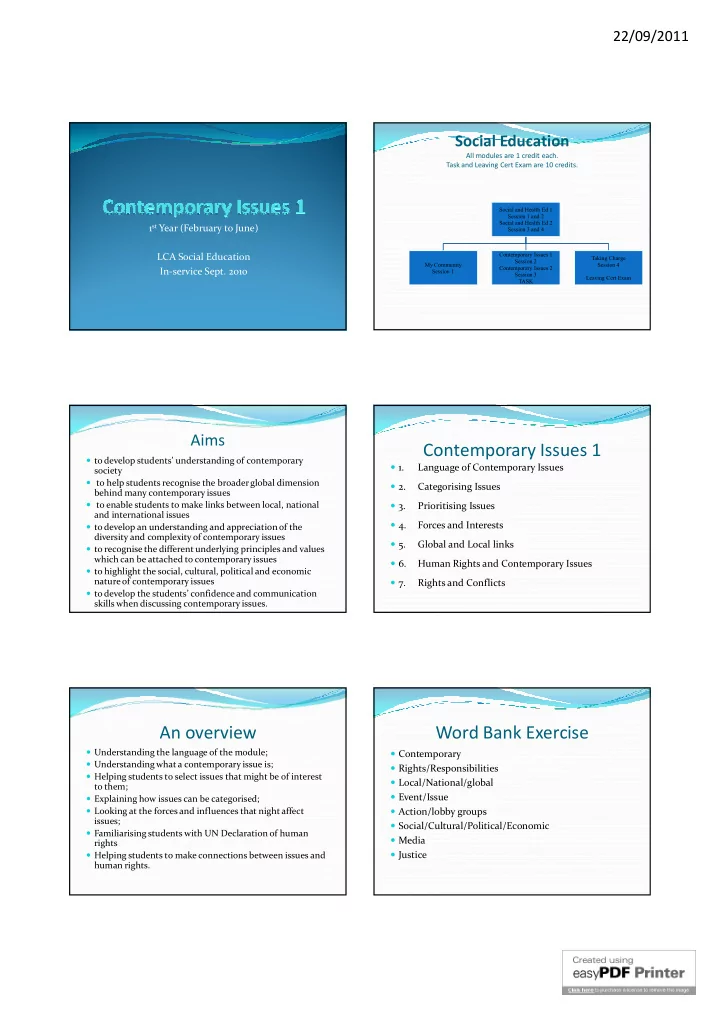
22/09/2011 Social Education All modules are 1 credit each. Task and Leaving Cert Exam are 10 credits. Social and Health Ed 1 Session 1 and 2 Social and Health Ed 2 1 st Year (February to June) Session 3 and 4 Contemporary Issues 1 LCA


slide-1
SLIDE 1

22/09/2011 1

1st Year (February to June) LCA Social Education In-service Sept. 2010

Social Education

All modules are 1 credit each. Task and Leaving Cert Exam are 10 credits.

Social and Health Ed 1 Session 1 and 2 Social and Health Ed 2 Session 3 and 4 My Community Session 1 Contemporary Issues 1 Session 2 Contemporary Issues 2 Session 3 TASK Taking Charge Session 4 Leaving Cert Exam

Aims

 to develop students’ understanding of contemporary society  to help students recognise the broader global dimension behind many contemporary issues  to enable students to make links between local, national and international issues  to develop an understanding and appreciation of the diversity and complexity of contemporary issues  to recognise the different underlying principles and values which can be attached to contemporary issues  to highlight the social, cultural, political and economic nature of contemporary issues  to develop the students’ confidence and communication skills when discussing contemporary issues.

Contemporary Issues 1

 1. Language of Contemporary Issues  2. Categorising Issues  3. Prioritising Issues  4. Forces and Interests  5. Global and Local links  6. Human Rights and Contemporary Issues  7. Rights and Conflicts

An overview

 Understanding the language of the module;  Understanding what a contemporary issue is;  Helping students to select issues that might be of interest to them;  Explaining how issues can be categorised;  Looking at the forces and influences that night affect issues;  Familiarising students with UN Declaration of human rights  Helping students to make connections between issues and human rights.

Word Bank Exercise

 Contemporary  Rights/Responsibilities  Local/National/global  Event/Issue  Action/lobby groups  Social/Cultural/Political/Economic  Media  Justice

slide-2
SLIDE 2

22/09/2011 2

Ways of Examining Issues

 

  • 1. Newspapers

Local or National  

  • 2. Community Audit

Groups/Needs/ Facilities  

  • 3. Eilis flood Exercise

Interest/Not of Interest  

  • 4. List local issues

Make Local/National/Global links  

  • 5. List of Issues

Pick on from chief Examiners report  

  • 6. List of Rights

Name an abuse of some/Pick issue from that  

  • 7. Rights cards

Pick one you would not want to lose/ find related issue  

  • 8. Group issues

Issues that impact on young people/disabled/elderly etc.  

  • 9. Brainstorm

Take issues from CSPE or My Community   10 Role plays Take issues that arise from Ravi or other Role Plays 

  • 11. Rising to the ChallengeRandom list of contemporary Issues (Worksheet 1.2)

Event vs. Issue

EVENT ISSUE

 9/11  Pups Abandoned  Seven killed in crash  Elderly cant afford Heating  Man beaten in Street  School wall destroyed  No Car Day  Man killed by Machinery  Woman loses job over childcare  Terrorism  Animal Welfare  Road Safety  Equality/Poverty  Violence  Vandalism  Care for the Environment  Workplace Safety  Gender Equlaity

Forces and Interests

Alcohol (Positives) Alcohol (Negatives)

 Self Help Groups (A.A.)  Addiction Counselling Services  School Awareness Programmes  Personal problems that people want to forget  Drinking a part of Irish culture  Drunkenness largely accepted by Irish society

Forces and Interests

 Who is affected/concerned by the issue?  How are people affected by the issue?  Who should be concerned about the issue?  What factors are affecting the issue?  What are people doing about the issue?  Where is there an interest in this issue?  What progress, if any, has been made since the issue arose?  How has progress/change been achieved?  When did the interest arise in the issue?  What attitudes/opinions are positively or negatively affecting the issue?  What is going on that might make a difference?

Local

Man Found in Drain Local youth dies after pub brawl

National

  • 5000 sleeping rough

in Ireland each night

  • Violent crime on

the increase

Global

 Refugees mass on Border  Zero Tolerance Brings NY murder rate from 5000 to 400

Issue-Violence

Social;

People are afraid to help

  • ther people

Cultural

Act first think later mentality

Political

Lack of detention centres and not enough Garda

Economic

Not enough resources, or investment in certain areas

slide-3
SLIDE 3

22/09/2011 3

War in Iraq

 Positive forces (help)  Peace Movement  General distaste for War  U.N.  Concern for Iraqi People  Humanitarian effort  Awareness of effects of Sanctions (UNICEF)

 Negative Forces (worsen)  Media hype  Imperialism  2004 election in America  Arms Industry  Middle East  Sadam (100% vote)  Terrorists

UN Declaration of Human Rights

 1789 French Revolution,  1900’s rights defined,  1944 UN set up,  1948 UNDHR passed,  1954 Two conventions drafted,  1966 Conventions passed,  1976 Conventions came into force,  1992 Ireland Ratifies it.

Rights Development

 Human Rights defined as Civil and Political, Economic, Social, and Cultural.  Children's Rights defined as survival, development, protection and participation.  Children rights declared in 1959, but Convention 1989  Ireland only ratified in 1992 (USA and Somalia still no)  EU drafted a Convention on Human Rights in 1950 and renewed in 1998  EU court of Human Rights meets in Strasbourg.

Human Rights

 Right to live, exist.  To work for anyone  To own property  Free Speech  Security  Safety from violence  Protection from the law  Fair trial  To be innocent until proven guilty  To be a citizen of a country  To vote

Human rights (Cont.)

 To seek asylum if a country treats you badly  To think freely  To believe and practice the religion a person wants  To peacefully protest (speak against) a government or group  Health care (medical care)  Education  Eat/drink  To communicate through a language  Not be forced into marriage  To pursue happiness

Human Rights Debate

Get them to the “I agree” or the “I disagree” corner of the room and explain why they have taken that stand; Sample statement could include:  All children should have the right to education no matter what heir behaviour;  All student have the right to privacy so their lockers should never be searched;  Free legal aid should be open to all;  The law should be changed to allow same sex couples to marry;  The full consent of the father should always be sought before adoption.

slide-4
SLIDE 4

22/09/2011 4

Rights and Conflict

Smoking

Adults have the right to choose to smoke wherever they wish but

  • ther people have the right to enjoy a smoke-free environment.

Cultural identity

A Muslim/Traveller student has the right to express his or her identity (e.g. by wearing many earrings) but the school has the right to insist on a certain dress code (e.g.wearing of uniform).

Industrial development

People living in an area near large industrial developments have the right to a healthy environment but unemployed people in the area have a right to employment as a result of these developments.

Rights and Conflicts (cont.)

A quiet life

Young people who have few facilities have the right to play music loudly and play football on the street but others living in the area have the right to a quiet life.

Right of way

Farmers have the right to own land in scenic areas (e.g. mountains) but the public have the right to walk in the mountains (i.e. right of way).

Economic migrants

People in poorer countries have the right to seek a better quality of life but national governments have the right to protect the economic interests of their citizens by restricting the overall numbers of migrant workers.

Visitors

 Fas  Amnesty International (Local/school branch)  Narcotics Anonymous/Alcoholics Anonymous  One World Centre/Development Education Centre  Rape Crisis Centre  Victim Support  St Vincent de Paul/The Samaritans/AWARE  Bank/Credit Union Office/Money Advice and Budgeting Service  Someone from an ethnic or other minority group  Someone who works with minority groups  Politician (local or otherwise)  Person with disability  Employee in sheltered placement/member of Camphill or L'Arche community  Someone who has worked in a Third World or developing country  Single parent  Member of a solidarity or country- focus group e.g. West Papuan Action  Nurse /Iocal GP  Gardaf - Juvenile Liaison Officer  Role play

Links with other subjects

 Child care (Care for babies, child development, parenting, special needs, older people  VPG (Community work, work and living)  Religion (Living Faith, World Religions)

Key Assignments

Four Key Assignments are to be undertaken. One of these must be a group activity, one must be an out-of-school activity.  I took part in a role-play (either as a participant or observer) and recorded my observations about a situation where the denial of a human right was at issue.  I informed the class about a human rights issue/campaign I found in the newspaper or elsewhere.  I created an A1 sized promotional poster upholding one of the Rights in the Universal Declaration of Human Rights.

Key Assignments (2)

 I explained to my class three things I considered right and three things I considered wrong with regard to a particular contemporary issue.  I contacted an organisation/centre outside school that had information about a contemporary issue and gave a report to my class about what I had found out.  With other members of my class I organised a survey

  • n attitudes in our local area to a particular

contemporary issue