A public health approach to dementia could prevent up to 30 percent - - PowerPoint PPT Presentation

a public health approach to dementia could prevent up to
SMART_READER_LITE
LIVE PREVIEW

A public health approach to dementia could prevent up to 30 percent - - PowerPoint PPT Presentation

Disclosures Advisor / Director Grants The Tau Consortium, Scientific Advisor National Institute of Health/National Institute of Aging grants: P50 AG023501, P01 AG019724, The John Douglas French Foundation, Medical P50 AG1657303, and T32


slide-1
SLIDE 1

[ADD PRESENTATION TITLE: INSERT TAB > HEADER & FOOTER > NOTES AND HANDOUTS] 2/9/2017 1

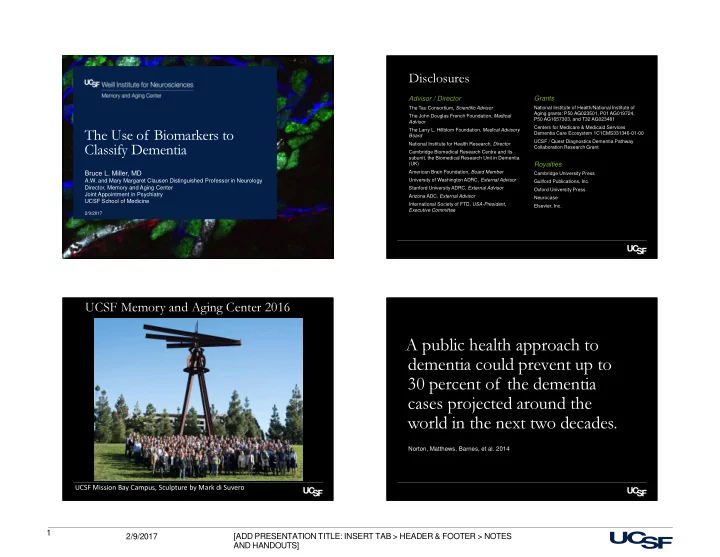
The Use of Biomarkers to Classify Dementia

2/9/2017

Bruce L. Miller, MD

A.W. and Mary Margaret Clausen Distinguished Professor in Neurology Director, Memory and Aging Center Joint Appointment in Psychiatry UCSF School of Medicine

Disclosures

Advisor / Director

The Tau Consortium, Scientific Advisor The John Douglas French Foundation, Medical Advisor The Larry L. Hillblom Foundation, Medical Advisory Board National Institute for Health Research, Director Cambridge Biomedical Research Centre and its subunit, the Biomedical Research Unit in Dementia (UK) American Brain Foundation, Board Member University of Washington ADRC, External Advisor Stanford University ADRC, External Advisor Arizona ADC, External Advisor International Society of FTD, USA-President, Executive Committee

Grants

National Institute of Health/National Institute of Aging grants: P50 AG023501, P01 AG019724, P50 AG1657303, and T32 AG023481 Centers for Medicare & Medicaid Services Dementia Care Ecosystem 1C1CMS331346-01-00 UCSF / Quest Diagnostics Dementia Pathway Collaboration Research Grant

Royalties

Cambridge University Press Guilford Publications, Inc. Oxford University Press Neurocase Elsevier, Inc.

UCSF Memory and Aging Center 2016

UCSF Mission Bay Campus, Sculpture by Mark di Suvero

“A public health approach to dementia could prevent up to 30 percent of the dementia cases projected around the world in the next two decades.

Norton, Matthews, Barnes, et al. 2014

slide-2
SLIDE 2

[ADD PRESENTATION TITLE: INSERT TAB > HEADER & FOOTER > NOTES AND HANDOUTS] 2/9/2017 2

Neurodegenerative Causes

Alzheimer’s disease frontotemporal dementia Lewy body disease and more

Dementia

cognitive decline that interferes with everyday functioning

memory, executive, behavioral, and/or motor symptoms

Overview

  • Neurodegeneration caused by protein

aggregation in specific circuits

  • Research criteria for AD and FTD
  • FTD genes – towards precision medicine
  • Molecular markers in AD
  • Molecular markers in FTD
  • Drug development

Models of Degenerative Dementia

All degenerative dementias have:

– Genetic and sporadic form – Cell culture and animal model – Preclinical, early symptomatic and symptomatic phase – Abnormal protein aggregation – Proteins spread from cell to cell

Neuropathology & Chemistry of Inclusions

  • CJD: prions (1982)
  • AD: plaque (Aβ-42, 1984),

tangle (tau, 1986)

  • PD/DLB: Lewy body (α-synuclein, 1998)
  • FTLD: Pick body (tau, 1990), ubiquitin positive

tau negative inclusions (TDP43, 2006), (FUS, 2009), dipeptides from C9 mutations (2013)

slide-3
SLIDE 3

[ADD PRESENTATION TITLE: INSERT TAB > HEADER & FOOTER > NOTES AND HANDOUTS] 2/9/2017 3

Molecular Changes Underlying AD

Pick 3R PSP 4R CBD 4R TDP-A TDP-B TDP-C FTLD-TDP FTLD-tau Dipeptides (C9ORF72) FTLD-FUS

NFL Player: Amygdala/Tau

McKee AC et al. J Neuropathol Exp Neurol. 2009

Lewy body

Idiopathic Parkinson’s Disease

Parkinson (1817): f Lewy (1913): concentric hyaline

  • inclusions. Trétiakoff (1919): Substantia nigra

degeneration

slide-4
SLIDE 4

[ADD PRESENTATION TITLE: INSERT TAB > HEADER & FOOTER > NOTES AND HANDOUTS] 2/9/2017 4

Differing Anatomy Defines Dementias

Disease Imaging Anatomy 1st Symptom Spared AD

Hippocampus posterior temporal-parietal Memory, naming, visuospatial Social behavior Movement

FTD

Frontal (emotional > cognitive neocortex) Apathy, behavior Navigation, memory

DLB

Amygdala temporal-

  • ccipital

Movement, hallucinations visuospatial sleep Behavior, memory

Research Criteria for Alzheimer’s Disease

  • At least two of the following:
  • Impairment in ability to remember new information
  • Impaired reasoning ability to manage complex

tasks

  • Impaired visuospatial abilities
  • Impaired language functions (speaking, reading,

writing)

  • Changes in behavior, personality or comportment
  • Insidious onset of decline and progressive worsening of

symptoms and function

  • Evidence of a causative genetic mutation
  • Biomarkers for amyloid deposition

Preclinical AD – Staging

  • Stage I: Asymptomatic

– Elevated amyloid PET/low CSF Aβ42

  • Stage II: Early synaptic dysfunction

– Positive amyloid biomarker – Abnormal CSF tau or MRI or FDG-PET

  • Stage III: Symptomatic

– Positive amyloid biomarker – Abnormal CSF tau or MRI or FDG-PET – Abnormal cognitive testing

International Research Criteria for Behavioral Variant FTD

  • 1. Early (2–3 yrs) behavioral disinhibition
  • 2. Early (2–3 yrs) apathy or inertia
  • 3. Early (2–3 yrs) loss of emotional

reactivity/sympathy and empathy

  • 4. Perseverative, stereotyped or

compulsive/ritualistic behavior

  • 5. Hyperorality and dietary changes
  • 6. FTD neuropsychological profile
slide-5
SLIDE 5

[ADD PRESENTATION TITLE: INSERT TAB > HEADER & FOOTER > NOTES AND HANDOUTS] 2/9/2017 5

VBM of FTD & AD vs Controls

Concept from Delay, Brion Escourolle 1950s, Thibodeau MP, Miller BL. Neurocase. 2013

Behavioral Variant Language Variants Semantic Variant Nonfluent Variant

R L

Rarely genetic 83% TDP-C Some genetic 85% Tau, TDP-A Often genetic Tau, TDP, FUS 2/3 TDP

3 Types Frontotemporal Dementia

R Ossenkoppele et al. Brain. 2015

Voxel-wise Comparisons of Grey Matter Volumes

How Classify C9ORF72 Carriers?

n=41

bvFTD nfvPPA svPPA ALS

PSP

CBS

Other

Parkinsonism

slide-6
SLIDE 6

[ADD PRESENTATION TITLE: INSERT TAB > HEADER & FOOTER > NOTES AND HANDOUTS] 2/9/2017 6

How Classify GRN Carriers?

n=41

ALS bvFTD nfvPPA svPPA CBS PSP Other

Parkinsonism

How Classify MAPT Carriers?

n=41 bvFTD nfvPPA svPPA ALS CBS PSP Other Parkinsonism

Rare Variants with FTD-ALS

Gene Variant Phenotype Publication TARDBP P112H FTD Moreno et al 2015 FUS Q140H tauopathy Ferrer et al 2015 LRRK2 C2154F tauopathy Chen-Plotkin et al 2008 TBK-1 Nonsense variant FTD-ALS Le Ber et al 2015 PRNP Q160X dementia Fong et al 2016 OPTN deletion, nonsense & missense mutation ALS Maruyama et al 2010 UBQLN2 PXX ALS Deng et al 2011

Pick’s, 8 CBD, 3 PSP, 2 FTDP-17, 2

Tau unclassifiable, 3

TDP-A, 6 TDP-A, MND, 1 TDP-B, 5 TDP-B, MND, 15 TDP-C, 3 TDP-U, 1 TDP-U, MND, 7 ALS-TDP, 1 aFTLD-U (FUS), 7 AD, 4

bvFTD, high confidence, n = 68

slide-7
SLIDE 7

[ADD PRESENTATION TITLE: INSERT TAB > HEADER & FOOTER > NOTES AND HANDOUTS] 2/9/2017 7

Role of Biomarker

  • Capture early disease (sensitive)
  • Separate healthy aging from

neurodegeneration (specific)

  • Determine molecular determinants of

neurodegeneration (AD vs. FTD due to tau, TDP, FUS, and PDD or DLB (specific)

  • Help with staging of disease

Tablet-based Cognitive Assessments

FTD vs. AD: Executive Control

  • AD & bvFTD are similar:

– Working memory: Spatial 1-Back, Dot count – Category fluency: Animal generation – Attention: Set shift, Flanker

  • bvFTD worse than AD

– Letter fluency – Antisaccade accuracy – Social decision making: Social norms – Social behavior: Behavior checklist

  • Discriminant function classify 73% bvFTD vs AD

Possin et al. Neurology 2014

Executive Control in bvFTD & AD

Performance on executive tasks, emotion recognition increasing disease severity AD (n= 678) vs bvFTD (n=206)

Ranasinghe & Rankin Neurol 2016

slide-8
SLIDE 8

[ADD PRESENTATION TITLE: INSERT TAB > HEADER & FOOTER > NOTES AND HANDOUTS] 2/9/2017 8

PSP Disease Severity Circadian Activity

Walsh et al, Sleep Medicine, 2016

Rest-activity Rhythm Disruption PSP

Walsh et al, Sleep Medicine, 2016

Automated Classification Analysis of sMRI Scans

  • Averaging across patient maps can be very insensitive
  • Machine-learning algorithms (e.g., using support vector

machines) more effectively discriminate when atrophy patterns heterogeneous within same clinical class patient

Network-based Neurodegeneration

Time (sec) Single subject

Seeley et al Neuron 2009

slide-9
SLIDE 9

[ADD PRESENTATION TITLE: INSERT TAB > HEADER & FOOTER > NOTES AND HANDOUTS] 2/9/2017 9

Plasma Neurofilament PSP vs. Controls

Rojas et al., Ann Clin Transl Neurol. 2016

Neurofilament Level Cognitive Decline

Rojas et al, Ann Clin Transl Neurol. 2016

Amyloid Deposition in Autosomal Dominant AD

Bateman et al., NEJM 2012

Carriers Non-carriers Years from symptom onset

NHCH3 N O O O

18F

18F-florbetapir (AmyvidTM)

FDA approved April 2012

18F-flutemetamol (VizamylTM)

FDA approved October 2013

18F-florbetaben (NeuraceqTM)

FDA approved March 2014

slide-10
SLIDE 10

[ADD PRESENTATION TITLE: INSERT TAB > HEADER & FOOTER > NOTES AND HANDOUTS] 2/9/2017 10

AD FTLD CONT

DVR

2.5

Amyloid vs. FDG-PET in Differential Diagnosis of AD vs. FTD

AD (N=62, age 65, MMSE 22) FTD (N=45, age 65, MMSE 22) Amyloid (PIB) PET visual reads

90% sensitivity, 83% specificity Inter-rater agreement κ=0.96

FDG-PET visual reads

78% sensitivity*, 84% specificity Inter-rater agreement κ=0.72*

70 autopsy-proven cases

PIB: Sensitivity 96%, Specificity 88% FDG: Sensitivity 88%, Specificity 89%

Rabinovici et al. Neurology 2011

* - p<0.05 vs. PIB

Amyloid PET vs. CSF Aβ

Landau et al, Ann Neurol 2013

Florbetapir cortical retention ratio

κ = 0.72

Both positive Both negative

Normal κ = 0.76 EMCI κ = 0.65 LMCI κ = 0.71 AD κ = 0.70

abnormal

CSF Aβ1-42

normal

  • National, open-label study on clinical utility of amyloid

PET in ~18,500 Medicare beneficiaries with MCI or dementia of uncertain cause

  • Eligible patients referred for PET by dementia experts
  • Scans covered by CMS, performed and interpreted locally
  • Aim 1: Impact of scan on management plan at 3 months
  • Aim 2: Impact on major medical outcomes at 12 months

The primary hypothesis is that, in diagnostically uncertain cases, amyloid PET will lead to significant changes in patient management, and this will translate into improved medical outcomes

IDEAS-Study@acr.org IDEAS-Study.org

slide-11
SLIDE 11

[ADD PRESENTATION TITLE: INSERT TAB > HEADER & FOOTER > NOTES AND HANDOUTS] 2/9/2017 11

462 active dementia practices 772 dementia experts 302 active PET facilities

6,924 patients registered 6,300 scans completed Median age 76 (range: 65-99) 61.8% MCI, 38.2% dementia Aβ-PET positive:

MCI 54.65%, dementia 69.9%

96.3% consent to use images 86.8% consent to be contacted about other research

D D

Dialkylamino-naphyelthyilidene derivatives Quinoline derivatives Benzoimidazopyrimidine and pyridoindole derivatives Benzimidazole derivatives Phenyl/pyridinyl-butadienyl-benzothiazoles/ benzothiazoliums derivatives

18F-FDDNP 18F-THK-523 18F-THK-5105 18F-THK-5317 18F-THK-5351 18F-AV1451 (a.k.a. T807) 18F-T808 18F-RO69558948 11C-PBB3 11C-N-Methyl Lansoprazole 18F-N-Methyl Lansoprazole 18F-GT1 18F-MK-6240

Azaindole derivatives

Slide courtesy of Victor Villemagne

Tau Imaging Radiotracers

Pure Tauopathies vs. Mixed Tauopathy

  • Mutations – bvFTD,

nfvPPA, PSP, CBD

  • Pick – bvFTD,

nfvPPA

  • CBD – bvFTD,

nfvPPA, executive/motor

  • PSP – falls, gaze,

axial PD, dementia

  • AD*
  • CTE*
  • Guam-PD-

Dementia

  • Postencephalitic

Parkinson’s

  • Niemann-Pick

disease

T807 Tau PET in AD

Healthy Very Mild AD Mild AD Severe AD

slide-12
SLIDE 12

[ADD PRESENTATION TITLE: INSERT TAB > HEADER & FOOTER > NOTES AND HANDOUTS] 2/9/2017 12

Tau PET: The New Frontier

Amyloid, tau & brain metabolism 57 year-old AD Brain dysfunction correlates with tau but not amyloid

Amyloid (PIB-PET) Atrophy (MRI) Tau (AV1451-PET)

Ossenkoppele et al., Brain 2016

Tau PET Patterns Correlate with AD Phenotype

Tau PET Correlates of Cognition in AD (N=40, Mean MMSE 22.2)

Bejanin et al., in prep

slide-13
SLIDE 13

[ADD PRESENTATION TITLE: INSERT TAB > HEADER & FOOTER > NOTES AND HANDOUTS] 2/9/2017 13

68 yo Retired NFL Player With Neurobehavioral Decline, PIB-neg

0.0 2.3 AV1451 SUVR

CTE Stage III

McKee et al. Brain 2013

bvFTD V337M MAPT Mutation

Spina et al Neurology 2017

Functional Connectivity Dorsal Midbrain Tegmental Network & Tau PET in PSP

Gardner et al. Ann Neurol 2013, Rabinovici 2015

2.5

Functional Connectivity Tau PET

slide-14
SLIDE 14

[ADD PRESENTATION TITLE: INSERT TAB > HEADER & FOOTER > NOTES AND HANDOUTS] 2/9/2017 14

Roles of Tau PET Drug Development

  • Accurate patient selection for clinical trials
  • f tau-based therapies
  • PSP (>90% have tau), CBS (~60%)
  • Provide early evidence of drug effect
  • Does drug lower tau levels, prevent

spread?

  • Early detection ➙ early intervention and

disease prevention

Trail of Tears (AD Trials)

  • Misdiagnosis (36% bapineuzumab, solenezumab

apoE3 carriers amyloid negative)

  • Oversimplification – 60-95 years all dementia is

AD – TDP43 – Vascular disease – α-synuclein

  • Too late
  • Wrong molecule?

MAC Clinical Trials

  • Crenezumab
  • Levetiracetam
  • Solanezumab
  • Aducanumab
  • TPI-287

Alzheimer

  • FRM-0334
  • Tau
  • TPI-287
  • Oral

salsalate

  • Plasma

transfusion

  • BMS-986168
  • C2N-8E12

FTD PSP/CBD

GBHI Leadership

Ian Robertson, PhD Chair Psychology at Trinity College Dublin, Founding Director of the Trinity College Institute of Neuroscience Research. Studies the brain’s attention systems. Has developed new therapeutic methods that improve cognitive function and may delay dementia. Bruce Miller, MD A.W. and Mary Margaret Clausen Distinguished Professor in Neurology at UCSF. Directs Memory and Aging Center with 30 full-time faculty. Research into frontal lobes and FTD. Explores brain regions involved in altruism and prosocial behavior. Leads research consortia for dementia therapies. Brian Lawlor, MD Conolly Norman Professor of Old Age Psychiatry at Trinity College Dublin and consultant psychiatrist at St. James’s Hospital. He directs the Memory Disorders Clinic at Mercer’s Institute for Research

  • n Aging. His research programs range from clinical trials, biomarkers, and

early detection to caregiver burden. Victor Valcour, MD, PhD Geriatrician trained behavioral neurology. Professor Neurology & Geriatrics at UCSF. Research brain protection and early intervention for HIV. Co-Directs SEARCH-Thailand research group and the International NeuroHIV Cure Consortium. His programs stretch from San Francisco to Africa and Southeast Asia. Studies HIV and aging.

slide-15
SLIDE 15

[ADD PRESENTATION TITLE: INSERT TAB > HEADER & FOOTER > NOTES AND HANDOUTS] 2/9/2017 15

Approach

Fellows (8/year) Scholars (32/year) Comprehensive Learning Environment UCSF/TCD Core Strength in Basic and Clinical Neuroscience

GBHI Curriculum

  • Core 1: Neuroscience
  • Brain-Behavior Relationships
  • Cognitive Assessment
  • Alzheimer’s Disease, MCI, & Other Dementias
  • Pathology of Aging
  • Alcohol and Mental Health
  • Risk Factors for Neurodegenerative Disease
  • Core 2: Public Health & Epidemiology
  • Introduction to Clinical Trials
  • Understanding Validity and Reliability
  • Type of Bias, Confounding, Interaction
  • Use of Epidemiology in Public Health
  • Introduction to Survey Data
  • Intro to Cost Analysis in Health Care
  • Core 3: Health Policy & Economics
  • Intro to Behavioral Economics
  • Intro to Health Policy
  • Intro to Implementation Science
  • Intro to Health Law
  • Core 4: Leadership & Communications
  • Principles of Global Health leadership
  • Strategy Formulation and Implementation
  • Teambuilding, Funding & Stakeholder

Engagement

  • Bioethics
  • Core 5: Social Science
  • Features of Dementia
  • Pharmaceuticals for the Elderly
  • Ethical Issues in Brain Health
  • Legal Issues in Brain Health
  • End of Life Care and Decision-making
  • Core 6: Supplementary
  • Caregiver Burden in Dementia
  • Building a Career in Brain Health
  • Health Behaviors and Brain Health
  • Social Factors and Dementia
  • Mental Health Disorders and Brain Health

Over 75 modules to be available for asynchronous learning ILLUSTRATIVE

2016 Atlantic Fellows

Jalayne Arias, JD, MA

USA, UCSF neuroethics, bioethics, health policy, law

Mircea Balasa, MD, PhD

Barcelona, Spain, TCD neurology, dementia, AD, FTD, biomarkers, medical education

Alissa Bernstein, PhD, MPH

USA, UCSF medical anthropology, public health policy, social determinants, ethnography diversity

Dominic Campbell

Ireland, TCD elder activism, creativity, positive aging, ageism, social enterprise

Heidi Clare, MMA

USA, UCSF music, creativity, song writing podcast on music and aging

Jorge Llibre Guerra, MD, MS

Havana, Cuba, UCSF neurology, dementia, cognition, behavior, cerebrovascular disease

Geeske Peeters, PhD

Netherlands, TCD public health, preventive medicine, musculoskeletal health, fall prevention

Elisa França Resende, MD

Belo Horizonte, Brazil, UCSF neurology, memory impairment, control

  • f risk factors, prevention strategies

Adrià Rofes, MSc, PhD

Barcelona, Spain, TCD neuroscience clinical linguistics, brain mapping, language processing

Lina Velilla, MS

Medellin, Colombia, UCSF psychology, epidemiology, training, public health

Atlantic Institute

  • Hosted by Rhodes House

in Oxford, England

  • Career-long global network
  • f Atlantic Fellows
  • Atlantic Fellows programs:
  • 1. Global Brain Health Institute
  • 2. Heath Equity

in South Africa at Tekano

  • 3. Health Equity in Southeast Asia
  • 4. The Narrative Initiative

with the Ford Foundation

  • 5. Racial Equity

at Columbia University

  • 6. Social & Economic Equity

at International Inequalities Institute

  • 7. Social Equity University Melbourne
slide-16
SLIDE 16

[ADD PRESENTATION TITLE: INSERT TAB > HEADER & FOOTER > NOTES AND HANDOUTS] 2/9/2017 16

Sustained Connected Community Committed to Social Change

Shared identity Lateral connectivity Learning from each

  • ther

Collective strength

International Inequalities Institute Health Equity South Africa Racial Equity Global Brain Health Institute The Equity Initiative / Health Equity SE Asia Social Equity The Atlantic Philanthropies Narrative Initiative Atlantic Institute Learning & Evaluation Partners

The Narrative Initiative Summary

1. Clinical symptoms are associated with specific atrophy in the underlying functional brain networks affected by disease 2. Circadian activity rhythms are disrupted in individuals with PSP 3. Neurodegenerative disease leads to long term changes in CSF biochemical markers, brain amyloid deposition, and brain metabolism – in addition to progressive cognitive impairment

slide-17
SLIDE 17

[ADD PRESENTATION TITLE: INSERT TAB > HEADER & FOOTER > NOTES AND HANDOUTS] 2/9/2017 17

Selected Bibliography

1. Bateman RJ, Xiong C, Benzinger TL, Fagan AM, Goate A, Fox NC, Marcus DS, Cairns NJ, Xie X, Blazey TM, Holtzman DM, Santacruz A, Buckles V, Oliver A, Moulder K, Aisen PS, Ghetti B, Klunk WE, McDade E, Martins RN, Masters CL, Mayeux R, Ringman JM, Rossor MN, Schofield PR, Sperling RA, Salloway S, Morris JC; Dominantly Inherited Alzheimer

  • Network. Clinical and biomarker changes in dominantly inherited Alzheimer's disease. N Engl J Med. 2012 Aug

30;367(9):795-804. Erratum in: N Engl J Med. 2012 Aug 23;367(8):780. 2. Gardner RC, Boxer AL, Trujillo A, Mirsky JB, Guo CC, Gennatas ED, Heuer HW, Fine E, Zhou J, Kramer JH, Miller BL, Seeley WW. Intrinsic connectivity network disruption in progressive supranuclear palsy. Ann Neurol. 2013 May;73(5):603-16. 3. Landau SM, Lu M, Joshi AD, Pontecorvo M, Mintun MA, Trojanowski JQ, Shaw LM, Jagust WJ; Alzheimer's Disease Neuroimaging Initiative. Comparing positron emission tomography imaging and cerebrospinal fluid measurements of β-

  • amyloid. Ann Neurol. 2013 Dec;74(6):826-36.

4. McKee AC, Cantu RC, Nowinski CJ, Hedley-Whyte ET, Gavett BE, Budson AE, Santini VE, Lee HS, Kubilus CA, Stern

  • RA. Chronic traumatic encephalopathy in athletes: progressive tauopathy after repetitive head injury. J Neuropathol Exp
  • Neurol. 2009 Jul;68(7):709-35.

5. McKee AC, Stern RA, Nowinski CJ, Stein TD, Alvarez VE, Daneshvar DH, Lee HS, Wojtowicz SM, Hall G, Baugh CM, Riley DO, Kubilus CA, Cormier KA, Jacobs MA, Martin BR, Abraham CR, Ikezu T, Reichard RR, Wolozin BL, Budson AE, Goldstein LE, Kowall NW, Cantu RC. The spectrum of disease in chronic traumatic encephalopathy. Brain. 2013 Jan;136(Pt 1):43-64. 6. Ossenkoppele R, Pijnenburg YA, Perry DC, Cohn-Sheehy BI, Scheltens NM, Vogel JW, Kramer JH, van der Vlies AE, La Joie R, Rosen HJ, van der Flier WM, Grinberg LT, Rozemuller AJ, Huang EJ, van Berckel BN, Miller BL, Barkhof F, Jagust WJ, Scheltens P, Seeley WW, Rabinovici GD. The behavioural/dysexecutive variant of Alzheimer's disease: clinical, neuroimaging and pathological features. Brain. 2015 Sep;138(Pt 9):2732-49. 7. Ossenkoppele R, Schonhaut DR, Schöll M, Lockhart SN, Ayakta N, Baker SL, O'Neil JP, Janabi M, Lazaris A, Cantwell A, Vogel J, Santos M, Miller ZA, Bettcher BM, Vossel KA, Kramer JH, Gorno-Tempini ML, Miller BL, Jagust WJ, Rabinovici GD. Tau PET patterns mirror clinical and neuroanatomical variability in Alzheimer's disease. Brain. 2016;139:1551–67. 8. Possin KL, Feigenbaum D, Rankin KP, Smith GE, Boxer AL, Wood K, Hanna SM, Miller BL, Kramer JH. Dissociable executive functions in behavioral variant frontotemporal and Alzheimer dementias. Neurology. 2013 Jun 11;80(24):2180- 5.

Selected Bibliography, cont.

9. Rabinovici GD, Rosen HJ, Alkalay A, Kornak J, Furst AJ, Agarwal N, Mormino EC, O'Neil JP, Janabi M, Karydas A, Growdon ME, Jang JY , Huang EJ, Dearmond SJ, Trojanowski JQ, Grinberg LT, Gorno-Tempini ML, Seeley WW, Miller BL, Jagust WJ. Amyloid vs FDG-PET in the differential diagnosis of AD and FTLD. Neurology. 2011 Dec 6;77(23):2034-42. 10. Ossenkoppele R, Cohn-Sheehy BI, La Joie R, Vogel JW, Möller C, Lehmann M, van Berckel BN, Seeley WW, Pijnenburg YA, Gorno-Tempini ML, Kramer JH, Barkhof F, Rosen HJ, van der Flier WM, Jagust WJ, Miller BL, Scheltens P, Rabinovici GD. Atrophy patterns in early clinical stages across distinct phenotypes of Alzheimer's

  • disease. Hum Brain Mapp. 2015 Nov;36(11):4421-37.

11. Racine AM, Koscik RL, Nicholas CR, Clark LR, Okonkwo OC, Oh JM, Hillmer AT, Murali D, Barnhart TE, Betthauser TJ, Gallagher CL, Rowley HA, Dowling NM, Asthana S, Bendlin BB, Blennow K, Zetterberg H, Carlsson CM, Christian BT, Johnson SC. Cerebrospinal fluid ratios with Aβ42 predict preclinical brain β-amyloid

  • accumulation. Alzheimers Dement (Amst). 2016;2:27-38.

12. Ranasinghe KG, Rankin KP, Pressman PS, Perry DC, Lobach IV, Seeley WW, Coppola G, Karydas AM, Grinberg LT, Shany-Ur T, Lee SE, Rabinovici GD, Rosen HJ, Gorno-Tempini ML, Boxer AL, Miller ZA, Chiong W, DeMay M, Kramer JH, Possin KL, Sturm VE, Bettcher BM, Neylan M, Zackey DD, Nguyen LA, Ketelle R, Block N, Wu TQ, Dallich A, Russek N, Caplan A, Geschwind DH, Vossel KA, Miller BL. Distinct Subtypes of Behavioral Variant Frontotemporal Dementia Based on Patterns of Network Degeneration. JAMA Neurol. 2016 Sep 1;73(9):1078-88. 13. Rojas JC, Karydas A, Bang J, Tsai RM, Blennow K, Liman V, Kramer JH, Rosen H, Miller BL, Zetterberg H, Boxer AL. Plasma neurofilament light chain predicts progression in progressive supranuclear palsy. Ann Clin Transl Neurol. 2016 Feb 1;3(3):216-25. 14. Seeley WW, Crawford RK, Zhou J, Miller BL, Greicius MD. Neurodegenerative diseases target large-scale human brain networks. Neuron. 2009 Apr 16;62(1):42-52. 15. Spina S, Schonhaut DR, Boeve BF, Seeley WW, Ossenkoppele R, O'Neil JP, Lazaris A, Rosen HJ, Boxer AL, Perry DC, Miller BL, Dickson DW, Parisi JE, Jagust WJ, Murray ME, Rabinovici GD. Frontotemporal dementia with the V337M MAPT mutation: Tau-PET and pathology correlations. Neurology. 2017 Jan 27. 16. Walsh CM, Ruoff L, Varbel J, Walker K, Grinberg LT, Boxer AL, Kramer JH, Miller BL, Neylan TC. Rest-activity rhythm disruption in progressive supranuclear palsy. Sleep Med. 2016 Jun;22:50-6.

CSF Measures & Baseline PiB Burden

Racine AM et al. Alzheimers Dement (Amst). 2016