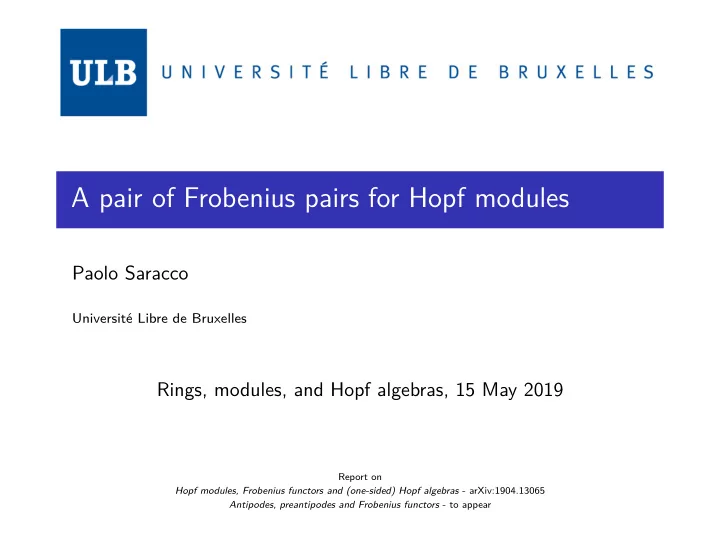
A pair of Frobenius pairs for Hopf modules Paolo Saracco Universit - - PowerPoint PPT Presentation

a pair of frobenius pairs for hopf modules
SMART_READER_LITE
LIVE PREVIEW

A pair of Frobenius pairs for Hopf modules Paolo Saracco Universit - - PowerPoint PPT Presentation

A pair of Frobenius pairs for Hopf modules Paolo Saracco Universit Libre de Bruxelles Rings, modules, and Hopf algebras, 15 May 2019 Report on Hopf modules, Frobenius functors and (one-sided) Hopf algebras - arXiv:1904.13065 Antipodes,


slide-1
SLIDE 1

A pair of Frobenius pairs for Hopf modules

Paolo Saracco

Université Libre de Bruxelles

Rings, modules, and Hopf algebras, 15 May 2019

Report on Hopf modules, Frobenius functors and (one-sided) Hopf algebras - arXiv:1904.13065 Antipodes, preantipodes and Frobenius functors - to appear

slide-2
SLIDE 2

General recalls: one-sided Hopf, Frobenius algebras

k is a commutative ring (from time to time a field). B a k-bialgebra.

Definition ([GNT, 1980])

A left (resp. right) convolution inverse of IdB is called a left (resp. right) antipode and B a left (resp. right) Hopf algebra.

Definition

A k-algebra A is Frobenius if ∃ ψ ∈ A∗ and e ∈ A ⊗ A such that (ψ ⊗ A)(e) = 1 = (A ⊗ ψ)(e) and ae = ea (∀ a ∈ A). Equivalently, if A is fgp and AA ∼ = AA∗ with regular structures.

[GNT] Green, Nichols, Taft, Left Hopf algebras. J. Algebra 65 (1980).

2 / 12

slide-3
SLIDE 3

General recalls: one-sided Hopf, Frobenius algebras

k is a commutative ring (from time to time a field). B a k-bialgebra.

Definition ([GNT, 1980])

A left (resp. right) convolution inverse of IdB is called a left (resp. right) antipode and B a left (resp. right) Hopf algebra.

Definition

A k-algebra A is Frobenius if ∃ ψ ∈ A∗ and e ∈ A ⊗ A such that (ψ ⊗ A)(e) = 1 = (A ⊗ ψ)(e) and ae = ea (∀ a ∈ A). Equivalently, if A is fgp and AA ∼ = AA∗ with regular structures.

[GNT] Green, Nichols, Taft, Left Hopf algebras. J. Algebra 65 (1980).

2 / 12

slide-4
SLIDE 4

General recalls: Frobenius functors

Definition ([CMZ, 1997],[CGN, 1999])

  • A pair of functors F : C → D and G : D → C is called a Frobenius

pair if G ⊣ F ⊣ G (equivalently, F ⊣ G ⊣ F).

  • A functor F is Frobenius if ∃ G such that (F, G) is a Frobenius pair.

Theorem ([M, 1965])

A k-algebra A is Frobenius iff U : AM → kM is Frobenius. ➻ Frobenius functors are a natural extension of Frobenius algebras to category theory.

[CMZ] Caenepeel, Militaru, Zhu, Doi-Hopf modules, Yetter-Drinfel’d modules and Frobenius type

  • properties. Trans. Amer. Math. Soc. 349 (1997).

[CGN] Castaño Iglesias, Gómez-Torrecillas, Năstăsescu, Frobenius functors, applications.

  • Comm. Algebra 27 (1999).

[M] Morita, Adjoint pairs of functors and Frobenius extensions. Sci. Rep. Tokyo Kyoiku Daigaku

  • Sect. A 9 (1965).

3 / 12

slide-5
SLIDE 5

General recalls: Frobenius functors

Definition ([CMZ, 1997],[CGN, 1999])

  • A pair of functors F : C → D and G : D → C is called a Frobenius

pair if G ⊣ F ⊣ G (equivalently, F ⊣ G ⊣ F).

  • A functor F is Frobenius if ∃ G such that (F, G) is a Frobenius pair.

Theorem ([M, 1965])

A k-algebra A is Frobenius iff U : AM → kM is Frobenius. ➻ Frobenius functors are a natural extension of Frobenius algebras to category theory.

[CMZ] Caenepeel, Militaru, Zhu, Doi-Hopf modules, Yetter-Drinfel’d modules and Frobenius type

  • properties. Trans. Amer. Math. Soc. 349 (1997).

[CGN] Castaño Iglesias, Gómez-Torrecillas, Năstăsescu, Frobenius functors, applications.

  • Comm. Algebra 27 (1999).

[M] Morita, Adjoint pairs of functors and Frobenius extensions. Sci. Rep. Tokyo Kyoiku Daigaku

  • Sect. A 9 (1965).

3 / 12

slide-6
SLIDE 6

General recalls: Frobenius functors

Definition ([CMZ, 1997],[CGN, 1999])

  • A pair of functors F : C → D and G : D → C is called a Frobenius

pair if G ⊣ F ⊣ G (equivalently, F ⊣ G ⊣ F).

  • A functor F is Frobenius if ∃ G such that (F, G) is a Frobenius pair.

Theorem ([M, 1965])

A k-algebra A is Frobenius iff U : AM → kM is Frobenius. ➻ Frobenius functors are a natural extension of Frobenius algebras to category theory.

[CMZ] Caenepeel, Militaru, Zhu, Doi-Hopf modules, Yetter-Drinfel’d modules and Frobenius type

  • properties. Trans. Amer. Math. Soc. 349 (1997).

[CGN] Castaño Iglesias, Gómez-Torrecillas, Năstăsescu, Frobenius functors, applications.

  • Comm. Algebra 27 (1999).

[M] Morita, Adjoint pairs of functors and Frobenius extensions. Sci. Rep. Tokyo Kyoiku Daigaku

  • Sect. A 9 (1965).

3 / 12

slide-7
SLIDE 7

General recalls: Frobenius functors

Definition ([CMZ, 1997],[CGN, 1999])

  • A pair of functors F : C → D and G : D → C is called a Frobenius

pair if G ⊣ F ⊣ G (equivalently, F ⊣ G ⊣ F).

  • A functor F is Frobenius if ∃ G such that (F, G) is a Frobenius pair.

Theorem ([M, 1965])

A k-algebra A is Frobenius iff U : AM → kM is Frobenius. ➻ Frobenius functors are a natural extension of Frobenius algebras to category theory.

[CMZ] Caenepeel, Militaru, Zhu, Doi-Hopf modules, Yetter-Drinfel’d modules and Frobenius type

  • properties. Trans. Amer. Math. Soc. 349 (1997).

[CGN] Castaño Iglesias, Gómez-Torrecillas, Năstăsescu, Frobenius functors, applications.

  • Comm. Algebra 27 (1999).

[M] Morita, Adjoint pairs of functors and Frobenius extensions. Sci. Rep. Tokyo Kyoiku Daigaku

  • Sect. A 9 (1965).

3 / 12

slide-8
SLIDE 8

General recalls: Frobenius-Hopf connections

Theorem ([LS, 1969])

Any fgp Hopf algebra over a PID is Frobenius.

Theorem ([P, 1971])

A bialgebra B is an fgp Hopf algebra with

  • r B∗ ∼

= k iff it is Frobenius with Frobenius homomorphism ψ ∈

  • r B∗.

Argument

ηM : M → B ⊗

BM

ǫV :

BB ⊗ V ∼ =

→ V

B BM coB (−)

  • k ⊗B −
  • kM

B⊗−

  • γV : V

∼ =

coB(B ⊗ V )

θM : B ⊗

coBM → M

➻ B fgp Hopf ⇒ B∗ ∈ B

BM and θB∗ : B ⊗

  • r B∗ ∼

= B∗ ⇒ BB ∼ = BB∗.

[LS] Larson, Sweedler, An Orthogonal Bilinear Form for Hopf Algebras. Amer. J. Math. 91 (1969). [P] Pareigis, When Hopf algebras are Frobenius algebras. J. Algebra 18 (1971).

4 / 12

slide-9
SLIDE 9

General recalls: Frobenius-Hopf connections

Theorem ([LS, 1969])

Any fgp Hopf algebra over a PID is Frobenius.

Theorem ([P, 1971])

A bialgebra B is an fgp Hopf algebra with

  • r B∗ ∼

= k iff it is Frobenius with Frobenius homomorphism ψ ∈

  • r B∗.

Argument

ηM : M → B ⊗

BM

ǫV :

BB ⊗ V ∼ =

→ V

B BM coB (−)

  • k ⊗B −
  • kM

B⊗−

  • γV : V

∼ =

coB(B ⊗ V )

θM : B ⊗

coBM → M

➻ B fgp Hopf ⇒ B∗ ∈ B

BM and θB∗ : B ⊗

  • r B∗ ∼

= B∗ ⇒ BB ∼ = BB∗.

[LS] Larson, Sweedler, An Orthogonal Bilinear Form for Hopf Algebras. Amer. J. Math. 91 (1969). [P] Pareigis, When Hopf algebras are Frobenius algebras. J. Algebra 18 (1971).

4 / 12

slide-10
SLIDE 10

General recalls: Frobenius-Hopf connections

Theorem ([LS, 1969])

Any fgp Hopf algebra over a PID is Frobenius.

Theorem ([P, 1971])

A bialgebra B is an fgp Hopf algebra with

  • r B∗ ∼

= k iff it is Frobenius with Frobenius homomorphism ψ ∈

  • r B∗.

Argument

ηM : M → B ⊗

BM

ǫV :

BB ⊗ V ∼ =

→ V

B BM coB (−)

  • kM

B⊗−

  • γV : V

∼ =

coB(B ⊗ V )

θM : B ⊗

coBM → M

➻ B fgp Hopf ⇒ B∗ ∈ B

BM and θB∗ : B ⊗

  • r B∗ ∼

= B∗ ⇒ BB ∼ = BB∗.

[LS] Larson, Sweedler, An Orthogonal Bilinear Form for Hopf Algebras. Amer. J. Math. 91 (1969). [P] Pareigis, When Hopf algebras are Frobenius algebras. J. Algebra 18 (1971).

4 / 12

slide-11
SLIDE 11

General recalls: Frobenius-Hopf connections

Theorem ([LS, 1969])

Any fgp Hopf algebra over a PID is Frobenius.

Theorem ([P, 1971])

A bialgebra B is an fgp Hopf algebra with

  • r B∗ ∼

= k iff it is Frobenius with Frobenius homomorphism ψ ∈

  • r B∗.

Argument

ηM : M → B ⊗

BM

ǫV :

BB ⊗ V ∼ =

→ V

B BM coB (−)

  • kM

B⊗−

  • γV : V

∼ =

coB(B ⊗ V )

θM : B ⊗

coBM → M

➻ B fgp Hopf ⇒ B∗ ∈ B

BM and θB∗ : B ⊗

  • r B∗ ∼

= B∗ ⇒ BB ∼ = BB∗.

[LS] Larson, Sweedler, An Orthogonal Bilinear Form for Hopf Algebras. Amer. J. Math. 91 (1969). [P] Pareigis, When Hopf algebras are Frobenius algebras. J. Algebra 18 (1971).

4 / 12

slide-12
SLIDE 12

General recalls: Frobenius-Hopf connections

Theorem ([LS, 1969])

Any fgp Hopf algebra over a PID is Frobenius.

Theorem ([P, 1971])

A bialgebra B is an fgp Hopf algebra with

  • r B∗ ∼

= k iff it is Frobenius with Frobenius homomorphism ψ ∈

  • r B∗.

Argument

ηM : M → B ⊗

BM

ǫV :

BB ⊗ V ∼ =

→ V

B BM coB (−)

  • k ⊗B −
  • kM

B⊗−

  • γV : V

∼ =

coB(B ⊗ V )

θM : B ⊗

coBM → M

➻ B fgp Hopf ⇒ B∗ ∈ B

BM and θB∗ : B ⊗

  • r B∗ ∼

= B∗ ⇒ BB ∼ = BB∗.

[LS] Larson, Sweedler, An Orthogonal Bilinear Form for Hopf Algebras. Amer. J. Math. 91 (1969). [P] Pareigis, When Hopf algebras are Frobenius algebras. J. Algebra 18 (1971).

4 / 12

slide-13
SLIDE 13

The Frobenius question

➻ When is the functor B ⊗ − : kM → B

BM Frobenius?

Lemma

  • There is a canonical morphism

σM :

  • coBM

ǫ−1

coB

BB ⊗

coBM BθM

BM

  • ,

natural in M ∈ B

BM, given by σM(m) = m for all m ∈ M.

  • B ⊗ − is Frobenius iff σ is a natural iso, iff M ∼

=

coBM ⊕ B+M (∀ M).

➻ What can we say about B when B ⊗ − : kM → B

BM is Frobenius?

Consider B ⊗ B := •

  • B ⊗ •B ∈ B

BM and σB ˆ ⊗B : coB(B

⊗ B) →

BB

⊗ B.

5 / 12

slide-14
SLIDE 14

The Frobenius question

➻ When is the functor B ⊗ − : kM → B

BM Frobenius?

Lemma

  • There is a canonical morphism

σM :

  • coBM

ǫ−1

coB

BB ⊗

coBM BθM

BM

  • ,

natural in M ∈ B

BM, given by σM(m) = m for all m ∈ M.

  • B ⊗ − is Frobenius iff σ is a natural iso, iff M ∼

=

coBM ⊕ B+M (∀ M).

➻ What can we say about B when B ⊗ − : kM → B

BM is Frobenius?

Consider B ⊗ B := •

  • B ⊗ •B ∈ B

BM and σB ˆ ⊗B : coB(B

⊗ B) →

BB

⊗ B.

5 / 12

slide-15
SLIDE 15

The Frobenius question

➻ When is the functor B ⊗ − : kM → B

BM Frobenius?

Lemma

  • There is a canonical morphism

σM :

  • coBM

ǫ−1

coB

BB ⊗

coBM BθM

BM

  • ,

natural in M ∈ B

BM, given by σM(m) = m for all m ∈ M.

  • B ⊗ − is Frobenius iff σ is a natural iso, iff M ∼

=

coBM ⊕ B+M (∀ M).

➻ What can we say about B when B ⊗ − : kM → B

BM is Frobenius?

Consider B ⊗ B := •

  • B ⊗ •B ∈ B

BM and σB ˆ ⊗B : coB(B

⊗ B) →

BB

⊗ B.

5 / 12

slide-16
SLIDE 16

The Frobenius question

➻ When is the functor B ⊗ − : kM → B

BM Frobenius?

Lemma

  • There is a canonical morphism

σM :

  • coBM

ǫ−1

coB

BB ⊗

coBM BθM

BM

  • ,

natural in M ∈ B

BM, given by σM(m) = m for all m ∈ M.

  • B ⊗ − is Frobenius iff σ is a natural iso, iff M ∼

=

coBM ⊕ B+M (∀ M).

➻ What can we say about B when B ⊗ − : kM → B

BM is Frobenius?

Consider B ⊗ B := •

  • B ⊗ •B ∈ B

BM and σB ˆ ⊗B : coB(B

⊗ B) →

BB

⊗ B.

5 / 12

slide-17
SLIDE 17

The Frobenius question

➻ When is the functor B ⊗ − : kM → B

BM Frobenius?

Lemma

  • There is a canonical morphism

σM :

  • coBM

ǫ−1

coB

BB ⊗

coBM BθM

BM

  • ,

natural in M ∈ B

BM, given by σM(m) = m for all m ∈ M.

  • B ⊗ − is Frobenius iff σ is a natural iso, iff M ∼

=

coBM ⊕ B+M (∀ M).

➻ What can we say about B when B ⊗ − : kM → B

BM is Frobenius?

Consider B ⊗ B := •

  • B ⊗ •B ∈ B

BM and σB ˆ ⊗B : coB(B

⊗ B) →

BB

⊗ B.

5 / 12

slide-18
SLIDE 18

The first main results: one-sided Hopf algebras

Theorem

The endomorphism S := (ε ⊗ B)

  • σ−1

B ˆ ⊗B(− ⊗ 1)

  • f B satisfies
  • S(1) = 1, ε ◦ S = ε;
  • S(a1b)a2 = ε(a)S(b), ∀ a, b ∈ B.

In particular, it is a left antipode and B is a left Hopf algebra. Moreover, S is anti-multiplicative and anti-comultiplicative.

Theorem

TFAE for a bialgebra B

  • B is a left Hopf algebra with anti-(co)multiplicative left antipode;
  • σ is a natural isomorphism;
  • σB ˆ

⊗B is invertible.

6 / 12

slide-19
SLIDE 19

The first main results: one-sided Hopf algebras

Theorem

The endomorphism S := (ε ⊗ B)

  • σ−1

B ˆ ⊗B(− ⊗ 1)

  • f B satisfies
  • S(1) = 1, ε ◦ S = ε;
  • S(a1b)a2 = ε(a)S(b), ∀ a, b ∈ B.

In particular, it is a left antipode and B is a left Hopf algebra. Moreover, S is anti-multiplicative and anti-comultiplicative.

Theorem

TFAE for a bialgebra B

  • B is a left Hopf algebra with anti-(co)multiplicative left antipode;
  • σ is a natural isomorphism;
  • σB ˆ

⊗B is invertible.

6 / 12

slide-20
SLIDE 20

The first main results: one-sided Hopf algebras

Theorem

The endomorphism S := (ε ⊗ B)

  • σ−1

B ˆ ⊗B(− ⊗ 1)

  • f B satisfies
  • S(1) = 1, ε ◦ S = ε;
  • S(a1b)a2 = ε(a)S(b), ∀ a, b ∈ B.

In particular, it is a left antipode and B is a left Hopf algebra. Moreover, S is anti-multiplicative and anti-comultiplicative.

Theorem

TFAE for a bialgebra B

  • B is a left Hopf algebra with anti-(co)multiplicative left antipode;
  • σ is a natural isomorphism;
  • σB ˆ

⊗B is invertible.

6 / 12

slide-21
SLIDE 21

The first main results: one-sided Hopf algebras

Theorem

The endomorphism S := (ε ⊗ B)

  • σ−1

B ˆ ⊗B(− ⊗ 1)

  • f B satisfies
  • S(1) = 1, ε ◦ S = ε;
  • S(a1b)a2 = ε(a)S(b), ∀ a, b ∈ B.

In particular, it is a left antipode and B is a left Hopf algebra. Moreover, S is anti-multiplicative and anti-comultiplicative.

Theorem

TFAE for a bialgebra B

  • B is a left Hopf algebra with anti-(co)multiplicative left antipode;
  • σ is a natural isomorphism;
  • σB ˆ

⊗B is invertible.

6 / 12

slide-22
SLIDE 22

The first main results: one-sided Hopf algebras

Theorem

The endomorphism S := (ε ⊗ B)

  • σ−1

B ˆ ⊗B(− ⊗ 1)

  • f B satisfies
  • S(1) = 1, ε ◦ S = ε;
  • S(a1b)a2 = ε(a)S(b), ∀ a, b ∈ B.

In particular, it is a left antipode and B is a left Hopf algebra. Moreover, S is anti-multiplicative and anti-comultiplicative.

Theorem

TFAE for a bialgebra B

  • B is a left Hopf algebra with anti-(co)multiplicative left antipode;
  • σ is a natural isomorphism;
  • σB ˆ

⊗B is invertible.

6 / 12

slide-23
SLIDE 23

The first main results: one-sided Hopf algebras

Theorem

The endomorphism S := (ε ⊗ B)

  • σ−1

B ˆ ⊗B(− ⊗ 1)

  • f B satisfies
  • S(1) = 1, ε ◦ S = ε;
  • S(a1b)a2 = ε(a)S(b), ∀ a, b ∈ B.

In particular, it is a left antipode and B is a left Hopf algebra. Moreover, S is anti-multiplicative and anti-comultiplicative.

Theorem

TFAE for a bialgebra B

  • B is a left Hopf algebra with anti-(co)multiplicative left antipode;
  • σ is a natural isomorphism;
  • σB ˆ

⊗B is invertible.

6 / 12

slide-24
SLIDE 24

The first main results: one-sided Hopf algebras

Theorem

The endomorphism S := (ε ⊗ B)

  • σ−1

B ˆ ⊗B(− ⊗ 1)

  • f B satisfies
  • S(1) = 1, ε ◦ S = ε;
  • S(a1b)a2 = ε(a)S(b), ∀ a, b ∈ B.

In particular, it is a left antipode and B is a left Hopf algebra. Moreover, S is anti-multiplicative and anti-comultiplicative.

Theorem

TFAE for a bialgebra B

  • B is a left Hopf algebra with anti-(co)multiplicative left antipode;
  • σ is a natural isomorphism;
  • σB ˆ

⊗B is invertible.

6 / 12

slide-25
SLIDE 25

The first main results: Hopf algebras

There is a right-handed analogue with canonical map ςM : McoB → M

B

and distinguished Hopf module B ⊗ B = B• ⊗ B•

  • ∈ MB

B.

Theorem

TFAE for a bialgebra B

  • B is a Hopf algebra;
  • σ and ς are natural isomorphisms;
  • σB ˆ

⊗B and ςB ˜ ⊗B are invertible;

  • σB ˆ

⊗B is invertible and either ηB ˆ ⊗B is injective or θB ˆ ⊗B is surjective.

  • ςB ˜

⊗B is invertible and either ηB ˜ ⊗B is injective or θB ˜ ⊗B is surjective.

7 / 12

slide-26
SLIDE 26

The first main results: Hopf algebras

There is a right-handed analogue with canonical map ςM : McoB → M

B

and distinguished Hopf module B ⊗ B = B• ⊗ B•

  • ∈ MB

B.

Theorem

TFAE for a bialgebra B

  • B is a Hopf algebra;
  • σ and ς are natural isomorphisms;
  • σB ˆ

⊗B and ςB ˜ ⊗B are invertible;

  • σB ˆ

⊗B is invertible and either ηB ˆ ⊗B is injective or θB ˆ ⊗B is surjective.

  • ςB ˜

⊗B is invertible and either ηB ˜ ⊗B is injective or θB ˜ ⊗B is surjective.

7 / 12

slide-27
SLIDE 27

The first main results: Hopf algebras

There is a right-handed analogue with canonical map ςM : McoB → M

B

and distinguished Hopf module B ⊗ B = B• ⊗ B•

  • ∈ MB

B.

Theorem

TFAE for a bialgebra B

  • B is a Hopf algebra;
  • σ and ς are natural isomorphisms;
  • σB ˆ

⊗B and ςB ˜ ⊗B are invertible;

  • σB ˆ

⊗B is invertible and either ηB ˆ ⊗B is injective or θB ˆ ⊗B is surjective.

  • ςB ˜

⊗B is invertible and either ηB ˜ ⊗B is injective or θB ˜ ⊗B is surjective.

7 / 12

slide-28
SLIDE 28

The first main results: Hopf algebras

There is a right-handed analogue with canonical map ςM : McoB → M

B

and distinguished Hopf module B ⊗ B = B• ⊗ B•

  • ∈ MB

B.

Theorem

TFAE for a bialgebra B

  • B is a Hopf algebra;
  • σ and ς are natural isomorphisms;
  • σB ˆ

⊗B and ςB ˜ ⊗B are invertible;

  • σB ˆ

⊗B is invertible and either ηB ˆ ⊗B is injective or θB ˆ ⊗B is surjective.

  • ςB ˜

⊗B is invertible and either ηB ˜ ⊗B is injective or θB ˜ ⊗B is surjective.

7 / 12

slide-29
SLIDE 29

The first main results: Hopf algebras

There is a right-handed analogue with canonical map ςM : McoB → M

B

and distinguished Hopf module B ⊗ B = B• ⊗ B•

  • ∈ MB

B.

Theorem

TFAE for a bialgebra B

  • B is a Hopf algebra;
  • σ and ς are natural isomorphisms;
  • σB ˆ

⊗B and ςB ˜ ⊗B are invertible;

  • σB ˆ

⊗B is invertible and either ηB ˆ ⊗B is injective or θB ˆ ⊗B is surjective.

  • ςB ˜

⊗B is invertible and either ηB ˜ ⊗B is injective or θB ˜ ⊗B is surjective.

7 / 12

slide-30
SLIDE 30

Examples and consequences

Example ([GNT, 1980]) Consider T := k

  • e

(k) i,j | 1 ≤ i, j ≤ n, k ≥ 0

  • with

  • e

(k) i,j

  • :=

n

  • h=1

e

(k) i,h ⊗ e (k) h,j ,

ε

  • e

(k) i,j

  • := δi,j

and s

  • e

(k) i,j

  • := e

(k+1) j,i

. The ideal I generated by

  • n
  • h=1

e

(k+1) h,i

e

(k) h,j − δi,j1, n

  • h=1

e

(l) i,he (l+1) j,h

− δi,j1

  • 1 ≤ i, j ≤ n, k ≥ 0, l ≥ 1
  • is an s-stable bi-ideal, whence T/I is a left Hopf algebra with

anti-(co)multiplicative left antipode which is not an antipode.

[GNT] Green, Nichols, Taft, Left Hopf algebras. J. Algebra 65 (1980).

8 / 12

slide-31
SLIDE 31

Examples and consequences

Example ([GNT, 1980]) Consider T := k

  • e

(k) i,j | 1 ≤ i, j ≤ n, k ≥ 0

  • with

  • e

(k) i,j

  • :=

n

  • h=1

e

(k) i,h ⊗ e (k) h,j ,

ε

  • e

(k) i,j

  • := δi,j

and s

  • e

(k) i,j

  • := e

(k+1) j,i

. The ideal I generated by

  • n
  • h=1

e

(k+1) h,i

e

(k) h,j − δi,j1, n

  • h=1

e

(l) i,he (l+1) j,h

− δi,j1

  • 1 ≤ i, j ≤ n, k ≥ 0, l ≥ 1
  • is an s-stable bi-ideal, whence T/I is a left Hopf algebra with

anti-(co)multiplicative left antipode which is not an antipode.

[GNT] Green, Nichols, Taft, Left Hopf algebras. J. Algebra 65 (1980).

8 / 12

slide-32
SLIDE 32

Examples and consequences

Example ([GNT, 1980]) Consider T := k

  • e

(k) i,j | 1 ≤ i, j ≤ n, k ≥ 0

  • with

  • e

(k) i,j

  • :=

n

  • h=1

e

(k) i,h ⊗ e (k) h,j ,

ε

  • e

(k) i,j

  • := δi,j

and s

  • e

(k) i,j

  • := e

(k+1) j,i

. The ideal I generated by

  • n
  • h=1

e

(k+1) h,i

e

(k) h,j − δi,j1, n

  • h=1

e

(l) i,he (l+1) j,h

− δi,j1

  • 1 ≤ i, j ≤ n, k ≥ 0, l ≥ 1
  • is an s-stable bi-ideal, whence T/I is a left Hopf algebra with

anti-(co)multiplicative left antipode which is not an antipode.

[GNT] Green, Nichols, Taft, Left Hopf algebras. J. Algebra 65 (1980).

8 / 12

slide-33
SLIDE 33

Examples and consequences

Example ([GNT, 1980]) Consider T := k

  • e

(k) i,j | 1 ≤ i, j ≤ n, k ≥ 0

  • with

  • e

(k) i,j

  • :=

n

  • h=1

e

(k) i,h ⊗ e (k) h,j ,

ε

  • e

(k) i,j

  • := δi,j

and s

  • e

(k) i,j

  • := e

(k+1) j,i

. The ideal I generated by

  • n
  • h=1

e

(k+1) h,i

e

(k) h,j − δi,j1, n

  • h=1

e

(l) i,he (l+1) j,h

− δi,j1

  • 1 ≤ i, j ≤ n, k ≥ 0, l ≥ 1
  • is an s-stable bi-ideal, whence T/I is a left Hopf algebra with

anti-(co)multiplicative left antipode which is not an antipode.

[GNT] Green, Nichols, Taft, Left Hopf algebras. J. Algebra 65 (1980).

8 / 12

slide-34
SLIDE 34

Examples and consequences

Example ([RT, 2005]) Let q ∈ k× and consider the algebra SLq(2) generated by Xi,j, 1 ≤ i, j ≤ 2, and subject to the relations X2,1X1,1 = qX1,1X2,1, X2,2X1,2 = qX1,2X2,2, X2,2X1,1 = qX1,2X2,1 + 1, X2,1X1,2 = qX1,1X2,2 − q. This is a left Hopf algebra which is not Hopf and no left antipode is anti-multiplicative.

[RT] Rodríguez-Romo, Taft, A left quantum group. J. Algebra 286 (2005).

9 / 12

slide-35
SLIDE 35

Connections with Pareigis’s results

Theorem

TFAE for a fgp k-bialgebra B. (1) The functor − ⊗ B : M → MB

B is Frobenius and

  • r B∗ ∼

= k. (2) B is a Hopf algebra with

  • r B∗ ∼

= k. (3) B is a Frobenius algebra with Frobenius homomorphism in

  • r B∗.

(4) The functor − ⊗ B : MB → MB

B is Frobenius and we have

HomB(UB(M), V u) ∼ = Hom(McoB, V ), naturally in M ∈ MB

B, V ∈ M,

where V u denotes the trivial comodule structure. (5) The functor − ⊗ B : M → MB

B is Frobenius and

  • r B ∼

= k. (6) B∗ is a Hopf algebra with

  • r B∗∗ ∼

= k. (7) B∗ is a Frobenius algebra with Frobenius homomorphism in

  • r B∗∗.

(8) The functor − ⊗ B : MB → MB

B is Frobenius and we have

HomB(Vε, UB(M)) ∼ = Hom(V , M

B), naturally in M ∈ MB B, V ∈ M,

where Vε denotes the trivial module structure.

[KS] Kadison, Stolin, An approach to Hopf algebras via Frobenius coordinates. Beiträge Algebra

  • Geom. 42 (2001).

10 / 12

slide-36
SLIDE 36

Connections with Pareigis’s results

Theorem

TFAE for a fgp k-bialgebra B. (1) The functor − ⊗ B : M → MB

B is Frobenius and

  • r B∗ ∼

= k. (2) B is a Hopf algebra with

  • r B∗ ∼

= k. (3) B is a Frobenius algebra with Frobenius homomorphism in

  • r B∗.

(4) The functor − ⊗ B : MB → MB

B is Frobenius and we have

HomB(UB(M), V u) ∼ = Hom(McoB, V ), naturally in M ∈ MB

B, V ∈ M,

where V u denotes the trivial comodule structure. (5) The functor − ⊗ B : M → MB

B is Frobenius and

  • r B ∼

= k. (6) B∗ is a Hopf algebra with

  • r B∗∗ ∼

= k. (7) B∗ is a Frobenius algebra with Frobenius homomorphism in

  • r B∗∗.

(8) The functor − ⊗ B : MB → MB

B is Frobenius and we have

HomB(Vε, UB(M)) ∼ = Hom(V , M

B), naturally in M ∈ MB B, V ∈ M,

where Vε denotes the trivial module structure.

[KS] Kadison, Stolin, An approach to Hopf algebras via Frobenius coordinates. Beiträge Algebra

  • Geom. 42 (2001).

10 / 12

slide-37
SLIDE 37

Connections with Pareigis’s results

Theorem

TFAE for a fgp k-bialgebra B. (1) The functor − ⊗ B : M → MB

B is Frobenius and

  • r B∗ ∼

= k. (2) B is a Hopf algebra with

  • r B∗ ∼

= k. (3) B is a Frobenius algebra with Frobenius homomorphism in

  • r B∗.

(4) The functor − ⊗ B : MB → MB

B is Frobenius and we have

HomB(UB(M), V u) ∼ = Hom(McoB, V ), naturally in M ∈ MB

B, V ∈ M,

where V u denotes the trivial comodule structure. (5) The functor − ⊗ B : M → MB

B is Frobenius and

  • r B ∼

= k. (6) B∗ is a Hopf algebra with

  • r B∗∗ ∼

= k. (7) B∗ is a Frobenius algebra with Frobenius homomorphism in

  • r B∗∗.

(8) The functor − ⊗ B : MB → MB

B is Frobenius and we have

HomB(Vε, UB(M)) ∼ = Hom(V , M

B), naturally in M ∈ MB B, V ∈ M,

where Vε denotes the trivial module structure.

[KS] Kadison, Stolin, An approach to Hopf algebras via Frobenius coordinates. Beiträge Algebra

  • Geom. 42 (2001).

10 / 12

slide-38
SLIDE 38

Connections with Pareigis’s results

Theorem

TFAE for a fgp k-bialgebra B. (1) The functor − ⊗ B : M → MB

B is Frobenius and

  • r B∗ ∼

= k. (2) B is a Hopf algebra with

  • r B∗ ∼

= k. (3) B is a Frobenius algebra with Frobenius homomorphism in

  • r B∗.

(4) The functor − ⊗ B : MB → MB

B is Frobenius and we have

HomB(UB(M), V u) ∼ = Hom(McoB, V ), naturally in M ∈ MB

B, V ∈ M,

where V u denotes the trivial comodule structure. (5) The functor − ⊗ B : M → MB

B is Frobenius and

  • r B ∼

= k. (6) B∗ is a Hopf algebra with

  • r B∗∗ ∼

= k. (7) B∗ is a Frobenius algebra with Frobenius homomorphism in

  • r B∗∗.

(8) The functor − ⊗ B : MB → MB

B is Frobenius and we have

HomB(Vε, UB(M)) ∼ = Hom(V , M

B), naturally in M ∈ MB B, V ∈ M,

where Vε denotes the trivial module structure.

[KS] Kadison, Stolin, An approach to Hopf algebras via Frobenius coordinates. Beiträge Algebra

  • Geom. 42 (2001).

10 / 12

slide-39
SLIDE 39

Connections with Pareigis’s results

Theorem

TFAE for a fgp k-bialgebra B. (1) The functor − ⊗ B : M → MB

B is Frobenius and

  • r B∗ ∼

= k. (2) B is a Hopf algebra with

  • r B∗ ∼

= k. (3) B is a Frobenius algebra with Frobenius homomorphism in

  • r B∗.

(4) The functor − ⊗ B : MB → MB

B is Frobenius and we have

HomB(UB(M), V u) ∼ = Hom(McoB, V ), naturally in M ∈ MB

B, V ∈ M,

where V u denotes the trivial comodule structure. (5) The functor − ⊗ B : M → MB

B is Frobenius and

  • r B ∼

= k. (6) B∗ is a Hopf algebra with

  • r B∗∗ ∼

= k. (7) B∗ is a Frobenius algebra with Frobenius homomorphism in

  • r B∗∗.

(8) The functor − ⊗ B : MB → MB

B is Frobenius and we have

HomB(Vε, UB(M)) ∼ = Hom(V , M

B), naturally in M ∈ MB B, V ∈ M,

where Vε denotes the trivial module structure.

[KS] Kadison, Stolin, An approach to Hopf algebras via Frobenius coordinates. Beiträge Algebra

  • Geom. 42 (2001).

10 / 12

slide-40
SLIDE 40

Connections with Pareigis’s results

Theorem

TFAE for a fgp k-bialgebra B. (1) The functor − ⊗ B : M → MB

B is Frobenius and

  • r B∗ ∼

= k. (2) B is a Hopf algebra with

  • r B∗ ∼

= k. (3) B is a Frobenius algebra with Frobenius homomorphism in

  • r B∗.

(4) The functor − ⊗ B : MB → MB

B is Frobenius and we have

HomB(UB(M), V u) ∼ = Hom(McoB, V ), naturally in M ∈ MB

B, V ∈ M,

where V u denotes the trivial comodule structure. (5) The functor − ⊗ B : M → MB

B is Frobenius and

  • r B ∼

= k. (6) B∗ is a Hopf algebra with

  • r B∗∗ ∼

= k. (7) B∗ is a Frobenius algebra with Frobenius homomorphism in

  • r B∗∗.

(8) The functor − ⊗ B : MB → MB

B is Frobenius and we have

HomB(Vε, UB(M)) ∼ = Hom(V , M

B), naturally in M ∈ MB B, V ∈ M,

where Vε denotes the trivial module structure.

[KS] Kadison, Stolin, An approach to Hopf algebras via Frobenius coordinates. Beiträge Algebra

  • Geom. 42 (2001).

10 / 12

slide-41
SLIDE 41

Connections with Pareigis’s results

Theorem

TFAE for a fgp k-bialgebra B. (1) The functor − ⊗ B : M → MB

B is Frobenius and

  • r B∗ ∼

= k. (2) B is a Hopf algebra with

  • r B∗ ∼

= k. (3) B is a Frobenius algebra with Frobenius homomorphism in

  • r B∗.

(4) The functor − ⊗ B : MB → MB

B is Frobenius and we have

HomB(UB(M), V u) ∼ = Hom(McoB, V ), naturally in M ∈ MB

B, V ∈ M,

where V u denotes the trivial comodule structure. (5) The functor − ⊗ B : M → MB

B is Frobenius and

  • r B ∼

= k. (6) B∗ is a Hopf algebra with

  • r B∗∗ ∼

= k. (7) B∗ is a Frobenius algebra with Frobenius homomorphism in

  • r B∗∗.

(8) The functor − ⊗ B : MB → MB

B is Frobenius and we have

HomB(Vε, UB(M)) ∼ = Hom(V , M

B), naturally in M ∈ MB B, V ∈ M,

where Vε denotes the trivial module structure.

[KS] Kadison, Stolin, An approach to Hopf algebras via Frobenius coordinates. Beiträge Algebra

  • Geom. 42 (2001).

10 / 12

slide-42
SLIDE 42

Connections with Pareigis’s results

Theorem

TFAE for a fgp k-bialgebra B. (1) The functor − ⊗ B : M → MB

B is Frobenius and

  • r B∗ ∼

= k. (2) B is a Hopf algebra with

  • r B∗ ∼

= k. (3) B is a Frobenius algebra with Frobenius homomorphism in

  • r B∗.

(4) The functor − ⊗ B : MB → MB

B is Frobenius and we have

HomB(UB(M), V u) ∼ = Hom(McoB, V ), naturally in M ∈ MB

B, V ∈ M,

where V u denotes the trivial comodule structure. (5) The functor − ⊗ B : M → MB

B is Frobenius and

  • r B ∼

= k. (6) B∗ is a Hopf algebra with

  • r B∗∗ ∼

= k. (7) B∗ is a Frobenius algebra with Frobenius homomorphism in

  • r B∗∗.

(8) The functor − ⊗ B : MB → MB

B is Frobenius and we have

HomB(Vε, UB(M)) ∼ = Hom(V , M

B), naturally in M ∈ MB B, V ∈ M,

where Vε denotes the trivial module structure.

[KS] Kadison, Stolin, An approach to Hopf algebras via Frobenius coordinates. Beiträge Algebra

  • Geom. 42 (2001).

10 / 12

slide-43
SLIDE 43

Further developments

➻ The functor − ⊗ B : Mk → MB

B does not encode enough informations

to recover a Hopf algebra structure.

Theorem

  • The functor − ⊗ B : BM → BMB

B fits into an adjoint triple BMB B − ⊗B k = (−) B

  • BHomB

B(B⊗B,−)

  • BM

−⊗B

  • and there is a canonical natural transformation given by

σM : BHomB

B (B ⊗ B, M) → M B,

f → f (1 ⊗ 1)

  • M ∈ BMB

B

  • .
  • B is a Hopf algebra iff − ⊗ B : BM → BMB

B is Frobenius, iff σ is a

natural isomorphism. ➻ Presently, it is unclear if being Frobenius for − ⊗ B can be encoded in the invertibility of a unique canonical morphism.

11 / 12

slide-44
SLIDE 44

Further developments

➻ The functor − ⊗ B : Mk → MB

B does not encode enough informations

to recover a Hopf algebra structure.

Theorem

  • The functor − ⊗ B : BM → BMB

B fits into an adjoint triple BMB B − ⊗B k = (−) B

  • BHomB

B(B⊗B,−)

  • BM

−⊗B

  • and there is a canonical natural transformation given by

σM : BHomB

B (B ⊗ B, M) → M B,

f → f (1 ⊗ 1)

  • M ∈ BMB

B

  • .
  • B is a Hopf algebra iff − ⊗ B : BM → BMB

B is Frobenius, iff σ is a

natural isomorphism. ➻ Presently, it is unclear if being Frobenius for − ⊗ B can be encoded in the invertibility of a unique canonical morphism.

11 / 12

slide-45
SLIDE 45

Further developments

➻ The functor − ⊗ B : Mk → MB

B does not encode enough informations

to recover a Hopf algebra structure.

Theorem

  • The functor − ⊗ B : BM → BMB

B fits into an adjoint triple BMB B − ⊗B k = (−) B

  • BHomB

B(B⊗B,−)

  • BM

−⊗B

  • and there is a canonical natural transformation given by

σM : BHomB

B (B ⊗ B, M) → M B,

f → f (1 ⊗ 1)

  • M ∈ BMB

B

  • .
  • B is a Hopf algebra iff − ⊗ B : BM → BMB

B is Frobenius, iff σ is a

natural isomorphism. ➻ Presently, it is unclear if being Frobenius for − ⊗ B can be encoded in the invertibility of a unique canonical morphism.

11 / 12

slide-46
SLIDE 46

Further developments

➻ The functor − ⊗ B : Mk → MB

B does not encode enough informations

to recover a Hopf algebra structure.

Theorem

  • The functor − ⊗ B : BM → BMB

B fits into an adjoint triple BMB B − ⊗B k = (−) B

  • BHomB

B(B⊗B,−)

  • BM

−⊗B

  • and there is a canonical natural transformation given by

σM : BHomB

B (B ⊗ B, M) → M B,

f → f (1 ⊗ 1)

  • M ∈ BMB

B

  • .
  • B is a Hopf algebra iff − ⊗ B : BM → BMB

B is Frobenius, iff σ is a

natural isomorphism. ➻ Presently, it is unclear if being Frobenius for − ⊗ B can be encoded in the invertibility of a unique canonical morphism.

11 / 12

slide-47
SLIDE 47

Heartfelt wishes and many thanks

12 / 12