
SLIDE 1
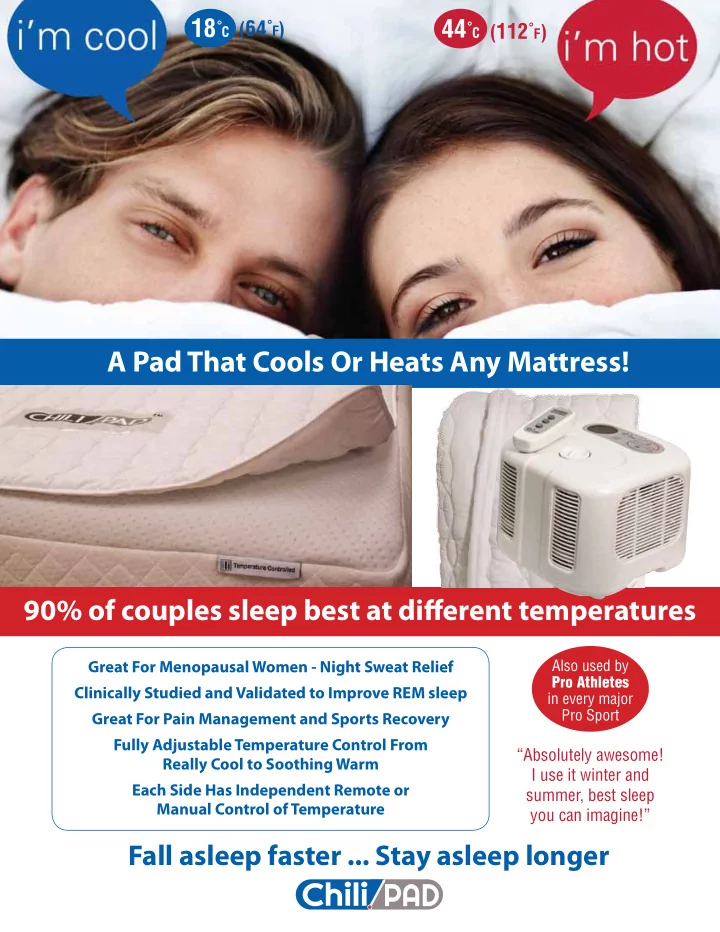
A Pad That Cools Or Heats Any Mattress! 90% of couples sleep best at - - PDF document
18 C 44 C ( 64 F ) ( 112 F ) A Pad That Cools Or Heats Any Mattress! 90% of couples sleep best at different temperatures Also used by Great For Menopausal Women - Night Sweat Relief Pro Athletes Clinically Studied and Validated to
8. REGULATING CORE BODY TEMPERATURE ALLOWS THE BODY TO USE THE EXCESS ENERGY FOR A MORE RESTORATIVE SLEEP USED FOR: insomnia, fibromyalgia, weight loss, elevated blood pressure, hot flashes, cold sweats, endometriosis, arthritis, on set sleep apnea, restorative sleep, menopausal insomnia, narcolepsy, fertility, inflammation, peripheral neuropathy, chemotherapy night sweats. USED BY: U.S. Olympic Women’s Rowing Team; professional athletes in every professional sport; also used in hospitals ECONOMICS: According to the EPA for every one-degree that you lower your thermostat FOR EVERY ONE DEGREE THAT LOWER YOUR THERMOSTATE you have a savings of 7% of your bill. ChiliPad™ uses 80 watts An air conditioner on average 3,800 watts Contact: Henry Zeifman (416)315-8973 1-844-244-5446 henry.mindsoul@yahoo.ca www.chilitechnologycanada.ca
It’s great to have a ChiliPad™ to ensure a good night’s sleep. Whether you sleep warm or cold, this mattress topper offers individualized comfort on your sleep surface. But did you know that the ChiliPad™ offers many of our customers relief from certain health problems and life-threatening medical conditions? Body Temperature Regulation At Exceptional Care For Children, a pediatric skilled nursing facility in Newark, Del., which cares for medically fragile children, Chili Technology has changed the lives of four patients through the use of the ChiliPad™. All had been unable to regulate their body temperature, with one of the four on the verge of being discharged to the hospital due to the severity of her condition. In a last-ditch effort to help their young patients, the staff at Exceptional Care ordered the ChiliPad™ after a desperate search
With its ability to heat up quickly and consistently, the ChiliPad™ has allowed these children to regulate their body temperature and remain at Exceptional Care rather than return to the ICU. It has also saved these families over half a million dollars in Medicaid costs. One patient who needed the ChiliPad™ at all times to maintain his temperature struggled with the limitations of having to remain on the mattress pad. While it helped him remain healthy, it left him unable to play or interact with the other children. When Chili Technology learned of the boy’s plight, the company sent the boy a custom-made, Spiderman-themed wearable blanket featuring the temperature-regulating technology. No longer confined to his bed, the young patient was allowed to move freely and enjoy the company of other children.
The medical and financial advantages of the ChiliPad™ have been so beneficial to Exceptional Care that the hospital received a grant to purchase additional ChiliPad™s for its patients. “The ChiliPad™ has truly been magical for our patients,” said Traci Martin, director of nursing at Exceptional Care. “It is wonderful, easy to clean, safe for medical institutions and an all-around great product.” Endometriosis Suffering with the constant pain of endometriosis, one woman sought a way to heat her lower abdomen for an extended period of time to provide relief. A traditional dry heating pad was inadequate due to its inability to retain heat, and a warm bath or hot water had to be constantly reheated. In addition, unconfirmed reports have indicated a possible link between the electromagnetic radiation emitted by heating pads and an increased risk of developing cancer. A healthier solution needed to be found. After numerous failed attempts, she did some research and discovered the ChiliPad™. Its moist, consistent heat, which is proven to penetrate 27 times deeper than that of a traditional heating pad, has offered her unparalleled relief and comfort, and provides the additional healing benefits of increased circulation to the area. Menopause From hot flashes to cold sweats, the hormone fluctuations that accompany menopause can be difficult for any woman to handle. The ChiliPad™ has provided women with the relief and comfort they need to achieve restorative, satisfying sleep. “I am writing to let you know that I am thrilled with my ChiliPad™,” said one satisfied customer. “Every woman should be aware of your product before their doctor starts prescribing anti-depressants, blood pressure medication or hormones for hot flashes. I have not had a single hot flash since I started using your product.” Another customer, who recently underwent a hysterectomy, also praised the ChiliPad™ after she decided that hormone replacement therapy was out of the question for her. “There are so many people that could benefit from this product, not just women with hot flashes and night sweats,” she
sleep well at night, you have faster recovery from illness or surgery and require less medication to recover.” Arthritis Arthritis can be a crippling disease that makes everyday life a struggle. Suffering from the debilitating side effects of inflammation and joint stiffness, one woman was unable to find the nighttime relief she craved so much. When her husband purchased a ChiliPad™ for her, it meant a new way of life for both
“My wife has been diagnosed with rheumatoid arthritis and fibromyalgia,” he said. “It has been years since she has had a comfortable night’s sleep. With her first night sleeping on the ChiliPad™, not only did she sleep through the night, but she slept longer than eight hours!” The ability of the ChiliPad™ to change temperature has provided this customer’s wife with soothing comfort for her aching bones and joints, allowing her to truly relax and get the rest that she so desperately needed. “Now that [my wife] is sleeping better, she is more alert, has more energy and, most importantly, she has finally found relief from her pain,” he said. “The ChiliPad™ has changed both of our lives!”
Effects of Temperature on Sleep: Manipulating Body Temperature to Improve Sleep Quality, Onset, and Arousal. David Gaynor, Kelsey Breseman March 14, 2013 Abstract Core body temperature is a crucial factor influencing how easy it is to fall asleep, ease of awakening, and quality of sleep. This paper reports on research supporting the effects of temperature on sleep and proposes a device to improve sleep quality by manipulating the temperature of a sleeping subject. 1 Introduction According to a 2010 National Sleep Foundation poll, three in ten Americans report rarely get-ting a good night’s sleep. This perception of in-sufficient sleep can be due not only to the quantity of sleep received, but also the experience of falling asleep and waking as well as the quality of sleep
least 15 minutes to fully wake up in the morning. A study by the National Sleep Foundation in 2009 found that 29% of Americans have difficulty falling asleep at least once a week [15]. Finally, the National Sleep foundation’s 2008 Sleep in America study reported that 42% of respondents had mid sleep awakenings, multiple times a week [14]. When faced with these sleep difficulties, many turn to prescription or over-the-counter medication; a 2008 Consumer Reports study found that 1 in 5 Americans medicate for sleep at least once a week [3]. To help remedy this situation we propose a system, which is both healthier and more effective than medication, which allows for improved sleep onset, arousal and quality without side effects. This system, which we are calling Warm Wake, will allow for a more natural waking experience, quicker sleep onset, increased REM sleep quantity, and few nocturnal awakenings. Its combination of temperature sensing, sleep state monitoring, and temperature control allows it to manipulate the users’ core body temperature in order to maintain or terminate sleep depending on the users’ needs. 2 Temperature and Sleep Onset Sleep Sleep is easiest to attain during the temperature minimum circadian phase. This phase starts about 5-6 hours before the circadian temperature minimum and extends to about 1-3 hours after it, with sleep propensity increasing the closer you are to the sleep minimum, and decreasing as the sleep initiation process is most likely to occur at the maximum rate of temperature decline [16]. Immediately before the temperature minimum phase is the wake maintenance circadian zone (WMZ), in which sleep is most difficult to attain. Individuals with sleep onset insomnia (SOI), usually exhibit delayed circadian phases, where their temperature minimum phase comes later than their bedtime. As a result they find it very difficult to fall asleep. Studies show that sleep onset is influenced by the rhythm of temperature [17] and can be influenced by the manipulation of a subject’s temperature. Lowering core body temperature, for example, through selective warming of skin at the hands and feet, can effectively advance one’s temperature minimum, and additionally, release melatonin, both of which increase sleep propensity. [12].
3 Temperature and Sleep Quality It has been suggested that skin temperature could act as an input signal to the regulation of sleep [12]. Sleep consists of rapid eye movement (REM), in which the brain is very active but the body has a reduced regulatory response; and non-REM (NREM) sleep, characterized by an actively regulating but otherwise inactive brain in a moveable body. NREM sleep is further subcategorized into four numbered stages of increasing depth of sleep. Stages 1 and 2 are light sleep, from which a sleeper can be easily awakened. These typically occur at the onset of sleep. Stages 3 and 4 are termed “slow you approach the maximum [10, 17]. In fact, 1”slow-wave- sleep” (SWS) and cycle periodically with REM sleep, throughout the night [6]. “Good” sleep is typically characterized by high sleep efficiency (amount of time asleep divided by amount of time in bed attempting to sleep), a low number of arousals, and a refreshed feeling upon
and sleep occurs near the trough in core temperature [1, 2]. Additionally, the absolute amount of REM sleep a subject experiences at night has been correlated with higher intellectual functioning the next day [6]. Body temperature is highly correlated with the regulation of sleep state. Though many more studies are available on the correlation of core temperature with sleep phase, these studies require rectal probes, and are thus not directly applicable to our device. Instead, we focus on the manipulation of ambient temperature, temperature inside the bed, and skin temperature, all of which have proved strong effects on sleep structure [11, 12, 13]. In particular, the number of arousals reduces significantly when the temperature is maintained at a zone of thermoneutrality within the bed at a temperature of approximately 30°C. Even slight variations around this thermo-neutral zone can change the structure
with more heat [11]. Sleep structure is also dependent on circadian oscillators, including core body temperature (not to be confused with skin temperature or the temperature of the environment [5]). REM sleep is preferentially distributed toward the later part of the night, which is linked to a circadian oscillator, which can be tracked through the oscillation of core body temperature [6, 7, 9, 11]. This means that if sleep does not reach into the peak circadian time for REM sleep, a subject will be disproportionately deprived
sleep propensity and body temperature cycle could mean that the two are independently controlled by a different circadian oscillator, or that there could be a direct and manipulable effect of body temperature on the timing of REM sleep and on the sleep-wake cycle [17]. The ability to maintain sleep is also dependent on sleep stage, and thus on temperature. In particular, the body’s thermoregulatory responses are sleep stage dependent: during REM sleep, the body reduces its regulation of temperature and of the sweating response. Thus sleep is more easily disturbed during REM sleep, and is more sensitive in general to cooling than to warming. Some sources suggest that the cyclic alternation between SWS and REM may be necessary in order to keep the body within its thermoneutral zone and thus asleep for longer [11, 17].
4 Temperature and Waking Just as a lower core body temperature is more amenable to falling asleep, a higher one can result in increased alertness upon awakening. In a subjective study, patients who were asked how refreshed and alert they felt when they woke up consistently rated their waking experience higher when awakened near the peak of their temperature cycles [2]. Furthermore, a study by Erin Baerh for NIH found that M-type individuals (morning people) had an earlier sleep minimum, and thus woke up higher on their temperature curve, closer to their maximum [4]. M-types are more active and productive in the morning, after waking than N-types, who have a later temperature minimum. This can be problematic for N-types who, as shown by a study at the University of North Texas in Denton, perform a fulletter grade worse than those who have pleasant waking experiences (M-type)[8]. We hypothesize that artificially raising core body temperature near waking will result in a more pleasant arousal, and possibly an overall advanced circadian phase. Other factors contributing to a refreshed feeling upon awakening include higher sleep efficiency [1] and the amount of SWS sleep present in the night: the more SWS sleep subjects accumulated in the night, the harder it was to arouse them [2] (though notably, it does not seem to matter which phase of sleep a subject is in when they are awakened [2, 7]). All of these factors are controllable, as discussed above, by a device, which regulates body temperature. 5 Our System 5.1 Summary Our system design consists of four major subsystems: a sleep phase monitoring subsystem, a skin temperature monitoring subsystem, a temperature actuation subsystem, and a data processing subsystem. The sleep phase monitor uses a dry EEG headband (the Zeo) to measure the sleep state of the user, differentiating between light, deep and REM sleep. It is worn throughout the night and passes the user’s sleep state to the processing subsystem in ten-second intervals. The skin temperature monitoring subsystem consists of a small temperature sensor, strapped across the chest, and fixed to the users side, underneath their left arm. The temperature actuation subsystem consists of a temperature regulating mattress pad. The mattress pad circulates heated or cooled water throughout the pad to maintain a set temperature. It is controlled by the processing subsystem, which interprets the sleep phase data coming from the headband, and the temperature data coming from the temperature probe while also monitoring the time and time since sleep onset. Using this data, it runs a simple algorithm to set the optimal temperature. This processing subsystem, and the integration it provides is the novel element in our system. There currently exist multiple solutions for sleep state monitoring, including dry EEG solutions such as the Zeo headband and less accurate smartphone apps, which monitor movement. There also exists at least one temperature regulating mattress pad, sold by Chili Technologies as the ChiliPad. However, we have been unable to find any system, which integrates these technologies, along with a temperature monitor to provide the benefits promised by the aforementioned research.
5.2 Research System Once we solidified our initial design we constructed a research system. This was necessary in order to confirm that the results found in our literature review could be replicated using inexpensive, consumer grade devices, under nonlaboratory conditions. Our research system has all the same specifications as our full system design described above, but with some additional functionality for monitoring and debugging. For our sleep monitoring subsystem we use the Zeo (Zeo, Inc.) sleep phase monitoring headband. The headband communicates with an Android (Google) application of our own design that monitors sleep phase data and submits it to a debugging and logging server, as well as the system’s data processing server. Our skin temperature monitoring subsystem consists of a form-fitting shirt; modified to hold a battery pack, will enabled microcontroller, and temperature probe. The temperature probe is mounted to the inside of the shirt, which provides insulation while also a fixing the probe to the skin. The data processing server determines the correct temperature to set at any given time, using an algorithm of
For our research system, this algorithm is very simple; it is an alarm that changes the temperature at a certain time. This is only for research, so we can observe the effect of changing ambient temperature under consistent and relatively controlled conditions. However, the processing subsystem does have full access to real-time temperature and sleep phase data, so once initial research is complete the algorithm can be easily developed to be more intelligent. The data processing subsystem communicates wirelessly with our temperature actuation subsystem. This linkage, in our research system, is simply an Arduino connected to a wireless controller. For temperature actuation we use the ChiliPadTM(Chili technology) temperatures regulating mattress
induce wakefulness. Our system architecture and component specification can be seen in Figure 1 6 Validation While we have not yet run a rigorous enough study to fully validate whether our system will be able to effect the sleep improvements seen in the above research, we have performed preliminary tests on one team member, which has returned promising results. Figure 1: Our system architecture and component specification. The blue arrows indicate data flow and the red arrow indicates actuation.
In our trials, we set the temperature of the mattress pad to the room temperature (75 degrees Fahrenheit) for the rest half of the night, then approximately halfway through the night, at 8:30 AM, the temperature was switched. This allowed us to use the first half of the night as a “control” to which we could compare the second half of the night. This control is flawed, as sleep is not time invariant, and changes as duration increases. However, by comparing these trials to tests run without temperature manipulation we believe we can begin to identify possible effects of changing ambient temperature mid-sleep. We ran two sets of temperature-switch trials. The first involved a mid-sleep ambient-to-warm temperature change. In these tests, we switched the temperature of the matress pad to 93 degrees Fahrenheit halfway through the night. 93 degrees is at the upper edge of the thermoneutral zone, the temperature range through which ambient temperature can be manipulated during sleep without inducing wakefulness. Based on our research, we expected that the subject would experience more REM, and less deep, sleep. Our results, some of which are shown in Figure 2, appear to validate our expectations. It seems that increasing the temperature to the edge of the thermoneutral zone suppressed deep sleep, which does not appear following the temperature switch in either trial. In addition, the switch may be enhancing REM sleep, which appears to increase in duration and frequency following the 8:30 mark. Of course, REM sleep does naturally increase in duration over the course of a night, so it is difficult to make even preliminary conclusions regarding the effect of temperature on REM sleep frequency and duration with this data alone. Furthermore, from the temperature data in Figure 2 it is clear that our method of temperature measurement is imprecise, and probably inadequate for observing the effects of changing the ambient
changes in skin temperature, as most research we read reported temperature changes no more than +- 1 degree. Our second set of trials involved an ambient-to-cold temperature switch. Based on our research, lowering the ambient temperature during sleep should have the opposite effect from raising the temperature; the frequency and duration of deep sleep should increase, and REM should reduce. For these trials, we had most of the same environmental conditions as in the aforementioned experiments, but switched the temperature to 68 degrees Fahrenheit instead of 93 degrees halfway through the night.
Figure 2: The temperature and phase data from two trials where ambient temperature was increased to 93 degrees Fahrenheit at 8:30 AM It should be kept in mind that all the experiments we ran were both to test our hypotheses, but also to test the system, to identify and address issues. As such, many trials, including these ambient-to-cold tests in particular were plagued by technical difficulties. We were, however, able to collect one sleep session’s worth of phase data, shown in Figure 3. Although we were not able to collect temperature data (due to equipment failures) it is clear that the response to the temperature switch here is different from before. The most obvious difference is that there are two periods of deep sleep following the 8:30 shift. This is markedly different from the warm-to- hot trials shown above, in Figure 3: Sleep phase data from a trial where temperature was switched to 68 degrees Farenheit at 8:30
following the 8:30 mark. Unfortunately, the phase monitor fell off an hour after the switch, so we were unable to see if there were additional periods of deep sleep, or reduced REM sleep during the rest of the session.
We also collected data for 2 control trials (data not shown), in which ambient temperature was maintained at the room temperature for the whole night. The data returned from these trials was inconclusive, with similar results to the ambient-to-warm trials. This indicates that there is a possibility
necessary before making any conclusions. While we are not able to draw any statistically significant conclusions about the effect of manipulating ambient temperature on sleep quantity and quality, from our trials, the testing was still immensely
which warrant further exploration, including the possible increase in deep sleep quantity and duration caused by cold ambient temperatures, and increase in REM duration and quantity caused by warm temperatures. 7 Conclusion The research detailed above clearly supports the idea that a device which modulates temperature during sleep can have a profound effect on the quality and composition of sleep, as well as easing the
this research we designed and constructed a system capable of manipulating ambient temperature during sleep based on skin temperature and sleep phase. Using this system, we have performed experimental trials, testing the effectiveness and reliability of the system, while also identifying areas of exploration, in relation to our research. These areas we identified, namely the effect the system has on deep and REM sleep, are worthy of additional research. This research should be aimed at discovering whether the system can really be used to effect sleep in the ways described in various studies, and whether it can use those effects to improve sleep quality and quantity for the average consumer. 8 Acknowldegments The authors would like to acknowledge the contributions of Joanne Pratt and Drew Bennett as advisors to this project, and Aaron Green berg, Andrea Cuadra, and Andrew Heine for their early work on this concept. References [1] T Akerstedt, D Minors, and J Waterhouse. Did You Have a Good Sleep? Journal of Interdisiplinary Cycle Research, 24(4): 7{9,1993. [2] Torbjorn Akerstedt, Ken Hume, David Minors, and Jim Waterhouse. Good sleep- it’s timing and physiological sleep characteristics. Journal of Sleep Research, 6:221{229,1997. [3] anonymous. How did you sleep last night?, September 2008. [4] Erin K. Baehr, William Revelle, and Charmane I. Eastman. Individual differences in the phase and amplitude of the human circadian temperature rhythm: with an emphasis on morningness{eveningness. Journal of Sleep Research, 9(2):117{127, 2000.
[5] M Bogh, David Minors, Jim Waterhouse, and S. Folkard. Can Insulated Skin Temperature be Used as a Marker of the Circadian Rhythm of Deep Body Temperature? Journal of Interdisciplinary Cycle Research, 24(4): 259{260, 1993. [6] Mary A Carskadon and William C Dement. Normal Human Sleep: An Overview. In Principles and practice of sleep medicine., chapter 2, pages 16{26. Elsevier Saunders, St. Louis, 5 edition, 2011. [7] C A Czeisler, J C Zimmerman, J M Ronda, M C Moore-Ede, and E D Weitzman. Timing of REM sleep is coupled to the circadian rhythm of body temperature in man. Sleep, 2(3): 329{46, January 1980. [8] Adam D. Bramoweth Kevin Sethi Daniel J. Taylor, Kendra C. Clay and Brandy M. Roane. Circadian phase preference in college students: Relationships with psychological functioning and academics. Chronobiology International, 28(6):541{547. [9] G a Kerkhof and M Lancel. EEG slow wave activity, REM sleep, and rectal temperature during night and day sleep in morning-type and evening-type subjects. Psychophysiology, 28(6):678{88, November 1991. [10] Leon C. Lack, Michael Gradisar, Eus J.W. Van Someren, Helen R. Wright, and Kurt Lushington. The relationship between insomnia and body temperatures. Sleep Medicine Reviews, (12):307{317, 2008. [11] Alexander Von Muralt. Ambient Temperature and Human Sleep. Experientia, 40(5):425{9, 1984. [12] Kazue Okamoto-Mizuno and Koh Mizuno. Effects of thermal environment on sleep and circadian
[13] R. J. E. M. Raymann, D. F. Swaab, and E. J. W. Van Someren. Skin deep: enhanced sleep depth by cutaneous temperature manipulation. Brain : a journal of neurology, 131(2):500{13, 2008. [14] WBA Market Research. 2008 sleep in america poll. Technical report, National Sleep Foundation, 2008. [15] WBA Market Research. 2009 sleep in america poll. Technical report, National Sleep Foundation, 2009. [16] Campbell SS and Broughton RJ. Rapid decline in body temperature before sleep: u_ng the physiological pillow? Chronobiology International, pages 126{131, April1994. [17] Jurgen Zulley, Rutger Wever, and Jurgen Ascho_. The Dependence of Onset and Duration of Sleep
The Importance of Temperature By Renita Rietz For most of the health conscious people I know, nutrition, supplementation and exercise are usually the top three priorities. For many of us, myself included, sleep is often overlooked. It is very easy to rationalize working that extra hour or sending a few more emails. Although most of us are aware that getting sleep is of vital importance, we sometimes make other choices. The second issue is that many people can’t even access that deep REM (Rapid Eye Movement) sleep that is so vital for healing and repair. The circadian rhythm refers to the daily cycle of the internal biological clock. Chronobiology, or the science of circadian rhythms has in fact shown us that our biological design and the optimal functioning of various systems of the body from endocrine to nervous to cardiovascular to digestive health is dependent on a cyclical rhythm that is in tune with nature and the planet’s natural cycle of light and dark. Many studies validate the importance of following the circadian rhythm. We cannot underestimate the importance of regular, early sleep patterns (ideally before 10pm) for influencing all systems of the body. The modern world has disrupted our relationship with the earth’s natural rhythms. The circadian rhythm was intrinsic to ancient cultures and it is really only since the advent of technology that
to artificial light for example after the sun goes down we disrupt hormones such as melatonin and cortisol.
Temperature also plays a critical role in regulating the sleep response and optimizing the body’s ability to enter deep sleep states, crucial for repair and synchronization within the body. The body has an ideal internal thermostat for determining sleep quality. The internal temperature drops during the night, reaching its lowest level about four hours after you begin sleeping. Sleep researchers generally believe that the ideal sleep temperature is between 60°– 68°F. Temperatures above 75°F and below 54°F will disrupt optimal sleep. Being within this critical temperature range has been clinically proven to increase REM sleep. Most of us don’t even think about the temperature-sleep connection. Insomnia and insomnia-related issues are on the rise. There are many things you can do to improve your sleep. It is absolutely crucial to follow the seasons and the natural cycle of light and dark. Turn off all artificial lights at a reasonable time and light beeswax candles to prepare the eye and brain for the release of critical sleep hormones. Do not read in bed, instead meditate or listen to guided meditations, do some deep breathing and positive visualization. Install proper curtains, wear an eye mask and do everything in your power to create darkness. Regulating your core body temperature is one of the most important of all the strategies for optimizing restorative sleep. A new innovation in sleep technology for regulating sleep temperature known as the ChiliPad™ is having a profound impact for many of the issues that cause sleep deprivation. A patented temperature controlled, water-conducted pad offers cooling and heating options in order to adjust the body’s internal temperature for the very best in recuperative sleep. Not only can those with insomnia and other sleep-related disorders benefit, but also those with pain, athletes seeking optimal recovery, menopausal women, those with chemotherapy night sweats and couples with different sleep temperature needs all benefit as both sides of the pad can be independently controlled and regulated. ChiliPad™ technology uses water to generate a wide range of in-bed temperatures in a convenient, thin mattress pad that sits on top of the mattress, under the sheets. Similar to the semi-conductor technology that cools computers, water passes by the chip and depending on the direction of electron flow, the water is cooled or heated. The water flows through soft coils in the pad, actively adjusting the temperature of the surface of the bed. There is nothing but water flowing through the pad. All temperature change happens in the control unit placed beside the bed therefore there are no electromagnetic fields produced unlike an electric blanket, which emits large amounts of dirty
air-conditioning. The pad is controlled in one degree increments with a hand held remote. The result is a perfectly controlled cool or warm bed throughout the night. We can’t deny the fact that one of the core pillars of rejuvenation, longevity and wellness is deep
this central tenet: that repair is as crucial if not more essential than training itself. Most of us need to reprioritize rest as a critical aspect for achieving optimal health and start embracing the powerful medicine to be found in sleep. Renita Rietz is a health and nutrition writer and speaker who educates on the phytotherapeutic potential of indigenous foods and plants for prevention and regeneration. This article appears in the September 2014 issue of Tonic Toronto
http://www.digitaljournal.com/pr/2346196 a.The most common and well-known sleep disorders are Sleep Apnea and Insomnia. Sleep apnea,
shown in studies conducted by the National Sleep Foundation. On the other hand, insomnia, or the inability to fall and/or stay asleep, is experienced by approximately 60 million Americans in a year. 2) http://www.dailymail.co.uk/femail/article-2855301/Shattering-symptom-menopause-no-one- warns-about.html (Menopause)
personality.
cause insomnia. Menoupausal women are 4x more likely to have insomnia. 3) http://www.sleepreviewmag.com/2014/12/manipulating-body-temperature-control-narcolepsy/
Department Sleep and Cognition, Netherlands Institute for Neuroscience, Amsterdam, The Netherlands, and colleagues found that skin temperature affects sleep onset and sleep depth in individuals without sleep complaints and in people suffering from insomnia. The study found that proximal skin warming significantly suppressed wakefulness and enhanced slow wave sleep (SWS). In contrast, distal skin warming enhanced wakefulness and stage 1 sleep at the cost of SWS and rapid eye movement (REM) sleep. The optimal combination of proximal skin warming and distal skin cooling led to a 160% increase in SWS, a 50% increase in REM sleep, and a 68% decrease in wakefulness, compared with the least beneficial combination of proximal skin cooling and distal skin warming, Van Someren reports.
integrated skin temperature sensing and manipulative feedback loop system to be tested in long- term field studies to find individual optimal manipulation schedules.
thermoregulatory systems in the brain overlap in part with sleep regulating systems. Sleep is best when the environmental temperature or microclimate of the bed is neither too hot nor too cold, but such that skin temperature is perfectly comfortable.* To fall asleep and stay sound asleep, the brain should sense that circumstances are perfectly comfortable, so that it can tune down its primary tasks: to monitor the environment for opportunities and dangers, and to be prepared to act when they occur.
unknown, but studies by Van Someren and colleagues suggest that it is a temperature that induces the skin of the trunk to be between 34.5˚C and 35˚C.
4) http://time.com/3602415/sleep-problems-room-temperature/
room could have some calorie-burning health benefits. Healthy men who spent a month sleeping in a cool (but not cold) 66-degree room increased their stores of metabolically active brown fat, says Dr. Francesco Celi, chair of Virginia Commonwealth University’s division of endocrinology and
and dispose of excess blood sugar, he explains.
Netherlands Institute for Neuroscience. While a dip in core temperature before bedtime flips on your brain and body’s “time for bed” switches and helps you fall asleep, Someren’s research shows that keeping your skin temperature “perfectly comfortable” is important when it comes to maintaining deep, restful slumber. 5) http://www.medicaldaily.com/trouble-sleeping-heres-what-we-learned-about-getting-better- sleep-2014-313182
the word “sleep,” we get seven pages of results from this past year alone. It’s not a new concept, and yet, it’s a part of the health conversation now more than ever. 6) http://www.uncommonwisdomdaily.com/5-simple-ways-to-improve-your-sleep-this- winter-19368
the morning and feel tired throughout the day. This is because it’s not just about how much sleep you get, but the quality of your sleep.
faster and had a better overall quality of sleep following behaviors that cooled the body, such as taking a cold shower right before bed.” [Dreamland: Adventures in the Strange Science of Sleep] The benefits I know are huge and I use the cold water every time I shower for good reasons. Good luck making that habit part of your lifestyle.
incredible health benefits including: · Fat loss · Improved circulation · Healthy skin and hair · Better fertility · Decreased inflammation in the body 7) http://www.asianage.com/health-fitness/goodnight-sleep-tight-654
happy with their quality of sleep. Another finding showed that menopausal women are nearly four times more likely to have insomnia.
are not able to explain or even identify it because of the vague symptoms.
8) http://www.shape.com/lifestyle/mind-and-body/how-adjust-your-life-winter-according-science
perfect dozing-off point.