A Nationa nal l Energy gy Progra gram m Treating Energy as a - - PowerPoint PPT Presentation

a nationa nal l energy gy progra gram m treating energy
SMART_READER_LITE
LIVE PREVIEW

A Nationa nal l Energy gy Progra gram m Treating Energy as a - - PowerPoint PPT Presentation

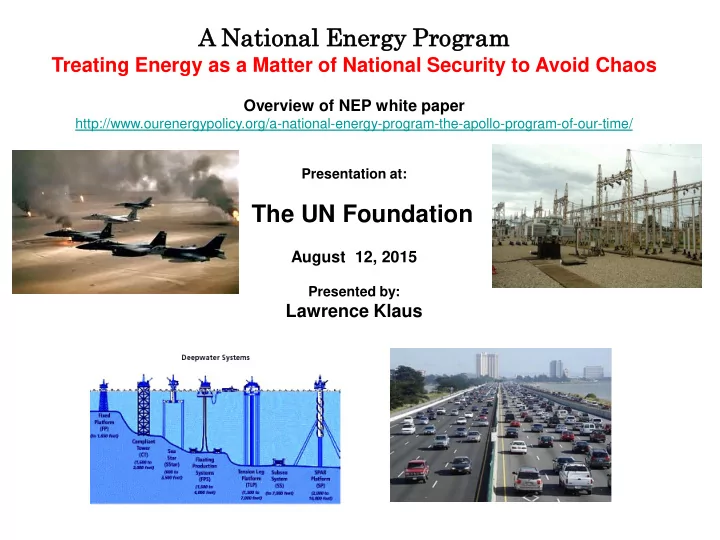
A Nationa nal l Energy gy Progra gram m Treating Energy as a Matter of National Security to Avoid Chaos Overview of NEP white paper http://www.ourenergypolicy.org/a-national-energy-program-the-apollo-program-of-our-time/ Presentation at: The


slide-1
SLIDE 1

A Nationa nal l Energy gy Progra gram m

Treating Energy as a Matter of National Security to Avoid Chaos

Overview of NEP white paper

http://www.ourenergypolicy.org/a-national-energy-program-the-apollo-program-of-our-time/ Presentation at:

The UN Foundation

August 12, 2015

Presented by:

Lawrence Klaus

slide-2
SLIDE 2

2 2

Presentation Outline – What, When Why and How?

  • What Is The Goal
  • When Will We Achieve it?
  • Why Should We Achieve the Goal? Matter of National Security
  • How Will We Achieve the Goal? Use proven methods
  • How Do We Start? NEP Planning Project
  • How Will We Educate Leaders of the Future? Planning and Operations Studies

Presentation Approach

  • What, When and Why – National security matter, goal and timeline to address it

Q&A

  • How – Structured time sensitive approach used for national security

Q&A Refreshments and informal discussion

slide-3
SLIDE 3

3

“What” Is The Goal: “When” Will We Achieve it?

Goal defined over time in discussions with many interests developing white paper

  • To eliminate the gap between U.S. oil consumption and production

and reduce green house gas emissions in a decade as a milestone on the road to a sustainable energy future.

– Six million barrels of oil a day - High end of EIA, IEA forecasts for 2025

  • Natural gas plentiful. Eliminating the “oil gap” = energy independence

– 1,300 million metric tons of CO2 equivalent by 2025

  • Goal and timeline set by Barak Obama and Xi Jinping at APEC summit

– Oil, emissions timelines made coterminous to facilitate joint planning

  • It’s not just about us!

– Our security and stability is becoming inextricably linked to security and stability elsewhere in the world - DOD 2013 National Security Strategy – America must lead by example to Induce other nations to become less dependent on unfriendly and unstable nations

  • Use methods proven “at scale”

– “Apollo like” long term program planning and management to achieve goal – Supply chains built during program position U.S. for sustainable future – Planning project to prepare a NEP plan in time to impact new administration coming into office

  • White paper provides a basis “for discussion purposes” to begin the project
slide-4
SLIDE 4

Oil gap and

Emissions Reduction >= 6 MBD >= 1300 MMT

10 Years

Time

20 Years

Oil Gap and Emissions Energy Products, Efficiency and Supply Chains

0 Years

The Goal is a “Milestone” on the Road to a Sustainable Future

Unlike Apollo NEP isn’t a “one shot deal”

4 NEP isn’t a “Zero Sum” game Fossil fuel and green energy interests make tradeoffs during planning process to resolve differences and secure buy in.

slide-5
SLIDE 5

5

Projected Oil Gap 4-7 MBD in 2025 – IEA, EIA

Business as usual forecasts oblivious of world events

  • Velocity in instability is ever increasing around the world
  • Army Chief of Staff, General Raymond Odierno, Army Times
  • Risk of supply disruptions, energy crises, conflicts not considered

– Set oil gap objective at higher end (at least 6 MBD) to cover “downside risk” – Oil, emissions objectives and timelines set as floor not a ceiling – Frontload NEP activity to avoid being blindsided by events again

U.S dependence on imported liquids depends on both supply and demand

Source: EIA annual energy outlook 2013

slide-6
SLIDE 6

6 6

Short Term Energy Euphoria Ignores Long Term Reality

US and World experiencing weak demand, artificial oversupply and low prices in globally unstable conditions marked by rout in commodities

Euphoria

More oil produced at home than we buy from the rest of the world – the first time that’s happened in nearly 20 years … The all-of-the-above energy strategy I announced a few years ago is working, and today, America is closer to energy independence than we’ve been in decades

  • President Barak Obama, 2014 State of the Union Address

Reality

IEA, EIA forecast U.S. oil production will peak in 2020 then decline without achieving energy independence.

EIA Annual Energy Outlook, 2015 IEA Forecast of US Oil Production, 2012

slide-7
SLIDE 7

Long Term Reality: Global Production Won’t Eliminate the Oil Gap

Global energy demand projected to increase one third from 2011- 2035 - IEA WEO 2013

World’s major oil companies all suffer from some version of

the same problem: spending more money to produce less

  • il. The world’s cheap, easy-to-find reserves are basically

gone; the low-hanging fruit was picked decades ago. The new stuff is harder to find, the older stuff is running out faster and faster. - Bloomberg Businessweek, “Big Oil Has Big Problems”

7 Costly Quest

Exxon, Shell and Chevron have been spending at record levels as they seek to boost their oil and gas output. It has yet to pay off. Below, change in production since 2009 Source: the companies, reflects company 2013 estimates. - WSJ

If Global economy doesn’t return from the great recession, oil will be the least of our problems.

slide-8
SLIDE 8

8

US and World Have a Long Term Oil Problem, Plenty of Gas

  • America needs an open fuel standard to convert gas to liquids for transportation

– GTL could compete in liquids market if Congress enacted an open fuel standard requiring new cars to run on all-alcohol fuels, including methanol - US Senate Hearing

  • If America won’t use its natural gas to produce methanol others should and will

– Chinese company considering two Gulf Coast locations for a $4.5 billion, 7.2 million ton methanol manufacturing and exporting plant [800 TBD in Btu equivalent]

  • Chinese group plans $4.5-billion methanol complex at Texas City, IHS Chemical Week

– Chinese firms pour money into US R&D in shift to innovation 8

Source: DOE AEO2014 early Release Review

US Natural Gas Production 1990-2040

slide-9
SLIDE 9

9

Why Should America Achieve the Goal?

Must treat energy as a matter of national security to avoid chaos

  • “Arc of instability” from North Africa to Southeast Asia [the region] could

become an “arc of chaos” involving forces of many nations

  • DOD 2010 Joint Operating Environment Report

– Seven of top ten nations with largest oil and gas reserves in the region - EIA – We have a losing record in the region since WWII – Implications for future combat are ominous, should nations see the need to militarily secure energy resources - JOE 2010

  • As our armed forces grow smaller, withdraw to the periphery and “pivot to

Asia”, our ability to defend the oil supply diminishes accordingly

– Countries [state actors] with high performance weapons develop capabilities to deny our forces access into their countries and theater energy supplies [A2/AD]

  • JOE 2010

– While the armed forces will grow smaller, it is less likely their operational tempo will decrease - Capstone Concept for Joint Operations: Joint Force 2020, Joint Chiefs of Staff

  • Shrunken fleet stays deployed longer and gets repaired less
  • The Seas Are Great but the Navy Is Small, John Lehman, former Secretary of the Navy, WSJ
  • U.S. Army to shrink to pre-World War II level - WSJ
  • Our leaders focus on pump price disconnected from national security

enabling “addicts” to live in denial of the threat

– We have been on the “imported oil roller coaster” too long to have learned nothing from experience

Decline of Empire is losing control and living in denial of it

slide-10
SLIDE 10

As Empire Declines Barbarians Gather at the Gates

Precision air strikes remain and option… unduly reducing American ground forces risks creating a vacuum - Colonel Michael Eastman, WSJ

  • Terrorists and organized crime [non-state actors] intermingling in

“shadow markets” enabling them to coordinate activities at global scale

– An informal series of overlapping pipelines [supply chains] moves products, money, weapons, personnel and goods

  • As these markets grow, adversaries will be able to generate attacks at higher level of

rapidity and sophistication

  • Terrorist-Criminal Pipelines and Criminalized States: Emerging Alliances, NDU
  • $2-3 trillion growing faster than legal and commercial trade - JOE 2010
  • We will bleed America to bankruptcy [Thanks Big Banks and US government]
  • Osama bin-Laden
  • Relationships between non-state and state actors provide numerous

benefits to both - Terrorist-Criminal Pipelines

– Wahhabi - Saud alliance older than U.S.

  • Islamic fundamentalism would be a trace element in Islam without Saudi support
  • “Addict-Pusher” relationship induces our leaders to ignore blood in the oil
  • Drones kill fighters, not financiers

– Eliminate oil addiction to drain money from states and non-state actors they support and threats they pose will diminish accordingly

  • It’s not just about us! Lead world to eliminate addiction

10 Armies were like plants, immobile, firm-rooted, nourished through long stems to the head. We might be a vapor, blowing where we listed…extending our front to the maximum, since that was materially there most costly form of war. - T.E. Lawrence, “Seven Pillars of Wisdom

slide-11
SLIDE 11

11

Our National Interest Isn’t Sunni or Shiite. It’s Protecting the Oil Supply

Where an increase in terrorist activity intersects energy supplies the need for immediate action may require significant conventional capabilities - JOE 2010

Fire at Libya’s biggest oil terminal destroys 1.8 million barrels of oil - Reuters ISIL blamed for new strikes aimed at crippling Libya oil production, rather than capturing it - WSJ

Future Stability Of Saudi Arabia Not Assured.

Saudis trying to finish new border fence and then slam shut the gates as Yemen collapses - Reuters

If proxy wars turn into regional war key energy facilities impacting oil market and global stability will be at risk.

ISIL fighters set Iraq's Beiji oil refinery ablaze - Al Jazeera

What has to blow up before our leaders get it?

slide-12
SLIDE 12

12

Power Shifts to Energy Producers With Different Interests

Short term issue is oil glut; long term issue is oil reserves

  • Seven of top ten nations with largest oil and gas reserves in the region

– Russia and Venezuela also in top ten

  • America has losing record in major conflicts in the region since WWII and we don’t

learn from history and experience

– As we should have learned in Vietnam, invaders have to win, insurgents have to not lose until invaders leave. – Don’t repeat British experience in the First Anglo-Afghan war

/

Proved Natural Gas Reserves by Country 2013

Top 10 Countries Source: US Energy Information Administration

Proved Oil Reserves by Country 2013

Top 10 countries Rank Country Billion of barrels of crude oil Rank Country Trillions of cubic feet of natural gas

slide-13
SLIDE 13

Power Shifts to Energy Producers With Different Interests

Since Peter the Great European invaders freeze in the dark in a conflict with Russia

  • E.U. imports approximately 30% of its crude oil, gas and hard coal from Russia
  • Eurostat, European Commission

– Countries closer to Russia’s border import energy at a much higher rates – Lifting ban on U.S. oil exports doesn’t help Eastern European countries decrease reliance without building pipelines from ports to refineries - Reuters – Russia’s strategy of buying up European oil refineries could compromise the bloc’s energy security [and ours] - EurActiv.com – For Russia preventing Ukraine from turning West is an existential issue - Reuters – Ukraine should be in neither camp. It should be a meeting place, not an outpost - Kissinger Expanding NATO would be the most fateful error of American policy in the post -Cold War

  • era. Such a decision may be expected… to impel Russian foreign policy in directions

decidedly not to our liking - George F. Kennan, 1997 Gas supplied by Russia

Percent of total 2012 Source: Eurogas

Some European nations import 80-90%

  • f their energy needs from Russia
slide-14
SLIDE 14
  • Greece and Russia sign MOU extending planned Turk Stream pipeline

to Europe through Greece, with financing from Russia - Bloomberg.com

Control of Pipelines Shifts Power to Nations with Different Interests

South Stream and Nabucco gas pipelines

South Stream won competition with EU and American supported Nabucco. EU changed the rules

Turk Stream to bypass Ukraine

Russia to halt gas shipments across Ukraine to Europe when transit contract ends in 2019 - Bloomberg.com

Gazprom to build new Nord Stream-2 gas pipeline under Baltic Sea to Germany by 2020 with E.ON (Germany’s largest utility), Shell, OMV.

  • Reuters

Russians building Kerch Strait bridge E.ON argues that Europe's demand for Russian gas will grow as domestic production declines to 185 BCM by 2030 from 275 BCM in 2010

America leads by example. If we plan maybe Europe will

slide-15
SLIDE 15

Russia’s Pivot to Asia is Real - Bloomberg.com

Shifts emphasis on oil and gas supply to China/Pacific as pipeline networks grow

  • Russia, China sign 30 year $400 Billon gas/pipeline deal in local currencies - Reuters
  • Russia and China sign about 40 agreements on energy, finance and high-speed rail

cooperation, created currency swap line

  • China moves from Littoral to Silk Road to buy a maximum of energy as far away from the

U.S. Navy as possible - Reshuffling Eurasia’s Energy Deck,, Iran, China and Pipelineistan, Pepe Escobar

15

Western and Power of Siberia Eastern Route to China/Pacific 68 BCM

Western route could grow to 60 or 100 BCM - Reuters

Eastern Siberia Pacific Ocean (ESPO)

  • il pipeline 1.6 MBD

Russia surpassed Saudi Arabia to become China’s top crude supplier in May. Saudis will need to accept renminbi for oil payments instead of just the dollar

– Bloomberg.com East Eastern West stern

Russian oil and gas pipelines through China to India ?

ESPO ESPO

slide-16
SLIDE 16

America Can’t Sanction Geography

Russia assuming role of Central Asian traders as bridge between Europe and Asia

  • A geopolitical "big bang" in Eurasia as BRICS, SCO and EEU leaders meet

unnoticed in US

– India, Pakistan join SCO, Iran and Turkey to join, new banks and forex reserve formed – Formation of non-dollar trading block among major players in global energy markets

  • North-South Transport Corridor moves goods from India to Afghanistan, Central

Asia and Europe through Iran, bypasses Pakistan, counters China at Hormuz

– Corridor provides access and potential for investment by India in oil rich Central Asia – Russia signed €70 billion in projects with Iran using local currencies, confirmsS-300 ‘s

  • East-West $240 Billion Moscow/Beijing High-Speed Rail Link to be built.

– China launches freight train service from Harbin in North East China to Europe 16

Previous Route NSTC 45-60 day travel time 25-30 day travel time 40% Shorter & 30% cheaper High speed rail Travel time from Moscow to Beijing Down from 5 days to 30 hours Freight transport Harbin to Europe in 15 days

slide-17
SLIDE 17

North-South Corridor, Overland and Maritime Silk Road

China builds Burma and Pakistan corridors to avoid Indian Ocean and Strait of Malacca

17 The Gwadar port China developed in Baluchistan is now to be linked to Xinjiang with a 3,000-km road, rail and pipeline network. Along the way will rise new dams, energy lines and cities.

  • The New Indian Express, T J S George
slide-18
SLIDE 18

China’s “String of Pearls” Maritime Silk Road Strategy

Protects China’s energy security, negates U.S. influence and projects power overseas

  • Participation in economic and infrastructure projects builds leverage that could

soon subordinate U.S. relations with the same countries

  • Chinese army personnel participate in overseeing projects
  • Washington Institute for Near East Policy
  • In submarine warfare, space, and cyberspace, China can compete with U.S. on

nearly equal footing - JOE 2010

– U.S. forces may be “outgunned” by China’s emerging ASCM technology

  • The Real Military Threat from China: Anti-Ship Cruise Missiles, Lyle Goldstein, Naval War College

– Chinese anti-satellite tests demonstrated the capability to destroy military communications satellites - “Anti-satellite race heats up with China, Russia”, Defense Systems. Com – China and Russia developing hypersonic weapons to defeat U.S. missile defenses designed to counter non-maneuvering ballistic missile warheads – Russia released new naval doctrine that singles out China as its core partner in the Pacific

  • The Hindu

18

slide-19
SLIDE 19

Is America’s “Pivot to Asia” a Pivot from Old Energy Wars to a New Energy War in the China Seas?

China rapidly expanding offshore oil fleet – adding coast guard vessels to protect it – as it ventures farther into the sea, threatening more altercations with neighbors - WSJ

19 Sea floor thought to be repository of large oil and gas deposits in contention by nations in region China’s “Nine-Dash” chart not in accord with UNCLOS US should sign this treaty to be credible

Chinese coast guard vessels protecting oil rig ram Vietnamese vessel in disputed waters in South China Sea Mature network of military facilities would extend China’s ability to project power by over 800 kilometers

Dispute over territorial boundaries defining drilling rights.

slide-20
SLIDE 20

Must Treat Energy as a Matter of National Security to Avoid Chaos

Implications for future combat are ominous, should nations see the need to militarily secure energy resources - JOE 2010

Force won’t change conditions – competent American leadership will Force

  • Stumble into war trying to cut China off from energy in the China Seas

– Growing tensions in the East and South China Seas have raised the risk of a “miscalculation” spilling over into a regional conflict

– China encirclement could spark war, The Diplomat

Leadership

  • U.S. works with China and Asia/Pacific nations to secure adequate energy sources

and reduce demand to avoid a new energy war

– Every barrel of oil equivalent produced in America that is sent to Asia/Pacific, is a barrel we won’t have to defend or fight over with China – China net oil imports will rise from 6.3 MBD in 2013 to 9.2 MBD in 2020 - Forbes – China used 170 BCM of gas in 2013 will use 400- 420 BCM in 2020 - Fortune – 83% of global energy demand growth in non-OECD countries - EIA

The U.S. must take care not to repeat in its China policy the pattern of conflicts entered into

with vast public support and broad goals but ended when the American political process insisted on a strategy of extrication that amounted to abandonment, if not complete reversal

  • f the country’s proclaimed objectives…
  • “The Future of U.S.-Chinese Relations, Conflict is a Choice, Not a Necessity”, Henry Kissinger, Foreign Affairs

20

slide-21
SLIDE 21

How Will We Achieve The Goal? Use Methods Proven “At Scale” to Solve Today's Problems

No one could have planned the mess we are in!

  • “Apollo like” program planning and management

achieves the goal

– Eliminate at least 6 MBD – Eliminate at least 1,300 million tons of CO2 equivalent – Achieve both together in a decade

  • Supply chains place U.S. on road to a sustainable

energy future

– Goal is “milestone” on road to achieve longer term goals though growth of supply chains built during program

  • Long term planning replaces short term thinking

– Stop thinking short term, making it up as we go along, chasing rosy scenarios blindsided by unforeseen events – NEP planning project prepares plan for next administration as it comes into office

  • Methods used in the energy domain will be useful in
  • ther domains.

21 The basic principles of strategy are so simple that a child may understand them. But to determine their proper application to a given situation requires the hardest kind of work from the finest staff officers. This planning meant the toilsome drudgery of grinding countless unrelated facts into homogenous substance.

  • Dwight D. Eisenhower, Crusade in Europe
slide-22
SLIDE 22

22

Start by Ending Project/Program Confusion

President Obama mentioned “funding the Apollo projects of our time” in

  • energy. He then mentioned electric cars and passenger rail in the same breath

as Apollo as though all were projects. - 2010 State of the Union message

Apollo wasn’t a project. It was a program.

  • Programs achieve “ends” - goals and objectives

– Ends must be defined and agreed upon FIRST (go to the moon, build a national highway system, achieve energy independence)

  • Projects - “means” achieve ends

– Means (Keystone Pipeline, cap and trade, electric cars, passenger rail, etc.) then defined and ranked in achieving goals and objectives

  • Placing means before ends = Gridlock since 1973 OPEC Oil Embargo

– Can’t see forest for the trees – Each interest hugs its tree and “fights below the tree line” to cut down trees of opposing interests

22 Perfection of means and confusion of ends seem to characterize our age - Albert Einstein

slide-23
SLIDE 23

23 23

Approach: Replace Imported Oil and Reduce Emissions in Economic Sectors as Required to Achieve Goal

Replace oil in economic sectors from other sources in rank order at least 6 MBD

  • Priority to sector objectives based on oil usage
  • Priority to means within sectors based on contribution to objective in a decade

Energy Consumption by Sector and Energy Source, 2012

Source: DOE, EERE, Vehicles Technologies Office

slide-24
SLIDE 24

Reduce GHG emissions in Economic Sectors at Least 1,300 MMT

Achieve President Obama’s goal: GHG emission 26-28% below 2005 levels by 2025

24

Total U.S. Greenhouse Gas Emissions by Economic Sector in 2012

6,526 Million Metric Tons of CO2 equivalent

Source: All emission estimates from the Inventory of U.S. Greenhouse Gas Emissions and Sinks: 1990-2012

  • Priority to sector objectives based on potential emissions reduction
  • Priority within sectors to means based on contribution to objective in a decade
slide-25
SLIDE 25

Energy Efficiency Potentially Largest Source of Energy Production and Emissions Reduction

Energy Efficiency = Energy - Emissions

  • Rejected energy equal to 58.1% of energy used - Lawrence Livermore National Laboratory

– Priority to sectors and means based on contribution to the goal

  • U.S Army “Net Zero” Program covering waste, energy and water is a model for

cross market development.

– Waste reduction is life and death to military; dollars and cents to civilians 25

slide-26
SLIDE 26

26 26

“Apollo like” Program Planning and Management

Method to define and achieve goals and objectives from inception to completion

  • The President defines a goal and timeline

– Goal in white paper used as “placeholder” for goal to be set by next President

  • Objectives/work elements to achieve the goal designed by stakeholders.

– Sector profiles produced and used as baselines for planning

  • Means (assemblies, tasks, projects) defined in tiers “down and across”
  • bjectives in a work breakdown structure (WBS)
  • Means related to performing organizations in an organization breakdown

structure (OBS)

  • Public/private finance sources/organizations are defined by means in a

financial breakdown structure (FBS)

– FBS unique to NEP which differs from publicly funded NASA and DOD programs – Public sector finances difference between private sector and needed investment

  • A cost/schedule system is developed to manage all work elements
  • The above are structured within a management framework wherein a change in

any element immediately translates into impacts on all other elements

slide-27
SLIDE 27

Proposed NEP Program Breakdown Structure

27

slide-28
SLIDE 28

28

Proposed Objectives

White paper provides goal, objectives, scenarios/assemblies and methodology “for discussion purposes” to begin NEP planning project

  • Building & Processes Sector:

– Replace oil use in energy efficient buildings and processes to meet end user needs and achieve the goal.

  • Transportation Sector:

– Replace oil use in energy efficient motor vehicles and build supply chains for the conventional and alternative vehicles fleet to meet customer needs and achieve the goal.

  • Power Sector:

– Build a safe, secure, energy efficient, 21st century power sector that replaces oil use by end customers and reduces emissions to meet the goal.

  • Fuels Sector:

– Build an energy efficient fuels sector that replaces oil use and reduces emissions to meet the goal and will always be able to provide fuel for cars

  • n our roads and tanks on the battlefield.
  • Defense Sector:

– Replace oil use in an energy efficient U.S. military that has the operational energy security to go and win America's wars without initial access to theater bases and energy supplies if required.

  • Energy Technologies Research, Development and Deployment:

– Develop and deploy energy technologies in “rank order” to achieve sector

  • bjectives as required to achieve the goal.
slide-29
SLIDE 29

Plan and Build Supply Chains for a Sustainable Energy Future

Example: Transportation Sector Supply Chain

  • What is supply chain management?

– “Cradle to grave” planning, implementation and control of flow of information, materials, products and services from raw material to customer fulfillment and life cycle support and waste reduction/recycling

  • Supply chain work elements built “down and across” objectives

29

Vehicles Customer/System Interface Power/fuels (Charging/Fueling Stations)

Transportation Sector Power and Fuels Sectors

slide-30
SLIDE 30

30

Transportation Sector Supply Chain

  • What is needed is an integrated, multi-pronged approach that cuts

across Administrations and covers transportation fuels and vehicles

  • Fuel Choice for American Prosperity, Institute for the Analysis of Global Security
  • Transportation receives top priority based on oil usage
  • 70% of all the petroleum used in U.S.
  • 96% of energy used in the transportation sector is oil
  • Concentrate on motor vehicles - 59% of oil use in sector for light duty

cars and trucks - Blue Print for Securing America’s Energy Future, US Chamber of Commerce

  • Other vehicle types may be included with support from related

industries (Aircraft, Ships, Rail, etc)

30

slide-31
SLIDE 31

31 31

Planning Transportation Sector Supply Chains

Priority to means in “rank order” to contribution to sector objective in a decade

  • Make “apples to apples” comparisons to prioritize each supply chain

– How Much, How Fast, How Clean, What Risk, What Cost?

  • Gas: CNG uses existing gas production and distribution system

– Gas is “transition fuel” – plentiful, low cost, shorter term – Need engine conversion, new fueling station network – Reduces emissions by substituting less polluting means for oil

  • Electricity: EV’s use existing power grid

– Electricity longer term requires extensive R,D&D – Need “competitive” vehicle batteries, charging systems and fueling network – “Buying new” costs more than conversion – EV’s have range problem – Eliminates emissions

  • Liquids: Use existing vehicles and gas station network

– Alternatives “to” and “from” conventional fossil fuels (Biofuels, GTL, CTL) – Need R&D, new plants, pipelines, freight transportation varies with fuel – Methanol requires little change in existing system, but has range problem – Emissions reduction varies by liquid

  • Hybrids: Transitional vehicles
  • Other: R,D&D continuous process to bring new technologies to market as they

become commercially viable - NEP white paper

slide-32
SLIDE 32

Alternative Supply Chains Require Considerable R,D&D

  • Government programs are “Hobby Shops”

– Fragmentation + inadequate funding + bureaucracy + poor deployment

  • Business requires real business opportunities to participate

– Ex: NGVs only useful if refueling infrastructure readily available - Navigant Research

  • NEP brings together fleet operators, oil and gas, trucking and financial interests to plan

conversion of an economic number of vehicles to support building NGV fueling network

  • Government fill financial gaps, eliminates roadblocks to facilitate implementation

32

Source: U.S. EIA, based on DOE Alternative Fuels & Advanced Data Center, March 2012.

It wasn’t my job to tell industry how to do its job; it was our function to show industry what had to be done and then do everything in our power to enable industry to do it – including stepping in if the marketplace couldn’t deliver fast enough.

  • Donald Nelson, Director of the War Production Board, Freedom’s Forge, Arthur Herman

160,000 gas stations, less than 10,000 all other types

slide-33
SLIDE 33

33

Russia’s National Natural Gas Vehicle Program

Convert to gas. Have more oil and equivalent to sell long term

  • Creates national “supply chain” for NGV market development

– Constructs CNG and cryogenic filling stations, gas liquefaction and

  • ther facilities

– Cooperates with 31 regions to develop NGV market – Creates infrastructure to boost consumer demand, diversify gas powered machinery and equipment – Optimizes law regarding NGV market and creates efficient government regulation mechanisms

  • Expands presence in NGV sector internationally with pilot projects

– “Value added services” make gas commodity more competitive

  • By 2020 goals planned as proportion of:

– CNG to conventional fueled vehicles (Forecast 10.4 BCM)

  • Public transport and municipal vehicles – 50%
  • Local freight transport and lightweight commercial vehicles – 30%
  • Private vehicles – 10%
  • Agricultural equipment – 20%

– LNG to conventional fueled vehicles (Forecast 5.2 BCM)

  • Agricultural equipment – 20%
  • Long distance motor vehicles – 30%
  • Rail transport – 2%

– Milestones for future national and global market development

slide-34
SLIDE 34

34

Transportation Sector Supply Chain – Department of Defense NEP “military compatible” structure can integrate military and civilian efforts

  • Over 70% of tonnage to position U.S. Army into battle is fuel

– Number of convoys to transport an ever increasing requirement for fossil fuels is a root cause of casualties - Energy Security: America’s Best Defense, Deloitte – Green energy vs. fossil fuels not issue, reduce tonnage of all liquid fuels

  • Focus on R&D of much more energy efficient and alternative vehicles

– Example: Oshkosh Defense HEMTT A3 Diesel Electric Tactical Truck

  • Improves fuel efficiency up to 20%
  • 100 kW of clean, exportable AC power, enough to run a field hospital
  • Single-unit, power-generating solution, eliminates need for additional vehicles

– Example of DOD “co-investment” to be used in NEP

  • Public sector fills gap between private sector and needed investment as a matter
  • f national security

HEMTT A3 Diesel Electric Heavy Expanded Mobility Tactical Truck

Off-road hauling capability and self-contained ability to generate 100 kW of clean exportable AC power

slide-35
SLIDE 35

35

What About The Roads?

  • Highway Program “First Generation” National Infrastructure Program

– Gasoline tax becoming obsolete: more efficient vehicles pay less at pump; hybrids much less; electric cars pay nothing – Must “pay as you go” by vehicle type, weight, how much and where vehicles drive to equitably pay to maintain roads

  • Infrastructure 2.0: $3.6 trillion in infrastructure investment needed by 2020
  • American Society of Civil Engineers, Infrastructure Report Card

– National infrastructure investment “programs” with sound revenue streams replace fragmented “projects” spending that can’t provide needed investment – Quants don’t pour concrete: Jobs for the 99%, productive investments for 100% – The challenge ahead is the challenge of sharing prosperity

New York explosion exposes nation’s dangerous and aging gas mains A 93-year -old water main breaks above UCLA

slide-36
SLIDE 36

36

How Will We Start? NEP Planning project

  • Produce a plan available to impact next administration coming into office
  • Planning of each objective by stakeholders involved in implementation
  • Stakeholders will have interest in influencing their constituencies in Congress

– Options

  • Government project: assistance from industry, financial sector, universities,

national laboratories, think tanks

  • University or think tank project: assistance from government, industry, financial

sector, national laboratories.

  • “Plan B” for energy on separate track from our current track – gridlock

– Example: President Roosevelt’s actions prior to Pearl Harbor

  • Saw danger and prepared for war on a separate track in a nation living in denial
  • Project analogous to “advisory” NDAC formed by President Roosevelt in 1940

– Hopefully, NEP won’t require another calamity to be implemented

  • At minimum, project provides contingency plan to deal with unforeseen events
  • Have to start somewhere

– NEP white paper presents a goal, objectives, implementation scenarios, methods “for discussion purposes” to begin the project.

When the evils that arise have been foreseen, they can be redressed, but when having not

been foreseen, they are permitted to grow in a way that everyone can foresee them, there is no remedy - Niccolo Machiavelli, The Prince

slide-37
SLIDE 37

37

How Will We Educate Leaders of the Future? Planning and Operations Studies

  • Education

– Teach “hard skills” not taught in public policy programs to enable students to become competent leaders

  • Examples: comparative public, private, military organization; systems engineering;

program and project management; supply chain management and logistics; infrastructure economics; management information systems; accounting; finance.

– Courses not all found at one institution: integrate multiple institutions

  • Projects

– Center for developing plans and programs in national interest – Students work on real world projects, gain experience, build relationships

  • NEP planning first project
  • Civilian/military interaction in classroom and projects builds understanding/

cooperation

  • Research and Development

– Develop courses, seminars, briefings and documents to support education program and inform national discourse – Students participate in R&D

What we do here will only be taught in professional and technical schools

  • Dwight D. Eisenhower, Crusade in Europe
slide-38
SLIDE 38

NEP Planning Project: Coalition of the Willing

Small team sets up project and recruits participants Stakeholders/participants in planning provide funding and in-kind services

Short list of skill sets for NEP planning project

  • Supply Chain Management and Logistics (military,

civilian)

  • Program and project management (military, NASA,

aerospace)

  • Investment , Commercial banks, Public finance
  • Energy business and finance
  • Accounting
  • Coal, Oil and Gas industries (strategic planning and
  • perations)
  • Conventional and alternative automotive industries
  • Industrial processes equipment and energy systems
  • Residential, Commercial and industrial buildings

energy systems

  • Utility transmission, distribution systems and

regulation

  • Highways
  • Solar, Wind, distributed generation
  • Environmental management, engineering, impact

mitigation

  • Environmental and regulatory law
  • Universities and think tanks with relevant departments

Illustration from Tom Sawyer Courtesy The Mark Twain House, Hartford

Whitewashing the fence

“We have found that it is most effective and efficient for us to focus our efforts on established

  • rganizations, such as think tanks, universities, business associations, and bipartisan policy groups”
  • Email from William M. Colton, Vice President, Corporate Strategic Planning, Exxon Mobil Corporation

38

slide-39
SLIDE 39

39 39

Lawrence Klaus began his career as an architect in the offices of Emery Roth & Sons working on projects including working drawings for the World Trade Center. As a research engineer in the Boeing Aerospace Group (ASG) he designed and implemented automated business systems concerned with the design, manufacture, test, delivery, and installation of major military missile, space, and associated programs. He also participated in internal business planning to define ASG program management and information systems capabilities with civilian

  • applications. At Peat Marwick Mitchell (now KPMG) he designed PPB and

management and reporting systems for federal government agencies. This included projects such as design of a program planning system for regional plans for the Public Health Service. He founded and was president of Development Management Consultants Inc. and planned and managed company operations

  • n dozens of projects working with utilities, lenders, contractors, non-profit
  • rganizations and government. This work included projects such managing local

and federal disaster rapid emergency mass home repair. As a manager in the network systems group of Unisys Corporation he worked with company engineers to design networked PC to mainframe systems that integrated company and vendor software and hardware. This included projects such as the user friendly IDEAS online education system for the Air National Guard. As a consultant at Synergic Resources Corporation (now Navigant Consulting) he worked on energy efficiency projects for utilities such as MidAmerican Energy. As an independent consultant has worked on projects related to energy policy, networks and distributed generation. Mr. Klaus holds a B.S, Bachelor of Architecture and M.B.A. from the City College of New York. Contact Information Lawrence Klaus 651 E Township Line RD #2121 Blue Bell, PA 19422 Phone: 610-631-2190 Cell: 610-247-3363 Email: larryklaus1@gmail.com