A Literature Review (IMW) and Knowledge Synthesis Ken Fetcho and - - PowerPoint PPT Presentation

a literature review imw and knowledge synthesis ken
SMART_READER_LITE
LIVE PREVIEW

A Literature Review (IMW) and Knowledge Synthesis Ken Fetcho and - - PowerPoint PPT Presentation

Ecological Effects of Tide Gate Restoration: A Literature Review (IMW) and Knowledge Synthesis Ken Fetcho and Renee Davis OWEB Board Meeting Jon Souder (OSU) January 30, 2018 Presentation Overview Significance of the tide gate topic


slide-1
SLIDE 1

(IMW)

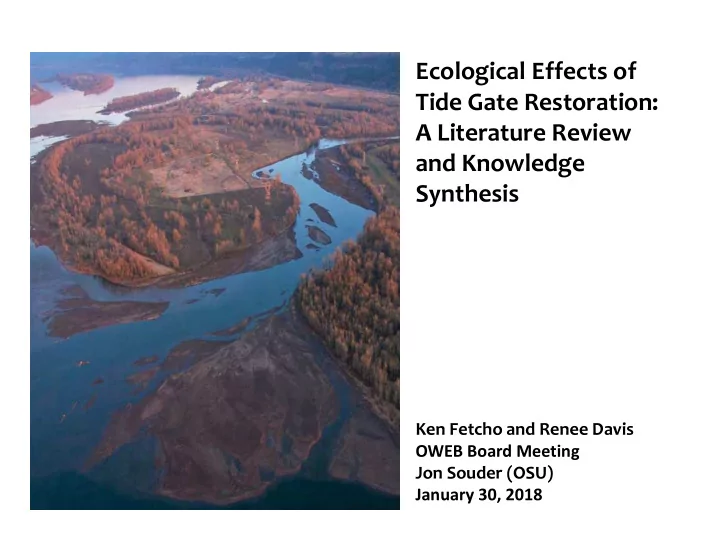
Ken Fetcho and Renee Davis OWEB Board Meeting Jon Souder (OSU) January 30, 2018

Ecological Effects of Tide Gate Restoration: A Literature Review and Knowledge Synthesis
slide-2
SLIDE 2

Presentation Overview

 Significance of the tide gate topic  Purpose of literature review  Presentation outline

  • Tide gate report overview
  • Report summary
  • Introduction to the issue
  • Key findings
  • Recommendations
  • Lessons learned
  • Next Steps
slide-3
SLIDE 3

Report Organization

∗ Executive Summary ∗ Ch. 1 - Introduction – Tide gate basics ∗ Ch. 2 - Methods ∗ Ch. 3 - Summary of ecological effects of tide gates and importance of estuary habitat ∗ Ch. 4 - Overview of work to determine tide gate restoration effects to salmonids and environmental factors ∗ Ch. 5 - Regional tide gate restoration and monitoring project summaries

slide-4
SLIDE 4

Report Organization

∗ Ch. 6 - Thinking systematically about tide gates ∗ Ch. 7 – Summary of findings and recommendations ∗ Appendices ∗ Literature Cited

slide-5
SLIDE 5

Literature Review

Ecological Effects of Tide Gate Upgrade or Removal: A Literature Review and Knowledge Synthesis Institute for Natural Resources Oregon State University

slide-6
SLIDE 6

Overview

  • 1. How Tide Gates Work
  • 2. Context For Restoration
  • 3. Ecological Effects of Tide Gates
  • 4. Restoration Approaches
  • 5. Findings & Recommendations
slide-7
SLIDE 7

How Tide Gates Work

slide-8
SLIDE 8

Neap Tides Spring Tides

Daily & Monthly Tidal Cycles

slide-9
SLIDE 9
slide-10
SLIDE 10

Trade-Offs

  • 1. Opening Size & Angle
  • 2. Water Velocity
  • 3. Period Open
slide-11
SLIDE 11

Side-hinged Mitigator Muted Tidal Regulator (MTR)

Photos courtesy of Nehalem Marine

slide-12
SLIDE 12

Context: Tide Gate Geography

  • 1. Stream/River

Mouth

  • 2. Tributary

Mouth

  • 3. Field

Drain/Ditch

slide-13
SLIDE 13

Context: Project Goals

  • 1. Infrastructure

Protection

  • 2. Fish Passage

Improvement

  • 3. Estuarine Rearing

Habitat

  • 4. Flood Control
slide-14
SLIDE 14
  • 1. Tide Gate Removal or

Upgrade

  • 2. Dike Removal and/or

Setback

  • 3. Channel Re-

meandering

  • 4. Vegetation & Wood

Placement

slide-15
SLIDE 15

Effects: Water Quality

  • Summer Water

Temperature Higher

  • Dissolved Oxygen

(DO) Lower

  • Abrupt Change in

Salinity

  • Inhibited Sediment

Transport

slide-16
SLIDE 16

Native : Exotic Proportions

  • Reference Sites: Mostly Natives / Few

Exotics

  • Behind Gates: Non-game Native & Exotics

Fish Abundance

  • Behind Gates: Natives Still Predominant
  • Potential Climate Change Effects
slide-17
SLIDE 17

Conventional

Single Life History

Current

Multiple Life Histories

0% 5% 10% 15% 20% 25%

2002 2003 2004 2005 2006 2007 2008 2009 2010 2011 2012 2013 2014 2015 Spawning Year

Freshwater Survival OWEB #212-2044

Larson Creek (CoosWA) Palouse Creek (CoosWA) WF Smith River (ODFW) Winchester Creek (ODFW)

slide-18
SLIDE 18

Response: Remove Tide Gate

Best Tide Gate = No Tide Gate

→ Multi-faceted Estuarine Restoration

slide-19
SLIDE 19

Response: Upgrade Tide Gates

Upgrades = Incremental Improvement

  • Best Conditions: ≈ 50% Open
  • Better Passage + Better Water Quality

Restoration Benefits

  • Just Gate Upgrade ≠ Restoration
  • Habitat Determines Benefits
slide-20
SLIDE 20

Finding: Incremental Continuum

Upgrade with Muted Tidal Mechanism Replace & Resize Complete Structure Multi-faceted Restoration

$ $

slide-21
SLIDE 21

Finding: Program Benefits

  • Designated

Restoration Areas

  • Permitting Facilitated

For Upgrades

  • Leverages Funding

Sources

  • Improves

Communication

slide-22
SLIDE 22

Finding: Incorporate Mitigation

  • 1. Largest Restoration Programs

Driven By Mitigation Needs

  • 2. Mitigation Expands Funding
  • 3. Leverages Restoration Funds
  • 4. Requires Effectiveness Monitoring
slide-23
SLIDE 23

Finding: Program Monitoring

  • 1. Need Consistent Protocols
  • 2. Longer Time Frames (10+ Years)
  • 3. Estuarine Restoration Benefits Known
  • 4. Need Tide Gate Upgrade Information
slide-24
SLIDE 24

Authors

  • Jon Souder, OSU Forest Engineering,

Resources & Management

  • Guillermo Giannico, OSU Fisheries & Wildlife
  • Londi Tomaro, Institute for Natural Resources
  • Jeff Behan, Institute for Natural Resources
slide-25
SLIDE 25

Next Steps

 Dissemination of Findings  Explore connections to tide gate

‘Big Table’ effort

 Evaluate future monitoring needs

McDonald Slough – pre- and post-project

slide-26
SLIDE 26

Questions?