A Global Study of the Mobile Tracking Ecosystem (NDSS18) Abbas - - PowerPoint PPT Presentation

a global study of the mobile tracking ecosystem ndss18
SMART_READER_LITE
LIVE PREVIEW

A Global Study of the Mobile Tracking Ecosystem (NDSS18) Abbas - - PowerPoint PPT Presentation

A Global Study of the Mobile Tracking Ecosystem (NDSS18) Abbas Razaghpanah, Rishab Nithyanand, Narseo Vallina-Rodriguez, Srikanth Sundaresan, Mark Allman, Christian Kreibich, Phillipa Gill Presenter: Xueqing Liu 1 Mobile Tracking 2 Mobile

slide-1
SLIDE 1

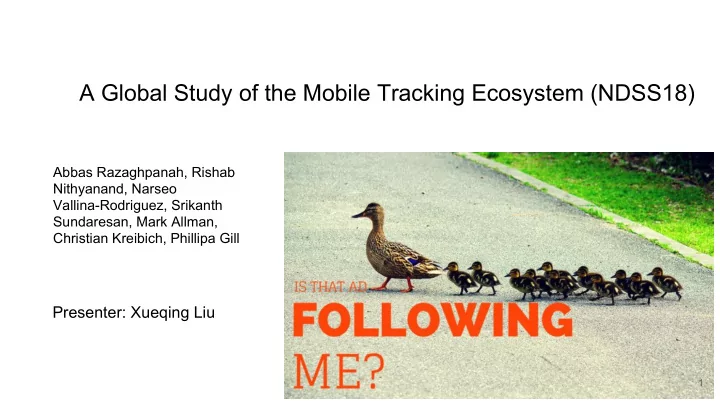
A Global Study of the Mobile Tracking Ecosystem (NDSS18)

Abbas Razaghpanah, Rishab Nithyanand, Narseo Vallina-Rodriguez, Srikanth Sundaresan, Mark Allman, Christian Kreibich, Phillipa Gill

Presenter: Xueqing Liu

1

slide-2
SLIDE 2

Mobile Tracking

2

slide-3
SLIDE 3

Mobile Tracking

3

slide-4
SLIDE 4

How Are Users Tracked by Third-Party Services?

4

Advertising and Tracking Services (ATS) Advertising and Tracking Services - capable (ATS-c)

slide-5
SLIDE 5

Monetization with Advertising

5

33 billion

  • 94% free apps
slide-6
SLIDE 6

Violation of Least-Privileged Principle

6

Permission 1 Permission 2 Permission 3 App 1 yes yes App 2 yes yes Opacity to user:

  • Which 3rd party services
  • How sensitive data are

handled

  • Whether eventually shared

with a 4th party

Bring Transparency to the Ecosystem!

slide-7
SLIDE 7

7

Part 1: Data Collection through Crowdsourcing

slide-8
SLIDE 8

8

  • Leverage Android VPN

permission

  • Route packages to local

device Correlate Information Flow with Contextual Info:

  • Identity
  • Location
  • Contact list, SMS, call logs

Identify PII in payload

  • Intercept traffic via TLS

proxy with user consent

  • 11,384 users from

100+ countries

  • 14,599 apps
  • 40,533 domains
  • Send summarized and

anonymized data

slide-9
SLIDE 9
  • IRB approved

○ Not involving human subject, analyzing software, not users

  • Informed consent on interception
  • Allow to disable interception at any time
  • Summarized and anonymized

9

Ethical Consideration

slide-10
SLIDE 10

Discussion

  • Is there any ethical problem with their approach?

10

slide-11
SLIDE 11

Comparison with Similar Studies

“Won’t Somebody Think of the Children?” Examining COPPA Compliance at Scale ReCon: Revealing and Controlling PII Leaks in Mobile Network Systems

11

Recon:

  • Sending all device traffic

to a proxy server

  • Intercept at the server

side Lumen:

  • Capture user data locally on

device

  • Correlate contextual

information (e.g., process ID) with flows

Higher precision

Dynamic analysis:

  • Not real user engagement
  • Low coverage with automated

UI execution tool Static Analysis:

  • False positive
  • Scalability
  • Obfuscation
slide-12
SLIDE 12

Discussion

  • What do you think of ReCon vs. this paper? Precision?

12

slide-13
SLIDE 13

13

Part 2: Classification on Third-party Domains

slide-14
SLIDE 14

Classifying the Destination Domain

Baseline: leveraging publicly available services/list

  • e.g., EasyList, OpenDNS

domain tagger

14

Deficiency: low coverage Their three-step approach

  • Identifying third-party domain

by comparing TLS certificate

  • Identifying ATS domains with

machine learning

  • Identifying ATS-c from the rest

which UID is sent to

http://googleadsservices.com -> “Advertising”

slide-15
SLIDE 15

First Step: Identifying Third-Party Domains

15

crashlytics.com graph.facebook.com scorecardresearch.com accuweather.com com.spotify.music com.accuweather.android com.htc.sense.hsp com.facebook.katana

slide-16
SLIDE 16

Second Step: Classifying ATS-domains

Label ■ ATS: random samples from EasyList ■ non-ATS: random samples from alexa Top

  • Added domains from service/lists, e.g., EasyList
  • Evaluation: 200 predicted ATS, 100 predicted non-ATS
  • 4% false positive, 10% false negative

16

  • Train an SVM classifier:

○ Feature ■ Front page content of the domain ■ Text scrapped from DuckDuckGo

slide-17
SLIDE 17

Discussion

  • Identifying ATS-domains:

○ Data noise -> low precision? ■ Topic ATS: “ads”, “analytics”, “services” ■ Topic non-ATS: anything

17

slide-18
SLIDE 18

Third Step: Identifying ATS-c Domain

  • Classify a domain as ATS-c if:

○ It is not ATS ○ Some user identifiers are sent to the domain

18

slide-19
SLIDE 19

Evaluation on Coverage

19

233 domains not covered by any list/service

slide-20
SLIDE 20

20

Part 3: Basic Analysis on ATS data

slide-21
SLIDE 21

UID harvesting

21

  • 3rd party domain = 20% of all domains
  • But they are responsible for 40% of UID harvesting
  • Only 14.4% of all ATSes harvest UID from the device => other tracking e.g.,

HTTP headers, cookies

  • Most commonly harvested data is Android ID
  • Android ID should not be associated with any other PII in 34% cases
slide-22
SLIDE 22

Which Companies Own the Most ATSes?

  • Map domains to parent

company:

○ D&B Hoovers, Crunchbase

22

0.35% 31% Facebook Graph API

slide-23
SLIDE 23

Does Paid Apps Free You from Being Tracked?

  • 82% apps connects to at least 1 ATS
  • 29% apps connects to at least 5 ATSs
  • Free apps: 2 ATSs, 1 ATS-c
  • Paid apps: 1 ATS, 1 ATS-c
  • Apps with In-app Purchase: 3 ATSs, 2 ATS-c

23

slide-24
SLIDE 24

Who Tracks You on Both Mobile and Web?

  • Collect website tracking statistics from

Alexa Top 1,000

  • Both mobile and web:

○ pagead2.googlesyndication.com ○ Googleads,g,doubleclick.net

  • Web >> mobile:

○ www.youtube.com ○ www.google.com

24

slide-25
SLIDE 25

Where Did The Data Go Eventually?

  • Privacy policy statement about data sharing

25

slide-26
SLIDE 26

26

Part 4: Analysis regarding Regulation Compliance

slide-27
SLIDE 27

General Data Protection Regulation

  • European Union data protection law
  • Protection of the data belonging to European users (EU) and European

Economic Area (EEA)

  • In effect since May 25, 2018
  • “Data protection by design and by default” (Article 25)

27

slide-28
SLIDE 28

GDPR Content Related to Mobile Security

  • Explicit consent:

○ Must explicitly request user consent for accessing data (opt-in) ○ Explain the purpose with plain words

  • Right to access/erasure:

○ Data processor must provide a copy of accessed user data ○ User can opt-out and require to erase the data at any time

  • Transfer data outside Europe:

○ Strictly prohibited

28

slide-29
SLIDE 29

A Geographical View of Data Flow

29

Germany Spain Canada USA India

USA

Italy

Location of Lumen user ATS-related IP address

slide-30
SLIDE 30

Cross-Continent Flow

30

Spain Germany Netherland

slide-31
SLIDE 31

A Different Measurement Result

31

Tracing Cross Border Web Tracking, IMC 2018

  • Browser information flow
  • “Inaccurate geolocation on IP“

○ Physical location of Google server -> Mountain View ○ Use Improved IP mapping ○ RIPE IPmap

EU users are fine!

slide-32
SLIDE 32

GDPR Reception

32

slide-33
SLIDE 33

Google Ads Consent SDK

33

slide-34
SLIDE 34

Compliance to COPPA

  • 88% Game & educational apps are under 13
  • Do not use less ATS/ATS-c

34

slide-35
SLIDE 35

Insights on Regulation Compliance

  • Due to the opacity of ATS, it is difficult to uncover how organizations collect,

store and share the data

  • The clarity of GDPR needs further improvement

○ How consent must be obtained? Install-time permission OK? ○ How exact to withdraw the consent? Uninstall enough?

  • User has no control of who has access to their data

35

slide-36
SLIDE 36

Future Work

  • What is the impact of GDPR on ATS tracking?
  • Do apps behave the same after opt-out?

36

slide-37
SLIDE 37

Takeaway

  • ATS tracking are pervasive
  • Big companies are the biggest data brokers
  • You can get somewhat less tracking by paying for it
  • Difficult to strictly enforce GDPR on ATS
  • Would not judge individual compliance

37

slide-38
SLIDE 38

38

Questions?