A framework Crohns disease DM1 Directly related Directly related - - PDF document

a framework
SMART_READER_LITE
LIVE PREVIEW

A framework Crohns disease DM1 Directly related Directly related - - PDF document

4/13/2018 Skin signs of endocrine disorders Anna Haemel MD Assistant Professor UCSF Dermatology Skin and systemic disease: A framework Crohns disease DM1 Directly related Directly related (cutaneous Crohns) (scleredema


slide-1
SLIDE 1

4/13/2018 1

Skin signs of endocrine disorders

Anna Haemel MD Assistant Professor UCSF Dermatology

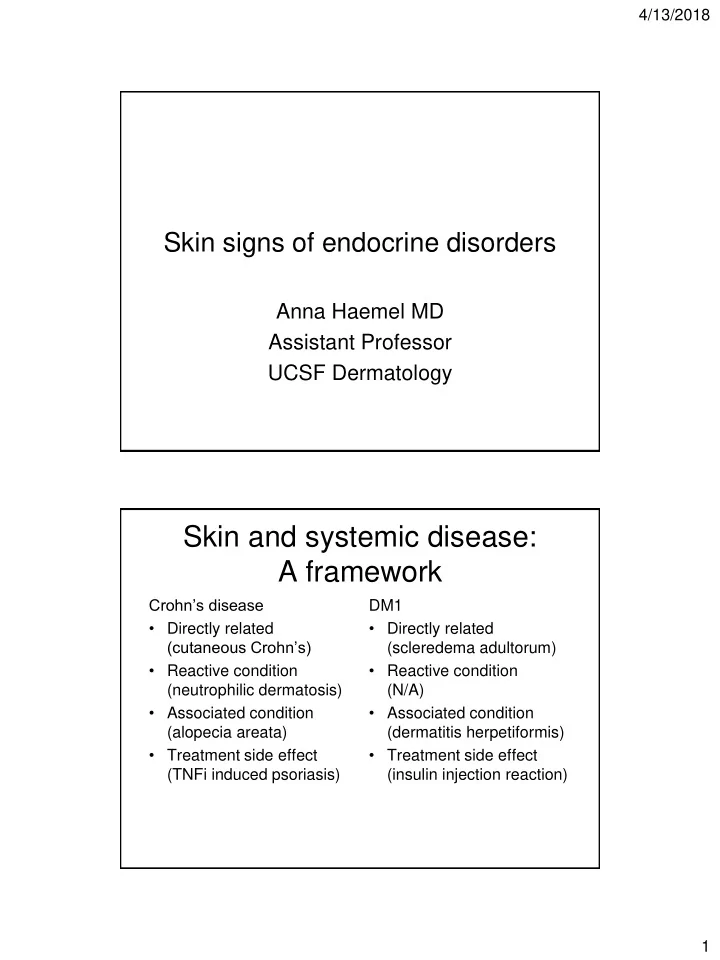
Skin and systemic disease: A framework

Crohn’s disease

  • Directly related

(cutaneous Crohn’s)

  • Reactive condition

(neutrophilic dermatosis)

  • Associated condition

(alopecia areata)

  • Treatment side effect

(TNFi induced psoriasis) DM1

  • Directly related

(scleredema adultorum)

  • Reactive condition

(N/A)

  • Associated condition

(dermatitis herpetiformis)

  • Treatment side effect

(insulin injection reaction)

slide-2
SLIDE 2

4/13/2018 2

Overview

  • Skin manifestations of

nonmalignant endocrine d/o incl:

– Thyroid

  • Hyper
  • Hypo

– Pancreas

  • Diabetes

– Androgen excess

  • PCOS
  • Skin manifestations of

neoplastic endocrine conditions incl:

– Genetic

  • MEN syndromes

– Metabolic

  • Glucagonoma

– Paraneoplastic

  • Dermatomyositis

Case 1: Textural changes to legs

slide-3
SLIDE 3

4/13/2018 3

Case 1 Case 1

  • 1 year hx of textural changes to shins>

upper extremities

  • Consult question: Does this patient have

scleromyxedema?

  • Skin bx forearm – dermal mucinosis
  • Labs – SPEP/IFE/free light chains neg
slide-4
SLIDE 4

4/13/2018 4

Case 1

  • Prior hx Graves’, incl Graves’
  • phthalmopathy

– Significant proptosis – Significant ocular surface exposure OD>OS – No signs of optic nerve compromise – Intermittent diplopia that is not bothersome to the patient

Graves’ disease Cutaneous Features

  • Ophthalmopathy (30%)
  • Pretibial myxedema (4%)
  • Acropachy (1%)
  • Stimulation of thyrotropin receptor results in

mesenchymal tissue expansion

  • Correction of thyroid level has no effect on skin

lesions

Transl Pediatr. 2017 Oct;6(4):300-312. Int J Dermatol. 2015 Aug;54(8):e280-6

slide-5
SLIDE 5

4/13/2018 5

Thyroid Dermopathy Pretibial Myxedema

  • Accumulation of glycosaminoglycans
  • Bilateral, localized
  • Nonpitting infiltration
  • Nodules and plaques
  • Elephantiasis-like
  • Usually have ophthalmopathy
  • Acropachy is variable

Transl Pediatr. 2017 Oct;6(4):300-312. Int J Dermatol. 2015 Aug;54(8):e280-6

Case 1

  • Treatment approach

– Ophtho consult for thyroid associated

  • rbitopathy: Currently inactive
  • Encouraged current attempts to quit smoking

– Skin directed therapy:

  • Topical/intralesional triamcinolone
  • Compression garments orders (sleeves, gloves,

stockings)

slide-6
SLIDE 6

4/13/2018 6

Case 1

Relative sparing at sites

  • f compression/straps

Thyroid Acropachy

  • Clubbing
  • Soft tissue swelling of hands and feet
  • Periosteal reaction of extremity bones
  • Thyroid acropachy is associated w severe

Graves’ orbitopathy and need for orbital decompression

Transl Pediatr. 2017 Oct;6(4):300-312. Int J Dermatol. 2015 Aug;54(8):e280-6

  • Thyroid. 2003 Dec;13(12):1141-4.
slide-7
SLIDE 7

4/13/2018 7

  • nycholysis

soft tissue swelling Thyroid acropachy: periosteal bone formation at the metacarpophalanges and proximal phalanges

N Engl J Med. 2016 Jul 21;375(3):261.

slide-8
SLIDE 8

4/13/2018 8

Hypothyroidism Myxedema = systemic mucinosis

  • Skin is cold, xerotic, pale
  • Coarse hair
  • Loss of outer third of eyebrow = madarosis
  • Puffy face
  • Broad nose
  • Thick lips and large tongue (macroglossia)
  • Drooping eyelids and periorbital swelling

– MPS deposition

  • Cutis verticis gyrata
  • Carotenemia  yellow palms and soles

Transl Pediatr. 2017 Oct;6(4):300-312.

slide-9
SLIDE 9

4/13/2018 9

Hyperthyroidism

  • Skin is warm, moist, and smooth
  • Palmar erythema
  • Facial flushing
  • Hair is thinned, downy
  • Hyperpigmentation
  • Hyperhidrosis
  • Nail changes

– Plummer nails: concave with distal

  • nycholysis

Transl Pediatr. 2017 Oct;6(4):300-312. Int J Dermatol. 2015 Aug;54(8):e280-6

slide-10
SLIDE 10

4/13/2018 10

Hyperthyroidism Other Cutaneous Features

  • Vitiligo

– 7% of patients with Graves’ disease – Increased in patients with Hashimoto's thyroiditis

  • Urticaria

– Check thyroid antibodies in chronic urticaria

Transl Pediatr. 2017 Oct;6(4):300-312.

slide-11
SLIDE 11

4/13/2018 11

Case 2: Referral for “morphea”

slide-12
SLIDE 12

4/13/2018 12

Case 2

  • Skin bx: thickening of the reticular dermis

with a slight increase in the amount of interstitial mucin in the deep dermis

  • Dx: Scleredema adultorum

– Sclerodermiform mucinosis – Glycosylation of proteins

Transl Pediatr. 2017 Oct;6(4):300-312.

slide-13
SLIDE 13

4/13/2018 13

Scleredema adultorum

  • Painless non pitting swelling/induration

starting on upper back/neck and can spread to upper torso

  • 2.5-14% of pts with DM; more common in

men

  • Increased deposition of collagen due to

irreversible nonenzymatic glycosylation of collagen/resistance to degradation

  • Very challenging to treat – PUVA, MTX,

IVIG, other…

Clin Rev Allergy Immunol. 2017 Dec;53(3):306-336.

Skin Signs of diabetes

Directly related

  • Scleredema
  • Diabetic

cheiroarthropathy

  • Diabetic

dermopathy

  • Bullous

diabeticorum

  • Acanthosis

nigricans Associated conditions

  • Candidiasis
  • Fungal infections
  • Necrobiosis lipoidica
  • Granuloma annulare?
  • Psoriasis
slide-14
SLIDE 14

4/13/2018 14

  • Diabetic dermopathy

– Most common cutaneous marker of DM – 70% of adults w DM

Transl Pediatr. 2017 Oct;6(4):300-312.

  • Bullous diabeticorum

– Rare but specific (0.05% of pts) – Large noninflammatory monolocular bullae

  • n dorsal foot/ankle

Image courtesy of Lindy Fox MD Transl Pediatr. 2017 Oct;6(4):300-312.

slide-15
SLIDE 15

4/13/2018 15

Acanthosis nigricans assoc w insulin resistance

  • AN is a sign of

peripheral insulin resistance

  • Increased in groups

with DM commonly (NA, Hispanics, AA’s) and in obesity

  • Elevated insulin levels

bind to Insulin Growth Factor receptors on keratinocytes causing AN

Transl Pediatr. 2017 Oct;6(4):300-312.

Skin Signs of diabetes

Directly related

  • Scleredema
  • Diabetic

cheiroarthropathy

  • Diabetic dermopathy
  • Bullous diabeticorum
  • Acanthosis nigricans

Associated conditions

  • Candidiasis
  • Dermatophytosis
  • Necrobiosis lipoidica
  • Granuloma annulare ?
  • Psoriasis
slide-16
SLIDE 16

4/13/2018 16

slide-17
SLIDE 17

4/13/2018 17

  • Necrobiosis lipoidica

diabeticorum

– 0.3% to 1.6% of pts w DM – BUT 75% of cases of NLD occur in pts who have or will develop DM

Case 3: Severe adult female acne

  • 28 YOF
  • Acne in teens, now recurrent again in late

20s

  • Irregular menses, excess hair growth,

thinning scalp hair

  • A1c = 5.8%
slide-18
SLIDE 18

4/13/2018 18

Photo courtesy of Kanade Shinkai MD, PhD

PCOS and skin

  • 72-82% of pts w PCOS have cutaneous signs of

hyperandrogenism

  • Acne - 61% of pts w PCOS – not a reliable

marker

  • Hirsutism – 53% of pts w PCOS – excellent

marker

  • Acanthosis nigricans – 37% of pts w PCOS –

excellent marker

  • Hirsutism and AN are both assoc w elevated

free testosterone level and increased insulin resistance

Schmidt T et al (2016) JAMA Derm, 152: 391-398

slide-19
SLIDE 19

4/13/2018 19

Hirsutism - a specific sign in PCOS

Photo courtesy of Kanade Shinkai MD, PhD Photo courtesy of Kanade Shinkai MD, PhD

slide-20
SLIDE 20

4/13/2018 20

Acanthosis nigricans is specific sign in PCOS

Photo courtesy of Kanade Shinkai MD, PhD

Androgenetic alopecia - not a reliable marker of PCOS

Schmidt T et al (2015) JAMA Derm, Dec 23:1-8

slide-21
SLIDE 21

4/13/2018 21

Treatment

  • Weight loss
  • Dietary changes
  • OCPs
  • Metformin as needed for hyperglycemia
  • Spironolactone for hirsutism, acne

Dermatology & disorders of androgen excess

  • PCOS (most common)
  • CAH
  • Ovarian tumors
  • Adrenal tumors
slide-22
SLIDE 22

4/13/2018 22

Case 4

slide-23
SLIDE 23

4/13/2018 23

Necrolytic migratory erythema (assoc w glucagonoma)

  • Glucagonoma syndrome: NME skin

findings, incr glucagon levels, diabetes/glucose intolerance

  • NME: Migratory plaques w superficial

epidermal necrosis, central flaccid bullae, and crusted erosions

– Favors flexural areas – Skin may respond to somatostatin analog (octreotide)

Int J Dermatol. 2018 Feb 16.

slide-24
SLIDE 24

4/13/2018 24

Skin manifestations of neoplastic endocrine disorders

– Metabolic/neuroendocrine

  • Glucagonoma

– Paraneoplastic

  • Dermatomyositis

– Genetic

  • MEN syndromes

Necrolytic migratory erythema (assoc w glucagonoma)

  • Pathogenesis: metabolic etiology involving

excess glucagon, amino acid deficiency, zinc deficiency, and free fatty acid deficiency

– Skin may impove w IV amino acid supplementation or zinc – Clinically appears similar to eruption of acrodermatitis enteropathica

Int J Dermatol. 2018 Feb 16.

slide-25
SLIDE 25

4/13/2018 25

Skin manifestations of neoplastic endocrine disorders

– Metabolic/neuroendocrine

  • Glucagonoma

– Paraneoplastic

  • Dermatomyositis

– Genetic

  • MEN syndromes
slide-26
SLIDE 26

4/13/2018 26

Malignancy in dermatomyositis

  • Most studies have found an increased risk
  • f cancer with DM in up to 30% of

patients

  • Ovarian cancer over-represented
  • Risk is highest in first 2 years, but

remains elevated out to 5 years

  • Disease may improve with cancer

treatment

Am J Clin Dermatol. 2015 Apr;16(2):89-98.

slide-27
SLIDE 27

4/13/2018 27

Palmar fasciitis - polyarthritis: Assoc w ovarian cancer

Clin Exp Dermatol. 2017 Apr;42(3):328-330.

Skin manifestations of neoplastic endocrine disorders

– Metabolic/neuroendocrine

  • Glucagonoma

– Paraneoplastic

  • Dermatomyositis

– Genetic

  • MEN syndromes
slide-28
SLIDE 28

4/13/2018 28

Arch Dermatol. 2010 Jul;146(7):715-8

MEN Type I: Wermer

  • Endocrine: Parathyroid hyperplasia, islet

cell tumors, pituitary adenomas

  • Skin: Facial angiofibromas, collagenomas,

(sometimes) lipomas

Semin Oncol. 2016 Jun;43(3):335-40.

MEN IIA: Sipple

  • Endocrine: Parathyroid hyperplasia,

medullary thyroid carcinoma, pheochromocytoma

  • Skin: Macular and lichen amyloid, notalgia

paresthetica

Semin Oncol. 2016 Jun;43(3):335-40.

slide-29
SLIDE 29

4/13/2018 29

MEN IIA and lichen amyloid

Clin Endocrinol (Oxf). 2003 Aug;59(2):156-61.

MEN IIB: Multiple mucosal neuromas syndrome

Semin Oncol. 2016 Jun;43(3):335-40

  • Endocrine: Medullary thyroid cancer,

pheochromocytoma

  • Skin: Multiple mucosal neuromas,

marfanoid habitus, joint laxity

slide-30
SLIDE 30

4/13/2018 30

Questions?