A Discrete Strategy Improvement Algorithm for Solving Parity Games - - PDF document

a discrete strategy improvement algorithm for solving
SMART_READER_LITE
LIVE PREVIEW

A Discrete Strategy Improvement Algorithm for Solving Parity Games - - PDF document

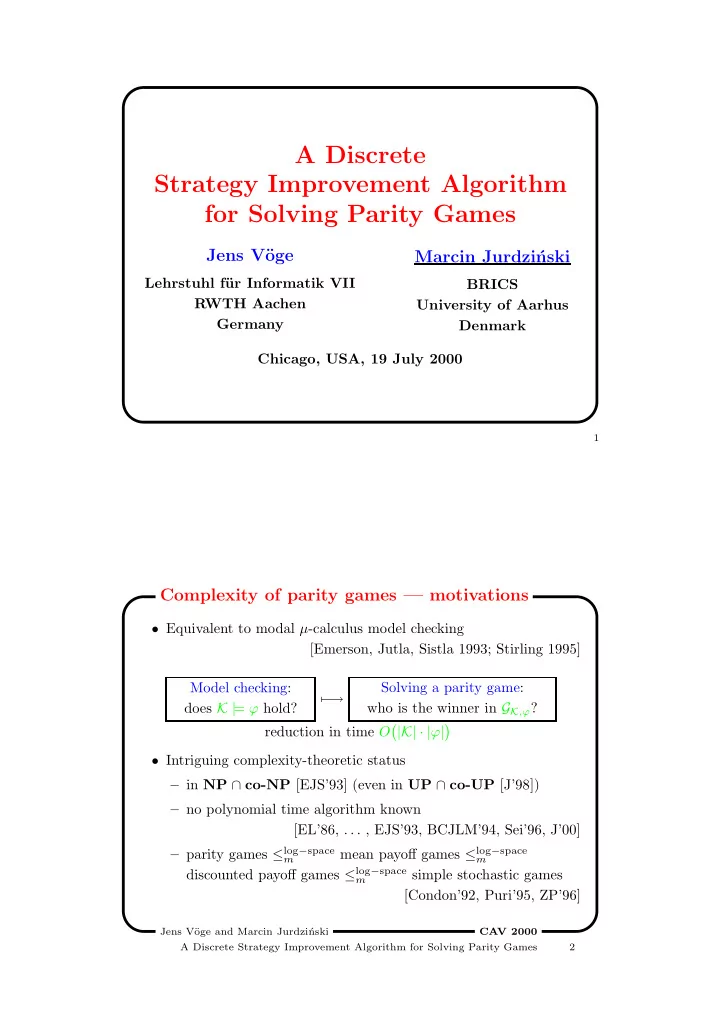
A Discrete Strategy Improvement Algorithm for Solving Parity Games Jens V oge Marcin Jurdzi nski Lehrstuhl f ur Informatik VII BRICS RWTH Aachen University of Aarhus Germany Denmark Chicago, USA, 19 July 2000 1 Complexity of


slide-1
SLIDE 1

A Discrete Strategy Improvement Algorithm for Solving Parity Games

Jens V¨

  • ge

Lehrstuhl f¨ ur Informatik VII RWTH Aachen Germany

Marcin Jurdzi´ nski

BRICS University of Aarhus Denmark Chicago, USA, 19 July 2000

1

  • Equivalent to modal µ-calculus model checking

[Emerson, Jutla, Sistla 1993; Stirling 1995] Model checking: does K | = ϕ hold? − → Solving a parity game: who is the winner in GK,ϕ? reduction in time O

  • |K| · |ϕ|
  • Intriguing complexity-theoretic status

– in NP ∩ co-NP [EJS’93] (even in UP ∩ co-UP [J’98]) – no polynomial time algorithm known [EL’86, . . . , EJS’93, BCJLM’94, Sei’96, J’00] – parity games ≤log−space

m

mean payoff games ≤log−space

m

discounted payoff games ≤log−space

m

simple stochastic games [Condon’92, Puri’95, ZP’96]

Complexity of parity games — motivations

Jens V¨

  • ge and Marcin Jurdzi´

nski A Discrete Strategy Improvement Algorithm for Solving Parity Games 2 CA V 2000

slide-2
SLIDE 2

1966 Hoffman-Karp’s algorithm for stochastic games received a lot of attention in Operations Research community 1995 Puri’s algorithm for discounted payoff games Drawbacks of Puri’s algorithm:

  • Inefficient in practice

– solving linear programming instances – high precision arithmetic

  • Hard to analyze/understand

– manipulates real number encodings of discrete values – proof of correctness uses continuous methods (e.g., Banach fixed point theorem)

Strategy improvement algorithms — history

Jens V¨

  • ge and Marcin Jurdzi´

nski A Discrete Strategy Improvement Algorithm for Solving Parity Games 3 CA V 2000

We alleviate drawbacks of Puri’s algorithm

  • Fast implementation

– O(n · m) discrete algorithm for strategy improvement step

  • Hope for easier analysis/better understanding:

– manipulates discrete values explicitly – proof of correctness uses only discrete arguments Experimental evidence: small number of strategy improvement steps Open problem: is it a polynomial time algorithm?

Discrete strategy improvement algorithm

Jens V¨

  • ge and Marcin Jurdzi´

nski A Discrete Strategy Improvement Algorithm for Solving Parity Games 4 CA V 2000

slide-3
SLIDE 3
  • 1. Definition of parity games
  • 2. Solving parity games

(a) as a decision problem (b) as an optimization problem

  • 3. Strategy Improvement Algorithm

(a) generic idea (b) our implementation

  • 4. Time complexity
  • 5. Open problems

Plan

Jens V¨

  • ge and Marcin Jurdzi´

nski A Discrete Strategy Improvement Algorithm for Solving Parity Games 5 CA V 2000

G =

  • V, E, (MEven, MOdd)
  • V = {0, 1, 2, . . ., n} = MEven ⊎ MOdd
  • 0 ∈ MEven; o ∈ MOdd

5 6

  • 3
  • 1
  • 4
  • 2
  • Parity games — definition

Jens V¨

  • ge and Marcin Jurdzi´

nski A Discrete Strategy Improvement Algorithm for Solving Parity Games 6 CA V 2000

slide-4
SLIDE 4

Play P:

Loop(P )

  • 5

6 3 4

  • λ(P)

2

  • Loop(P) = {0, 2, 3, 4}

λ(P) = max

  • {0, 2, 3, 4}
  • = 4

Loop value λ(P) of a play P is defined by λ(P) = max

  • Loop(P)
  • Play P is a winning play for Even iff

λ(P) is even

Winning play

Jens V¨

  • ge and Marcin Jurdzi´

nski A Discrete Strategy Improvement Algorithm for Solving Parity Games 7 CA V 2000

Function σ : MEven → V is a strategy for Even iff

  • v, σ(v)
  • ∈ E for every v ∈ MEven

5 6

  • 3
  • 1
  • 4
  • 2
  • 5

σ

6 3

  • σ
  • 1

4

σ

2 5 6 3 1 4 2 Play P = v1, v2, . . ., vk is consistent with strategy σ iff vi+1 = σ(vi) for every vi ∈ MEven P: 5 6 3 4 2

  • 5

σ

6 3

σ

4

σ

2 5 6 3 4 2

Strategies

Jens V¨

  • ge and Marcin Jurdzi´

nski A Discrete Strategy Improvement Algorithm for Solving Parity Games 8 CA V 2000

slide-5
SLIDE 5

Playsσ(v) is defined to be the set of plays − starting from v, and − consistent with σ Strategy σ is a winning strategy for Even from v iff every play P ∈ Playsσ(v) is winning for Even

Winning strategies

Jens V¨

  • ge and Marcin Jurdzi´

nski A Discrete Strategy Improvement Algorithm for Solving Parity Games 9 CA V 2000

The winning set WEven =

  • v ∈ V : there is a winning strategy for Even from v
  • The problem of solving parity games

Given: a parity game G =

  • V, E, (MEven, MOdd)
  • Find: the winning set WEven ⊆ V

Solving parity games — decision problem

Jens V¨

  • ge and Marcin Jurdzi´

nski A Discrete Strategy Improvement Algorithm for Solving Parity Games 10 CA V 2000

slide-6
SLIDE 6

(Strategies, ⊑) ⊑ is a partial order on Strategies Postulates for (Strategies, ⊑):

  • 1. The ⊑-maximum strategy exists
  • 2. The ⊑-maximum element is a strategy

winning from every vertex in WEven The problem of solving parity games Given: a parity game G =

  • V, E, (MEven, MOdd)
  • Find: the ⊑-maximum strategy

Solving parity games — optimization problem

Jens V¨

  • ge and Marcin Jurdzi´

nski A Discrete Strategy Improvement Algorithm for Solving Parity Games 11 CA V 2000

(Strategies, ⊑) ⊑ Improve Postulates for a function Improve : Strategies → Strategies

  • 1. (Strategy Improvement)

If σ is not the ⊑-maximum strategy then σ ⊑ Improve(σ)

  • 2. (Optimum Strategy)

If σ is the ⊑-maximum strategy then Improve(σ) = σ Strategy Improvement Algorithm: pick a strategy σ for player Even while σ = Improve(σ) do σ := Improve(σ)

Generic Strategy Improvement Algorithm

Jens V¨

  • ge and Marcin Jurdzi´

nski A Discrete Strategy Improvement Algorithm for Solving Parity Games 12 CA V 2000

slide-7
SLIDE 7

In this talk:

  • 1. Definition of a partial order ⊑ on Strategies
  • 2. Definition of a function Improve : Strategies → Strategies

In (full versions of) the paper:

  • 1. Proofs of postulates for (Strategies, ⊑)
  • 2. Proofs of postulates for Improve:

(a) Proof of Strategy Improvement Lemma (b) Proof of Optimum Strategy Lemma

  • 3. Efficient implementation of Improve

Ingredients of Strategy Improvement Algorithm

Jens V¨

  • ge and Marcin Jurdzi´

nski A Discrete Strategy Improvement Algorithm for Solving Parity Games 13 CA V 2000

Assume we are given:

  • 1. (PlayValues, ): a linear order on PlayValues
  • 2. Θ : Plays → PlayValues: value of a play

(Strategies,

?

⊑) (

(V →PlayValues)

  • Valuations ,

point-wise extension

  • )

σ′ Ωσ′ Ωσ σ Ω

Ωσ : V → PlayValues Ωσ(v) = min Θ(P) : P ∈ Playsσ(v)

  • Intuition: Ωσ is the value of the best counter-strategy against σ

Our proposal for ⊑-order on Strategies

Jens V¨

  • ge and Marcin Jurdzi´

nski A Discrete Strategy Improvement Algorithm for Solving Parity Games 14 CA V 2000

slide-8
SLIDE 8

Improve : Strategies → Strategies Improve(σ) : MEven → V

  • Improve(σ)
  • (v) = the successor of v maximizing Ωσ (w.r.t. )

u2 u1 v

Improve(σ)

because Ωσ(u1) ⊲ Ωσ(u2) Improvement step for strategy σ in a nutshell:

  • 1. global minimization: find Ωσ, the best counter-strategy against σ
  • 2. local maximization: point Improve(σ) to -maximum Ωσ values

Our proposal for Improve function on Strategies

Jens V¨

  • ge and Marcin Jurdzi´

nski A Discrete Strategy Improvement Algorithm for Solving Parity Games 15 CA V 2000

Play P: 5 6 3 4

  • λ(P)

2

  • Prefix(P )

Prefix(P) = {0, 3, 5, 6} λ(P) = 4, π(P) = {5, 6}, #(P) = 4 Primary path value π(P) = Prefix(P) ∩

  • v : v > λ(P)
  • Secondary path value

#(P) =

  • Prefix(P)
  • Value of a play function Θ : Plays →

V ×℘(V )×N

  • PlayValues is defined by:

Θ(P) =

  • λ(P), π(P), #(P)
  • PlayValues and function Θ : Plays → PlayValues

Jens V¨

  • ge and Marcin Jurdzi´

nski A Discrete Strategy Improvement Algorithm for Solving Parity Games 16 CA V 2000

slide-9
SLIDE 9

PlayValues ⊆ V × ℘(V ) × N

  • n PlayValues is the lexicographic order on V × ℘(V ) × N
  • We define a linear order on loop values V
  • We define a linear order on primary path values ℘(V )
  • We use standard ≤ linear order on secondary path values N

Our proposal for order on PlayValues

Jens V¨

  • ge and Marcin Jurdzi´

nski A Discrete Strategy Improvement Algorithm for Solving Parity Games 17 CA V 2000

Definition (The linear order on loop values V ) (2k − 1) ≺ · · · ≺ 5 ≺ 3 ≺ 1 ≺ 0 ≺ 2 ≺ 4 ≺ 6 ≺ · · · ≺ 2k Definition (The linear order on primary path values ℘(V )) P Q iff FirstDiff(P; Q) FirstDiff(Q; P) Example P =

  • 7

> 6 > 5 > 4

  • Q

=

  • 7

> 6 > 4

  • R

=

  • 7

> 6 > 4 > 2

  • The linear orders on V and ℘(V )

Jens V¨

  • ge and Marcin Jurdzi´

nski A Discrete Strategy Improvement Algorithm for Solving Parity Games 18 CA V 2000

slide-10
SLIDE 10
  • 1. Efficient implementation of Improve; computing Ωσ
  • solving one-player games

(for player Odd: minimization instead of maximization)

  • solving special instances of shortest paths problem
  • 2. Strategy Improvement and Optimum Strategy Lemmas
  • local characterization of Ωσ (progressive valuation)
  • relaxations of valuations (under- and over-valuations)

Lemma 1. If Ξ is an under-valuation for Gσ then Ξ Ωσ Lemma 2. If Ξ is an over-valuation for Gτ then ℧τ Ξ

  • application of lemmas 1. and 2.

Prop.1. Ωσ is an under-valuation for GImprove(σ) Prop.2. If Improve(σ) = σ then Ωσ is an over-valuation for Gσ

Proof techniques

Jens V¨

  • ge and Marcin Jurdzi´

nski A Discrete Strategy Improvement Algorithm for Solving Parity Games 19 CA V 2000

Parameters of interest

  • The time needed to perform a single strategy improvement step

– A discrete O(n · m) time algorithm (efficient implementation in a companion paper [SV’00])

  • The number of strategy improvement steps

– An obvious

v∈MEven out-deg(v) upper bound

– Prop. O(n3) strategy improvement steps suffice for one-player parity games (cf. [Melekopoglou, Condon 1994]) – Prop. There exists a policy of improvement at one vertex at a time terminating in at most n steps (cf. [J’00]) – Prop. There are only O(n2) substantial improvement steps Experimental evidence. Small, often O(1) number of non-substantial improvement steps. (see [SV’00])

Time complexity

Jens V¨

  • ge and Marcin Jurdzi´

nski A Discrete Strategy Improvement Algorithm for Solving Parity Games 20 CA V 2000

slide-11
SLIDE 11
  • 1. Does our algorithm with the standard improvement policy

terminate in polynomial number of strategy improvement steps? If not: exhibit families of hard examples

  • 2. Are there polynomial time improvement policies for which our

algorithm terminates in polynomial number of strategy improvement steps? If not: exhibit families of hard examples

  • 3. Define and study other partial orders ⊑ on Strategies and
  • ther Improve operators
  • 4. Develop other algorithms than strategy improvement algorithm

for the optimization problem we have defined

Open problems

Jens V¨

  • ge and Marcin Jurdzi´

nski A Discrete Strategy Improvement Algorithm for Solving Parity Games 21 CA V 2000