A Concerted Effort Towards Flourishing Global Software Development - - PDF document

a concerted effort towards flourishing
SMART_READER_LITE
LIVE PREVIEW

A Concerted Effort Towards Flourishing Global Software Development - - PDF document

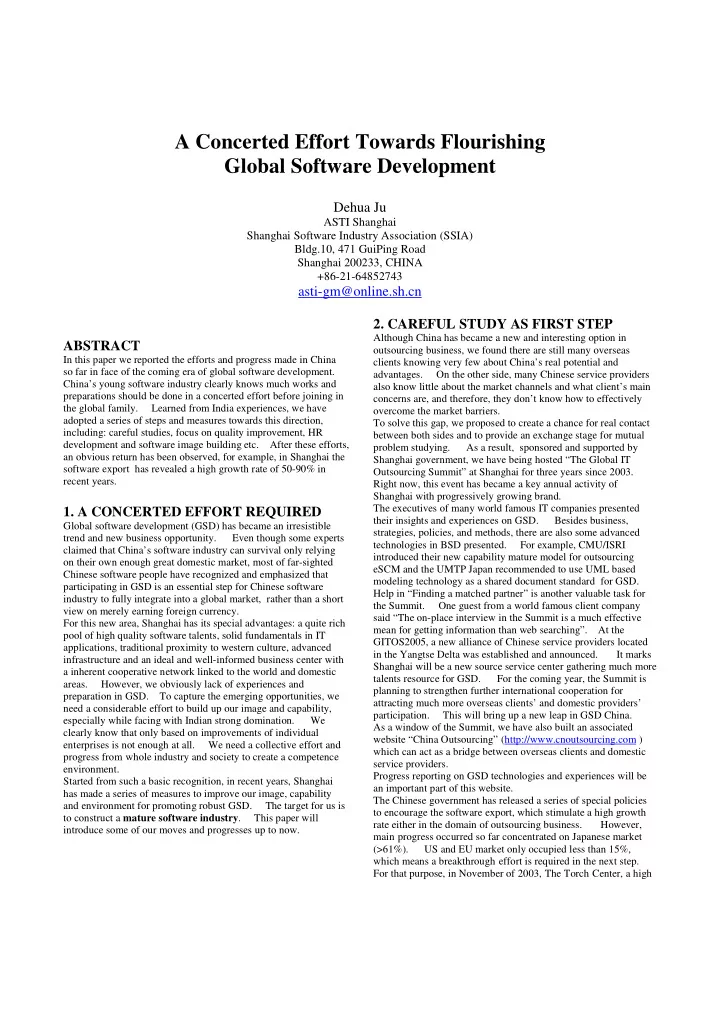
A Concerted Effort Towards Flourishing Global Software Development Dehua Ju ASTI Shanghai Shanghai Software Industry Association (SSIA) Bldg.10, 471 GuiPing Road Shanghai 200233, CHINA +86-21-64852743 asti-gm@online.sh.cn 2. CAREFUL STUDY AS


slide-1
SLIDE 1

A Concerted Effort Towards Flourishing Global Software Development

Dehua Ju

ASTI Shanghai Shanghai Software Industry Association (SSIA) Bldg.10, 471 GuiPing Road Shanghai 200233, CHINA +86-21-64852743

asti-gm@online.sh.cn ABSTRACT

In this paper we reported the efforts and progress made in China so far in face of the coming era of global software development. China’s young software industry clearly knows much works and preparations should be done in a concerted effort before joining in the global family. Learned from India experiences, we have adopted a series of steps and measures towards this direction, including: careful studies, focus on quality improvement, HR development and software image building etc. After these efforts, an obvious return has been observed, for example, in Shanghai the software export has revealed a high growth rate of 50-90% in recent years.

  • 1. A CONCERTED EFFORT REQUIRED

Global software development (GSD) has became an irresistible trend and new business opportunity. Even though some experts claimed that China’s software industry can survival only relying

  • n their own enough great domestic market, most of far-sighted

Chinese software people have recognized and emphasized that participating in GSD is an essential step for Chinese software industry to fully integrate into a global market, rather than a short view on merely earning foreign currency. For this new area, Shanghai has its special advantages: a quite rich pool of high quality software talents, solid fundamentals in IT applications, traditional proximity to western culture, advanced infrastructure and an ideal and well-informed business center with a inherent cooperative network linked to the world and domestic

  • areas. However, we obviously lack of experiences and

preparation in GSD. To capture the emerging opportunities, we need a considerable effort to build up our image and capability, especially while facing with Indian strong domination. We clearly know that only based on improvements of individual enterprises is not enough at all. We need a collective effort and progress from whole industry and society to create a competence environment. Started from such a basic recognition, in recent years, Shanghai has made a series of measures to improve our image, capability and environment for promoting robust GSD. The target for us is to construct a mature software industry. This paper will introduce some of our moves and progresses up to now.

  • 2. CAREFUL STUDY AS FIRST STEP

Although China has became a new and interesting option in

  • utsourcing business, we found there are still many overseas

clients knowing very few about China’s real potential and

  • advantages. On the other side, many Chinese service providers

also know little about the market channels and what client’s main concerns are, and therefore, they don’t know how to effectively

  • vercome the market barriers.

To solve this gap, we proposed to create a chance for real contact between both sides and to provide an exchange stage for mutual problem studying. As a result, sponsored and supported by Shanghai government, we have being hosted “The Global IT Outsourcing Summit” at Shanghai for three years since 2003. Right now, this event has became a key annual activity of Shanghai with progressively growing brand. The executives of many world famous IT companies presented their insights and experiences on GSD. Besides business, strategies, policies, and methods, there are also some advanced technologies in BSD presented. For example, CMU/ISRI introduced their new capability mature model for outsourcing eSCM and the UMTP Japan recommended to use UML based modeling technology as a shared document standard for GSD. Help in “Finding a matched partner” is another valuable task for the Summit. One guest from a world famous client company said “The on-place interview in the Summit is a much effective mean for getting information than web searching”. At the GITOS2005, a new alliance of Chinese service providers located in the Yangtse Delta was established and announced. It marks Shanghai will be a new source service center gathering much more talents resource for GSD. For the coming year, the Summit is planning to strengthen further international cooperation for attracting much more overseas clients’ and domestic providers’

  • participation. This will bring up a new leap in GSD China.

As a window of the Summit, we have also built an associated website “China Outsourcing” (http://www.cnoutsourcing.com ) which can act as a bridge between overseas clients and domestic service providers. Progress reporting on GSD technologies and experiences will be an important part of this website. The Chinese government has released a series of special policies to encourage the software export, which stimulate a high growth rate either in the domain of outsourcing business. However, main progress occurred so far concentrated on Japanese market (>61%). US and EU market only occupied less than 15%, which means a breakthrough effort is required in the next step. For that purpose, in November of 2003, The Torch Center, a high

slide-2
SLIDE 2

tech development program started by the Ministry of Science and Technology (MOST), launched the China Offshore Software Engineering Project (COSEP).

  • 3. QUALITY MOVEMENT AS AN

ESSENTIAL PART

Even India is a strong competitor to China, but also a good learning model for us. Quality first is a very successful experience from India. To enter global market, we have to pay high attention to software quality and process improvement. As an initial step, Chinese government released a state regulation policy --“Qualification for Double Software: i.e. qualified both Software companies and Software products”. It originated from a new Preferential Policy (Document Reference No.18) announced by the State Council in 2000. It specified only authorized software companies and registered software products can enjoy the state’s preferential policy, e.g. tax exemptions and reductions. As a result, so far 9968 software companies and 20192 software products have got the certificates in China. As a part of Software Qualification Program, a number of authorized testing centers have been established in China, distributed throughout the country, to Provide Third Party testing services required. China Software Testing Center (CSTC) is the first SW testing center in China approved by China National Accreditation Board of Laboratories (CNAL). So far it has certified 5000+ products, and served for acceptance testing and auditing of hundred information system projects. At Shanghai, there are two Software Testing Centers (SSTC) right now, also approved by the CNAL, as branch centers of CSTC to provide local services for software Testing. For promoting software quality/process improvement, the Software Industry Association acts a key role as advocator and media for technology transfer. At Shanghai, the Shanghai Software Industry Association (SSIA) built up the Shanghai Software Quality Consortium (SSQC), and the first SPIN and QAI Chapter in China. 18 famous international organizations sent their congratulations to its establishment and admired it as ‘A Right Step Towards Right Direction At Right Time’. Following the same model, right now there are five active SPIN Chapters, registered at CMU, in China. They are: Shanghai, Beijing, Guangdong, Shenzhen, and Nanjing. In Shanghai, the SSQC organized regular software quality seminars and activities to promote quality experiences exchange between member companies. In recent two years, we also supported and co-sponsored the China SPI Conference. To help the members familiar with Japanese software development practices, the Software Offshore Business Union of Shanghai (SOBUS), a consortium of Shanghai outsourcing service providers with 70 + member companies, has developed a guideline handbook of SE practices standard for outsourcing business to

  • Japan. As international exchange and cooperation, the SSQC

and JUSE have jointly held the reciprocity workshop for continual four years since 2002. Each year 20-35 industrial representatives from Shanghai and Japan respectively have a face- to-face group discussions divided into several topics (like project management, quality management, process improvement etc.) . New quality awareness results in a new hot spot in China, that is, Chinese software enterprises rush to ISO9000 and CMM-based SPI . As an additional promotion, Chinese government even promised to provide subsidy to CMM certification (Up To 50% cost). So far in Shanghai 200 SW companies got ISO9000 certificate, 32 CMM Level 3, 4 CMM Level 4, 6 CMM Level5 and 1 CMMI Level 5 – a significant and astonishing progress

  • appeared. Based on CMU/SEI profile [1], as shown in Table 1

below, number of China’s CMM appraisals has been listed as the third place in the world, only next to India and US, but with quickest growth. Table 1. Number of Appraisals (Based on CMU/SEI Profile) Country

  • Mar. 2002
  • Mar. 2004
  • Mar. 2005

China 18 152 243 India 153 330 387 USA 1498 1838 1947

  • 4. TALENTS ENGINEEING – THE No.1

STRATEGIC SELECTION

Based on such essential cognition of that future economic competition is, in the end, the competence race of human resource, especially in the software professionals. High qualified human resource development has been listed as a national strategic task and an important measure for that. The CPC Political Bureau has put forward the state strategy “Strengthen The Country By Talents” in 2003. It calls for to better train and utilize talented professionals, and to foster a batch of high rank experts who are competent to the needs of socialist modernization and reformation and opening policy. Now there are common consensus in the whole country: “S&T Is The First Productive Force” and “Talents Are The First Resource”. In the State Next (11th) 5 years plan (2006-2010), a key issue has been listed is how to ‘Construct the IT Talents Highland’. Experiences have shown the human factor is the most influential in any successful project. Nine system failures out of ten, in the final analysis, are attributed to the human factor. Software process is mastered by people with proper knowledge and skills. Therefore, needs right people playing right roles. Total System Maturity should be a plus of people maturity and process maturity. It is important to shift the organizational paradigm from "individual knowledge is power" to "collective knowledge is a competitive advantage". To fulfill this target, at Shanghai we have developed an IT resource website called “IT Source” (http://www.ITURLs.com ), supported by local government, acting as a technology transfer center and bridge linking SE and IT community. It contains rich technology resources and provides one-stop service ( link 25,000 URLs and more than 2,560 IT resource web sites in the world), covering many hot spots such as SE technologies, e- Business, new IT technologies, outsourcing, IT professional development etc. As a public service platform, the website helps in reducing learning curves and facilitates the organizational

  • learning. It has became one of the most attractive IT websites

in China. Its hit rate has exceeded 6.0 millions and there are more than 40,000 basic members. Mr. Steve McConnell, the Editor- in-Chief Emeritus of IEEE Software, wrote a special preface for IT Source admired it as a real demo of ‘Open Knowledge’. To solve the HRD problem from the root, Shanghai has put forwarded a clear new target: Marching towards “ SE/IT Professionalism”. Although China’s IT/SW industry is still in their infancy age, it is demanded to be mature more quickly. IT/SE professionalism has became a global trend. Earlier

slide-3
SLIDE 3

awareness for that is favorable for us to implement a jump development and aim at a high standard at HRD. As a key step toward this direction, the SSIA has cooperated with IEEE Computer Society to jointly introduce the CSDP program into China. IEEE-CS CSDP is a high-standard international training/certificate program for SE professionals, which is based

  • n SWEBOK & PMBOK and neutral to any specific company.

CSDP/SWEBOK-Based SE training materials, developed by the ASTI Shanghai, have been passed the review by the IEEE International Training Committee for Review and thus, ASTI Shanghai has been recognized as a qualified training center (1st in China and 4th in the world). It will remarkably reduce the local training cost for nationwide spreading out. To match the international high standard in training, we demand all training courseware developed will based on related Body of knowledge (BOKs). They are considered as a guidance and

  • bjective criteria for high quality training to reach scientific and

systematic structure & contents. In SE domain, we recommended to directly rely on the well-known standards, like SWEBOK and PMBOK. For the IT domain, there are many existing BOKs developed by different institutes. We will integrate their merits into an united version (IBOK), based on the specific needs of China’s informatization practices. For new product development (NPD) domain, supported by Shanghai Science commission, we has finished a research project on developing the Body of Knowledge for New Product Development (NPDBOK) which integrated and expanded DRM’s and SCPD’s similar works in the world. As the Shanghai action plan of “Prospering City By Science & Technology and Education”, this work was merged into a more magnificent project to develop a BOK for CTO. Now the version 3 of CTO BOK has worked out by a task force. And the Shanghai government has also announced an official certificate program for CTO, based on that CTO BOK. So far three rounds

  • f training and examinations have been taken part at Shanghai.

Taking as a concerted action, we have introduced six certificate programs so far, three international and three domestic ones. The first one is the PMI’s PMP program which has been introduced since 2000. In 2005 it is estimated near 10000 Chinese would get the PMP Certificates. Besides the CSDP program mentioned above, another initiative is cooperate with UMTP, Japan to promote UML-based software modeling technique which will be dedicated as a future common standard between Asian SE

  • communities. Three other certificate program are sponsored by

Shanghai government since 2003, they are respectively: Software Quality and Testing Engineers (CSQE/CSTE BOK based), CTOs and CIOs. SSIA acts as a crucial and active role in developing related BOKs and training programs. More certificate programs are being considered to be introduced in the near future, including: QAI’s CSQA/CSTE, iSQI’s certificate series and Japan IPA’s JITEC. As a serious step towards the SE professionalism, we have translated the IEEE-CS/ACM SE Code of Ethics and Professional Practice version 5.2 into Chinese, which has been determined as the Chinese version of the standard after reviewed by the international committee. The Shanghai Software Industry Association (SSIA) has being spread it over Shanghai SE

  • community. It is considered as a crucial step towards a mature

SE professionals. My company – ASTI Shanghai is the first software company in China to follow this Code of Ethics standard. As a return, it is promised to use the standard logo on their documents released.

  • 5. BUILDING OUR SOFTWARE IMAGE

Many foreigners often feel exciting after visiting Shanghai because they have really seen a vigorous place for business. However, someone just ask me: “ Why we should develop software in Shanghai ?”. This is really a challenge problem for us to reply. We have to create and demo our new “Software Image” to the world, which will be “Prosperous And Mature – a Quality World”. Hosting ICSE2006 at Shanghai will provide a good chance and stage to let world SE community to know more about China’s and Shanghai’s potentials and perspectives for GSD. The main purport of this event is “Harmonious Integration of China into the International Software Engineering Community”. We believe with our concerted effort China will be smoothly joined into the global SE family at last. As part of our concerted effort, the Shanghai Government has announced ten measures for promoting international SW cooperation, they are:

  • Attract Foreign Investment to build a SW R&D and Sales

center at Shanghai;

  • Promote SW outsourcing business;
  • Continuously support hosting the IT Outsourcing Summit;
  • Strengthen two ways exchange with global IT industry;
  • Help enterprises building ‘Leading in Home, Famous in

World’ brands;

  • Help enterprises to build overseas offices or bases abroad;
  • Construct National SW Outsourcing Base at Shanghai;
  • Build public information services platform;
  • Encourage R&D efforts in software technologies;
  • Give full play to software parks, SW Industry Association,

Industrial consortiums etc. Hard working has also produced high returns for us. As you can see, China’s software industry has made marked progress in their journey. Chinese software market has grown at an average

  • f 35% for the last 5 years, with no indication of slowing down.

The Shanghai software industry has even a more leaping development, with more than 50% growth rate in recent years, as shown in Table 2. Shanghai software professionals have increases from 41,000 in 2003 to 102,000 by 2005 (see Table 3). Table 2. Leaping Development In Shanghai Software Industry Year Revenue Growth SW Export Growth 2001 7.3B +52% $102M +96% 2002 11.7B +60% $175M +72% 2003 20.1B +65% $265M +51.4% 2004 30.2B +50% $376M +79.6% Table 3. Software Employees At Shanghai

Year 2000 2001 2002 2003 2004 2005 Persons 20,000 32,000 41,000 50,900 71,000 102,000 Growth Rate 60% 28% 24% 40% 43%

slide-4
SLIDE 4

The average growth rate of software employees at Shanghai has exceeded 38%, which approximately corresponds to the high growth rate of software revenue (>50%). The knowledge structure of software employees at Shanghai is as follows: PhD 2%, MS degrees 9%, and BS degrees >65%. Right now, in Shanghai, we have constructed seven software parks, a strong infrastructure for development of local software industry, they are respectively:

  • Shanghai PuDong Software Park (SPSP)
  • Shanghai S&T Jing City
  • Shanghai JiaoTong Univ./XuHui Software Park
  • Fudan Software Park
  • Eastern Software Park
  • ChangNing Software Park
  • CaoHeJing Hi-Tech Software Park

It can be expected that they will make great contribution in future GSD with their mature.

  • 6. ACKNOWLEDGEMENTS

Many works in this report are a collective effort of my colleagues in the Shanghai Software Industry Association. Thanks should be given to all of them. Many projects cited here were supported by the Shanghai Municipal Informatiztion Commission and Shanghai Foreign Commission.

  • 7. REFERENCES

[1] http://www.sei.cmu.edu/appraisal-program/profile/profile.html [2] Ju Dehua, “Country Report -- China’s Budding Software Industry”, IEEE Software, 18(3), pp. 92-95, May/June 2001.