1
Introduction to Cloud Computing
Electrical and Computer Engineering Department Rutgers The State University of New Jersey Rutgers, The State University of New Jersey
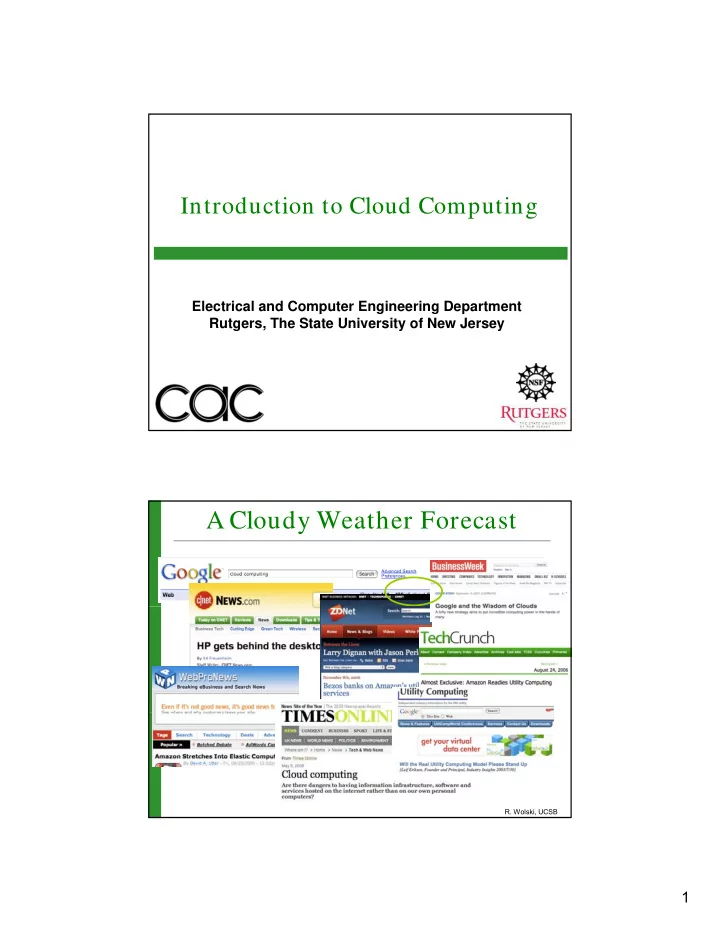
A Cloudy Weather Forecast
- R. Wolski, UCSB
A Cloudy Weather Forecast R. Wolski, UCSB 1 Trends in Web Search - - PDF document
Introduction to Cloud Computing Electrical and Computer Engineering Department Rutgers The State University of New Jersey Rutgers, The State University of New Jersey A Cloudy Weather Forecast R. Wolski, UCSB 1 Trends in Web Search (ack:
Journal
Media
Legend: Cluster computing, Grid computing, Cloud computing
The Definition
technology ('Computing'). The cloud is a metaphor for the Internet (based on how it is depicted in computer network diagrams) and is an abstraction for the complex infrastructure it conceals[1]. It is a style of computing where IT-related capabilities are provided “as a service”[2], allowing users to access technology-enabled services from the Internet ("in the cloud")[3] without knowledge of, ti ith t l th t h l i f t t th t t th [4] A di t th expertise with, or control over the technology infrastructure that supports them[4]. According to the IEEE Computer Society "It is a paradigm in which information is permanently stored in servers on the Internet and cached temporarily on clients that include desktops, entertainment centers, table computers, notebooks, wall computers, handhelds, etc."[5]. “ No Consensus on a good definition of “Cloud computing” - Today
anything and everything Internet will come with a cloud computing logo
The Bottom-line The Bottom line
Changes the economics of Computing from being a Capital investment to
Utilities (You buy electricity, you don’t buy generators )
Changes the way software is developed – Hardware provisioning ,
Deployment and Scaling now part of developer lifecycle as a program / script as compared to a Purchase order
Automates a whole bunch of infrastructure related tasks and
activities leading efficiencies and cost savings
Niraj Juneja, WebScale Solutions
SLAs Web Services Virtualization
IT resources provisioned outside of corporate data center Resources accessed over the internet Variable cost of services SaaS, PaaS, IaaS, HaaS A virtual computing environment Build and deliver always-on, pay-per-use IT services Near infinite-scale computing, storage, database, related
Scaling resources and services up and down Abstraction of the hardware from the service No need for on-premises software and servers
Consolidation and virtualization of cluster-based
Increasing size, cost and energy consumption make
Experience with very large datacenters, Grids
Unprecedented economies of scale
Other factors
Pay by use instead of provisioning for peak Risk of over-provisioning: underutilization Heavy penalty for under-provisioning: Lost revenue,
5-7x economies of scale [Hamilton 2008] Resource Cost in Medium DC Cost in Very Large DC Ratio Extra benefits Medium DC Very Large DC Network $95 / Mbps / month $13 / Mbps / month 7.1x Storage $2.20 / GB / month $0.40 / GB / month 5.7x Administration ≈140 servers/admin >1000 servers/admin 7.1x Extra benefits
Amazon: utilize off-peak capacity Microsoft: sell .NET tools Google: reuse existing infrastructure
UC Berkeley RAD Lab
Demand Capacity Resources Demand Capacity Resources
Static data center Data center in the cloud
Time Demand Time UC Berkeley RAD Lab
Demand Capacity Resources
Static data center
Time UC Berkeley RAD Lab
es
Lost revenue
es Resource Demand Capacity Time (days) 1 2 3 Resources Demand Capacity Time (days) 1 2 3
Lost users
Resource Demand Capacity Time (days) 1 2 3 Time (days) UC Berkeley RAD Lab
Wolfgang Gentzsch, DEISA
Instruction Set VM (Amazon EC2, 3Tera) Bytecode VM (Microsoft Azure) Framework VM
Google AppEngine, Force.com
Lower-level, Less management Higher-level, More management EC2 Azure AppEngine Force.com Less management More management
Niraj Juneja, WebScale Solutions
Source: http://peterlaird.blogspot.com/2008/09/visual-map-of-cloud-computingsaaspaas.html
17
Privacy: companies need to be ready to hand over
Need of massive server farms and high-speed networks
Scalability, any Security of data, applications, and user-related data Reliability: outages damage customers’ business (S3 in
Vendor lock-in and industry standards Vaporization (cloud-enabling) of applications Vaporization (cloud enabling) of applications Service level agreements, regulation, … Self-healing architecture, redundancy handled through
Rapidly growing volumes of data …..
If there are no issues with licenses, IP, secrecy, sensitive
If your app is (almost) architecture independent, not
If it’s just one app and zillions of parameters If latency and bandwidth are not an issue If time (wait, wall, run) doesn’t really matter If your job is low-priority, simple SLAs, can re-run, . . . Current cloud “killer” apps
Mobile and web applications Extensions of desktop software
Matlab, Mathematica
Batch processing / MapReduce
Hadoop at NY Times
UC Berkeley RAD Lab
“A computing cloud is a set of network enabled on demand IT services, scalable and QoS guaranteed, which could be accessed in a simple and pervasive way.”
| Marcel Kunze | OpenCirrus, NeSC Edinburgh | March 2009 23
| 24