A Canadian innovation centre in Qubec for the packaging of the next - - PowerPoint PPT Presentation

a canadian innovation centre in qu bec
SMART_READER_LITE
LIVE PREVIEW

A Canadian innovation centre in Qubec for the packaging of the next - - PowerPoint PPT Presentation

COLLABORATIVE A Canadian innovation centre in Qubec for the packaging of the next generation of microelectronics chips and microsystems Telecommunications Environment Sensors Power Microelectronics Defense Health care Energy Aerospace


slide-1
SLIDE 1

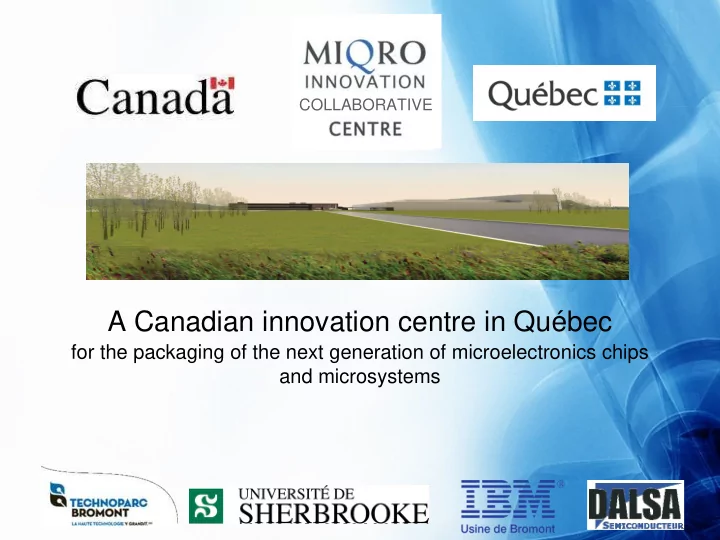
A Canadian innovation centre in Québec

for the packaging of the next generation of microelectronics chips and microsystems

COLLABORATIVE
slide-2
SLIDE 2

Defense Aerospace Telecommunications Environment Sensors Health care Transport Power Energy Microelectronics

slide-3
SLIDE 3

Internet – Every time anybody sends a request for information on the Internet,

  • ur microchips power network to find the

fastest route. Video games – Console video games rely on powerful microchips to compute images. Aerospace – When the defence industry needs to develop the next generation of equipment, microchips will be at the core of the capabilities. Health – Sophisticated medical scans are powered by Canada microchips to render images. Environment – Canada microchips enable computations behind the predictions for climate change and prediction of natural disasters in the Barcelona Supercomputing Center.

Leading Edge Canadian Microelectronics - Everywhere, in Everyday lives

When Rover and Pathfinder sent images from Mars, the image sensor systems relied on microchips to render the images. Automotive – In today's new cars, sensors powered by Canada microchips monitor vital functionning ranging from tire pressure to fuel injection system.

slide-4
SLIDE 4

“We are at the doorstep of the largest shift in the semiconductor industry ever, one that will dwarf the PC and even the consumer electronics eras ” “The approaching era of electronics technology advancement – the Fusion Era – will be massive in scope, encompassing the fields of information technology, biotechnology, and nanotechnology and will create boundless opportunities for new growth to the semiconductor industry”

  • Dr. Chang-Gyu Hwang, president-CEO, Samsung

Semiconductor, IEDM Conference, Dec. 2006

Microelectronics industry entering a new era of major change at fundamental level

slide-5
SLIDE 5

The Fusion Era: A Profound Change for the Industry, An Economic Opportunity for Canada

  • This new microelectronics economic era must be

invented and refined

– The technical challenges are very significant – The novel solutions will result in worldwide impact of our talented people

  • Innovation is a key ingredient of success in this era

– Needs to be linked to Canada’s research facilities, universities and industry partners and to international research centres – Needs to be channelled through collaboration at all levels – Canada is well positioned to leverage this opportunity and reap the rewards

slide-6
SLIDE 6

Key Technology Challenges Triple Convergence

  • Power now limits traditional scalability

– Power supply and thermal dissipation are severely challenged – The solutions are both exotic and tailored to the problem

  • Semiconductor material selection for scalability

New dielectric material (porous and fragile)

Materials’ properties a real issue

Mechanical integrity is critical

  • System architecture shifting to multi-core, multi-

threads

– Need new materials – Require the development of 3 dimensional and optoelectronic solutions – Need faster access time to data

slide-7
SLIDE 7

Northeast corridor of microelectronics

Albany Molecular Research Global Research Burlington Fishkill Poughkeepsie Albany Niskayuna Waterbury Sherbrooke Bromont

slide-8
SLIDE 8

Dynamic North-East Corridor

  • 33 000 microelectronics jobs
  • Investments of 11 billion $US
  • World class centre of excellence in

microtechnologies

  • Synergy between universities and research

institutions

  • 84 500 high technology jobs in Canada

reinforced by corridor economic activities

  • Anchored by Albany Nanotech at southern tip
slide-9
SLIDE 9

Existing Model: Minatec / LETI

  • 4 billion € in investment
  • 45 000 jobs created
  • 13350 microelectronics

professionals

  • 3500 R&D jobs
  • Integrated innovation approach
  • Strategy of alliances
  • Powerful concentration of know-

how

slide-10
SLIDE 10

Existing Model: Minatec / LETI

  • Integrated innovation approach

– From immediate industrial applications to the exploration of disruptive technologies

  • Powerful concentration of know-how and tools

– 3 500 engineers, researchers and academics on site

  • Strategy of alliances and international partnerships

– Dynamics of networks and collaborations linked to centres of excellence reinforce the effectiveness of Minatec

  • Policy of continuous and ambitious investment

– 4 billion Euros invested over the last 10 years by the microelectronics players in Grenoble-Isère

  • Huge pool of jobs dedicated to state of the art science

technology

– Powerful local workforce 13 350 microelectronics professionals

slide-11
SLIDE 11

Existing Model: Albany Nanotech

  • $4.2 billion in investment
  • 800 000 ft2 of research space
  • 2 000 jobs
  • 250 partners
  • Created in 2001
  • Development of next generation microchips
  • Research projects supported by industry, including:

– IBM, Toshiba, AMD, Freescale, STMicroelectronics, Infineon and Samsung, in partnership with University of Albany

  • R&D at the MiQro Innovation Collaborative Centre will be

complementary and focused on assembly, advanced packaging and test of new microchips

  • Technology focus provided by the presence of university partners

and world class research institutions

slide-12
SLIDE 12

Positioning Canada in the global high tech economy:

from strategy to reality

Leading edge microelectronics:

everywhere in everyday lives

Building on an existing coalition:

low risk, high return

A magnet to

attract resources

A partnership

to compete globally

5 1 2 3 4

COLLABORATIVE

slide-13
SLIDE 13

MiQro Innovation Collaborative Centre

  • Original partnership between Université de

Sherbrooke, DALSA Semiconductor, IBM Bromont and the TechnoParc Bromont

– Active recruitment of future industrial and academic partners – Unique opportunity for connecting university and industry researchers

  • Integrated research approach – from

fundamental research to commercialization

  • State-of-the-art infrastructure to attract, train and

retain highly qualified personnel

slide-14
SLIDE 14

Overview of Centre

  • Investment of $218 M
  • $ 83 million building
  • $ 95 million equipment
  • $ 40 million founding partners

and equipment manufacturers

  • Development of a Technology

Cluster

– Technology crossroads/showcase – 250 specialized scientific jobs – Retention and development of HQP – Scholarships and internships – Visiting international researchers

  • 2 buildings of ~120 000 ft2 in total

– Clean rooms: ~60 000 ft2 – Space reserved for incubation

  • Technology transfer

– University-industry partnerships

  • Spinoffs and entrepreneurship

– Emergence of new companies

  • Economic impact

– Consolidation of industrial leadership

  • Schedule

– Pre-concept, construction and processes coming online by end 2011

slide-15
SLIDE 15

COLLABORATIVE

slide-16
SLIDE 16

The Centre : cleanrooms

MEMS Future partners Packaging of microchips Laboratories

slide-17
SLIDE 17

Canadian Universities Research institutions and Associations International centres Equipment manufacturers Industrials Private R&D centres Private R&D centres

MICC Ecosystem

Funding for collaborative projects

COLLABORATIVE

slide-18
SLIDE 18

Impact

  • Development of a technology cluster
  • Technology transfer

– Close university industry partnerships

  • Spinoffs and entrepreneurship

– Emergence of new companies

  • In harmony with local environment

– Integrated within the Technoparc Bromont

  • Technology crossroads
  • International visibility (microelectronics

hub)

slide-19
SLIDE 19

Founding Partnership

  • Université de Sherbrooke

– A leader in research technology transfer in Canada (26 spinoffs, 330 patents, 360 partners)

  • DALSA Semiconductor

– Dedicated to front end specialty semiconductor manufacturing processes such as MEMS and 3D Wafer Level Packaging - ranked by Yole Development as one of the top MEMS pure play foundries in the world

  • IBM Bromont

– Specialized in transforming the world’s most advanced semiconductor wafers into leading edge microelectronic solutions for the full range of IBM hardware and key partners.

slide-20
SLIDE 20

DALSA’s involvement in MEMS

  • Dedicated to specialty semiconductor

manufacturing processes of: MEMS, 3D Wafer Level Packaging, High Voltage CMOS, CCD Image Sensors, and Analog Mixed Signal CMOS

  • Ranked by Yole Development as one of the top

MEMS pure play foundries in the world

  • In operation in Bromont since 1973
  • 400 employees at the Bromont site
  • 154K sq ft operation on a 52 acre site, when fully

loaded a $100M operation the majority of which is exported to US, Europe and Asia

  • Presently sell into the automotive, PC, cell phone,

digital camera, medical, industrial, and aerospace markets.

  • Gross R&D approx $8M/year
  • Some awards:
  • "Prix développement des exportations“ 2004

Manufacturiers et Exportateurs du Canada.

  • "Entreprise de l'année" - 2004 - Chambre de

Commerce du Québec

slide-21
SLIDE 21

IBM Bromont

Dedicated to the bond assembly and test of the most advanced, powerful microchips in production in the world; Among leading high tech exporters in all of Canada; In operation in Bromont for 35 years; 2,400 employees; Operates at full capacity (850,000

  • sq. ft) with yearly exports of 700 M$

in products to IBM, Cisco, Microsoft, Sony and Nintendo and more; Sustained annual R&D investments

  • f $15-20 M.
slide-22
SLIDE 22

UdeS – Research in Microelectronics and Information Engineering

  • Training objective of 200 new graduate students
  • ver 5 years
  • More than 30 research professors in these areas

– 4 research chairs – 7 centres, teams and research laboratories

  • Four faculties, from fundamental research to

applications:

– Engineering – Science – Medicine and health sciences – Physical Education

slide-23
SLIDE 23

Primary Centre Pre-Competitive Research – Semiconductor Packaging Technology Focus

  • Pre-competitive Research
  • Semiconductor Packaging

and packaging Inspection Technologies

  • IBM: Packaging and Test
  • f 300mm advanced

lithography (45-32-22 nm)

  • microchips. Lead free,

thermal dissipation, carrier design…

  • DALSA: Materials,

processes for 200mm (integrated) MEMS & 3D WLP

slide-24
SLIDE 24

DALSA’s involvement in MEMS

  • Salary Base ~ $25M/year
  • Since 2002:
  • 40M$ R&D Investment
  • 70M$ Capital Investment
  • Unsurpassed Innovation ~65

patents including ~35 in the MEMS/3D-WLP field

  • ~ 30 local suppliers. ~

$5.5M/year local business

  • The only ”pure play

semiconductor foundry” in Canada.

  • MEMS and 3D-WLP foundry

business is a growth driver for the company

  • Internationally acknowledged

as one of the top three “Pure Play” MEMS foundries – 500M$ market with 30% CAGR

  • MEMS are changing how

electronics interact with

  • utside world (sensing and

actuating) and the MEMS revolution has a seed in Bromont

SEMICONDUCTOR FOUNDRY BUSINESS

slide-25
SLIDE 25

DALSA’s involvement in MEMS

  • Automotive

– Pressure sensors, accelerometers, rollover detectors

  • Industrial

– Micro fluidics, pressure sensors

  • Consumer

– Cell Phones: Motion sensing gyros & Accelerometers, Microphones, RF components – Printers: Ink jet heads – Game console: Motion sensing Gyros & Accelerometers – PC: Microphones – GPS: Motion sensing Gyros & Accelerometers

  • Medical and Life Sciences

– Lab on a chip – Gas detection

WHICH END MARKETS ARE DRIVING MEMS AND 3D-WLP GROWTH?

An increasing number of cell phones incorporate MEMS microphone, speakers, and gyros

slide-26
SLIDE 26

DALSA’s involvement in MEMS

MEMS MARKET FORECAST 2007 – 20121

(IN MILLIONS)

Motion sensors are revolutionizing the world of cell phones, GPS, game consoles, cars, etc… MEMS microphones are making their way in cell phones and PC

slide-27
SLIDE 27

DALSA’s involvement in MEMS

DEVELOPMENT OF NEW MATERIALS AND PROCESSES – Advanced Photopolymers:

  • Study and develop novel polymer materials to be incorporated in

micromachining processes

  • Invent technique(s) to quantify & realize/improve the adhesion of

current and novel thick polymer layers on various films

  • Achieve a very high aspect ratio with a vertical resist profile (optimize

coating, exposure, develop) needed for plating and regular coat exposure and developing can also be used as a structural material

  • Develop fast process to strip thick polymers (all literature research to

date indicates very slow, one wafer at a time, process times). Unacceptable for a business. Develop new approaches to quicken the process.

  • Develop different coating techniques (spin and spray coating

technologies) to accommodate cavity filling, conformal coating requirements

slide-28
SLIDE 28

DALSA’s involvement in MEMS

– Low-stress Silicon Nitride (LSN):

  • Development of a repeatable process of LSN considering WIW

(within wafer) and WTW (wafer to wafer) thickness, RI, and stress variation

  • Evaluation of material properties (FTIR analysis, stress gradients,

etc.)

  • Custom develop, evaluate, and install CRITICAL customized

quartzware cleaning system (quartz tube, liner, boats etc) without etching quartz while etching LSN for cleaning of quartzware

  • Evaluation and implementation of in situ particle monitoring system

– Low-stress Doped Silicon:

  • Analyze and model current deposition processes used for

synthesizing low-stress doped silicon thin films

  • Study and quantify impact of deposition process parameters in

detail in order to optimize the deposition process or to develop new approaches

slide-29
SLIDE 29

DALSA’s involvement in MEMS

– Wet Oxidation Filling of Deep Trenches:

  • Study and model the DRIE process step and optimize the technique

for achieving high quality deep trenches and explore novel approaches

  • Study and analyze the specific processing steps required for deep

trench formation including:

– Strip and cleaning trenches – Low-stress nitride development – Stress balanced trenches – Electrical isolation testing – Hermiticity testing – Etchback process characterization

slide-30
SLIDE 30

DALSA’s involvement in MEMS

– Anhydrous HF Release :

  • Using methanol and anhydrous HF as mixtures, develop robust

recipes and perform electromechanical reliability tests

– Wafer bonding:

  • Develop specialized low-temperature wafer-level bonding

technologies such as plasma-activated bonding, solder bonding, eutectic bonding and thermo-compression bonding to ensure flexible technologies for complex wafer-level devices integration, such as integrated MEMS, hermetic WLP, and 3D interconnects.

slide-31
SLIDE 31

DALSA’s involvement in MEMS

  • 1X aligner with F/B capability
  • i-line 5X aligner with F/B capability
  • Spin and Spray resist coaters
  • DRIE cluster tool
  • RIE cluster tool
  • Anhydrous HF cluster tool
  • Automated wet etch benches
  • Wet & Dry resist strippers
  • Wafer bonders and debonders
  • Atmospheric and LPCVD vertical

furnaces

  • Wafer dicers – saw and laser –

with associated cleaning tools

  • CMP & Grinders
  • Sputter
  • PECVD
  • Screen printer
  • Advanced metrology tool
  • Advanced IR metrology tool
  • Advanced inspection tool

EQUIPMENT SET FOR MEMS R&D