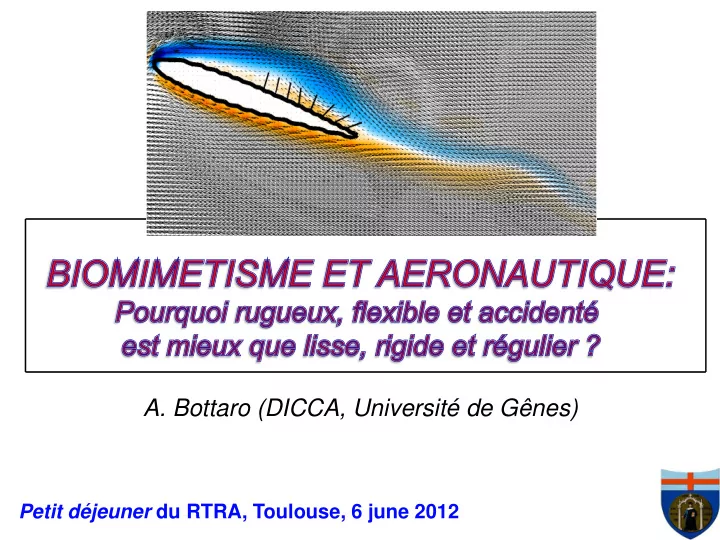
SLIDE 1
- A. Bottaro (DICCA, Université de Gênes)
Petit déjeuner du RTRA, Toulouse, 6 june 2012
SLIDE 2 Petit déjeuner du RTRA, Toulouse, 6 june 2012
Georges de Mestral, 1941
SLIDE 3 Petit déjeuner du RTRA, Toulouse, 6 june 2012
SLIDE 4
Penguins Sharks Seals
Focus: passive/active flow control
SLIDE 5 Penguins Sharks Seals
Known techniques of passive/active flow control:
- Injection of micro-bubbles and/or polymers
- Riblets
- Compliant walls
- Viscosity modifier
- Vortex generators
- …
SLIDE 6 Penguins Sharks Seals
Less known techniques of passive/active flow control:
- Butterfly and moth wings microstructure
Left: electron microscope image of butterfly scales. Right: perspective view (with dimensions) with details of a scale. UL: upper lamina; LL: lower lamina; T: trabecula.
SLIDE 7 Penguins Sharks Seals
Less known techniques of passive/active flow control:
The coating that reduces drag (Fraunhofer, Bremen)
SLIDE 8
How can we increase lift over a streamlined body at incidence by a passive technique?
SLIDE 9
How can we reduce pressure drag behind a solid bluff body by a passive technique?
SLIDE 10 Penguins Sharks Seals
Less known techniques of passive/active flow control: Passive, compliant hairy coating sea otter
(loutre de mer)
SLIDE 11
How can we increase lift over a streamlined body at incidence by a passive technique?
SLIDE 12
How can we increase lift over a streamlined body at incidence by a passive technique?
SLIDE 13
How can we increase lift over a streamlined body at incidence by a passive technique?
SLIDE 14 How can we increase lift over a streamlined body at incidence by a passive technique?
- Prof. Ingo Rechenberg, TU Berlin
http://www.bionik.tu-berlin.de/institut/xs2vogel.html
SLIDE 15 How can we increase lift over a streamlined body at incidence by a passive technique?
- Prof. Ingo Rechenberg, TU Berlin
http://www.bionik.tu-berlin.de/institut/xs2vogel.html
SLIDE 16 Wind tunnel tests in Genova
- F. Negrello, Engineering Diploma work, 2010
SLIDE 17 Wind tunnel tests in Genova
- F. Negrello, Engineering Diploma work, 2010
SLIDE 18 How can we increase lift over a streamlined body at incidence by a passive technique?
- Prof. Ingo Rechenberg, TU Berlin
http://www.bionik.tu-berlin.de/institut/xs2vogel.html
Flexible, porous flaps delay stall …
SLIDE 19
GOAL: instead of a single flexible flap, let’s model a continuous hairy/feathery coating to affect lift and drag
SLIDE 20
- Model mechanical properties of biological surfaces
- Structures with large displacements and large rotations
- Interaction between multiple structures
Coupling between a layer of oscillating
densely packed structures and a unsteady separated boundary layer Numerical challenges
SLIDE 21 The initial configuration
fluid fluid + solid solid Circular cylinder, Re=200 Model of the layer?
Porous, anisotropic and compliant
SLIDE 22
Case 1: bare cylinder
SLIDE 23
Case 2: rigid wall-normal hair
SLIDE 24
Case 3: rigid longitudinal hair
SLIDE 25
Case 4: moving hair
Tfluid ≈ 4 Tstructure
SLIDE 26 A projected frontal area V fluid velocity density C = F 1/2 V A
2 d d
Drag
C drag Time (s)
SLIDE 27 Drag (ctd.)
C drag Time (s)
SLIDE 28 C = F 1/2 V A
2 L L
Lift
C lift Time (s)
SLIDE 29 Lift (ctd.)
C lift Time (s)
C = F 1/2 V A
2 L L
SLIDE 30 Aerodynamic performances
Cd Cd' Cl' St Case 1 1.3689 (1.39;1.356) 0.0274 0.4381 0.199 (0.199;0.198) Case 2 3.1464 0.1943 1.1376 0.1946 Case 3 1.3035 0.0207 0.3839 0.1916 Case 4 1.2109 0.012 0.3008 0.1661 (Bergmann et al. Phys. Fluids 2005 ; He et al J. Fluid Mech. 2000)
SLIDE 31 Aerodynamic perf.(ctd.)
Cd Cd' Cl' St Case 1 ref ref ref ref Case 2 +130% +608% +160%
Case 3
- 4.78%
- 24.54%
- 12.37%
- 3.71%
Case 4
- 11.54%
- 56.09%
- 31.34%
- 16.53%
SLIDE 32
Physical mechanism
Difference of time-averaged pressure field <P with hair>-<P ref>
SLIDE 33
Physical mechanism
The hairy layer counteracts flow separation Contours of vertical velocity Movements of reference cilia Contours of vertical velocity Force field
SLIDE 34
15% drag reduction 40% reduction in lift fluctuations
Optimal self-adaptive hairy layer
SLIDE 35 Simulations show a reduction of pressure drag
- n a cylinder for a unsteady laminar flow (Re = 200).
The motion of the hairy structures can improve aerodynamic performances The structural parameters of the actuators have been optimised Immediate perspectives concern flexible filaments and turbulent configurations; possible applications to small underwater vehicles and to UAV/MAV (in the aeronautical field) Favier et al., JFM 2009
Reducing pressure drag:
SLIDE 36
In fact, a single flexible filament can do much already!!
Bagheri et al., PRL, 2012 (submitted)
SLIDE 37
In fact, a single flexible filament can do much already!!
Bagheri et al., PRL, 2012 (submitted)
SLIDE 38
A symmetry-breaking bifurcation occurs when vortices and structures resonate …
SLIDE 39
increasing R2 increased rigidity of the structure
SLIDE 40
Consider a hairfoil: the control elements (the “feathers”) must be placed in the position of largest sensitivity to achieve an effect
SLIDE 41
NACA0012 a = 18° a = 15° Re = 104
SLIDE 42
a = 18° a = 18° feathers = 890 Kg/m3 (keratin)
SLIDE 43 Summary of runs a = 15° <CD> = 0.284 <CL> = 0.579
Tfluid = 0.5 Tstructure + 1.35%
Tfluid = Tstructure + 2 %
Tfluid = 2 Tstructure + 3%
Tfluid= 4 Tstructure
+ 2.5% Tfluid = 8Tstructure
Results are similar when a = 18o, except that now <CL> increases the most when Tfluid = 2 Tstructure
SLIDE 44
Kunze & Brücker, CRAS 2012
SLIDE 45
Must excite
The amplitude of the oscillations decreases (the system’s stability improves) as Tstructure (i.e. m l Kr ) A parametric resonance must be triggered to optimise the response of the system
SLIDE 46
MAV/UAV Wind turbines Hydraulic machines (cavitation?) Sound mitigation
SLIDE 47
SLIDE 48 How can we increase lift over a streamlined body at incidence by a passive technique?
- Prof. Ingo Rechenberg, TU Berlin
http://www.bionik.tu-berlin.de/institut/xs2vogel.html
SLIDE 49
Biomimetic winglets
Guerrero et al., CRAS, 2012
SLIDE 50
Biomimetic winglets
SLIDE 51
Biomimetic winglets
SLIDE 52
Biomimetic winglets
SLIDE 53
Biomimetic winglets
SLIDE 54
Advantages
SLIDE 55
… which translate into:
SLIDE 56 Other biomimetics secrets currently under investigation include:
"It was just because of the surface of owl’s body have a lot of coupling interaction such as special surface morphology, unique wing configuration, special internal structure and highly flexible
- material. They can delay the separation of turbulent boundary
layer around the airfoil profile, reduce pulsating pressure of the surface of wings, and reduce the production of sound energy. Above all the feature make the surface have function of noise elimination." (Liang et al., Adv. Natur. Sciences, 2010)
SLIDE 57 Other biomimetics secrets currently under investigation include:
- owl silent flight
- tubercles on whale flipper, effect on stall, lift and drag …
Tubercle technology! Whalepower Corp., Canada
SLIDE 58 Other biomimetics secrets currently under investigation include:
- owl silent flight
- tubercles on whale flipper, effect on stall
- skin friction drag reduction with superhydrophobic surfaces
Leaves retain a air film underwater, using hydrophobic hairs with hydrophilic tips: 10% drag reduction in a large-scale ship model (Nees Institute, University of Bonn)
SLIDE 59
… and many others …