A B Intelligent Agents Chapter 2 Percepts: location and contents, - - PDF document

a b
SMART_READER_LITE
LIVE PREVIEW

A B Intelligent Agents Chapter 2 Percepts: location and contents, - - PDF document

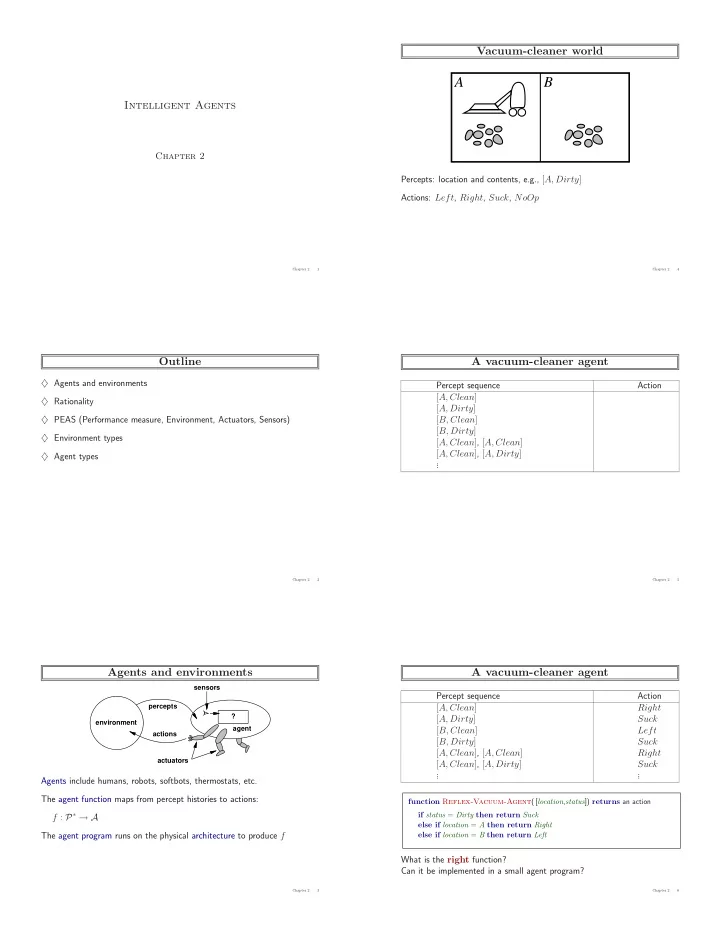
Vacuum-cleaner world A B Intelligent Agents Chapter 2 Percepts: location and contents, e.g., [ A, Dirty ] Actions: Left , Right , Suck , NoOp Chapter 2 1 Chapter 2 4 Outline A vacuum-cleaner agent Agents and environments Percept


slide-1
SLIDE 1

Intelligent Agents

Chapter 2

Chapter 2 1

Outline

♦ Agents and environments ♦ Rationality ♦ PEAS (Performance measure, Environment, Actuators, Sensors) ♦ Environment types ♦ Agent types

Chapter 2 2

Agents and environments

? agent percepts sensors actions environment actuators

Agents include humans, robots, softbots, thermostats, etc. The agent function maps from percept histories to actions: f : P∗ → A The agent program runs on the physical architecture to produce f

Chapter 2 3

Vacuum-cleaner world

A B

Percepts: location and contents, e.g., [A, Dirty] Actions: Left, Right, Suck, NoOp

Chapter 2 4

A vacuum-cleaner agent

Percept sequence Action [A, Clean] [A, Dirty] [B, Clean] [B, Dirty] [A, Clean], [A, Clean] [A, Clean], [A, Dirty] . . .

Chapter 2 5

A vacuum-cleaner agent

Percept sequence Action [A, Clean] Right [A, Dirty] Suck [B, Clean] Left [B, Dirty] Suck [A, Clean], [A, Clean] Right [A, Clean], [A, Dirty] Suck . . . . . .

function Reflex-Vacuum-Agent([location,status]) returns an action if status = Dirty then return Suck else if location = A then return Right else if location = B then return Left

What is the right function? Can it be implemented in a small agent program?

Chapter 2 6
slide-2
SLIDE 2

Rationality

Fixed performance measure evaluates the environment sequence – one point per square cleaned up in time T?

Chapter 2 7

Rationality

Fixed performance measure evaluates the environment sequence – one point per square cleaned up in time T? – one point per clean square per time step, minus one per move?

Chapter 2 8

Rationality

Fixed performance measure evaluates the environment sequence – one point per square cleaned up in time T? – one point per clean square per time step, minus one per move? – penalize for > k dirty squares?

Chapter 2 9

Rationality

Fixed performance measure evaluates the environment sequence – one point per square cleaned up in time T? – one point per clean square per time step, minus one per move? – penalize for > k dirty squares? A rational agent chooses whichever action maximizes the expected value of the performance measure given the percept sequence to date Rational = omniscient – percepts may not supply all relevant information Rational = clairvoyant – action outcomes may not be as expected Hence, rational = successful Rational ⇒ exploration, learning, autonomy

Chapter 2 10

PEAS

To design a rational agent, we must specify the task environment Consider, e.g., the task of designing an automated taxi: Performance measure?? Environment?? Actuators?? Sensors??

Chapter 2 11

PEAS

To design a rational agent, we must specify the task environment Consider, e.g., the task of designing an automated taxi: Performance measure?? safety, destination, profits, legality, comfort, . . . Environment?? streets in Lower Mainland, traffic, pedestrians, weather, . . . Actuators?? steering, accelerator, brake, horn, speaker/display, . . . Sensors?? video, accelerometers, gauges, engine sensors, keyboard, GPS, . . .

Chapter 2 12
slide-3
SLIDE 3

Internet shopping agent

Performance measure?? Environment?? Actuators?? Sensors??

Chapter 2 13

Internet shopping agent

Performance measure?? price, quality, appropriateness, efficiency Environment?? current and future WWW sites, vendors, shippers Actuators?? display to user, follow URL, fill in form Sensors?? HTML pages (text, graphics, scripts)

Chapter 2 14

Environment types

8-Puzzle Backgammon Internet shopping Taxi Observable??

Chapter 2 15

Environment types

8-Puzzle Backgammon Internet shopping Taxi Observable?? Yes Yes No No Deterministic??

Chapter 2 16

Environment types

8-Puzzle Backgammon Internet shopping Taxi Observable?? Yes Yes No No Deterministic?? Yes No Partly No Episodic??

Chapter 2 17

Environment types

8-Puzzle Backgammon Internet shopping Taxi Observable?? Yes Yes No No Deterministic?? Yes No Partly No Episodic?? No No No No Static??

Chapter 2 18
slide-4
SLIDE 4

Environment types

8-Puzzle Backgammon Internet shopping Taxi Observable?? Yes Yes No No Deterministic?? Yes No Partly No Episodic?? No No No No Static?? Yes Yes Semi No Discrete??

Chapter 2 19

Environment types

8-Puzzle Backgammon Internet shopping Taxi Observable?? Yes Yes No No Deterministic?? Yes No Partly No Episodic?? No No No No Static?? Yes Yes Semi No Discrete?? Yes Yes Yes No Single-agent??

Chapter 2 20

Environment types

8-Puzzle Backgammon Internet shopping Taxi Observable?? Yes Yes No No Deterministic?? Yes No Partly No Episodic?? No No No No Static?? Yes Yes Semi No Discrete?? Yes Yes Yes No Single-agent?? Yes No Yes (except auctions) No The environment type largely determines the agent design The real world is (of course) partially observable, stochastic, sequential, dynamic, continuous, multi-agent

Chapter 2 21

Agent types

Four basic types in order of increasing generality: – simple reflex agents – reflex agents with state – goal-based agents – utility-based agents All these can be turned into learning agents

Chapter 2 22

Simple reflex agents Agent Environment

Sensors What the world is like now What action I should do now Condition−action rules Actuators

Chapter 2 23

Example

function Reflex-Vacuum-Agent([location,status]) returns an action if status = Dirty then return Suck else if location = A then return Right else if location = B then return Left

Chapter 2 24
slide-5
SLIDE 5

Reflex agents with state Agent Environment

Sensors What action I should do now State How the world evolves What my actions do Condition−action rules Actuators What the world is like now

Chapter 2 25

Example

function Reflex-Vacuum-Agent([location,status]) returns an action static: last A, last B, numbers, initially ∞ if status = Dirty then . . .

Chapter 2 26

Goal-based agents Agent Environment

Sensors What it will be like if I do action A What action I should do now State How the world evolves What my actions do Goals Actuators What the world is like now

Chapter 2 27

Utility-based agents Agent Environment

Sensors What it will be like if I do action A How happy I will be in such a state What action I should do now State How the world evolves What my actions do Utility Actuators What the world is like now

Chapter 2 28

Learning agents

Performance standard

Agent Environment

Sensors Performance element changes knowledge learning goals Problem generator feedback Learning element Critic Actuators

Chapter 2 29

Summary

Agents interact with environments through actuators and sensors The agent function describes what the agent does in all circumstances The performance measure evaluates the environment sequence A perfectly rational agent maximizes expected performance Agent programs implement (some) agent functions PEAS descriptions define task environments Environments are categorized along several dimensions:

  • bservable? deterministic? episodic? static? discrete? single-agent?

Several basic agent architectures exist: reflex, reflex with state, goal-based, utility-based

Chapter 2 30