9/22/20 Opioid Moderatism and Rapprochement: The Search for a Sane - - PDF document

9 22 20
SMART_READER_LITE
LIVE PREVIEW

9/22/20 Opioid Moderatism and Rapprochement: The Search for a Sane - - PDF document

9/22/20 Opioid Moderatism and Rapprochement: The Search for a Sane Middle Ground Michael E. Schatman, PhD Department of Diagnostic Sciences Tufts University School of Dental Medicine Department of Public Health & Community Medicine Tufts


slide-1
SLIDE 1

9/22/20 1

Opioid Moderatism and Rapprochement: The Search for a Sane Middle Ground

Michael E. Schatman, PhD

Department of Diagnostic Sciences Tufts University School of Dental Medicine Department of Public Health & Community Medicine Tufts University School of Medicine Boston, MA

1

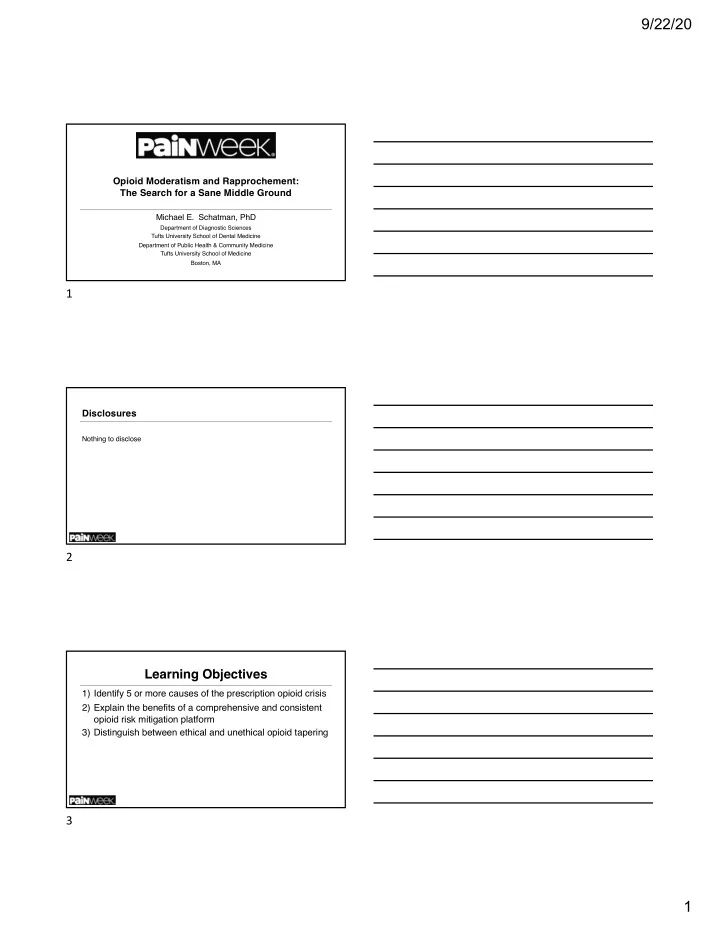
Disclosures

Nothing to disclose

2 Learning Objectives

1) Identify 5 or more causes of the prescription opioid crisis 2) Explain the benefits of a comprehensive and consistent

  • pioid risk mitigation platform

3) Distinguish between ethical and unethical opioid tapering

3

slide-2
SLIDE 2

9/22/20 2

History of the “Opioid Crisis”

§Where and how did this mess start? §EVERYONE seems to have a different opinion…. §Too many people are too anxious to blame it on a single cause… §Some are denying that we ever had a prescription

  • pioid crisis

§And some are suggesting that prescription opioid mortality is still a significant problem

Schatman ME, Ziegler SJ. J Pain Res. 2017;10:2489-2495.

4 History of the “Opioid Crisis”

SIMPLE ANSWERS TO COMPLEX QUESTIONS FROM THOSE WITH SIMPLE MINDS…. §Numerous causes:

vUnscrupulous marketing

Van Zee A. Am J Public Health. 2009;99(2):221-227.

vKickback schemes

US Attorney’s Office District of Massachusetts. Pharmaceutical executives charged in racketeering scheme. Available at: https://www.justice.gov/usao-ma/pr/pharmaceutical-executives-charged-racketeering-scheme.

vLucrative compensation for speaking as an incentive to prescribe

Hadland SE, et al. Am J Public Health. 2017;107(9):1493–1495.

vPromotion of off-label use

Burns SM, et al. ACS Chem Neurosci. 2018. doi: 10.1021/acschemneuro.8b00174. [Epub ahead of print].

5

Causes of the Opioid Crisis (continued)

v“Pill mills”

Pardo B. Addiction 2017;112(10):1773-1783.

vUnrealistic expectations regarding complete relief of pain

Peterson BL. Acad Forensic Pathol. 2017;7(1):viii-ix.

vState medical boards curtailing restrictions on prescribing opioids for non-cancer pain

Manchikanti L, et al. Pain Physician 2012;15(3 Suppl):ES9-38.

vPatient surveys including satisfaction with pain relief

Fischer A. Ann Health Law 2013;25:97-108.

vIncreased availability of prescription opioids on the internet

Forman RF. JAMA 2003;290:889.

vProviders’ failure to adequately identify and monitor misuse and

  • veruse

Deyo RA, et al. J Am Board Fam Med.2011; 24:717-727.

6

slide-3
SLIDE 3

9/22/20 3

History of the Opioid Crisis

§The list is hardly exhaustive §Recent analysis: “The root causes of the modern opioid crisis are complex and traceable to at least 30 or more factors”

Madras BK. Clin Pharmacol Ther. 2018;103(6):943-945.

§Some absolutely ridiculous

vE.g., Pharmaceutical industry lobbying was responsible for pain becoming monitored as the “5th vital sign”

Franklin GM. Neurology. 2014;83(14):1277-1284.

§Most efforts to curb the prescription opioid crisis have been rather…..draconian

7

Early “Efforts to Fix” - Washington State

§2005 - Washington State’s Medical Director of workers compensation began his war on opioids

vFound a positive correlation between high dosage opioids and

  • verdose death in workers comp patients

Franklin GM, et al. Am J Ind Med. 2005;48(2):91-99.

vDeveloped an “educational” opioid prescribing guideline in 2007, followed by a “recommended” guideline in 2010 and an updated guideline in 2015

Washington State Agency Medical Directors’ Group. Interagency guideline on opioid dosing for chronic non-cancer pain: an educational pilot to improve care and safety with opioid treatment. March, 2007. Available at: http://www.dli.mn.gov/PDF/references/A16_WA_opioid_guideline.pdf. Washington State Agency Medical Directors’ Group. Interagency guideline on opioid dosing for chronic non-cancer pain: an educational aid to improve care and safety with opioid therapy. 2010 update. Available at: https://www.swedish.org/~/media/images/swedish/pdf/wa%20med%20dir%20interagency%20guidelines%202010%20pdf.pdf. Washington State Agency Medical Directors’ Group (AMDG) in collaboration with an Expert Advisory Panel, Actively Practicing Providers, Public Stakeholders, and Senior State Officials. Interagency guideline on prescribing opioids for pain. 3rd Edition, June

  • 2015. Available at: http://www.agencymeddirectors.wa.gov/files/2015amdgopioidguideline.pdf.

8 Washington State

§The Guideline Writing Committees played “fast and hard” with the truth

vData misinterpreted vData “created” – (“false narratives”, “alternative facts”) vProgressively more draconian vGroup-think phenomenon vDissention was not tolerated

§And then they went national…. §And the 2016 CDC Guideline was born….

9

slide-4
SLIDE 4

9/22/20 4

Efforts to Curb the Prescription Opioid Crisis §Erroneously, patients (and prescribers) put the blame for “the pendulum swinging awry” on the 2016 CDC Guideline

Anson P. Survey: Opioids Reduced or Stopped for Most Patients; 2018. Available from: https://www.painnewsnetwork.org/stories/2016/8/4/survey-opioids-stopped-or-reduced-for-most-patients.

§The process of developing the guideline was problematic

vSecretive vNon-responsive to stakeholders vCommittee dominated by PROP

Schatman ME, Ziegler SJ. J Pain Res. 2017;10:2489-2495.

10 Efforts to Curb the Prescription Opioid Crisis

§Yet, many of us who see ourselves as patient advocates note that the guideline itself has its strengths

vShould primary care prescribers not think twice prior to increasing dosages beyond 90 MEDD? vThe recommendations are presented as “voluntary, rather than prescriptive standards”

Dowell D, et al. MMWR Recomm Rep. 2016;65(1):1–49.

vRecently, referred to as a “nuanced, patient-centric view on

  • pioid prescribing”

Cohen J. The importance of patient-centric opioid prescribing guidelines. Forbes, January 23, 2019.

11 Efforts to Curb the Prescription Opioid Crisis

§Is the guideline the problem, or is it the weaponization of the guideline? §AMA’s 2016 response:

v“The CDC recommendations also have the potential to cause confusion in light of institutional or state policies….. We are concerned that insurers and other payers will use the recommendations to deny or impose new hurdles to coverage of any dose that exceeds the CDC’s recommended thresholds. We are concerned that pharmacies will be under pressure to deny prescriptions that exceed those thresholds…”

Harris PA. Am Fam Physician. 2016;93(12):975.

12

slide-5
SLIDE 5

9/22/20 5

Efforts to Curb the Prescription Opioid Crisis

§State medical board opioid guidelines discourage clinicians from prescribing opioid dosages higher than the CDC guideline thresholds

Federation of State Medical Boards Guidelines for the Chronic Use of Opioid Analgesics. 2017. Available at: https://www.fsmb.org/globalassets/advocacy/policies/opioid_guidelines_as_adopted_april-2017_final.pdf.

§And the results? Depends upon whom you ask….

v2018 study – Internet-based survey found that CPPs tapered (involuntarily) from ER/LA opioids reported decreased pain control and diminished function

Twillman RK, et al. J Pain Res. 2018;11:2769-2779.

vInternet-based studies of CPPs from a patient-advocacy group are likely to be rife with selection bias issues…

13 Efforts to Curb the Prescription Opioid Crisis

§2018 study of patients on high-dosage opioids voluntarily tapered from a median of 288 mg to 150 mg in 4 months demonstrated no increase in pain levels

vThat the drop out rate was 38% needs to be considered

Darnall BD, et al. JAMA Intern Med. 2018;178(5):707-708.

§2019 study of patients tapered ≥20% (primarily involuntarily, but with psych assist) - reported no increase in pain or decrease in function

DiBenedetto DJ, et al. Pain Med. 2019;20:2155-2165.

14

Efforts to Curb the Prescription Opioid Crisis

§So, whom to believe? §Populations varied from study to study §Approaches to tapering varied as well §Methodologies inconsistent between studies §What about “outliers”? §Likely answer – Those CPPs tapered in a patient-centered manner (e.g. voluntarily, with psychological assistance) are likely to fare better than those rapidly tapered involuntarily §The former approach is consistent with the CDC Guideline §And consistent with the spirit of opioid moderatism!

15

slide-6
SLIDE 6

9/22/20 6

But the CDC Guideline Has Been Bastardized….. 16 Examples of Draconian State Laws

§By the end of 2017, 26 states had passed laws that impose mandatory limits on initial prescriptions for acute pain

Davis CS, et al. Drug Alcohol Depend. 2019;194:166-172.

§2018 Florida law – limits prescription for acute pain to 3- day supply

Controlled Substances, Florida HB 21 (2018), 2018-13. Available at: http://www.myfloridahouse.gov/Sections/Bills/billsdetail.aspx?BillId=60136.

§Similar laws are in place in other states, as well

17 Draconian State Laws

§Ohio and Rhode Island – 30 MEDD maximum for acute pain

State of Ohio Board of Pharmacy. For Prescribers - New Limits on Prescription Opioids for Acute Pain. Available at: https://www.pharmacy.ohio.gov/Documents/Pubs/Special/ControlledSubstances/For%20Prescribers%20- %20New%20Limits%20on%20Prescription%20Opioids%20for%20Acute%20Pain.pdf. State of Rhode Island Department of Health. Safe Opioid Prescribing. Available at: http://health.ri.gov/healthcare/medicine/about/safeopioidprescribing/#apain.

v A regulatory approach that takes into account prescriber intent and patient-specific factors that influence prescribing is likely more effective than a strict limitation on the amount or duration of

  • pioid prescribing

Mundkur ML, et al. Subst Abuse 2017;38:239-238. Samet JH, Kertesz SG. JAMA Network Open 2018;1(2):e180218.

18

slide-7
SLIDE 7

9/22/20 7

Draconian State Laws

vUnintended consequences for low income patients – transportation issues, more frequent office visits resulting in additional co-pays

Butkus R, et al. Ann Intern Med. 2020;172:S50-S59.

vPotential to drive some patients to the black market – illicit fentanyl and its analogues

Singer JA, et al. J Pain Res. 2019;12:617-620.

vIs there any evidence that the beneifits of such policies justify the potential risks and consequences?

19 Draconian State Laws – Chronic Pain

§Nebraska – Pharmacies now reject scripts for more than 150 doses of a short-acting opioid

Nebraska.gov. Gov. Ricketts Approves Major Opioid Abuse Prevention Measure. Available at: https://governor.nebraska.gov/press/gov-ricketts-approves-major-opioid-abuse-prevention-measure.

vDuration of action of IR opioids can be as brief as 2 hours

Lam LH, et al. J Clin Pharmacol. 2016;56(7):785-793.

vShould rapid metabolizers spend half of their day in potentially excruciating pain?

20 Draconian State Laws – Chronic Pain

§Nevada – If a patient needs more than 90 days of opioid therapy, he/she must undergo blood and radiology tests to determine the cause of the pain

v“Conduct an investigation, including, without limitation, appropriate hematological and radiological studies, to determine an evidence-based diagnosis for the cause of the pain”

NV Assembly Bill No. 474–Committee on Health and Human Services. Available at: https://nvdoctors.org/wp- content/uploads/AB474_Bill-FINAL.pdf.

§If most chronic pain is maldynic, such testing is going to tell us what?!?!?!

vSeems like an invitation to create a false narrative…

§And the list goes on and on….

21

slide-8
SLIDE 8

9/22/20 8

Draconian State Laws – Chronic Pain

§And then the sad case

  • f Massachusetts HB

3656….

22 Insurers and Pain Treatment

§Health insurers were certainly partially to blame for the prescription opioid crisis of the previous decade

vBy limiting safer evidence-based treatments such as interdisciplinary pain programs and PT generally, they left physicians with few options OTHER than opioids

Schatman ME. Pain Med. 2011;12:415-426. Loeser JD, Schatman ME. Postgrad Med. 2017;129:332-335. Schatman ME. The demise of interdisciplinary chronic pain management and its relationship to the scourge of prescription opioid diversion and abuse. In: Peppin J, Coleman J, Dineen KK, Ruggles A (eds.). Pain and Prescription Drug Diversion: Healthcare, Law Enforcement, and Policy Perspectives. New York: Oxford University Press, 2018:204-218.

vAnd years of refusing to pay for ADFs of opioids certainly didn’t help matters

Schatman ME, Webster LR. J Pain Res. 2015;8:153-158.

23 Insurers and Pain Management

§Insurers’ “about face” regarding opioids is laughable

vWas it about “concern” for the well-being of pain patients? vWas it about cost-containment and profitability associated with the high costs of insuring patients on opioids?

Kern DM, et al. Am J Manag Care. 2015;21(3):e222-234.

vRecent study demonstrates that insurers are still “inconsistent” in coverage for nonpharmacologic therapies

Heyward J, et al. JAMA Netw Open. 2018;1(6):e183044.

vIf they’re not paying for opioids and not paying for nonpharmacologic, evidence-based treatments, for what ARE they paying?!?!

24

slide-9
SLIDE 9

9/22/20 9

Insurers and Pain Management

§And its not just the for-profit private insurers…

vMedicare’s 90 MED hard limit almost became a reality vCurrently surpassing 90 MED requires a consult between the pharmacist and the prescriber vLikely to have a “chilling effect”

qPotentially puts the pharmacist and the prescriber in a confrontational situation

Sullum J. Practical Pain Manage. January 14, 2018. Available at: https://www.practicalpainmanagement.com/patient/resource-centers/chronic-pain-management-guide/medicare- rule-will-create-new-challenges.

25 Insurers and Pain Management

§Oregon – almost eradicated opioid analgesia for Medicaid patients altogether

vState backed off at the last minute

Terry L. The Lund Report, December 5, 2018. Available at: https://www.thelundreport.org/content/oregon-backs-opioid- cutoff-plan-chronic-pain-patients-adding-non-drug-treatments.

§Veterans Health Administration – insures over 9 million vets

US Department of Veterans Affairs. About VHA. Available at: https://www.va.gov/health/aboutvha.asp.

vFrom 2012 – 2017, decreased the ratio of patients prescribed an opioid to those patients prescribed any medication by 41%

United States Department of Veterans Affairs Office of Public and Intergovernmental Affairs. VA becomes first hospital system to release opioid prescribing rates. Available at: https://www.va.gov/opa/pressrel/pressrelease.cfm?id=3997.

26 Insurers and Pain Management

vThis drastic reduction compares to a 22% reduction in the general population from 2013 – 2017

American Medical Association. American Medical Association Opioid Task Force 2018 Progress Report Available at: https://www.end-opioid-epidemic.org/wp-content/uploads/2018/05/AMA2018-OpioidReport-FINAL-updated.pdf.

§The VHA has attempted to counterbalance the drastic reduction in opioids for chronic pain by developing interdisciplinary pain management programs

Murphy J, Schatman ME. Interdisciplinary chronic pain management: Overview and lessons from the public sector. In: Ballantyne JC, Fishman SM, Rathmell JP (eds.). Bonica’s Management of Pain, 5th Edition. Philadelphia: Lippincott, Williams & Wilkins, 2018;1709-1716.

vLimited funding has resulted in development in a very limited number of these programs

27

slide-10
SLIDE 10

9/22/20 10

Combatting “Collateral Damage”

§2013 – Those of us in policy had seen that the prescribing pendulum had already begun to swing awry…

Schatman ME, Darnall BD. A pendulum swings awry: seeking the middle ground on

  • pioid prescribing for chronic non-cancer
  • pain. Pain Med. 2013;14:617-620.

28 Combatting “Collateral Damage”

“Virtually, everyone agrees that some patients with chronic pain benefit from opioid therapy, while some (likely many) patients do not; society and all patients may be best served by physicians’ judicious consideration of a dichotomous question for opioid prescribing—“yes vs no,” rather than “how much?” And for the time being, that dichotomous question is a medical consideration that appropriately stands outside the scope of legislation” §So much for our warning….

29 Combatting “Collateral Damage”

§We followed up by suggesting that a big part of the answer was to provide mandatory pain education to those treating pain

Schatman ME, Darnall BD. “Just Saying No” to mandatory pain CME: how important is physician autonomy? Pain Med. 2013;14:1821-1825.

§Next, we tried to get pharmacists onboard

Atkinson TJ, Schatman ME, Fudin J. The damage done by the war on opioids: the pendulum has swung too far. J Pain Res. 2014;7:265-268.

v“…the [FDA’s] recent response to a strongly anti-opioid

  • rganization’s petition to further impede opioid prescription

was encouraging”

30

slide-11
SLIDE 11

9/22/20 11

Combatting “Collateral Damage”

§The media began to “pile on” against opioid analgesia §“If it bleeds, it leads”

Pooley E. New York Magazine. October 9, 1989.

§Few would argue that the American opioid crisis is not “bloody” §The media was a central player in the “war on opioids” – including that against manufacturers, prescribers, and patients

Pitts PJ. J Commer Biotechnol. 2014;20(3):3. Schweighardt AE, et al. Ann Pharmacother. 2014,48: 1362–1365. Wilbers LE. Humanity Society. 2015;39:86–111. Schatman ME. J Pain Res. 2015;8:885-887.

31 The Media Influence on Prescribing

§May 27-28, 2016 (24-hour) Google News search for “opioid” §75 stories yielded §Every story included some combination of the words “abuse”, “addiction”, “overdose” and “epidemic” §Not a single “feel-good” story §The closest found was entitled, “As Overdose Deaths Increase, So Do Life-Saving Organ Donations”

Nilsen E. Concord Monitor, May 7, 2016.

32 Bringing the Pendulum to the Center

§Certainly represents a challenge, as American society is “binary”, “pendulumistic”, “absolutist”

Uhlmann EL, et al. American moral exceptionalism. In: Jost JT, et al. (eds.). Social and Psychological Bases of Ideology and System Justification (pp. 27-52). New York: Oxford University Press, 2009.

vPatients, providers, insurers, hospital corporations, regulatory agencies, the media – so many stakeholders! vAll seem to establish themselves as either “anti-opioid” or “pro-opioid” vThe answer lies in the need to become “pro-patient” instead vAnd health care providers need to lead the way

Schatman ME, et al. J Pain Res. 2019;12:649-657.

33

slide-12
SLIDE 12

9/22/20 12

Physician Responsibility

§Opioid risk mitigation – imperfect yet helpful

Kertesz SG. J Addict Med. 2017;11(6):417-419.

vDespite criticism, use of mitigation strategies are a common endpoint in the empirical literature

Turner JA, et al. J Gen Intern Med. 2014;29:305–311. Liebschutz JM, et al. JAMA Intern Med. 2017;177(9):1265-1272. Ruff AL, et al. Subst Abuse 2017;38(2):200-204.

§Failure to take responsibility for appropriately mitigating risk has resulted in opioid analgesia being “litigated away”

Schatman ME, et al. J Pain Res. 2019;12:649-657.

34

What Constitutes Sound Risk Mitigation?

§Medication agreements

vVary in quality and approach vNo “perfect” agreement vNot a panacea, but a degree of evidence links them to better adherence, identification of those at risk for misuse

Starrels JL, et al. Ann Intern Med. 2010;152:712-720. Jamison RN, et al. J Pain. 2016;17(4):414-423.

vSome controversies - Considered one-sided nature, impact on patient physician relationship

Rager JB, Schwartz PH. Hastings Cent Rep. 2017;47(3):24-33.

vStill considered an aspect of best practices

Zgierska AE, et al. BMC Health Serv Res. 2018 5;18(1):415. Razouki Z, et al. Pain Med. 2019;20(10):1934-1941.

35 Sound Risk Mitigation

§Prescription Drug Monitoring Programs (PDMPs)

v49 of 50 states have active PDMPs with considerable variance regarding design and regulations

Brandeis University, The Heller School for Social Policy and Management. State PDMP Websites. Available at: http://www.pdmpassist.org/content/state-pdmp-websites.

vCurrently, 43 states mandate prescriber use

  • Dr. First. Mandates Driving EPCS and PDMP Utilization. Available at: https://drfirst.com/resources/regulatory-mandates.

vReasonable evidence for reducing doctor-shopping, diversion,

  • pioid morbidity and mortality, etc….if used correctly

Gugelmann H, Perrone J. JAMA. 2011;306(20):2258-2259. Green TC, et al. Pain Med. 2012;13(10):1314-1323. Finley EP , et al. BMC Health Serv Res. 2017;17(1):420.

36
slide-13
SLIDE 13

9/22/20 13

Sound Risk Mitigation

vFlorida – As recently as 2017, only 31% of prescribers were even registered to use the PDMP, with pharmacists more likely to consult it than physicians

Delcher C, et al. J Opioid Manag. 2017;13(5):283-289.

vOutcries were made for mandatory registration and use

Haffajee RL, et al. JAMA. 2015;313(9):891-892. Greenwood-Ericksen MB, et al. Ann Emerg Med. 2016;67(6):755-764. Ali MM, et al. Addict Behav. 2017;69:65-77. Winstanley EL, et al. Drug Alcohol Depend. 2018;188:169-174.

vInterstate sharing of PDMP data enhances their effectiveness

Lin HC, et al. Prev Med. 2019;118:59-65.

vAnd a national PDMP....?

Soelberg CD, et al. Anesth Analg. 2017;125(5):1675-1681.

37 Sound Risk Mitigation

§Urine Drug Testing (UDT)

vUtility for detecting aberrancy is relatively good

Manchikanti L, et al. Pain Physician. 2006;9(2):123–129. Matteliano D, et al. Pain Manag Nurs. 2015;16(1):51-59. Wiseman LK, Lynch ME. Can J Pain 2018;2(1):37-47.

vYet rates of consistent utilization remain woefully low…. vFor many years, it appeared to be linked closely to high levels of remuneration for physicians

Collen M. J Pain Palliat Care Pharmacother. 2012;26(1):13-17.

vKickback schemes were and remain a serious issue

Scharf H. Nova Law Rev. 2019;44:91-118. Flasher R, Lamboy-Ruiz MA. J Bus Ethics. 2019;157:217-229.

38 Sound Risk Mitigation

§Considerable disagreement between legislators, medical associations, and state medical boards on optimal approach to UDT

Schulte F, Lucas E. Kaiser Health News. Available at: https://khn.org/news/liquid-gold-pain-doctors-soak-up-profits-by- screening-urine-for-drugs/.

§Irrespective, UDT has been grossly underused in pain medicine

vOnly 7% of patients prescribed opioids at an HIV clinic underwent UDT

Önen NF, et al. Pain Pract. 2012;12(6):440-448.

v2011 study - over 1600 patients on chronic opioid therapy, only 8% underwent UDT

Starrels JL, et al. J Gen Intern Med. 2011;26(9):958-964.

39

slide-14
SLIDE 14

9/22/20 14

Sound Risk Mitigation

§Lately seems to be getting better…but not good enough

vMost recent data suggest that about a third receiving chronic

  • pioid therapy are receiving UDT

Chaudhary S, Compton P. Subst Abus. 2017;38(1):95-104. Zgierska AE, et al. BMC Health Serv Res. 2018;18(1):415.

vYet this is well below the “universal” UDT testing recommended by guidelines

Manchikanti L, et al. Pain Physician. 2012;15(3 Suppl):S67-116. Hegmann KT, et al. J Occup Environ Med. 2014;56(12):e143–e159. Dowell D, et al. MMWR Recomm Rep 2016; 65:1–49.

40 Sound Risk Mitigation

§Good news - Opioid risk reduction initiatives can make a difference in the rate of UDT utilization

vRecent study - providers participating in such initiatives increased their UDT compliance from less than 15% to 50%, while those in control clinics increased only to 20%

Sherman KJ, et al. J Am Board Fam Med. 2018;31(4):578-587.

§Thorough risk mitigation will never be “profitable” again

vIts purposes need to be to keep patients safe…and to maintain the viability of our practices

Schatman ME, et al. J Pain Res. 2019;12:649-657.

41 Rapprochement

§Review of social media (particularly Twitter) – discourse is nasty between patients with pain/pain patient advocates and those they perceive to be the cause of their suffering

vPROP vCDC vGovernment regulatory agencies vInsurers vPhysicians

§The vitriol is helping NO ONE!

42

slide-15
SLIDE 15

9/22/20 15

Rapprochement

§Yet neither are rampant false narratives! §Or the endless rhetoric and hyperbole…on both sides §Anti-opioid rhetoric and hyperbole:

v“When we talk about opioid painkillers we are essentially talking about heroin pills,” said Dr. Andrew Kolodny.

Smith T. Richmond Times-Dispatch, Oct. 23, 2015. Available at: https://www.richmond.com/life/health/risks-of-addiction- with-prescription-opioids-underestimated/article_705f0bb9-7341-59ad-acd5-6bf2d100c9cb.html.

v“…we continue putting countless Americans in ‘heroin prep school’ each year by overprescribing opioids”

Humphreys K. Testimony of Keith Humphreys to House Judiciary Subcommittee on Immigration and Border Security February 15, 2018 Hearing on Immigration and the Opioid Crisis. Available at: https://judiciary.house.gov/wp- content/uploads/2018/02/Witness-Testimony-Keith-Humphreys.pdf

43 Rapprochement

§Pro-opioid rhetoric, hyperbole, and misinformation – often found on Twitter feeds and bogus, biased publications:

v“There has never been a case of a person addicting while on long term or high dose pain medicine regimes”

Kline T. Medium, August 28, 2018. Available at: https://medium.com/@ThomasKlineMD/opioid-faqs-are-we-getting-the- whole-picture-7cd872dab3b8.

v“There are no harms from taking pain medicines. You will not addict (if not already) and will not die (only Heroin users die from

  • verdose deaths)”

Kline T. Medium, August 28, 2018. Available at: https://medium.com/@ThomasKlineMD/opioid-faqs-are-we-getting-the- whole-picture-7cd872dab3b8.

44 Rapprochement

§So, which group is saying things that are more dangerous? §Anti-opioid zealots cause stigmatization and marginalization, and have driven opiophobia §Pro-opioid zealots provide misinformation that can stop patients requiring opioid analgesia from taking their opioids seriously §Has pain medicine devolved as has inside the Beltway?!?! §Are “false narratives” helpful….to anyone?!?!?!

45

slide-16
SLIDE 16

9/22/20 16

Rapprochement

§But largely, key opinion leaders on both sides of the argument are reaching out to each other to find common ground

vMuch of this agreement pertains to thought leaders on all sides recognizing the physical, psychological, and especially ethical effects

  • f involuntary opioid tapers, particularly in patients doing well

Manhapra A, Arias AJ, Ballantyne JC. Subst Abus. 2018;39(2):152-161. Kertesz SG, Manhapra A. Spinal Cord Ser Cases. 2018;4:64. Kroenke K…Argoff C….Covington E….Kertesz SG, et al. Pain Med. 2019;20(4):724-735.

vThis has been extremely encouraging for those of us who see rapprochement as the only viable solution to this imbroglio

46 Rapprochement

§The ultimate in rapprochement:

vDarnall BD, et al. International stakeholder community of pain experts and leaders call for an urgent action on forced opioid tapering. Pain Med. 2019; 20(3):429-433.

vOver 100 signatories, including numerous pro-opioid and anti-

  • pioid individuals….as well as many of us who’ve embraced

moderatism vStarts with “We, the undersigned, stand as a unified community

  • f stakeholders and key opinion leaders deeply concerned about

forced opioid tapering in patients receiving long term prescription

  • pioid therapy for chronic pain. This is a large-scale

humanitarian issue”

47 Rapprochement

v“Regardless of one’s view on the advisability of high-dose opioid therapy, every thoughtful clinician recognizes rapid tapering as a genuine threat to a large number of patients who are often medically complex and vulnerable” v“Currently, no data exist to support forced, community-based

  • pioid tapering to drastically low levels without exposing patients

to potentially life-threatening harms” v“We therefore call for an urgent review of mandated opioid tapering policies for outpatients at every level of health care”

48

slide-17
SLIDE 17

9/22/20 17

Summary and Conclusions

§The prescription opioid crisis of the previous decade was indeed real, and stemmed from myriad causes

vNo single entity ought to be blamed….

§Efforts at quelling the crisis have been “too effective”, resulting in a deadly swing of the pendulum from opiophilia to opiophobia and oligoanalgesia

vYet everyone seems to put the blame on the 2016 CDC Guideline vWhen in actuality, it’s not the Guideline, but its weaponization

§Draconian laws and practices are causing direct harms to chronic pain sufferers

49 Summary and Conclusions

§State governments, medical associations, health care insurers, hospital corporations, and pharmacy corporations are all culpable §Chronic pain patients are the “collateral damage” of the

  • ngoing “opioid wars”….although physicians have been

beaten up as well §To right the pendulum, all who care about pain patients need to move away from being “pro-opioid” or “anti-opioid”

vLet’s consider becoming “pro-patient” instead….

50 Summary and Conclusions

§Physicians have an obligation to become better opioid risk mitigators

vPatient agreements, PDMPs and UDT are each imperfect, but if used in conjunction in a consistent manner, they indeed mitigate risk vOur failure to mitigate risk is a huge contributor to the current conundrum – as opioids have essentially been “litigated away”

§LET US ALL WORK TOWARD RAPPROCHEMENT!!!!

vLet’s leave the false narratives inside the Beltway…where they don’t necessarily belong either

51

slide-18
SLIDE 18

9/22/20 18

Summary and Conclusions

§Irrespective of one’s position on opioids, should not our patients’ best interests be paramount?! §The rhetoric and hyperbole being used – by both sides - are destructive

vDo yourself a favor and avoid Twitter!

§Recent collaborations between the sane members of both camps are so encouraging §And many, many cheers for Beth Darnall and other

  • pioid moderatists!

52

THANK YOU

53