8.5 EULER AND HAMILTON TOURS K ONIGSBERG BRIDGE PROBLEM def: An - - PDF document

8 5 euler and hamilton tours
SMART_READER_LITE
LIVE PREVIEW

8.5 EULER AND HAMILTON TOURS K ONIGSBERG BRIDGE PROBLEM def: An - - PDF document

8.5.1 Section 8.5 Euler and Hamilton Tours 8.5 EULER AND HAMILTON TOURS K ONIGSBERG BRIDGE PROBLEM def: An Eulerian tour in a graph is a closed walk that traverses every edge exactly once. def: An Eulerian graph is a graph that has an


slide-1
SLIDE 1

Section 8.5 Euler and Hamilton Tours

8.5.1

8.5 EULER AND HAMILTON TOURS

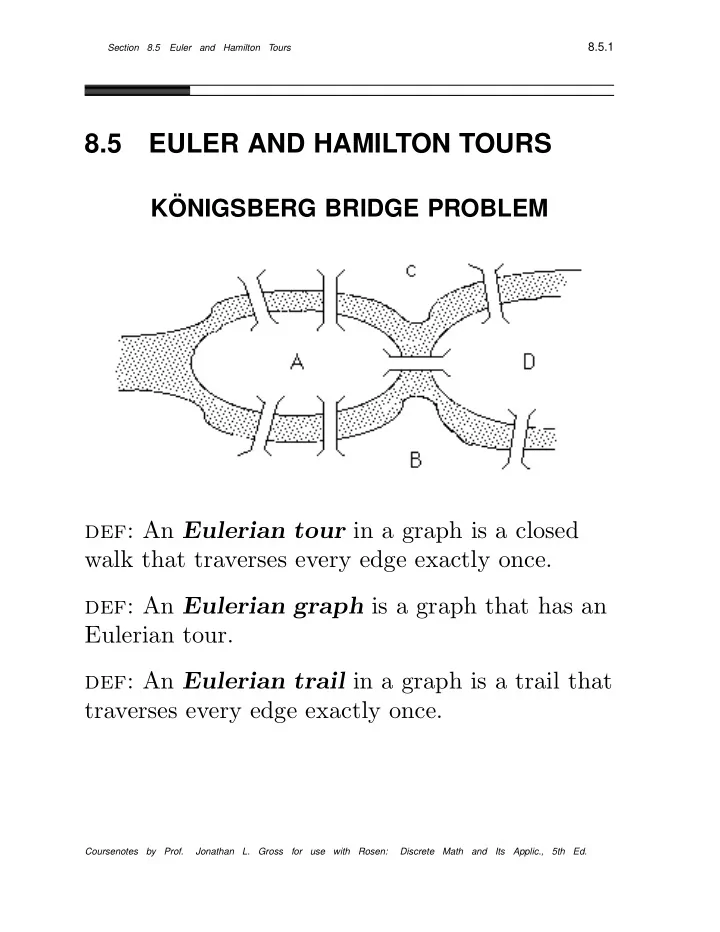
K ¨ ONIGSBERG BRIDGE PROBLEM def: An Eulerian tour in a graph is a closed walk that traverses every edge exactly once. def: An Eulerian graph is a graph that has an Eulerian tour. def: An Eulerian trail in a graph is a trail that traverses every edge exactly once.

Coursenotes by Prof. Jonathan L. Gross for use with Rosen: Discrete Math and Its Applic., 5th Ed.

slide-2
SLIDE 2

A B C D

Chapter 8 GRAPH THEORY

8.5.2

The K¨

  • nigsberg graph is a non-Eulerian graph.

Thm 8.5.1. A connected graph is Eulerian if and only if every vertex has even degree. Proof: sketch in class. Thm 8.5.2. A connected graph has an open Eulerian trail if and only it has exactly two vertices of odd degree.

Coursenotes by Prof. Jonathan L. Gross for use with Rosen: Discrete Math and Its Applic., 5th Ed.

slide-3
SLIDE 3

1 2 3 4 5 6 7

Section 8.5 Euler and Hamilton Tours

8.5.3

CLASSROOM QUESTIONS:

  • 1. Is this graph Eulerian?
  • 2. If not, how might it it be modified to make it

Eulerian?

Coursenotes by Prof. Jonathan L. Gross for use with Rosen: Discrete Math and Its Applic., 5th Ed.

slide-4
SLIDE 4

Chapter 8 GRAPH THEORY

8.5.4

HAMILTONIAN TOURS def: A Hamiltonian tour in a graph is a cycle that visits every vertex exactly once. def: An Hamiltonian graph is a graph that has a spanning cycle. def: An Hamiltonian path in a graph is a path that visits every vertex exactly once.

Coursenotes by Prof. Jonathan L. Gross for use with Rosen: Discrete Math and Its Applic., 5th Ed.

slide-5
SLIDE 5

000 100 010 110 001 101 011 111

Section 8.5 Euler and Hamilton Tours

8.5.5

Example 8.5.1: Find a Gray code in the hypercube.

Coursenotes by Prof. Jonathan L. Gross for use with Rosen: Discrete Math and Its Applic., 5th Ed.

slide-6
SLIDE 6

Chapter 8 GRAPH THEORY

8.5.6

Criterion for proving a graph is Hamiltonian. Theorem 8.5.3. (Dirac’s Theorem) Let G be a simple n-vertex graph with n ≥ 3, such that every vertex has degree at least n 2

  • . Then G is

Hamiltonian. Proof: Omitted. ♦ Example 8.5.2: Dirac’s Theorem simplifies the task of constructing all the isomorphism types

  • f 3-regular 6-vertex simple graphs, because it

implies that every one of them has a complete spanning cycle. There are only these two.

Coursenotes by Prof. Jonathan L. Gross for use with Rosen: Discrete Math and Its Applic., 5th Ed.

slide-7
SLIDE 7

Section 8.5 Euler and Hamilton Tours

8.5.7

Rules for proving a graph is not Hamiltonian. (1) If a vertex v has degree two, then both its incident edges must lie on a Hamiltonian cycle, if there is one. (2) If two edges incident on a vertex are required in the construction of a Hamilton cycle, then all the others can be deleted without changing the Hamiltonicity of the graph. (3) If a cycle formed from required edges is not a spanning cycle, then there is no spanning cycle. (4) A Hamilton graph has no cutpoints. Example 8.5.3: Example 8.5.4:

Coursenotes by Prof. Jonathan L. Gross for use with Rosen: Discrete Math and Its Applic., 5th Ed.