75% People homeless at Viral suppression among HIV diagnosis - - PDF document

75
SMART_READER_LITE
LIVE PREVIEW

75% People homeless at Viral suppression among HIV diagnosis - - PDF document

2/13/2020 Background 75% People homeless at Viral suppression among HIV diagnosis PLWH who are housed had 27-fold higher odds of 33% POP-UP Clinic, Ward 86 death Viral suppression among compared with PLWH who experience those with


slide-1
SLIDE 1

2/13/2020 1

POP-UP Clinic, Ward 86

Elizabeth Imbert, MD MPH

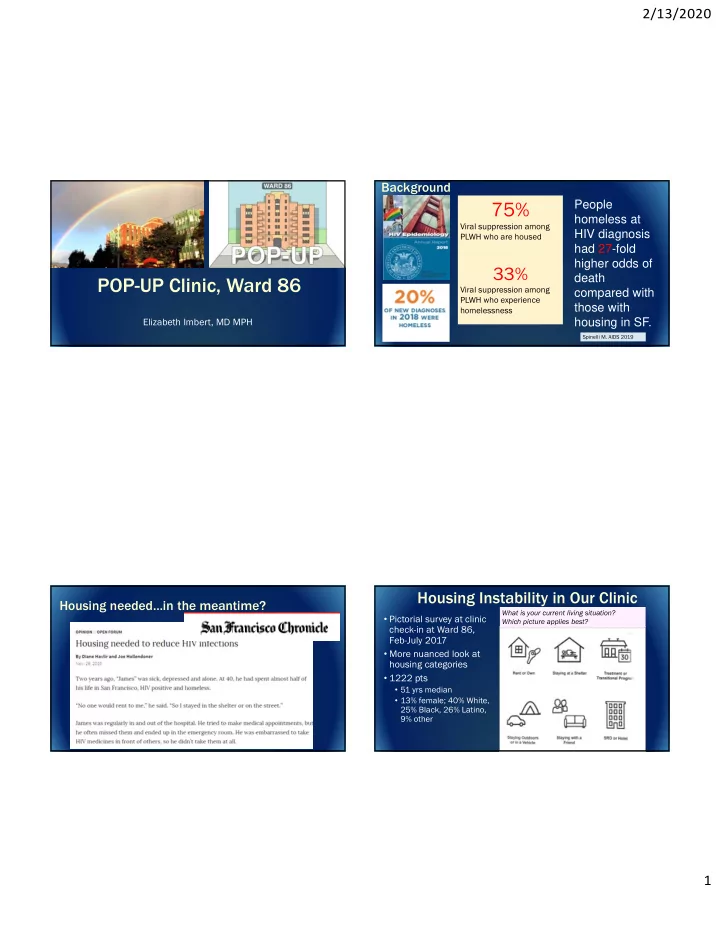
Background

75%

Viral suppression among PLWH who are housed

33%

Viral suppression among PLWH who experience homelessness

People homeless at HIV diagnosis had 27-fold higher odds of death compared with those with housing in SF.

Spinelli M. AIDS 2019

Housing needed…in the meantime?

Housing Instability in Our Clinic

  • Pictorial survey at clinic

check-in at Ward 86, Feb-July 2017

  • More nuanced look at

housing categories

  • 1222 pts
  • 51 yrs median
  • 13% female; 40% White,

25% Black, 26% Latino, 9% other

What is your current living situation? Which picture applies best?

slide-2
SLIDE 2

2/13/2020 2

Percen ent t of P

  • f Patients

tients with Viral with Viral Suppre Suppression

  • n and Mean Viral Load

and Mean Viral Load by Liv Living Arrangemen ng Arrangement at at Ward 8 rd 86 ( (N=1222) 222)

Viral load drawn +/- 90 days before survey Clemenzi A. OFID 2018

Patie tients ts with mo with more unst re unstable le ho housin using ha have hi higher er num numbers of dr

  • f drop
  • p-in visits

(and ER ER visits sits and hosp spitalizations) a italizations) at Ward 8 rd 86 (N=11 =1198 98)

Clemenzi A. OFID 2019

What are some of the barriers for our patients?

  • Forgetting Date and Time of Appointment
  • Drug Use
  • Negative provider-patient interactions
  • Lack of Knowledge of Routine Primary Care Needs
  • Transportation
  • Financial
  • Food
  • Loss of property
  • Housing
  • Stigma
  • Motivation

Clemenzi-Allen et al (unpublished data)

What are our patient’s preferences for care?

  • Discrete choice experiment
  • Sequential sampling of patients

reporting homelessness and unstable housing; ≥1 missed primary care visit; recent viremia

  • 65 pts
  • 61% > 40 yrs
  • 45% white; 77% male; 46%

heterosexual

  • 56% living outdoors or in

emergency housing; 44% temporary housing

Conte et al (unpublished data)

slide-3
SLIDE 3

2/13/2020 3

Patients willing to trade $32.79 in gift cards per visit to see providers and staff who know them as a person.

Conte et al (unpublished data)

Positive-health On-site Program for Unstably-housed Populations

Who is eligible?

  • 1. Homeless or Unstably housed
  • 2. Viral load non-suppressed or off ART
  • 3. Poor primary care visit adherence
  • 4. 2+ drop-in visits at Ward 86 in the last year

Referred from Ward 86 providers & staff, LINCS program, PHAST team, reach-out to patients who qualify

slide-4
SLIDE 4

2/13/2020 4

Patient visit

Patient Patient

SW SW RN RN Provider Provider Pharmacist Pharmacist Medical assistant Medical assistant

Identified at front desk as POP-UP patient

Components of POP-UP Clinic

Medi Medical ser services

  • ART: Onsite start DOT 5 days

a week & counseling

  • Health maintenance care

(vaccines, STI screening, cancer screening)

  • On-site mental health

services & medication- assisted treatment

Lif Life ser services

  • Food resources
  • Financial incentives
  • $10 gift card once a week-
  • $10 gift card for lab draws
  • $25 gift card for undetectable VL
  • Social services
  • Emergency housing

assessments and referrals

Januar nuary 20 y 2019-December 20

  • December 2019

64 patients 83% cis-men, 11% cis-women, 6% transgender/non-binary 47% white, 36% black, 8% Latinx 55% street homeless 100% with a substance use disorder (>90% using methamphetamines) 76% with a mental health disorder 39% with CD4<200

Janu January 20 y 2019-Dec ecember 20 2019 59 (92%) 59 (92%) restarted ART, most at enrollment (median 0, IQR 0-12 days) 59 (92%) 59 (92%) returned for follow-up within 90 days Cumulative incidence of viral suppression at 6 months post-enrollment was 60% 60% (95%C (95%CI 4 47-7

  • 74%)

) Nine patients were unenrolled from the program (3 died, 1 moved, 2 transferred back to PCP, 3 for threatening behavior)

slide-5
SLIDE 5

2/13/2020 5

Ultimate goals

Reduction duction i in dispar arities i ities in vir virologic supp suppres ression ra rates Reduction duction i in dispar arities i ities in vir virologic supp suppres ression ra rates Reduction duction i in dispar arities i ities in ER/ / urgen urgent car care/ / hospitalizat italizations ions Reduction duction i in dispar arities i ities in ER/ / urgen urgent car care/ / hospitalizat italizations ions

Redu

eduction in in dispar arities i ities in mortal ality ity

Redu

eduction in in dispar arities i ities in mortal ality ity

50% 50% 50% 50% 50% 50%

75% housed vs. 33% homeless so reduce that 42% disparity to 21% 3x as many ER visits: reduce to 1.5 Mortality much higher - reduce

The POP-UP team

Jon Oskarsson RN Mary Lawrence Hicks NP Jack Kelly SW Asa Clemenzi-Allen MD Erin Collins SW Helen Lin SW John Friend NP Matt Hickey, MD Lizzy Lynch RN Miguel Ibarra, SW Elizabeth Imbert MD Sandra Torres SW Midori Hiyagon Elia Arias Erin Antunez Diane Havlir, MD Monica Gandhi, MD Seamus McCoy, NP George Harrison, M

Darpun Sachdev, MD

Dean Goodwin Bill Blum Funders: City of San Francisco; Gilead Sciences; AIDS Walk