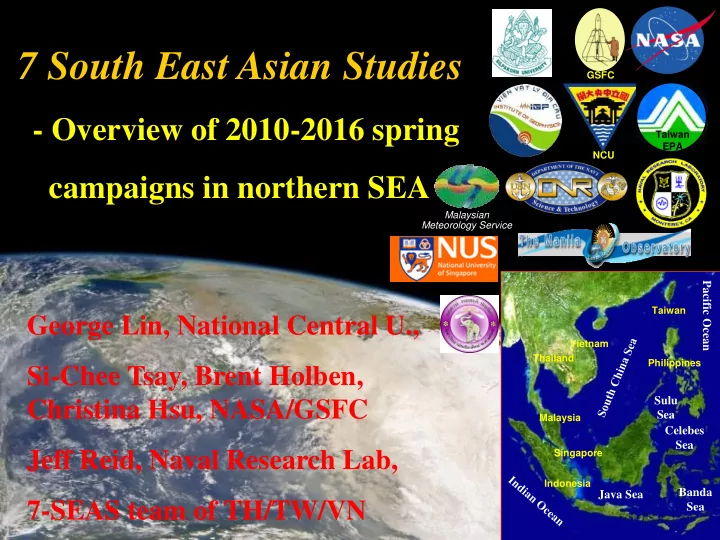
7 South East Asian Studies
Taiwan Vietnam Thailand Malaysia Singapore Indonesia Philippines
Pacific Ocean Java Sea Sulu Sea Celebes Sea Banda Sea
Malaysian Meteorology Service NCU Taiwan EPA GSFC
- Overview of 2010-2016 spring
7 South East Asian Studies GSFC - Overview of 2010-2016 spring - - PowerPoint PPT Presentation
7 South East Asian Studies GSFC - Overview of 2010-2016 spring Taiwan EPA NCU campaigns in northern SEA Malaysian Meteorology Service Pacific Ocean Taiwan George Lin, National Central U., Vietnam Thailand Philippines Si-Chee Tsay,
Taiwan Vietnam Thailand Malaysia Singapore Indonesia Philippines
Pacific Ocean Java Sea Sulu Sea Celebes Sea Banda Sea
Malaysian Meteorology Service NCU Taiwan EPA GSFC
Clear day Hazy day PM2.5 ~ 150 mg m-3 PM2.5 ~ 10 mg m-3
Agricultural residue burning Forest floor burning Stoke and waste fire
Investigate the impacts of aerosol particles on weather and the total SE Asian environment In order to do this, we need input from seven science areas:
prediction
Taiwan Vietnam Thailand Malaysia Singapore Indonesia Philippines
0.6
MISR AOT 2001-2009
Terra/MODIS true color image with AOD (2013/3/23)
NCU Dongsha Hengchun LABS Hanoi Yen Bai Phaimai Doi Ang Khang Son La
260 Km
Silpakorn Univ. Chiang Mai Luang Namtha Hong Kong
Super site Satellite site AERONET site
Taiping
Chemistry Physics NASA COMMIT- Dongsha, Son La NASA ACHIEVE Yen Bai NCU mobile 1 - Doi Ang Khang NCU mobile 2 – Hengchun NCU Mt. Lulin Dongsha supersites Air quality mobile - Hengchun
ChiangMai 1000MSL Apr BangKok 1000 MSL May DaNang 1500 MSL-Apr TuyHoa 1000 MSL -Apr PaknNamPho 1000 MSL May BacLieu 500 MSL May NaiMuang 1000 MSL March
Westerlies (high altitude)
DongSha HengChung Northeast monsoon Low level transport Updraft Flow
Flow pattern in Spring
ChiangMai Dongsha Island HengChung LABS DaNang Ocean Researcher No.1
(contributed by MT Chuang)
(Lin et al., 2013; Yen et al., 2013)
“Observation, Modeling and Impact Studies of Biomass Burning and Pollution in the SE Asian Environment – From BASE-ASIA and Dongsha Experiment to 7-SEAS”
Guest Editors: George Lin, NCU (nhlin@cc.ncu.edu.tw) Hal Maring, NASA Jeff Reid, NRL
SeaWiFS True Color TOMS Aerosol Index Laos Vietnam Thailand Vietnam Southern China Taiwan
Laos Cambodia Philippines Burma (Provided by Christina Hsu, NASA)
Son La
NASA/COMMIT Samplers Lidar
Population of Son La: 20,000 people Meteorological Station ~660 m
2012/4/6 4:51pm (LT) Looking south Photo by Carlo Wang
4/3/2012 8:36 am (LT) 4/6/2012 7:36 pm (LT)
3/07 3/09 3/11 3/13 3/15 3/17 3/19 3/21 3/23 3/25 3/27 3/29 3/31 4/02 4/04 4/06 4/08 20 40 60 80 100 120 140 160 180 200 PM1 conc. [mg m-3] PM1&PM2.5 data during 2012 SonLa Experiment PM2.5 PM1
Terra/MODIS true color image with AOD (2013/3/23)
NCU Dongsha Hengchun LABS Hanoi Yen Bai Phaimai Doi Ang Khang Son La
260 Km
Silpakorn Univ. Chiang Mai Luang Namtha Hong Kong
Super site Satellite site AERONET site
Taiping
NSPO/FORMOSAT II (2 m resolution) 2013/3/23 images
Doi Ang Khang
Son La
Chemistry sampling Air quality and aerosol in-situ Radiation
3/01 3/06 3/11 3/16 3/21 3/26 3/31 4/05 4/10 4/15 0.5 1 1.5 2 2.5 3 3.5 4 4.5 AOD at 500nm Date of year 2014 Doi Ang Khang Maesoon Luang Namtha Son La
0.1 0.2 0.3 0.4 0.5 1.5 2 3 4 5 6 Altitude (km) aerosol extinction (km-1) Mean aerosol extinction profile at Doi Ang Khang Number of profile = 50400 Period : 01-Mar-2014 - 15-Apr-2014 0.1 0.2 0.3 0.4 0.5 1.5 2 3 4 5 6 Altitude (km) aerosol extinction (km-1) 3-hourly aerosol extinction profile at Doi Ang Khang
07-10 LT 10-13 LT 13-16 LT 16-19 LT 19-22 LT 22-01 LT 01-04 LT 04-07 LT
PBL development plays a vital role on the distribution
(a) 2014/3/30 Aqua true color image (b) 2014/3/31 Terra true color image
is confined within lower elevation and distributed along valley. Fresh smoke plumes can be easily identified and transported eastward.
Biomass Burning Potential Source as CCN Characteristics
% 100 Ratio Activation
CN CCN
N N
CCNC (DMT 100,
0.5 lpm, CCN conc.)
CPC (TSI, 3010,
1.0 lpm, CN conc.)
Aerotrak (TSI 9000,
2.5 lpm, Alv. S.A. conc.)
APS (TSI 3321, 5.0 lpm,
course PSD)
TEOM (RP 1400, 16.7 lpm,
PM2.5 mass conc.)
PSAP (Radiance
Research, BC)
SMPS (TSI 3936,
0.3 lpm, fine PSD)
Aerosol Inlet
(dp,a<2.5μm)
Aerosol Inlet
NASA Trailer NCU instruments
% 100
CN CCN
N N S.S.: 0.15%, 0.3%, 0.45%, 0.6%, 0.75%
(TC Hsiao)
Supersaturation 0.0 0.2 0.4 0.6 0.8 1.0 Activation ratio ( CCN/CN ) 0.0 0.2 0.4 0.6 0.8 1.0
This study (Doi ang khong) Lathem (Fresh BB) Lathem (Aged BB) Bougiatioti (Marine) Patidar (Monsoon) This study (Lulin)
More fresh BB Aged BB
31
OC (µg m-3) 23.2 ± 12.9 EC (µg m-3) 4.5 ± 2.1 TC (µg m-3) 27.7 ± 14.9
OC/EC 4.9 ± 0.9
y = 0.153x + 0.98 R² = 0.8841
0.0 2.0 4.0 6.0 8.0 10.0 0.0 20.0 40.0 60.0
EC (µg m-3) OC ( µg m-3)
OC/EC can be used to identify sources (Chow et al., 2004; Cao et al., 2005), for instance, 1.1 for mobile source and 2.7 for coal burning (Watson et al., 2001), 5.1 for forest fire in (Pio et al., 2008). OC and EC are highly correlated with R2=0.88. (Provided by CT Lee)
Consistent levoglucosan/mannosan (LG/MN) ratio (~15)
→ Mixed types of biomass fuel, including
Anhydrosugar Ratios at Doi Ang Khang
K+/levoglucosan ratio: average at 0.77±0.54 in 2013. Low ratios indicate smoldering burning phase was predominant.
Biomass Burning Tracer Concentrations at Son La, 2013
SEM/EDX INDIVIDUAL PARTICLE ANALYSIS
100 m m
Fly Ash STRUCTURE of SMOKE
aluminum silicates mixed with K, Fe
Dust/Soil Organic/tar
soot
KCl
Sulfates K chlorides Ca - rich Fe - rich
Olga
Metals Complex Areas 90.7 pg/Nm3
Son La DAK LABS 20 40 60 80 100 120
PBDEs (pg/Nm3)
Median 25%-75% Non-Outlier Min-Max Outliers 55.2 31.4 14.9
Urban Areas 31.7 pg/Nm3 Rural Areas 15.9 pg/Nm3 The PBDE concentrations in the atmosphere of Mt. Lulin were comparable to that of the Rural Area in Taiwan.
(LC Wang)
NASA: S.-C. Tsay, N. C. Hsu, B. N. Holben, E. J. Welton Taiwan: led by N.-H. George Lin Thailand: led by Serm Janjai and by Somporn Chantara Vietnam: led by Anh X. Nguyen
Normalized Relative Backscatter λ= 532nm
2.0
Height (km)
15 10 5 0.0 0.5 1.0 1.5 2.5
(Countskm2µJ-1 µs-1) 18 March 2013
background molecules + ice crystals background molecules + aerosols
Doi Angkhang site
± 1σ
Mean
15 10 5
Reflecitivity (dBZ)
Height A.G.L. (km)
0.0 1.0 0.5 1.5 2.5 2.0
Development/Encroachment Drizzle/Light-Rain Dissipation
RHI & PPI
Insect contamination
RHI & PPI RHI & PPI
Time (UTC/Local)
12/19 (8 April) (7 April) 15/22 18/01 21/04 00/07 03/10
910 nm ceilometer derived cloud-base heights
7 April 2013: Yen Bai, Vietnam* *Loftus, et al., 2016, AAQR, doi:10.4209/aaqr.2015.11.0631. Permit better understanding of the cloud system lifecycle Simulate well the initial coupling of the aerosol and cloud layer Aid in estimations of precipitation on aerosol washout effect
boundary layer for validating remote sensing/retrievals and for initializing regional transport/chemical and cloud ensemble models
Guest Editors: James Campbell, NRL Guey-Rong Sheu, NCU Somporn Chantara, CMU
SMARTLabs/AERONET/MPLNET
Regional Instrumentation
Trace Gas – Column: O3, NO2, SO2, HCHO, CO, H2O; – Surface: CO, CO2, O3, SO2, NO, NOx/NOy; – Profile: NO2, (O3 in progress) Organic Carbon (OC): OC1 (120C), OC2 (280C), OC3 (480C), OC4 (580C), OP (pyrolyzed organic carbon, e.g., anhydrosugars, dicarboxylic acids) Aerosol Optical Thickness: multi-spectral from UV to shortwave-IR, dust at longwave-IR, and extinction profile Elemental Carbon (EC): EC1 (580C – OP), EC2 (740C), EC3 (840C) Aerosol Microphysics/Chemistry: size, mass, type, CCN, hygroscopicity, scattering/absorption/extinction Water soluble ions: Na+, NH4
+, K+, Mg2+, Ca2+, Cl-,
NO3
2-, nss-SO4 2-, NO2-, F-
Cloud Optical Thickness: multi-spectral from visible to longwave-IR Toxic: Mercury, PCDD/Fs (dioxin) Cloud Microphysics: size, liquid-/ice-water content, cloud-base/top/height, thermodynamic phase, Doppler fall-velocity, depolarization and reflectivity profiles Metal: Ti, Mn, Co, Ni, Cu, Zn, Mo, Ag, Cd, Sn, Sb, Tl, Pb, V, Cr, As, Y, Se, Zr, Nb, Ge, Rb, Cs, Ga, La, Ce, Pr, Nd, Sm, Eu, Gd Radiation Flux: surface solar and terrestrial irradiance UV radiation: spectral UV (erythemal) irradiance Meteorology: P, T, RH, wind, mixed-layer height, precipitation, visibility Supplementary data: sounding profile, sky image, particle spectroscopy/morphology, rainfall amount
Schematic diagram for illustrating how an intensified India- Burma Trough modulates the occurrence of biomass burning in northern Indochina and its downwind impact on Taiwan (Huang et al., 2016 JGR).
Sites Aerosol chemistry Aerosol in situ Trace gases Cimel MPL
PAHs, Ions, Metals, EC/OC mass, size,
CO, O3,… V Alishan V V Chaiyi V NCU V V
Sites Aerosol chemistry Aerosol in situ Trace gases Cimel MPL CMU PAHs, Ions, Metals, EC/OC mass,
Chiang Mai Met station V Omkoi V V
Experiment Period Yushan experiment 2013 Aug. – 2014 Aug. Douliu experiment 2015 Sep. – 2015 Oct. Alishan experiment 2016 Apr. – 2016 May
Chiayi
2016/9/30 45
LABS
Rain
Clouds Clouds Clouds Clouds
High PM2.5 frequent occurred under overcast According to lidar signal, the BB plume can reach to as high as 4.5 km a.s.l
Roof top of 9 science building (ScB1)
46
20 40 60 80 100 120 140 160 180
3-Mar-16 4-Mar-16 5-Mar-16 6-Mar-16 7-Mar-16 8-Mar-16 9-Mar-16 10-Mar-16 11-Mar-16 12-Mar-16 13-Mar-16 14-Mar-16 15-Mar-16 16-Mar-16 17-Mar-16 18-Mar-16 19-Mar-16 20-Mar-16 21-Mar-16 22-Mar-16 23-Mar-16 24-Mar-16 25-Mar-16 26-Mar-16 27-Mar-16 28-Mar-16 29-Mar-16 30-Mar-16 31-Mar-16 1-Apr-16 2-Apr-16 3-Apr-16 4-Apr-16 5-Apr-16 6-Apr-16 7-Apr-16 8-Apr-16 9-Apr-16 10-Apr-16 11-Apr-16 12-Apr-16 13-Apr-16 14-Apr-16 15-Apr-16 16-Apr-16 17-Apr-16 18-Apr-16 19-Apr-16 20-Apr-16 21-Apr-16 22-Apr-16 23-Apr-16
PM Concentration (µg/m3)
Date
PM2.5 (TEOM, CMU) PM2.5 (BGI, CMU) PM10 (MV, CMU)
Sampling period: 3 March – 23 April 2016
PM2.5 80 mg/m3 26 March, 2016 (3:30 UTC) PM2.5 150 mg/m3 18 April, 2016 (3:30 UTC) Clear sky, rainy season
Songkran Festival Usually the beginning of wet season due to zero burning policy or climate regime shift Largest event
Event 1 Event 2 3/25
Contact: George Lin nhlin@cc.ncu.edu.tw http://aerosol.atm.ncu.edu.tw