
7
Network Layer
RIP ( Routing Information Protocol)
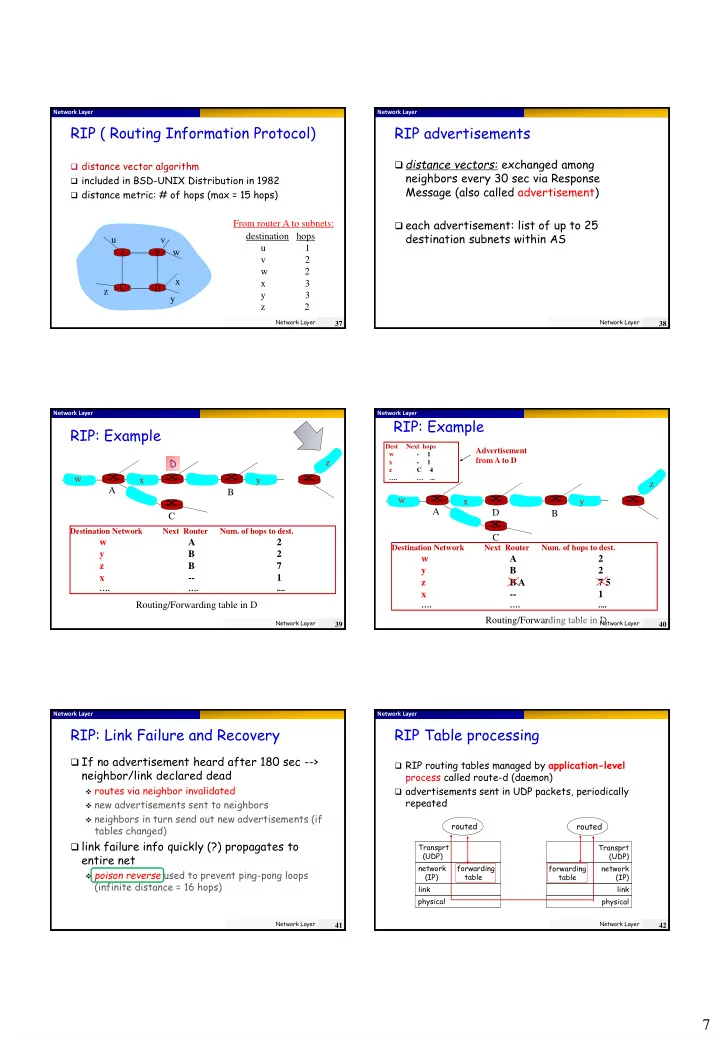
distance vector algorithm included in BSD-UNIX Distribution in 1982 distance metric: # of hops (max = 15 hops) D
C
B A
u v w x y z destination hops u 1 v 2 w 2 x 3 y 3 z 2 From router A to subnets:
Network Layer
37
Network Layer
RIP advertisements
distance vectors: exchanged among
neighbors every 30 sec via Response Message (also called advertisement)
each advertisement: list of up to 25
destination subnets within AS
Network Layer
38
Network Layer
RIP: Example
Destination Network Next Router Num. of hops to dest.
w A 2 y B 2 z B 7 x
- 1
…. …. ....
w x y z A C D B Routing/Forwarding table in D
Network Layer
39
Network Layer
RIP: Example
Destination Network Next Router Num. of hops to dest.
w A 2 y B 2 z B A 7 5 x
- 1
…. …. ....
Routing/Forwarding table in D w x y z A C D B
Dest Next hops w
- 1
x
- 1
z C 4 …. … ...
Advertisement from A to D
Network Layer
40
Network Layer
RIP: Link Failure and Recovery
If no advertisement heard after 180 sec -->
neighbor/link declared dead
routes via neighbor invalidated new advertisements sent to neighbors neighbors in turn send out new advertisements (if
tables changed) link failure info quickly (?) propagates to
entire net
poison reverse used to prevent ping-pong loops
(infinite distance = 16 hops)
Network Layer
41
Network Layer
RIP Table processing
RIP routing tables managed by application-level
process called route-d (daemon)
advertisements sent in UDP packets, periodically
repeated
physical link network forwarding (IP) table Transprt (UDP)
routed
physical link network (IP) Transprt (UDP)
routed
forwarding table
Network Layer
42