7 6 4-5 2-3 0-1 4. Fluency Speech sustained throughout Speech - - PowerPoint PPT Presentation

7 6 4 5 2 3 0 1 4 fluency speech sustained throughout
SMART_READER_LITE
LIVE PREVIEW

7 6 4-5 2-3 0-1 4. Fluency Speech sustained throughout Speech - - PowerPoint PPT Presentation

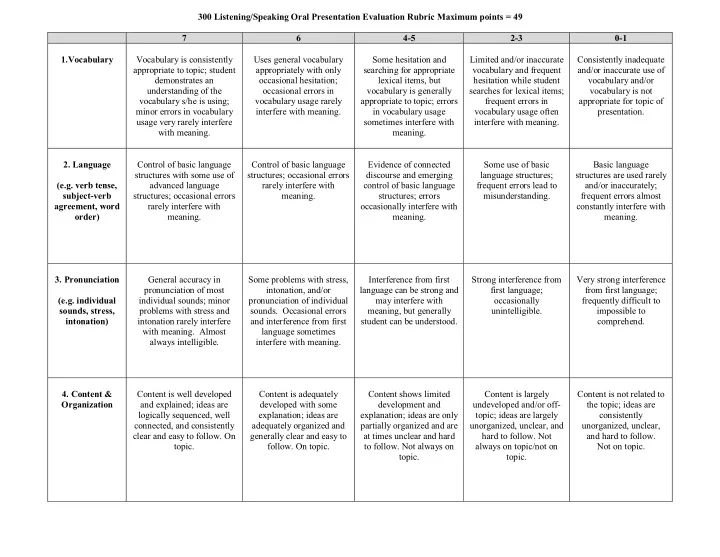
300 Listening/Speaking Oral Presentation Evaluation Rubric Maximum points = 49 7 6 4-5 2-3 0-1 1.Vocabulary Vocabulary is consistently Uses general vocabulary Some hesitation and Limited and/or inaccurate Consistently inadequate


slide-1
SLIDE 1

300 Listening/Speaking Oral Presentation Evaluation Rubric Maximum points = 49 7 6 4-5 2-3 0-1 1.Vocabulary Vocabulary is consistently appropriate to topic; student demonstrates an understanding of the vocabulary s/he is using; minor errors in vocabulary usage very rarely interfere with meaning. Uses general vocabulary appropriately with only

  • ccasional hesitation;
  • ccasional errors in

vocabulary usage rarely interfere with meaning. Some hesitation and searching for appropriate lexical items, but vocabulary is generally appropriate to topic; errors in vocabulary usage sometimes interfere with meaning. Limited and/or inaccurate vocabulary and frequent hesitation while student searches for lexical items; frequent errors in vocabulary usage often interfere with meaning. Consistently inadequate and/or inaccurate use of vocabulary and/or vocabulary is not appropriate for topic of presentation.

  • 2. Language

(e.g. verb tense, subject-verb agreement, word

  • rder)

Control of basic language structures with some use of advanced language structures; occasional errors rarely interfere with meaning. Control of basic language structures; occasional errors rarely interfere with meaning. Evidence of connected discourse and emerging control of basic language structures; errors

  • ccasionally interfere with

meaning. Some use of basic language structures; frequent errors lead to misunderstanding. Basic language structures are used rarely and/or inaccurately; frequent errors almost constantly interfere with meaning.

  • 3. Pronunciation

(e.g. individual sounds, stress, intonation) General accuracy in pronunciation of most individual sounds; minor problems with stress and intonation rarely interfere with meaning. Almost always intelligible. Some problems with stress, intonation, and/or pronunciation of individual

  • sounds. Occasional errors

and interference from first language sometimes interfere with meaning. Interference from first language can be strong and may interfere with meaning, but generally student can be understood. Strong interference from first language;

  • ccasionally

unintelligible. Very strong interference from first language; frequently difficult to impossible to comprehend.

  • 4. Content &

Organization Content is well developed and explained; ideas are logically sequenced, well connected, and consistently clear and easy to follow. On topic. Content is adequately developed with some explanation; ideas are adequately organized and generally clear and easy to

  • follow. On topic.

Content shows limited development and explanation; ideas are only partially organized and are at times unclear and hard to follow. Not always on topic. Content is largely undeveloped and/or off- topic; ideas are largely unorganized, unclear, and hard to follow. Not always on topic/not on topic. Content is not related to the topic; ideas are consistently unorganized, unclear, and hard to follow. Not on topic.

slide-2
SLIDE 2

7 6 4-5 2-3 0-1

  • 4. Fluency

(e.g. pace, flow, ease of speaking) Speech sustained throughout with few non-nativelike

  • pauses. Smooth and

rhythmic patterns rarely interfere with intelligibility. Speech sustained most of the time; some hesitation but manages to continue and complete thoughts. Some difficulty with smoothness & rhythmic patterns, which causes

  • ccasional interference

with intelligibility. Some sustained speech; few or no incomplete

  • thoughts. Speech is

choppy and/or slow with frequent pauses. Little sustained speech; speech is halting and uneven with long pauses

  • r incomplete thoughts.

Little to no sustained speech; frequent pauses and halting rhythm cause almost constant interference with intelligibility. Volume Eye contact Gestures & movement Confidence Student speaks clearly and volume is loud enough to be heard by all audience members throughout presentation. Student consistently makes eye contact with all audience members. Student consistently uses movement and gestures appropriately. Student consistently has good posture and appears relaxed and confident. Student’s voice is clear and volume is usually loud enough to be heard by all audience members. Student makes eye contact with most audience members. Student uses appropriate gestures and movement in most parts of presentation. Student has good posture and appears confident for most of presentation. Student occasionally speaks too quietly to be heard by all audience members. Student makes some eye contact, but not with all audience members. Student uses appropriate gestures and movement in some parts of presentation. Student sometimes has poor posture and/or appears nervous in some parts of presentation. Student often speaks quietly and audience members have difficulty hearing presentation. Student makes little eye contact with audience members. Student rarely uses appropriate gestures and/or movement. Student rarely has appropriate posture and/or appears nervous for most

  • f presentation.

Student consistently mumbles and/or speaks too quietly to be heard by audience members. Student makes little to no eye contact with audience members. Student does not use gestures and/or movement appropriately. Student consistently has poor posture and/or appears nervous throughout presentation.

  • 6. Visual Aids

Visuals are consistently clear, interesting, and well-

  • rganized; visuals

consistently add to audience's understanding of the topic. Visuals are clear and related to the topic; visuals generally add to audience’s understanding of the topic. Visuals are usually clear and related to the topic; visuals sometimes add to audience’s understanding

  • f the topic.

Visuals are sometimes unclear and/or unrelated to the topic; visuals rarely add to audience’s understanding of the topic. Visuals are consistently unclear and/or unrelated to the topic; visuals do not add to audience’s understanding of topic.

  • 7. Timing

Student spoke an equal amount of time as the other group members Student a little less than the

  • ther group members

Student spoke less than the

  • ther group members

Student spoke significantly less than the

  • ther group members

Student spoke for a very little amount of time

slide-3
SLIDE 3