61A Lecture 7 Midterm 1 is next Monday 9/23 from 7pm to 9pm in - - PDF document

61a lecture 7
SMART_READER_LITE
LIVE PREVIEW

61A Lecture 7 Midterm 1 is next Monday 9/23 from 7pm to 9pm in - - PDF document

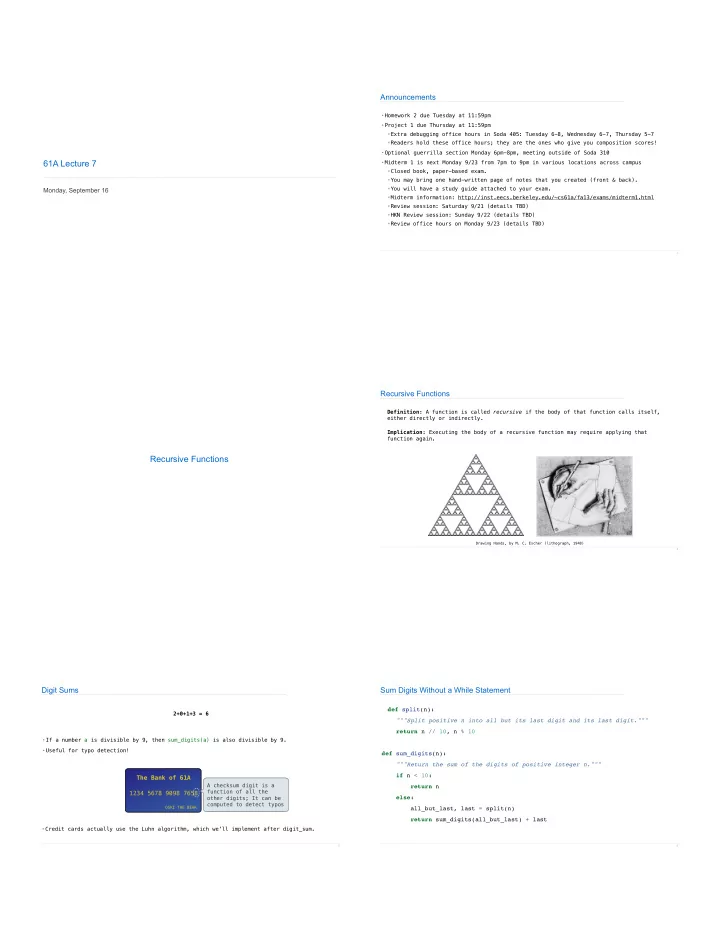
Announcements Homework 2 due Tuesday at 11:59pm Project 1 due Thursday at 11:59pm Extra debugging office hours in Soda 405: Tuesday 6-8, Wednesday 6-7, Thursday 5-7 Readers hold these office hours; they are the ones who give you


slide-1
SLIDE 1

61A Lecture 7

Monday, September 16

Announcements

  • Homework 2 due Tuesday at 11:59pm
  • Project 1 due Thursday at 11:59pm
  • Extra debugging office hours in Soda 405: Tuesday 6-8, Wednesday 6-7, Thursday 5-7
  • Readers hold these office hours; they are the ones who give you composition scores!
  • Optional guerrilla section Monday 6pm-8pm, meeting outside of Soda 310
  • Midterm 1 is next Monday 9/23 from 7pm to 9pm in various locations across campus
  • Closed book, paper-based exam.
  • You may bring one hand-written page of notes that you created (front & back).
  • You will have a study guide attached to your exam.
  • Midterm information: http://inst.eecs.berkeley.edu/~cs61a/fa13/exams/midterm1.html
  • Review session: Saturday 9/21 (details TBD)
  • HKN Review session: Sunday 9/22 (details TBD)
  • Review office hours on Monday 9/23 (details TBD)
2

Recursive Functions

Recursive Functions

Definition: A function is called recursive if the body of that function calls itself, either directly or indirectly. Implication: Executing the body of a recursive function may require applying that function again.

Drawing Hands, by M. C. Escher (lithograph, 1948) 4

Digit Sums

  • If a number a is divisible by 9, then sum_digits(a) is also divisible by 9.
  • Useful for typo detection!
5

The Bank of 61A 1234 5678 9098 7658

OSKI THE BEAR

A checksum digit is a function of all the

  • ther digits; It can be

computed to detect typos

  • Credit cards actually use the Luhn algorithm, which we'll implement after digit_sum.

2+0+1+3 = 6

Sum Digits Without a While Statement

def split(n): """Split positive n into all but its last digit and its last digit.""" return n // 10, n % 10 def sum_digits(n): """Return the sum of the digits of positive integer n.""" if n < 10: return n else: all_but_last, last = split(n) return sum_digits(all_but_last) + last

6
slide-2
SLIDE 2

The Anatomy of a Recursive Function

7
  • The def statement header is similar to other functions
  • Conditional statements check for base cases
  • Base cases are evaluated without recursive calls
  • Recursive cases are evaluated with recursive calls

(Demo)

def sum_digits(n): """Return the sum of the digits of positive integer n.""" if n < 10: return n else: all_but_last, last = split(n) return sum_digits(all_but_last) + last

Recursion in Environment Diagrams

Recursion in Environment Diagrams

9 Example: http://goo.gl/XOP9ps
  • The same function fact is called

multiple times.

  • Different frames keep track of the

different arguments in each call.

  • What n evaluates to depends upon

which is the current environment.

  • Each call to fact solves a simpler

problem than the last: smaller n. (Demo) 4! = 4 · 3 · 2 · 1 = 24 n! =

n

Y

k=1

k n! = ( 1 if n = 0 n · (n − 1)!

  • therwise

Iteration vs Recursion

Iteration is a special case of recursion

def fact_iter(n): total, k = 1, 1 while k <= n: total, k = total*k, k+1 return total def fact(n): if n == 0: return 1 else: return n * fact(n-1)

Using iterative control: Using recursion: n, total, k, fact_iter Math: Names: n, fact

10 Example: http://goo.gl/NgH3Lf

Verifying Recursive Functions

The Recursive Leap of Faith

Is fact implemented correctly? 1. Verify the base case. 2. Treat fact as a functional abstraction! 3. Assume that fact(n-1) is correct. 4. Verify that fact(n) is correct, assuming that

fact(n-1) correct.

Photo by Kevin Lee, Preikestolen, Norway

def fact(n): if n == 0: return 1 else: return n * fact(n-1)

12
slide-3
SLIDE 3

Mutual Recursion

The Luhn Algorithm

Used to verify credit card numbers From Wikipedia: http://en.wikipedia.org/wiki/Luhn_algorithm

  • 1. From the rightmost digit, which is the check digit, moving left, double the value of

every second digit; if product of this doubling operation is greater than 9 (e.g., 7 * 2 = 14), then sum the digits of the products (e.g., 10: 1 + 0 = 1, 14: 1 + 4 = 5).

  • 2. Take the sum of all the digits.
14

1 3 8 7 4 3 2 3 1+6=7 7 8 3 The Luhn sum of a valid credit card number is a multiple of 10. = 30 (Demo)

Recursion and Iteration

def sum_digits(n): """Return the sum of the digits of positive integer n.""" if n < 10: return n else: all_but_last, last = split(n) return sum_digits(all_but_last) + last

Converting Recursion to Iteration

Can be tricky: Iteration is a special case of recursion. Idea: Figure out what state must be maintained by the iterative function. What's left to sum A partial sum

16

(Demo)

Converting Iteration to Recursion

More formulaic: Iteration is a special case of recursion. Idea: The state of an iteration can be passed as arguments.

def sum_digits_iter(n): digit_sum = 0 while n > 0: n, last = split(n) digit_sum = digit_sum + last return digit_sum def sum_digits_rec(n, digit_sum): if n == 0: return digit_sum else: n, last = split(n) return sum_digits_rec(n, digit_sum + last)

Updates via assignment become... ...arguments to a recursive call

17