61A Lecture 19 Today: An arithmetic system over related types - - PDF document

61a lecture 19
SMART_READER_LITE
LIVE PREVIEW

61A Lecture 19 Today: An arithmetic system over related types - - PDF document

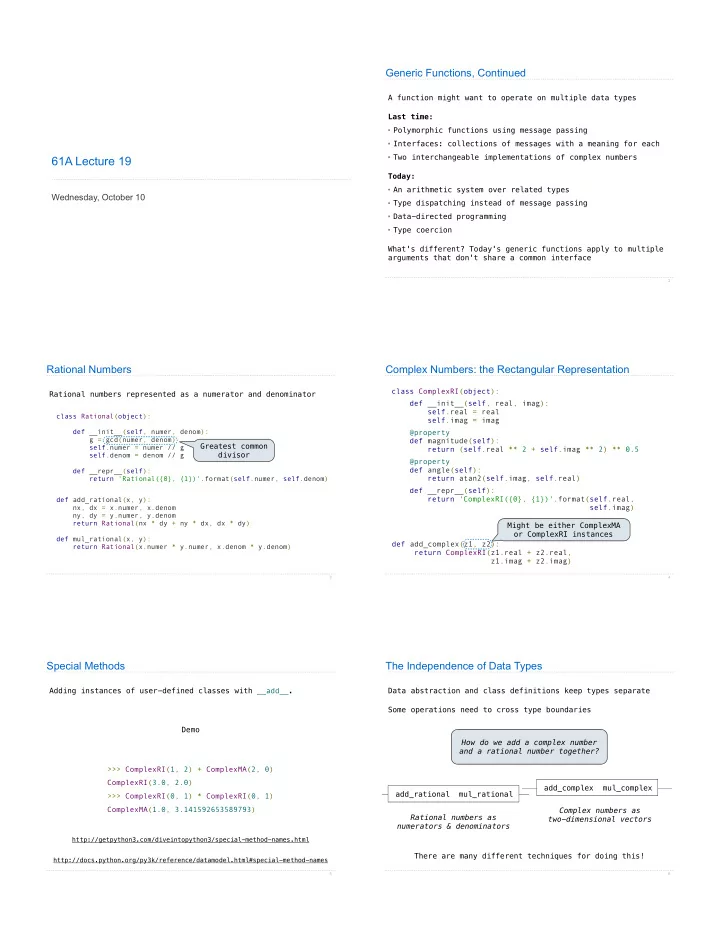
Generic Functions, Continued A function might want to operate on multiple data types Last time: Polymorphic functions using message passing Interfaces: collections of messages with a meaning for each Two interchangeable implementations


slide-1
SLIDE 1

61A Lecture 19

Wednesday, October 10

Generic Functions, Continued

A function might want to operate on multiple data types Last time:

  • Polymorphic functions using message passing
  • Interfaces: collections of messages with a meaning for each
  • Two interchangeable implementations of complex numbers

Today:

  • An arithmetic system over related types
  • Type dispatching instead of message passing
  • Data-directed programming
  • Type coercion

What's different? Today's generic functions apply to multiple arguments that don't share a common interface

2

Rational Numbers

Rational numbers represented as a numerator and denominator

3

class Rational(object): def __init__(self, numer, denom): g = gcd(numer, denom) self.numer = numer // g self.denom = denom // g def __repr__(self): return 'Rational({0}, {1})'.format(self.numer, self.denom) def add_rational(x, y): nx, dx = x.numer, x.denom ny, dy = y.numer, y.denom return Rational(nx * dy + ny * dx, dx * dy) def mul_rational(x, y): return Rational(x.numer * y.numer, x.denom * y.denom)

Greatest common divisor

Complex Numbers: the Rectangular Representation

4

class ComplexRI(object): def __init__(self, real, imag): self.real = real self.imag = imag @property def magnitude(self): return (self.real ** 2 + self.imag ** 2) ** 0.5 @property def angle(self): return atan2(self.imag, self.real) def __repr__(self): return 'ComplexRI({0}, {1})'.format(self.real, self.imag) def add_complex(z1, z2): return ComplexRI(z1.real + z2.real, z1.imag + z2.imag) Might be either ComplexMA

  • r ComplexRI instances

Special Methods

Adding instances of user-defined classes with __add__.

5

Demo >>> ComplexRI(1, 2) + ComplexMA(2, 0) ComplexRI(3.0, 2.0) >>> ComplexRI(0, 1) * ComplexRI(0, 1) ComplexMA(1.0, 3.141592653589793)

http://docs.python.org/py3k/reference/datamodel.html#special-method-names http://getpython3.com/diveintopython3/special-method-names.html

The Independence of Data Types

Data abstraction and class definitions keep types separate Some operations need to cross type boundaries

6

add_rational mul_rational Rational numbers as numerators & denominators add_complex mul_complex Complex numbers as two-dimensional vectors How do we add a complex number and a rational number together? There are many different techniques for doing this!

slide-2
SLIDE 2

Type Dispatching

Define a different function for each possible combination of types for which an operation (e.g., addition) is valid

7

def iscomplex(z): return type(z) in (ComplexRI, ComplexMA) def isrational(z): return type(z) is Rational def add_complex_and_rational(z, r): return ComplexRI(z.real + r.numer/r.denom, z.imag) def add_by_type_dispatching(z1, z2): """Add z1 and z2, which may be complex or rational.""" if iscomplex(z1) and iscomplex(z2): return add_complex(z1, z2) elif iscomplex(z1) and isrational(z2): return add_complex_and_rational(z1, z2) elif isrational(z1) and iscomplex(z2): return add_complex_and_rational(z2, z1) else: add_rational(z1, z2) Converted to a real number (float) Demo

Tag-Based Type Dispatching

Idea: Use dictionaries to dispatch on type

8

def type_tag(x): return type_tag.tags[type(x)] type_tag.tags = {ComplexRI: 'com', ComplexMA: 'com', Rational: 'rat'} def add(z1, z2): types = (type_tag(z1), type_tag(z2)) return add.implementations[types](z1, z2) add.implementations = {} add.implementations[('com', 'com')] = add_complex add.implementations[('rat', 'rat')] = add_rational add.implementations[('com', 'rat')] = add_complex_and_rational add.implementations[('rat', 'com')] = add_rational_and_complex lambda r, z: add_complex_and_rational(z, r) Declares that ComplexRI and ComplexMA should be treated uniformly

m · (m − 1) · n 4 · (4 − 1) · 4 = 48

Type Dispatching Analysis

Minimal violation of abstraction barriers: we define cross- type functions as necessary, but use abstract data types Extensible: Any new numeric type can "install" itself into the existing system by adding new entries to various dictionaries

9

Question: How many cross-type implementations are required to support m types and n operations? def add(z1, z2): types = (type_tag(z1), type_tag(z2)) return add.implementations[types](z1, z2) integer, rational, real, complex add, subtract, multiply, divide

Type Dispatching Analysis

Minimal violation of abstraction barriers: we define cross- type functions as necessary, but use abstract data types Extensible: Any new numeric type can "install" itself into the existing system by adding new entries to various dictionaries

10

Arg 1 Arg 2 Add Multiply Complex Complex Rational Rational Complex Rational Rational Complex Message Passing Type Dispatching

Data-Directed Programming

There's nothing addition-specific about add_by_type Idea: One dispatch function for (operator, types) pairs

11

def apply(operator_name, x, y): tags = (type_tag(x), type_tag(y)) key = (operator_name, tags) return apply.implementations[key](x, y) Demo

Coercion

Idea: Some types can be converted into other types Takes advantage of structure in the type system

12

>>> def rational_to_complex(x): return ComplexRI(x.numer/x.denom, 0) >>> coercions = {('rat', 'com'): rational_to_complex} Question: Can any numeric type be coerced into any other? Question: Have we been repeating ourselves with data-directed programming?

slide-3
SLIDE 3

Applying Operators with Coercion

  • 1. Attempt to coerce arguments into values of the same type
  • 2. Apply type-specific (not cross-type) operations

13

def coerce_apply(operator_name, x, y): tx, ty = type_tag(x), type_tag(y) if tx != ty: if (tx, ty) in coercions: tx, x = ty, coercions[(tx, ty)](x) elif (ty, tx) in coercions: ty, y = tx, coercions[(ty, tx)](y) else: return 'No coercion possible.' assert tx == ty key = (operator_name, tx) return coerce_apply.implementations[key](x, y) Demo

Coercion Analysis

Minimal violation of abstraction barriers: we define cross- type coercion as necessary, but use abstract data types Requires that all types can be coerced into a common type More sharing: All operators use the same coercion scheme

14

Arg 1 Arg 2 Add Multiply Complex Complex Rational Rational Complex Rational Rational Complex From To Coerce Complex Rational Rational Complex Type Add Multiply Complex Rational