$53 million federal support, with $ 256 M from state general fund = - - PDF document

53 million federal support with 256 m from state general
SMART_READER_LITE
LIVE PREVIEW

$53 million federal support, with $ 256 M from state general fund = - - PDF document

Enhancing Early Intervention: Putting Research Into Practice To Serve Infants, Toddlers & Their Families Marie Kanne Poulsen, Ph.D Keck School of Medicine University of Southern California Childrens Hospital Los Angeles Disclosures


slide-1
SLIDE 1

Enhancing Early Intervention: Putting Research Into Practice To Serve Infants, Toddlers & Their Families

Marie Kanne Poulsen, Ph.D Keck School of Medicine University of Southern California Children’s Hospital Los Angeles

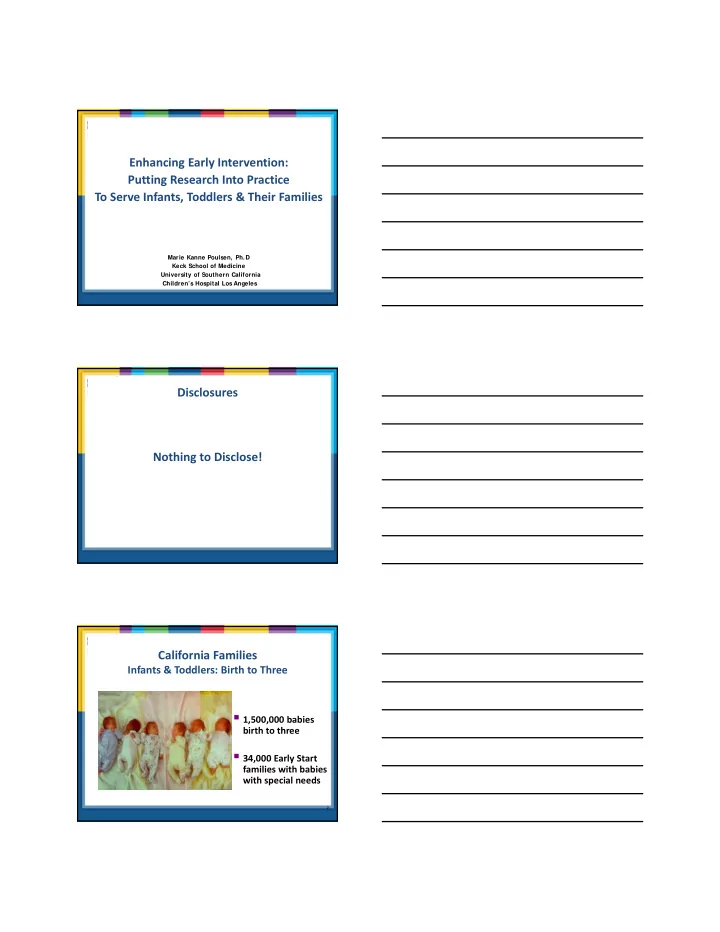
Disclosures Nothing to Disclose! California Families

Infants & Toddlers: Birth to Three

  • 1,500,000 babies

birth to three

  • 34,000 Early Start

families with babies with special needs

2

slide-2
SLIDE 2

California Early Start State Eligibility

Infants & Toddlers: Birth to Three 33% Developmental Delay :

  • motor
  • communication
  • cognitive
  • adaptive
  • social or emotional functioning

Established Risk: Probability of delay

California Early Start State Eligibility At Risk: 2 Biomedical Factors

  • Low birth weight
  • Assisted ventilation
  • Small for gestation
  • Asphyxia
  • Prenatal exposure
  • Neonatal seizure
  • CNS lesion
  • Failure to thrive

California Early Intervention Services Act

Early Start

Family service system for infants, toddlers and their families that coordinates health, developmental, educational and social services that are culturally competent and responsive to family‐identified needs.

‐‐‐ CEISA, Title 14, *95001

slide-3
SLIDE 3

California Early Start Families

Infants & Toddlers: Birth to Three

  • Audiology
  • Nursing
  • Nutrition
  • Occupational Therapy
  • Physical Therapy
  • Psychology
  • Social Work
  • Speech & Language
  • Family Training
  • Family Counseling
  • Service Coordination
  • Transportation
  • Vision Services
  • Assistive Technology
  • Health Service
  • Medical Services

Part C Federal Requirements

California Early Start Program

  • $53 million federal support, with $ 256 M from state

general fund = $309,000,000

  • Federal mandates, including Performance Plan and

Annual Report on 10 indicators of compliance

  • 2014 Added Requirement of a State Systemic

Improvement Plan addressing an outcome for high interest but low performance indicator

State Systemic Improvement Plan (SSIP)

2020 Achievable Measureable Result

  • Improves outcomes for

infants and toddlers and their families

  • Based on State data and

Stakeholder input

  • Recommended by the

State Systemic Improvement Plan Task Force

9

slide-4
SLIDE 4

CA State Identified Measurable Result

Social and Emotional Development By Three

  • Turns to caregivers for TLC, solace,

attention & guidance

  • Manages emotions & behaviors to

developmental expectations

  • Has the initiative to explore, discover, learn

& make friends

State Identified Measureable Result

Social and Emotional Development

  • Stakeholder Input
  • State Data
  • Critical preschool inclusion indicator
  • Infant brain research

State Identified Measureable Result

Social and Emotional Development

  • Infant brain research: mother‐infant

relationships play a crucial role in long‐ term outcome

slide-5
SLIDE 5

1997 White House Conference

Brain Development in Young Children

Insights on Early Mother‐Child Nurturing Relationships

  • Influence how the intricate circuitry
  • f the brain is wired
  • Influence extremity and frequency of stress

levels of cortisol

  • Interpersonal interaction, not sensory

stimulation, as the key to healthy development

Maternal Emotional Availability Infant Emotional Availability Mother- Infant Relation

  • ship

Infant/Family Mental Health Relationship as the Centrality of Development

Early Caregiving Relationships Matter!

  • Every child needs a close intimate bond with at

least one person who is sensitive to his needs and responsive to his cues.

slide-6
SLIDE 6

Infant Emotional Availability Mother- Infant Relation

  • ship

Infant/Family Mental Health Relationship as the Centrality of Development

Infant Emotional Response Vulnerability

Neurobehavioral Sensitive Status

  • Prematurity
  • Low birth weight
  • Substance exposure
  • Special health care needs
  • NICU experience
  • Antenatal depression

NICU Infant Experience

Neurobehavioral Impacts

  • Sensory over‐stimulation
  • Repeated medical procedures
  • Pain
  • Parental separations
  • Multiple caregivers
slide-7
SLIDE 7

Antenatal Depression, Trauma & Anxiety

Neurobehavioral Sensitive Status

  • Prenatal distress acts through the placenta

to alter fetal development

  • Prenatal distress predicts increased

behavioral reactivity and cortisol in response to novelty in infants.

‐‐‐ Monk et al, 2012

Poulsen/USC UCEDD

Infant Emotional Availability

Neurobehavioral Status that Influence Relationships

  • Organization of engagement behavior
  • States of arousal
  • Sleeping regulation
  • Crying consolability

Maternal Emotional Availability Mother- Infant Relation

  • ship

Infant/Family Mental Health Relationship as the Centrality of Development

slide-8
SLIDE 8

USC UCEDD CHLA

Mother as Regulator

  • Requires regulation of own emotional

state

  • Requires understanding/attunement to

infant’s internal state

  • Requires positive social supports

Motherhood is NOT an Innate Skill

  • Survey of new mothers .......

46% found it hard to care for their baby 61% found motherhood harder than expected 20% believed their babies had the ` motivation to be angry with them

  • Motherhood is learned from a

community of moms & home support!

slide-9
SLIDE 9

Social Capital

  • Benefits derived from personal

social relationships that influence parenting

‐‐ Desmond Runyon, 1998

Social Capital that Supports Parenting Adapted

  • Presence of 2 parents or parent‐figures
  • Social support for maternal caregiver
  • Number of children relative to family

emotional resources

  • Neighborhood support
  • Regular church/synagogue/mosque

attendance by the family

Where is the Community of Moms and Home Support!

Life in the 21st Century

  • Smaller families of origin
  • Single parenthood
  • Separation from families of origin
  • Neighbors in the workforce
  • Down church, temple, mosque

attendance

slide-10
SLIDE 10

How Do Infants Learn Healthy Crying, Sleeping and Feeding Patterns?

  • Parents play an important role in setting up

the neural circuitry that helps infants learn to regulate their behavior. ‐‐‐ Bruce Perry

  • Who is helping the mothers with sensitive

babies with special needs?

  • Who is helping the overwhelmed, anxious,

depressed mother?

Poulsen/ USC UCEDD

Mothers of Babies with Delays, Disabilities and Biomedical Risks

  • May be first time moms
  • May be experiencing anxiety
  • r depression
  • May be alone
  • May be worried about family circumstance
  • May be experiencing birth‐related

posttraumatic stress disorder

Maternal Psychosocial Stressors: Family Stability and Family Harmony

  • Economic worries: shelter, food, health care
  • Family discord
  • Family illness
  • Family separation
  • Ethnic discrimination
  • Community violence
slide-11
SLIDE 11

Maternal Stress/Trauma Circumstances Risks to Post Traumatic Stress Disorder

Living in Fear!

  • Undocumented status
  • Domestic violence
  • NICU experience

“Trauma causes an emotional concussion to the brain”

Poulsen/USC UCEDD

  • 24% live below federal poverty level
  • 46% babies live in low income families
  • 32% live in single parent families
  • 45% babies born to foreign‐born mothers
  • 10‐15% on new mothers experience

postpartum depression

California’s Challenging

Family Circumstances

  • 19% of mothers did not finish high school
  • 12% live in families with parents who are

unemployed

  • 23% of babies experience high mobility
  • 65% of babies have at least one risk factor

known to increase the chance of poor health, school & developmental outcome

California’s Challenging

Family Circumstances

slide-12
SLIDE 12

Maternal Depression/Anxiety/Trauma Prolonged Effects if Severe & Complex

  • The notion of CUMULATIVE RISK asserts that

the greater the number of biological and social‐environmental negative circumstances, the greater is the risk for negative developmental outcomes for mother & infant.

Maternal Depression/Anxiety/Trauma Severe Effects with Multiple Stressors

  • History of depression
  • Poverty
  • Single, isolated parenthood
  • Stressful live events
  • Conflictual relationship with baby’s

father

  • Infant health & development problems
  • Impact of maternal depression,

anxiety and trauma on infant – mother relationships

Poulsen/USC UCEDD

slide-13
SLIDE 13

Maternal Emotional Availability Infant Emotional Availability Mother- Infant Relation

  • ship

Infant/Family Mental Health Relationship as the Centrality of Development

Patterns of Depressed Parenting Responses to Cries and Cues

  • Sad, under‐stimulating & withdrawn
  • TLC devoid of affect
  • Tense facial expressions and handling
  • Inconsistent caregiving rituals & routines
  • Less gentle touching & stroking
  • Lack of contingent responding to infant cues
  • Blunted brain response to crying baby

Consequence of maternal depression

  • Infants withdrawn and less active
  • Infants become fussy
  • Infants with shorter attention
  • Elevated heart rates and cortisol levels
  • 75% with less frontal brain activity
  • Greatest risk between 6 and 18 months

‐‐‐

Dawson, 1994; Fields, 2010

Maternal Depression Infant Consequences

slide-14
SLIDE 14

Infant Brain‐Behavior Relationships

  • What does infant brain research tell us

about child neurobehavioral sensitivity, family discord, stress, distress proneness & the regulation of behavior?

Poulsen/USC UCEDD

Behavior is Communication!

  • Infants who experience antenatal stress may have

more sensitive & reactive nervous systems

‐‐‐ Monk et al., 2012

  • Infants and young children who chronically

experience stressors within the home may have more sensitive and reactive nervous systems!

‐‐‐ Jack Shonkoff, Early Childhood Summit, 2010

Poulsen/USC UCEDD

Stress Raises Cortisol Levels

slide-15
SLIDE 15

Toxic Stress Increased Levels of Cortisol

  • Destroys brain cells & connections

between brain cells

  • Affects: impulse modulation

emotional regulation behavioral control

Poulsen/USC UCEDD

Poulsen/ USC UCEDD

Chronic Stress Becomes Toxic Can Effect Architecture of the Brain Impact of Toxic Stress on the Brain

Poulsen/USC UCEDD

slide-16
SLIDE 16

Behavior is Communication!

  • Infants and toddlers may respond to

chronic stress with inconsolable crying, night awakening, noncompliance, & temper tantrums.

Poulsen/USC UCEDD

Distress Proneness

  • Long periods in high or low arousal states.
  • Repeated experiences encoded in implicit memory as

expectations of what the world is all about.

  • Cortisol leads to altered development of CNS
  • Perceived threat overloads the brain’s ‘stress

management’ system

Poulsen/USC UCEDD

Poulsen/ USC UCEDD

Normal and Chronic Stress

Chronic Stress Alarm Relaxation

slide-17
SLIDE 17

Infant Mental Health Development Project

Impact of Mismatched Caregiving

Child behavioral

  • ver-reaction

Patterns of hyperarousal

  • easily upset
  • impulsive
  • anxious/fearful
  • problems sleeping
  • poor concentration
  • vigilant

Surge of stress hormone

Patterns of neglectful and explosive experience Overinterpretation of non-verbal cues of potential threat Inadequate Caregiver Responsiveness

Brain wired on ‘hair trigger’ alert Elevated stress hormone

Neurobehavioral vulnerability Toxic stress

Poulsen/USC UCEDD

Maternal Anxiety & Depression Minimized Risk with Protective Factors

  • Healthy well nourished baby
  • Social capital: Family, faith, friends
  • Family resilience: Problem solving
  • Parenting self‐confidence
  • Concrete needs met

Maternal emotional availability Maternal responsivity

Brain-Behavior Relationships Pathways to Infant Mental Health

Robust brain function

synapse development, neurotransmitters, myelination

Infant Mental Health

Healthy attachment, emotional/behavioral self- regulation, engagement & mastery

Healthy neurobehavioral status

arousal, attention, initiative, responsivity, regulation of behavior Robust immune status University of Southern California University Center for Excellence in Developmental Disabilities Pre-natal care Maternal health Minimal stress in pregnancy Appropriate Parental expectations

Healthy nutrition

Good birth weight, expected size for gestational age, iron sufficiency Optimal health

Healthy mother-child interaction

Reciprocal dyadic engagement in nurturance, play, feeding, bathing and other activities of daily living

Functional engagement

Curiosity and exploratory behavior + experiential opportunity Internalized maternal representations Maternal support: social, emotional, spiritual, economic, Maternal health & mental health Energy physiological resilience Neonatal nurturance and care
slide-18
SLIDE 18

Poulsen/ USC UCEDD

Roots of Social‐Emotional Development Responsive Meaningful Caregiving

  • Promotion:

Anticipatory Guidance

  • Preventive Intervention:

Special Caregiving Strategies

  • Intervention/Treatment

Mother‐Child Dyadic Intervention

  • Family supports

Infant/Family Mental Health Support

For Mothers and Babies

When baby shows……….

  • Excessive fussiness & sleep deprivation
  • Feeding problems with low weight gain
  • Lack of initiating with mom
  • Lack of responding to TLC
  • Pervasive sadness or withdrawal
  • Long & frequent toddler tantrums
  • Extreme non‐compliance in toddlers
  • Overly active with disinterest in play

Dyadic Intervention

  • Most efficacious treatment approaches will

be those that address the needs of the mother, child and their relationship: reduce mother’s symptoms and increase her understanding of her infant’s internal experience.

slide-19
SLIDE 19

Dyadic Interventions

  • Infant Massage
  • Floortime
  • Interaction Guidance
  • Parent‐child Psychotherapy

Interaction Guidance Susan McDonough

  • Relationship‐based approach for “hard to

reach” over‐burdened mothers

  • Assist mothers in gaining
  • enjoyment from their child, and
  • an understanding of child’s development & behavior
  • Through an interactive play experience
  • Videotaped mother‐infant/toddler dyadic play

and review with mother

Poulsen/USC UCEDD

Interaction Guidance Relationship‐based Approach

  • Partner with mother: working alliance
  • Build on parenting strengths: focus on mother‐infant

relationship

  • Clarify interpretation of infant/toddler cues
  • Provide developmental guidance
  • Model a supportive, nurturing and caring

interactive style with mother

  • Respond to request for concrete assistance

Poulsen/USC UCEDD

slide-20
SLIDE 20

Mother‐Child Psychotherapy

  • For mothers who are struggling with

emotional conflicts related to parenting that need to be addressed.

  • Internal preoccupations prevent attention

to their babies.

  • Search for ‘ghosts in the nursery’ that

preoccupy mother’s psyche

Poulsen/USC UCEDD

‘Double Whammy’ Crisis Maternal Depression & Colicky Baby

  • “A fussy baby doesn’t make you sad, it

makes you mad.”

  • “I just want to open the door, keep running

and not come back.”

  • “I don’t even know if I like this child.”

Poulsen/USC UCEDD

Mother‐Child Psychotherapy

  • Aims at understanding how mother

interprets baby’s crying, sleeping, feeding and play behavior.

  • Aims at understanding the connection

between mother’s experience of her infant and her own relationship experiences, current and past.

Poulsen/USC UCEDD

slide-21
SLIDE 21

Mother‐Child Psychotherapy

  • The mother’s subjective experience of herself as a

mother and of herself as a child is explored.

  • Observed interactions of mother with her baby in the

sessions are used to discuss mother’s affective responses.

  • Negative attributions of infant and self are

challenged sensitively.

Poulsen/USC UCEDD

Mother‐Child Psychotherapy

  • Belief that mother’s behaviors change as

her perceptions of self and infant change.

  • Used when mother has pressing internal

conflict about her situation, displays intense interpersonal affect toward the child, and has the capacity for insight.

Poulsen/USC UCEDD

Risk is Not Destiny!

  • Many perinatal risks decline over the course of

development.

  • Dyadic interventions play critical roles in

helping infants build resilience.

  • Focusing on dyadic relationship can improve
  • utcome even if maternal depression/anxiety

remains.

Poulsen/USC UCEDD

slide-22
SLIDE 22

Seminal References

  • National Scientific Council on the Developing

Child (2010) The Foundations of Lifelong Health Are Built in Early Childhood. (http://www.developingchild.net)

  • National Scientific Council on the Developing

Child (2005) Excessive Stress Disrupts the Architecture of the Developing Brain: Working Paper #3 (http://www.developingchild.net)

Seminal References

  • Shonkoff, JP & Phillips, D. (Eds.) (2000) From

Neurons to Neighborhoods: The Science of early childhood development. Committee on Integrating the Science of Early Childhood

  • Development. Washington, D.C.: National

Academy Press.

Poulsen/ USC UCEDD

Seminal References

  • Schore, A. N., (1994) Affect Regulation and

the Origins of Self: The Neurobiology of Emotional Development. Hillsdale, New Jersey: Lawrence Erlbaum Associates, Publisher.